
Blog
Aven vs Joy (WithJoy): Which Should Singapore Couples Actually Use? (2026)
August 22, 2026 · Updated August 22, 2026
Joy (WithJoy) is a free US-built wedding website and registry platform. Aven is a free Singapore-built planning workspace for budget, vendors, and coordination. Here's the actual feature-by-feature difference, sourced from both platforms' own pages and independent reviews.
The short answer
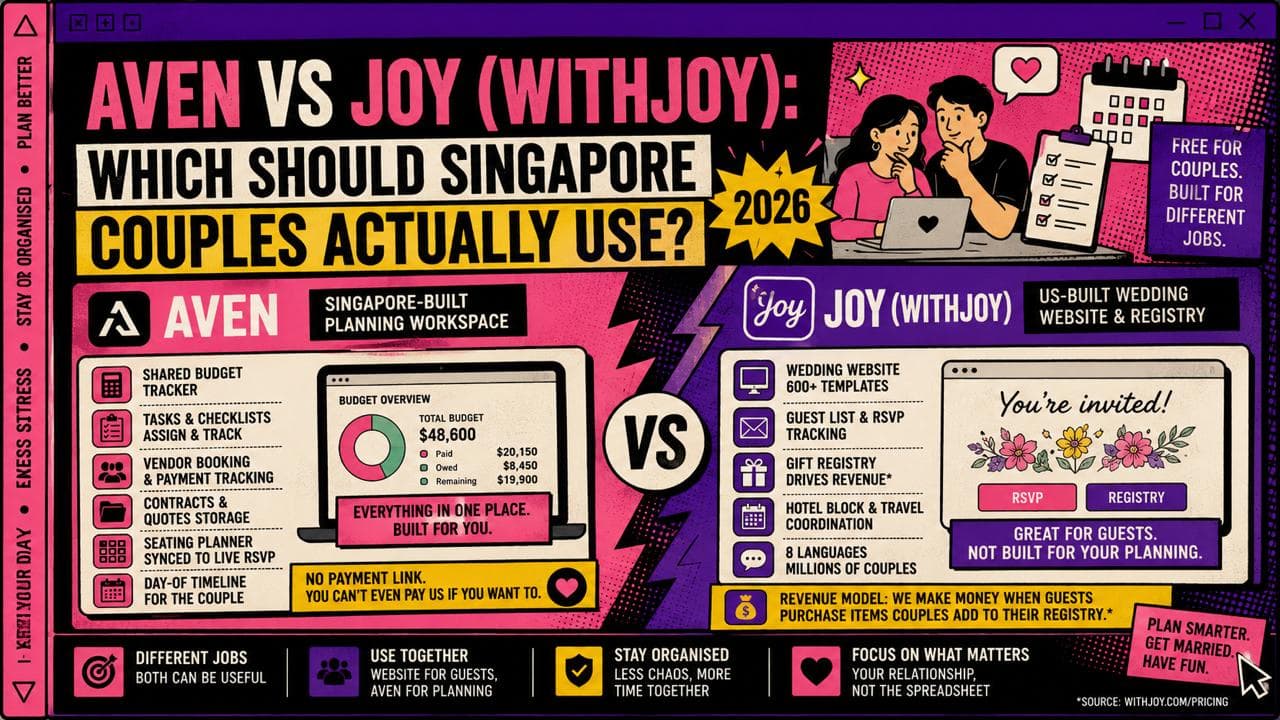
Aven and Joy (WithJoy) are both free, but they're built to solve different problems. Joy is a wedding website and guest-communication platform — its strengths are invitation design, a gift registry, and guest-facing RSVP, built primarily for the US market. Aven is a Singapore-built planning workspace for the couple themselves — shared budget tracking, a checklist, vendor booking and contract/quote storage, and a drag-and-drop seating planner that's actually synced to live RSVP data.
If what you need is a pretty website your guests visit to RSVP and buy you a blender, Joy does that well. If what you need is a shared place to track what you owe which vendor, what's actually been paid, and who's sitting where once RSVPs come in, that's what Aven is built for — and it's the part Joy's own product doesn't cover.
You don't have to pick just one leh — plenty of Singapore couples use Joy (or a similar site) purely for the guest-facing invitation and RSVP page, and Aven for everything happening behind the scenes between the two of you.
Key numbers
- Both platforms are completely free for couples — but the revenue model behind that free tier is different. Joy states directly that "we make money when guests purchase items couples add to their registry." Aven has no registry or commission model — per Aven's own site, "no payment link, you can't even pay us if you want to."
- Joy supports 8 languages and markets itself to "millions of couples" globally, with US-centric features like hotel room block coordination and a gift registry — neither of which maps cleanly onto a typical Singapore wedding, where ang bao (cash gifts), not a registry, is the norm.
- Independent reviews put Joy at 4.8/5 on G2 but as low as 1.8/5 on Trustpilot, with the lower score driven specifically by complaints about hotel-booking customer support — not the core website/RSVP product.
- A third-party comparison of Joy's seating capability found no dedicated, RSVP-synced seating chart tool — Joy's own planning guide reportedly points couples toward "post-its and notecards" instead.
- Aven bundles budget tracking, task management, vendor booking + contract/quote storage, and a live-RSVP-synced seating planner into one free workspace — features that are either absent, guest-facing only, or manual on Joy.
Feature-by-feature comparison
| Feature | Aven | Joy (WithJoy) |
|---|---|---|
| Wedding website | Not offered | Core feature, 600+ templates |
| Guest list + RSVP tracking | Yes, unique link for all guests/groups | Yes, 1 link, track elsewhere |
| Budget tracker | Yes, context aware, shared between partners | Yes |
| Task / checklist manager, shared & assignable | Yes | Not a dedicated in-app tool |
| Seating planner synced to live RSVP | Yes, drag-and-drop | No dedicated tool per third-party review; manual workarounds |
| Vendor booking tracking | Yes, linked to tasks and payments | Not offered |
| Contract & quote storage | Yes | Not offered |
| Day-of timeline / reception run sheet for the couple | Yes | Guest-facing personalized schedules only |
| Google Calendar sync | Yes | Not mentioned in Joy's own materials |
| Built for Singapore norms (ang bao, local vendor ecosystem) | Yes | No — built for the US market |
| Pricing | Free, no commission model | Free, monetised via registry purchases |
Where the two genuinely overlap — guest list, RSVP, and budget tracking — both platforms cover the basics. Where they diverge is everything that happens after RSVPs come in and vendors are booked: that's the part Joy leaves to spreadsheets, group chats, or third-party tools, and the part Aven was built around.
Why the comparison isn't really apples-to-apples
Joy's business exists to sell your guests things through your registry — that's stated plainly on their own pricing page, not something we're inferring. That's a completely reasonable model for the US market it was built for, where registries are the default gifting norm. But it doesn't translate well to Singapore, where guests give ang bao at the door, not gifts off a list, so a big chunk of what Joy is optimised for simply doesn't apply here.
Meanwhile the actual planning pain points Singapore couples hit — juggling ten vendor WhatsApp threads, losing track of which deposit's been paid, figuring out who sits where once the RSVP count keeps changing right up to the week before — sit in exactly the gap Joy's own materials don't cover. Aven isn't trying to be a nicer version of Joy hor, it's solving a different half of the problem: not "how do I tell my guests where to show up," but "how do my partner and I actually stay coordinated without losing our minds."
So the honest answer to "Aven or Joy" often isn't either/or. A couple can run their public-facing wedding website and RSVP collection on Joy (or theknot.com, or a similar site) and still need somewhere to track the budget, the vendor contracts, and the seating chart once real RSVP numbers come in — and that gap doesn't close itself lor, someone still has to build a spreadsheet for it if nothing else is there.
Common questions
Is Aven really free? Yes. Aven has no payment feature at all for couples — there's no premium tier to upgrade to.
Does Joy work for Singapore weddings? Partially. Its website, invitation, and RSVP tools work anywhere. Its registry and hotel-block features are built around US gifting and travel norms and are less relevant to a typical Singapore wedding, where ang bao replaces a gift registry.
Does Joy have a wedding checklist or task manager? Joy publishes checklist content as blog articles and guides, but a shared, assignable in-app task manager isn't a documented core feature the way it is on Aven.
Does Joy have a seating chart tool? Based on independent third-party reviews, Joy does not offer a dedicated, RSVP-synced seating chart — one comparison found Joy's own guidance points couples to manual methods like post-its instead.
Can I use Aven and Joy together? Yes. It's common to use a website platform like Joy for the guest-facing invitation and RSVP page, and Aven for the budget, vendor coordination, and seating work happening between the couple.
Which one tracks vendor payments and contracts? Aven does — vendor booking, contracts, and quotes are stored and linked directly to tasks and payments. This isn't a feature Joy's own materials describe.
Where these numbers came from
Aven's feature list comes directly from Aven's own site (aven.wedding). Joy's feature list is drawn from Joy's own site, pricing page, and app store listing, cross-checked against a third-party review site (Toolradar) and two independent seating-chart comparison articles (Tableplanner.io and VowConnection) for the specific claim that Joy lacks a dedicated seating tool.
The 4.8/5 G2 versus 1.8/5 Trustpilot rating gap for Joy is reported by Toolradar's review, which attributes the lower score specifically to hotel-booking support complaints rather than the core website/RSVP product — we've kept that distinction rather than presenting it as an overall satisfaction score.
We could not verify Joy's precise Singapore or Southeast Asia user numbers — Joy publishes global reach in broad terms ("millions of couples," 8 languages) without a regional breakdown, so we haven't invented a Singapore-specific figure. If Joy publishes clearer regional data in future, this page should be updated.
Sources
Last updated
August 2026. Both platforms update features regularly — if you spot something here that's changed, treat this as a snapshot rather than a permanent state, and check each platform's own site for the current feature list.