
Blog
Should You Go for Couples Therapy Before Your Wedding?
August 22, 2026 · Updated August 22, 2026
Premarital counselling is not only for couples having problems. Here is what it can help with, when it may be worth considering, and what to expect before getting married.
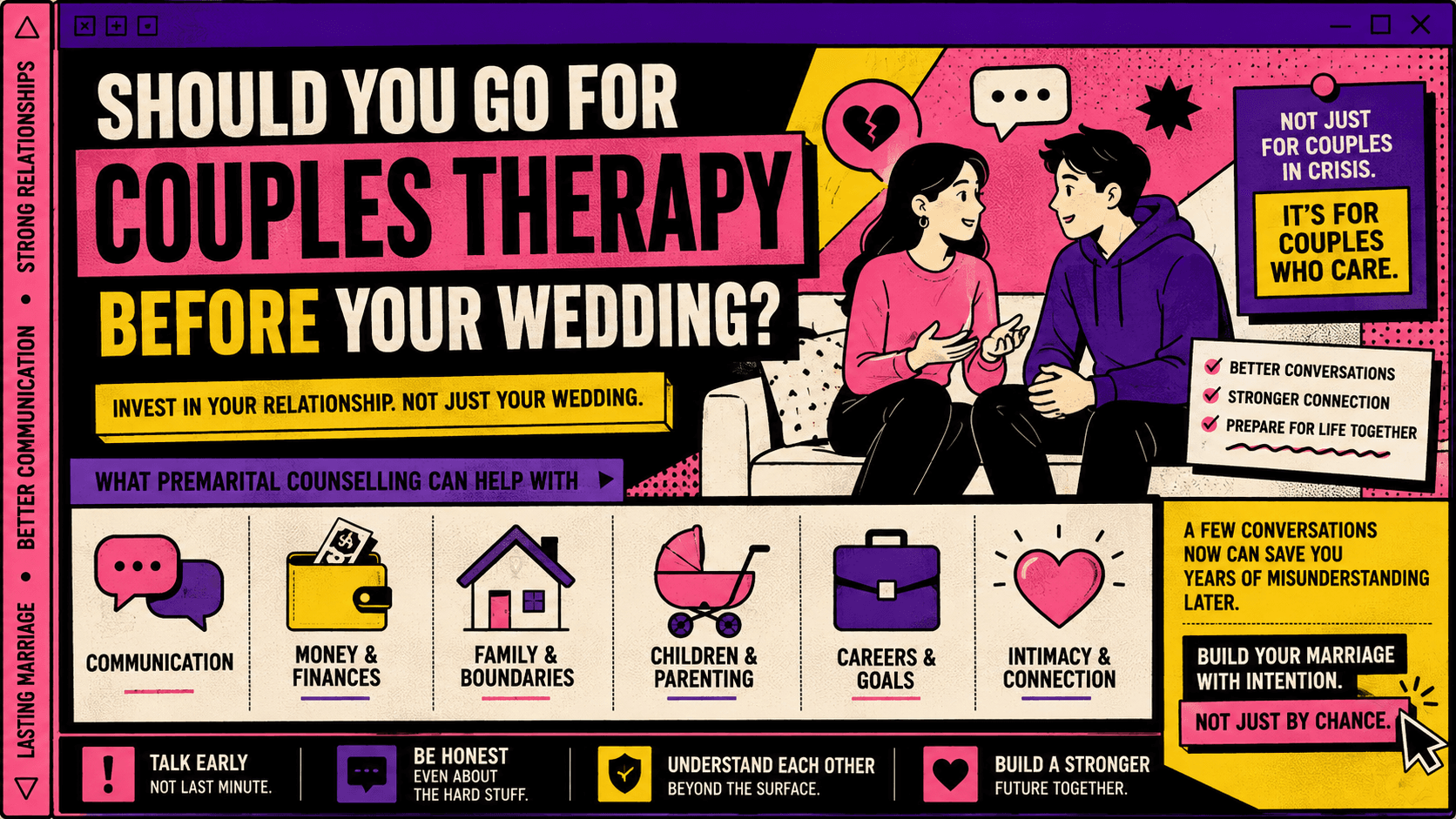
Couples therapy before marriage does not mean something is wrong
Mention "couples therapy" and many people immediately assume a relationship must be in trouble.
But going for counselling before marriage can serve a very different purpose.
Premarital counselling gives couples a structured environment to talk about topics that may become important later, including finances, family expectations, communication, children, careers and how each person handles conflict.
Think of it less as repairing a relationship and more as learning how the relationship works before making a long-term commitment.
You do not need to be fighting every week to benefit from that conversation.
What actually happens in premarital counselling?
Premarital counselling varies depending on the counsellor and the couple, but it usually involves guided conversations about your relationship.
Instead of simply asking whether you love each other, a counsellor may explore how you make decisions, respond to disagreements and communicate expectations.
Common topics include:
- Communication styles
- Conflict resolution
- Money and spending habits
- Debt and financial responsibilities
- Career priorities
- Household responsibilities
- Children and parenting expectations
- Relationships with parents and in-laws
- Religion and personal values
- Intimacy and affection
- Boundaries
- Long-term goals
- Expectations of married life
Some of these conversations may have happened naturally during your relationship. Others may reveal assumptions neither of you realised you were making.
The conversations worth having before saying "I do"
One of the biggest benefits of premarital counselling is discovering where your expectations differ before those differences become real-life decisions.
For example, both of you might say you want children.
But have you discussed when?
How many?
What happens if one person wants to stay home with them?
How will childcare costs be handled?
The same applies to money. Saying "we're both quite responsible with money" is very different from deciding whether you will combine your finances, maintain separate accounts, disclose debts or agree on how much either person can spend without discussing it first.
You do not need identical answers to everything.
What matters is knowing where you agree, where you differ and how you will make decisions when those differences matter.
When premarital counselling may be especially useful
Every couple can consider premarital counselling, but there are situations where having a neutral professional facilitate the conversation may be particularly valuable.
Consider it if:
- You repeatedly argue about the same issue without resolving it.
- One of you avoids difficult conversations.
- You have very different attitudes towards money.
- There are disagreements about children or parenting.
- Family or in-law boundaries are already causing tension.
- You have different religious or cultural expectations.
- One partner is relocating or making a major career sacrifice.
- There has been a significant breach of trust.
- You struggle to communicate without arguments escalating.
- You feel unable to discuss certain topics safely or honestly.
These situations do not automatically mean you should not get married.
But they are worth addressing rather than assuming marriage itself will make them disappear.
What if your relationship is already healthy?
You can still go.
In fact, counselling can feel very different when you are not attending in the middle of a crisis.
Instead of spending sessions trying to repair something urgent, you can focus on understanding each other better and building practical habits for your marriage.
You might learn that one person wants space immediately after an argument while the other wants reassurance straight away.
Neither response is necessarily wrong.
Understanding that difference makes it easier to recognise what is happening when your first major disagreement as a married couple eventually arrives.
A few sessions before marriage can essentially give you a shared vocabulary for handling those moments.
Therapy is not a compatibility test
Do not approach premarital counselling expecting the therapist to tell you whether you should get married.
A good counsellor is not there to choose for you.
Their role is generally to help both partners communicate clearly, recognise patterns and explore difficult topics in a constructive environment.
You may discover disagreements during the process.
That is not necessarily a bad outcome.
Finding a disagreement before marriage gives you the opportunity to understand it, work through it and decide whether a compromise actually exists.
Pretending the disagreement is not there simply postpones the conversation.
Do not wait until the week before your wedding
If you want to try premarital counselling, consider starting well before the wedding.
The final weeks are already filled with vendor confirmations, guest questions, seating arrangements and last-minute decisions. Adding emotionally significant conversations during that period can create unnecessary pressure.
Starting several months earlier gives you room between sessions to think about what you discussed and continue conversations privately.
It also makes counselling feel less like another item on your wedding checklist and more like preparation for the marriage itself.
The wedding lasts a day.
The relationship you are preparing for comes afterwards.
So, should every couple go?
Not necessarily.
Couples who communicate openly and have already discussed major life decisions may feel they do not need formal counselling.
But there is also little reason to view premarital counselling as something reserved only for relationships in trouble.
A better question might be:
Are there important parts of our future together that we have never properly talked about?
Before deciding, try having a conversation about:
- How will we manage our money?
- Do we want children, and what does parenting look like to us?
- How will we divide household responsibilities?
- What boundaries will we have with our families?
- What are our career priorities?
- How do we handle disagreements?
- What does quality time mean to each of us?
- What are our expectations around intimacy?
- Where do we want our lives to be in five or ten years?
- What would make either of us seek professional help in the future?
If those questions lead to productive conversations, great.
If you repeatedly get stuck, avoid certain subjects or realise you have never discussed some major decisions, a qualified couples counsellor may be worth considering.
Wedding planning spends a lot of time preparing couples for one important day.
Premarital counselling is one way to spend a little time preparing for everything that comes after it.