
Blog
How to Plan Your Wedding Banquet Guest List in Singapore
August 20, 2026 · Updated August 20, 2026
Planning your wedding banquet guest list in Singapore can feel overwhelming, especially when balancing family, friends, plus-ones and venue limits. This guide covers a simple way to organise your guest list, set priorities, manage RSVPs and plan your banquet tables without the stress.
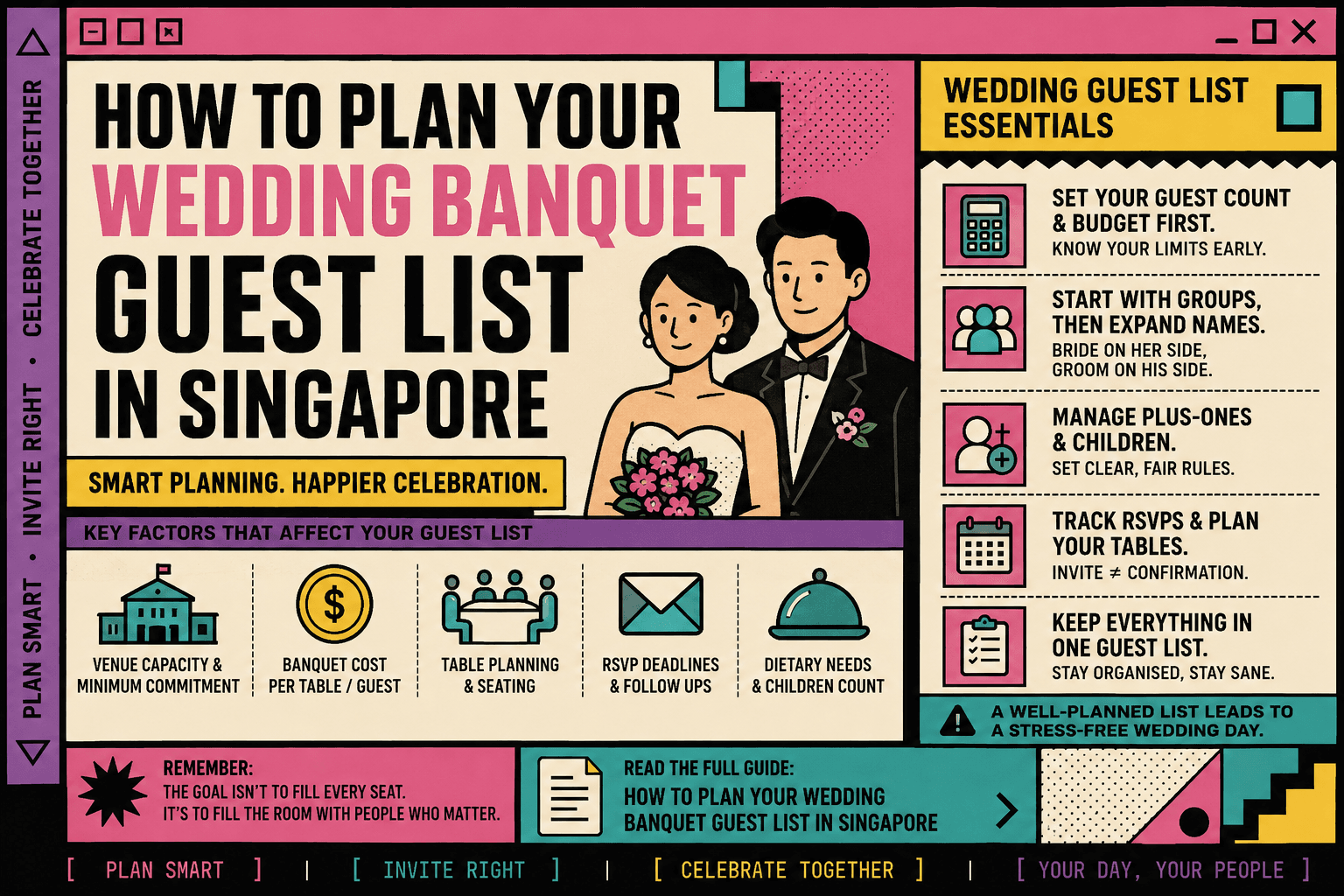
Set Your Guest Count and Banquet Budget First
Before deciding who to invite, decide approximately how many people you can actually afford to invite.
For banquet weddings in Singapore, your guest count and venue budget are closely connected. Start by working backwards:
Wedding budget → Banquet budget → Estimated cost per table/guest → Target guest count
Don't choose a 300-person wedding simply because a ballroom can fit 300 people. Your comfortable guest count should account for the banquet package, service charges, GST and other venue-related costs.
It's also worth treating any ang bao you receive as a bonus rather than money you need in order to afford the wedding.
Your venue contract matters here too. Before committing, understand its minimum table or guest requirement, maximum capacity, final confirmation deadline and what happens if your attendance falls below the minimum.
If you've committed to 25 tables but eventually only have enough guests for 21, you may still be paying based on your contracted minimum.
Ideally, have a rough guest count before you start seriously comparing venues, rather than choosing a venue first and forcing your guest list to fit it later.
Before deciding who to invite, decide approximately how many people you can actually afford to invite.
For banquet weddings in Singapore, your guest count and venue budget are closely connected. Start by working backwards:
Wedding budget → Banquet budget → Estimated cost per table/guest → Target guest count
Don't choose a 300-person wedding simply because a ballroom can fit 300 people. Your comfortable guest count should account for the banquet package, service charges, GST and other venue-related costs.
It's also worth treating any ang bao you receive as a bonus rather than money you need in order to afford the wedding.
Your venue contract matters here too. Before committing, understand its minimum table or guest requirement, maximum capacity, final confirmation deadline and what happens if your attendance falls below the minimum.
If you've committed to 25 tables but eventually only have enough guests for 21, you may still be paying based on your contracted minimum.
Ideally, have a rough guest count before you start seriously comparing venues, rather than choosing a venue first and forcing your guest list to fit it later.
Now forget about your limit temporarily and put everyone you might invite into one master list.
Include both families, relatives, friends, mutual friends, colleagues, parents' friends, family friends, partners and children.
Then divide them into three broad groups:
A — Must Invite: Immediate family, close relatives, closest friends and people you genuinely want there.
B — Would Love to Invite: Extended relatives, good friends, close colleagues and other people you'd be happy to celebrate with.
C — Invite If Space Allows: Distant relatives, old classmates, former colleagues, acquaintances and more obligatory invitations.
This gives you somewhere to cut when your planned 200-person wedding somehow turns into a list of 287 names.
One useful test is simply:
“If this person wasn't at our wedding, would we actually notice?”
You don't have to invite someone simply because you attended their wedding five years ago or because your parents know their parents.
There will inevitably be some family obligations, but your wedding doesn't have to become a reunion for everyone your family has ever met.
Agree on Family Allocations, Plus-Ones and Children
This is where many Singapore wedding guest lists become complicated.
Rather than allowing both families to keep adding names indefinitely, agree on a rough allocation.
For a 200-person wedding, for example:
Couple's friends — 80 guests Bride's family — 60 guests Groom's family — 60 guests
It doesn't need to be perfectly equal. One family may be significantly larger than the other. The important part is that everyone understands there is a limit.
You should also decide your rules for plus-ones and children at this stage.
Thirty guests receiving plus-ones can potentially mean another 30 seats. You might choose to invite spouses, fiancés and long-term partners by name while deciding separately whether other guests receive unrestricted plus-ones.
For children, decide whether your banquet will be adults-only, children of immediate family only or children welcome. Check with your venue about children's menus, seating and how children count towards your package.
Whatever rules you choose, consistency makes things much easier.
Plan for RSVPs, Drop-Offs and Actual Banquet Tables
An invitation is not a confirmed seat.
Some guests will decline. Others may initially accept and later be unable to attend. This is why you shouldn't treat your first guest list as your final banquet attendance.
Set your RSVP deadline comfortably before the venue's final confirmation deadline so you have time to follow up and adjust.
You can also keep a small reserve list of people you'd genuinely like to invite if space becomes available. Just handle later invitations tactfully so people don't feel like replacements.
At the same time, start thinking in terms of tables, not just total guests.
A guest list of 200 doesn't necessarily divide itself into perfectly organised tables.
You might have seven university friends who only know each other, nine relatives who should sit together and twelve colleagues who don't fit neatly onto one table.
Start grouping people early:
Secondary school friends — 8 guests + 2 possible partners Mum's relatives — 9 adults + 1 child Office — 7 colleagues + 2 spouses
You don't need to decide exact seats yet. You're simply making sure your guest list can eventually become a sensible seating plan.
Keep Everything in One Master Guest List
Once invitations start going out, your guest list becomes much more than a list of names.
For each guest, you may eventually need to track:
Name • Bride/Groom/Family side • Guest group • Invitation status • RSVP • Plus-one • Dietary requirements • Children • Table assignment • Contact details • Notes
Trying to remember all of this across WhatsApp conversations, spreadsheets sent by parents and random notes becomes messy very quickly.
Keep one shared source of truth that both partners can access and update.
Your guest list will evolve throughout the planning process. Start with a rough number before venue hunting, refine your list after booking, collect RSVPs after invitations go out, then finalise your tables and dietary requirements according to your venue's deadline.
Plan your master guest list using this https://aven.wedding/guests
The Bottom Line
The first question when planning your wedding guest list shouldn't be:
“Who should we invite?”
It should be:
“How many people do we actually want and can comfortably afford at our wedding?”
Set your number first. Build your master list. Agree on boundaries with both families. Prioritise the people who matter. Then refine everything as your RSVPs come in.
And remember: having 300 people at your wedding doesn't automatically make it a better celebration.
The goal isn't to fill every ballroom seat. It's to fill the room with people you actually want to celebrate with.