
Blog
How to Plan Your Wedding Day Schedule in Singapore
August 20, 2026 · Updated August 20, 2026
Planning your wedding day schedule in Singapore means balancing everything from hair and makeup to gatecrash, tea ceremonies, solemnisation and the banquet. Learn how to build a realistic wedding timeline with proper travel time, buffers and vendor coordination so your big day runs smoothly without feeling rushed.
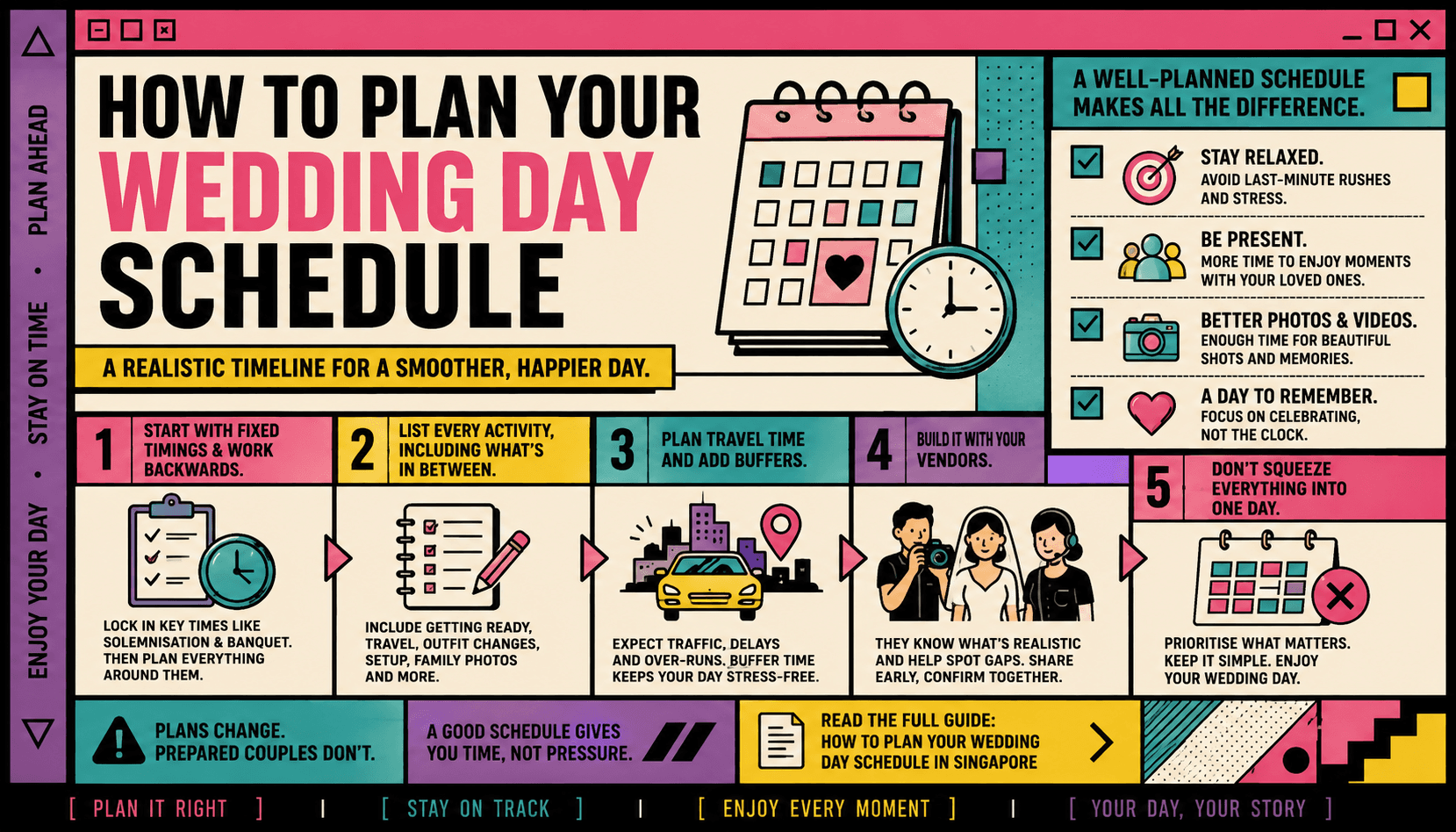
How to Plan Your Wedding Day Schedule in Singapore
Your wedding day will probably be one of the most tightly scheduled days of your life.
Hair and makeup, gatecrash, tea ceremony, solemnisation, photo sessions, travelling between locations, hotel check-in, reception and your banquet can all happen within the same day.
And the biggest mistake couples make?
Planning everything according to how long it should take when everything goes perfectly.
Things will run late. Someone will disappear right before a group photo. Your makeup may take longer than expected. Traffic might be terrible. Your parents might suddenly remember another relative who needs a photo.
A good wedding schedule isn't one that packs the most activities into a day. It's one that gives you enough time to actually enjoy them.
Start With Your Fixed Timings and Work Backwards
Don't start your wedding schedule at 6:00am and plan forward.
Start by identifying the timings that cannot easily move.
For example:
Solemnisation — 5:30pm Cocktail reception — 6:30pm Banquet doors open — 7:00pm First march-in — 7:30pm
Once those are established, work backwards.
If your solemnisation starts at 5:30pm, when should guests arrive? When should you finish your couple portraits? When do you need to be dressed? When should makeup begin?
Do the same for your morning activities.
If the groom needs to reach the bride's home by 8:00am for the gatecrash, work backwards from 8:00am to determine when the groom and groomsmen need to gather, get dressed and leave.
This is much more reliable than randomly assigning times to activities and hoping everything eventually fits together.
List Every Activity, Including the Things Between Them
Couples usually remember the big events:
Gatecrash. Tea ceremony. Solemnisation. Banquet.
It's everything between those events that gets forgotten.
Your schedule also needs to account for things like getting dressed, touch-ups, packing and loading the car, travelling between locations, parking, waiting for lifts, changing outfits, setting up the reception table and gathering family members for photos.
Instead of writing:
10:00am — Tea ceremony 11:00am — Couple photos
Think about what actually needs to happen:
10:00am — Tea ceremony begins 10:40am — Family photos 11:00am — Pack up and prepare to leave 11:15am — Travel to photo location 11:45am — Couple photos begin
Suddenly, that one-hour gap doesn't look very long.
The easiest way to catch these missing pieces is to walk through the entire wedding day in your head from the moment you wake up until the banquet ends.
Plan Around Travel Time and Add Buffers
In Singapore, two locations looking close on Google Maps doesn't mean you should schedule them back-to-back.
You still have to get everyone downstairs, load dresses and equipment, wait for transport, travel, unload everything and get the right people into the right place.
And that's assuming there isn't traffic.
Build buffer time into the important transitions throughout your day.
If travelling somewhere normally takes 20 minutes, don't automatically give yourself exactly 20 minutes.
The same applies to makeup, tea ceremonies, photography and getting dressed.
A buffer doesn't mean your wedding will definitely run late. It means that when one part of the day runs 15 minutes behind, the entire wedding doesn't immediately become 15 minutes behind.
If everything stays on schedule, you've simply gained a few minutes to sit down, eat something, take a breather or spend time with the people around you.
That's a much better problem to have.
Don't Try to Squeeze Everything Into One Day
This is probably the most important part.
You don't need to do something every 30 minutes just because you technically can.
A schedule like:
Gatecrash → Tea ceremony → Outdoor shoot → Lunch → Hotel → Second tea ceremony → Solemnisation → Cocktail reception → Banquet
might fit perfectly into a spreadsheet.
Living through it is another story.
Decide which parts of the wedding are genuinely important to both of you. If something makes the day unnecessarily complicated, consider moving it, shortening it or removing it.
And once you've created the final schedule, make sure the important people have it.
Your bridal party, family members, vendors and coordinator don't necessarily need every tiny detail, but they should know where they need to be and when they need to be there.
Most importantly, don't make yourselves responsible for keeping everyone on schedule on your wedding day. Assign a coordinator, bridal party member or trusted person to watch the clock and gather people when necessary.
You should be experiencing your wedding, not spending the entire day checking the time.
The Bottom Line
A good wedding-day schedule isn't the one that fits the most things into 24 hours.
It's the one that still works when something inevitably runs late.
Start with your fixed timings. Work backwards. Account for the small transitions people forget. Give yourself realistic travel time and buffers. Then have your vendors check the plan before you lock it in.
Your wedding will probably not follow the schedule down to the exact minute.
That's completely fine. The schedule is there to keep your day moving, not to control every second of it.
Wedding day schedule planner : https://aven.wedding/dday