
Blog
How to Plan Your Wedding Together Without One Person Doing Everything
August 21, 2026 · Updated August 21, 2026
Wedding planning shouldn't become one person's responsibility. Learn how to divide the workload, communicate better and plan your wedding as a team without unnecessary stress or resentment.
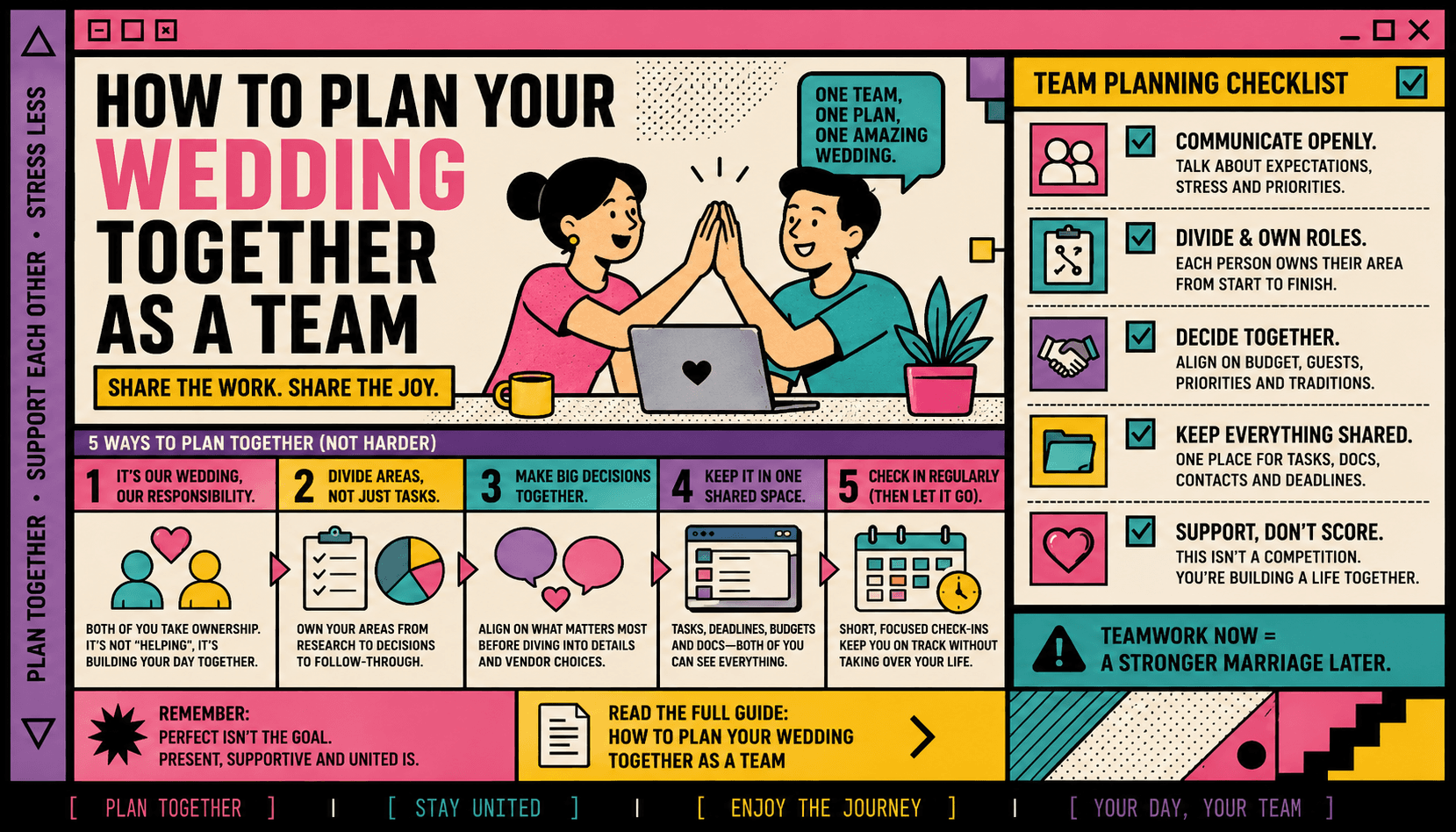
1. Treat Wedding Planning as a Shared Responsibility
It's surprisingly easy for wedding planning to slowly become one person's job.
One partner starts researching venues. Then they contact the photographer, compare packages, manage the guest list, remember payment deadlines and coordinate with both families.
Meanwhile, the other partner might genuinely believe they're helping because they say:
“Just tell me what you need me to do.”
The problem is that this still leaves one person responsible for thinking about everything.
Planning a wedding involves hundreds of small decisions over several months. If one person has to remember every task, research every option and constantly delegate work to their partner, the mental load can become exhausting.
Start with the understanding that this is our wedding and our responsibility, rather than one person planning while the other person helps.
You don't necessarily need to split every task 50/50. You just need both people to take ownership of making the wedding happen.
If needed, you can use our co-work space provided free for couples to use https://aven.wedding/partner
2. Divide Responsibilities, Not Just Individual Tasks
Instead of constantly assigning tiny tasks to each other, divide the wedding into areas that each person can own.
For example:
Partner A
- Photographer and videographer
- Wedding outfits
- Decorations and styling
- Invitations
Partner B
- Venue and banquet coordination
- Transport
- Entertainment
- Accommodation
Together
- Budget
- Guest list
- Seating plan
- Solemnisation
- Major decisions
Ownership means more than simply completing a task.
If you're responsible for the photographer, you should be able to research photographers, compare packages, arrange meetings, keep track of deadlines and bring the best options back to your partner.
Your partner shouldn't need to remind you every week that something needs to be done.
At the same time, divide responsibilities according to your strengths and schedules rather than trying to make everything perfectly equal. One person may enjoy researching vendors while the other is much better at logistics and spreadsheets.
Fair doesn't always mean 50/50. It means neither person feels like they're planning the wedding alone.
3. Make the Big Decisions Together
Dividing responsibilities doesn't mean planning two separate halves of the same wedding.
Some decisions should still belong to both of you.
Before diving into vendors and details, agree on the fundamentals:
- Overall wedding budget
- Approximate guest count
- Type of wedding you want
- Venue preferences
- What you're willing to spend more on
- What you don't particularly care about
- Traditions that matter to either family
- Your non-negotiables
This gives both partners the same direction.
If one person is imagining an intimate 80-person celebration while the other is planning a 300-person hotel banquet, dividing tasks isn't going to solve the problem.
You also don't need your partner's approval for every tiny decision.
If you've already agreed on a floral budget and general style, the person handling flowers shouldn't need to ask, “What do you think about this?” for every centrepiece.
Decide the important things together, then trust each other with the details.
4. Keep Everything in One Shared Place
One of the easiest ways for wedding planning to become stressful is when information lives everywhere.
The photographer's quotation is in one person's WhatsApp. The venue contract is buried in an email. The guest list is on a spreadsheet. Someone's mother has another list of relatives. Payment dates are being remembered mentally.
Eventually, one person becomes the only person who knows what's happening.
Keep your wedding information somewhere both partners can access.
At minimum, you should both be able to see:
- Tasks and who is responsible
- Upcoming deadlines
- Vendor contacts
- Contracts and quotations
- Payment schedules
- Wedding budget
- Guest list and RSVPs
- Wedding day schedule
Have a short wedding check-in regularly instead of talking about wedding planning every night.
Spend 15 to 30 minutes going through what's completed, what's coming up and whether either person needs help.
Then move on with your lives.
Your relationship shouldn't feel like a never-ending project meeting just because you're getting married.
5. Speak Up Before Stress Turns Into Resentment
Wedding planning can become stressful even when both people have good intentions.
One person might feel overwhelmed while the other genuinely doesn't realise how much work is happening behind the scenes.
Don't wait until you're arguing over invitation fonts to finally talk about it.
If you're carrying too much, say so early.
Instead of:
“You don't help with anything.”
Try:
“I'm currently handling the venue, guest list, photographer and invitations. I'm getting overwhelmed. Can you take full ownership of transport and the wedding day schedule?”
That's a problem you can actually solve.
The same applies when your partner is struggling. If their workload suddenly becomes heavier because of work, family or other commitments, redistribute responsibilities temporarily.
You're not keeping score.
You're trying to get through one of the busiest periods of your relationship as a team.
Wedding planning is temporary, but how you communicate and solve problems together matters long after the wedding is over.
The goal isn't to prove that both of you contributed exactly 50%.
The goal is to reach your wedding day feeling like you planned it together, rather than one person feeling relieved that their second job is finally over.