
Blog
How to Structure Wedding Vendor Packages in Singapore: Help Couples Choose the Right Scope
October 12, 2026 · Updated October 12, 2026
Create wedding service packages that couples can understand and your team can deliver. A practical Singapore vendor guide covering inclusions, meaningful options, custom quotations and presenting your offering on Aven.wedding.
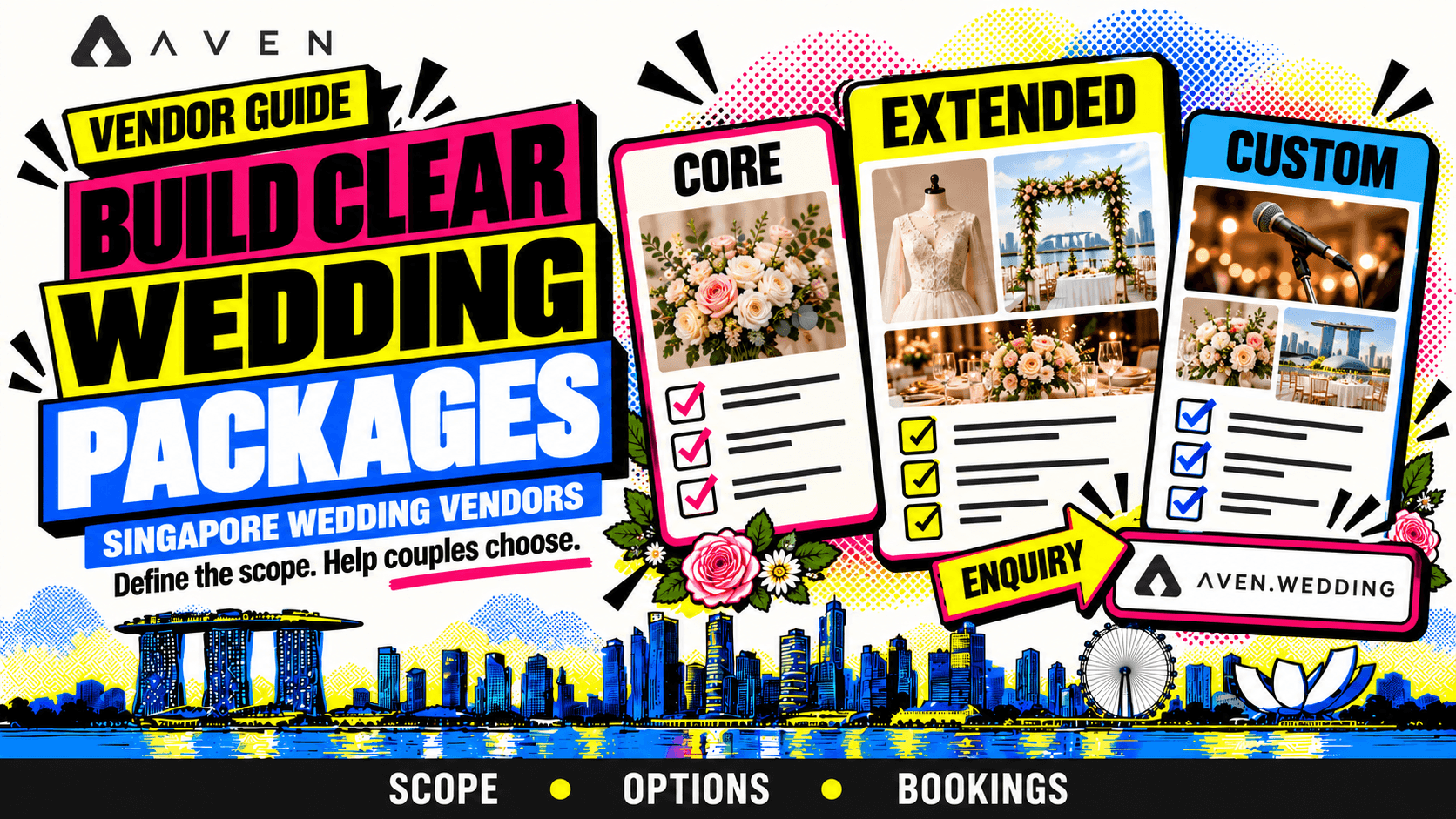
Make the difference between your options easy to understand
A couple comparing your packages should be able to explain what changes between them.
Do they receive more time, different deliverables, additional styling areas or a different level of support?
Clear packages help couples choose a suitable scope. They also give your team a defined service to prepare, quote and deliver.
For Singapore wedding vendors, the same information should remain consistent across your website, proposals and Aven.wedding profile.
On the aven.wedding vendor marketplace, couples can connect with vendors, enquire, make bookings and track budgets directly. Understandable packages help them consider your offering within that journey.
This guide applies across vendor categories and belongs to our wedding vendor pricing guide and the complete Singapore wedding vendor business guide.
Start with the decisions couples need to make
Identify the main choices involved in your service.
Examples include:
- How much coverage is needed?
- Which areas need styling?
- What performance format suits the programme?
- Which planning responsibilities should be delegated?
- What attire and fitting arrangements are required?
- What catering format suits the guest requirements?
Build options around those decisions.
A package should answer a genuine need rather than simply contain a longer list than the previous option.
Use enquiry questions and completed projects to identify where couples regularly need help choosing.
Choose a package model that fits your work
Three practical models are:
| Model | How it works | When it may be useful |
|---|---|---|
| Defined package | One clearly specified service | A repeatable offering with consistent scope |
| Distinct options | Several services with meaningful differences | Recurring needs that can be grouped |
| Custom quotation | Scope prepared around the brief | Work with substantial variation |
You can combine them.
A florist might offer defined bridal flower options and quote reception styling separately. A venue might present a starting framework before confirming event-specific requirements.
You do not need three tiers for every business.
Define a complete core service
Your core offering should work for the need it claims to serve.
List the elements required to deliver it properly.
Depending on your category, these may include:
- Preparation.
- Consultation.
- Materials or equipment.
- Service delivery.
- Setup.
- Collection.
- Agreed deliverables.
Avoid advertising a complete service while leaving essential elements unexplained.
For example, if a setup requires delivery and installation, clarify whether they are included, separately charged or arranged by another party.
Our service cost guide helps identify the work behind each inclusion.
Use measurable inclusions
Replace ambiguous descriptions with defined scope.
Instead of “extended coverage”, state the duration and how it is scheduled.
Instead of “full styling”, identify the areas and arrangements covered.
Instead of “premium entertainment”, explain the performers, format and sets.
Useful package details include:
- Hours or session duration.
- Quantities.
- Team size.
- Deliverables.
- Appointment stages.
- Locations.
- Setup and collection arrangements.
- Approval or revision limits.
Use the measures that accurately describe your work.
Build differences around service scope
Meaningful differences might involve:
- A longer service duration.
- Additional areas.
- A different performance format.
- More deliverables.
- Additional appointments.
- A broader planning role.
- More guests or quantities.
Explain why a couple might choose each option.
If a package includes everything in another option, say so clearly and identify the additions. If the options differ rather than build on one another, show that distinction.
Do not make quality or basic professionalism sound optional. Every service should meet the standard you promise.
Work through a hypothetical entertainment example
Suppose an entertainment business offers two defined performance formats and a custom option.
| Detail | Ceremony performance | Reception performance | Custom programme |
|---|---|---|---|
| Main purpose | Music for agreed ceremony moments | Music across agreed reception sets | A brief spanning different requirements |
| Timing | Defined around confirmed cues | Defined set duration and breaks | Confirmed in the quotation |
| Performers | Specified lineup | Specified lineup | Selected for the brief |
| Equipment | Clearly identified arrangements | Clearly identified arrangements | Confirmed after requirements review |
| Preparation | Agreed briefing and music planning | Agreed briefing and music planning | Defined consultation scope |
This is an illustrative structure, not a recommended package specification.
The options address different needs. They do not have to be labelled as progressively better versions of the same service.
Adapt the structure across vendor categories
Use differences relevant to your business.
| Vendor category | Possible package distinction |
|---|---|
| Venues | Space, duration, guest requirements and included services |
| Bridal boutiques | Attire options, fittings and accessories |
| Makeup and hair | Appointment requirements, trials and locations |
| Florists and stylists | Bridal flowers, ceremony areas and reception areas |
| Planners | Full planning, partial planning and coordination |
| Caterers | Menu, service format, quantities and staffing |
| Photobooths | Session duration, deliverables and booth format |
| Photography and videography | Coverage, team arrangements and deliverables |
| Stationery | Design scope, quantities and production choices |
| Transport | Vehicle requirements, locations and service time |
Cost each option separately rather than assuming the additional price covers its extra work.
Keep optional additions separate
An addition should extend or adapt the service in a useful way.
Examples include an extra styling area, another appointment, additional performance time or extra deliverables.
Explain:
- What it includes.
- When it is available.
- Any preparation requirements.
- When it must be confirmed.
- How it affects timing or logistics.
Check whether the addition creates further costs beyond the visible item.
Our add-ons guide explains how to develop and price these options.
Describe practical boundaries
Packages need clear limits.
Depending on your service, explain:
- Locations covered.
- Access requirements.
- Setup space.
- Service start and end arrangements.
- Collection responsibilities.
- Changes requiring a revised quotation.
Singapore weddings may involve several locations, early appointments or venue setup windows. Clarify how those circumstances affect the offering.
Avoid assuming the same arrangements apply to every venue.
Our overtime and travel pricing guide covers relevant quotation details.
Name options so couples can recognise their purpose
Names can reflect the service or scope.
Examples include:
- Ceremony Flowers.
- Reception Styling.
- Bridal Appointment.
- Wedding Day Coordination.
- Acoustic Reception Performance.
If you use names such as Core or Extended, pair them with a plain description.
Avoid making couples decode several themed names before they can compare inclusions.
Only use labels such as “most booked” if you have current evidence supporting them.
The main question is whether a reader can identify the option that fits their requirements.
Present comparisons consistently
Use the same comparison fields across options.
For example:
- Suitable use.
- Duration.
- Team.
- Inclusions.
- Deliverables.
- Logistics.
- Price or quotation basis.
- Next step.
Keep important boundaries close to the relevant information rather than hiding them in unrelated text.
Where you publish an amount, make clear what it covers and apply the price-display requirements relevant to your business.
Our guide to publishing vendor prices develops that decision.
Explain when a custom quotation is needed
A custom route can serve requirements outside your defined options.
Explain which details you need, such as:
- Wedding date.
- Venue.
- Guest count.
- Areas or locations.
- Timing.
- Preferred deliverables.
- Reference material.
Then describe the next step.
A useful invitation is:
“Share your wedding details and required scope so we can recommend an option or prepare a customised quotation.”
Avoid presenting a starting package as though it covers every possible brief.
Our enquiry qualification guide explains how to clarify requirements.
Make your Aven offering easy to assess
Prepare package information for your Aven.wedding profile using the relevant fields available.
Include:
- A clear service introduction.
- Defined options.
- Scope or quotation guidance.
- Representative work.
- Optional additions.
- Practical requirements.
Use portfolio examples that match the offering. If an image shows a customised upgrade, identify it.
The Aven.wedding marketplace allows couples to connect, enquire, make bookings and track budgets directly. Clear options help them understand how your service fits their plans before they contact you.
Our vendor profile guide covers the wider presentation.
Guide couples through the choice
Use the enquiry conversation to recommend scope.
Ask what the couple needs and which priorities matter. Explain why an option fits rather than automatically directing everyone to the largest package.
For enquiries through Aven.wedding, clarify any details that affect the offering before confirming the booking.
Make sure the final quotation records the selected option and additions.
Our proposal and quotation guide explains how to present the agreed service.
Review packages against completed work
After delivery, compare the package with the actual workload.
Review:
- Preparation time.
- Materials.
- Team hours.
- Logistics.
- Additional requests.
- Questions couples repeatedly asked.
If the scope regularly expands, improve the boundaries or develop a distinct option.
If an option is rarely suitable, investigate whether it serves a genuine need.
Update your website, Aven profile and sales materials together when the offering changes. Keep existing agreed bookings aligned with their terms.
Frequently asked questions about package structure
Do I need three packages?
No. Use the structure that fits your service and recurring client needs.
Should the cheapest option include very little?
It should deliver the defined service properly. Give it a clear purpose and scope.
Can I offer packages and custom quotations together?
Yes. Explain when each route applies.
Should every option include the previous one?
Only if the structure genuinely works that way. Distinct services can also be compared.
Can I present the options on Aven.wedding?
Use the fields available to your account and keep descriptions consistent with your actual offering.
When should I review packages?
Review when costs, workload, service requirements or recurring enquiry patterns change.
Build options your team can deliver and couples can understand
Before publishing your packages:
- Identify the decisions couples need to make.
- Choose a suitable package model.
- Define complete scope.
- Use measurable inclusions.
- Cost each option.
- Clarify additions and boundaries.
- Name options understandably.
- Prepare the custom quotation route.
- Keep public information consistent.
Then present your offering clearly through your Aven.wedding profile.
On aven.wedding, couples can explore vendors, enquire, make bookings and track their wedding budgets directly. Help them choose a suitable scope before moving into the booking conversation.
Next, explore our guide to publishing wedding vendor prices.
Return to the pricing guide, or explore the complete Singapore wedding vendor business guide to connect packages with marketing, sales and operations.