
Blog
When a Bridal Studio Closes: What Happens to Your Wedding Plans and Your Money?
August 18, 2026 · Updated August 19, 2026
A bridal studio suddenly shutting down can leave couples in a very difficult position — especially when money have already been paid upfront. The recent Korean Artiz Studio situation is a reminder that the biggest risk is not simply losing a vendor; it is losing both the money and the time needed to find a replacement before the wedding. If you are affected, read to see the next steps.
When a bridal studio suddenly disappears
For couples, the most frightening part is often the uncertainty.
You may have already paid several thousand dollars for photography, gowns, makeup, albums or other services. Your wedding date is still coming, but suddenly the studio is no longer responding, staff are unpaid and nobody can tell you whether your package will actually be completed.
That appears to be the situation facing customers of Artiz Studio Singapore. A notice posted at its Bras Basah outlet said employees had outstanding salaries and that management had not provided clear instructions. Customers were also told that scheduled services could not currently be confirmed or guaranteed. Its Taipei outlet reportedly went bankrupt and closed on 10 August.
For couples caught in the middle, it is not just a business dispute. It is their wedding.
The money you already paid does not automatically come back
If you have paid Artiz $4,000 but only received part of the promised service, you generally cannot assume that the remaining amount will simply be refunded.
If the company remains operational, you can try to negotiate a refund or completion of the services. But if the company eventually enters insolvency or liquidation, the situation becomes much harder. You may become one of many creditors trying to recover money from whatever assets remain.
And this is the painful part: having a valid claim does not necessarily mean there is money available to pay that claim.
Singapore has seen this before. When Aisle Bridal suddenly closed, CASE reported at least $56,770 in consumer prepayments lost. CASE advised affected consumers to file claims with the Small Claims Tribunals while the business was still live on ACRA.
What should affected couples do now?
The first thing is: don't just wait for the company to reply.
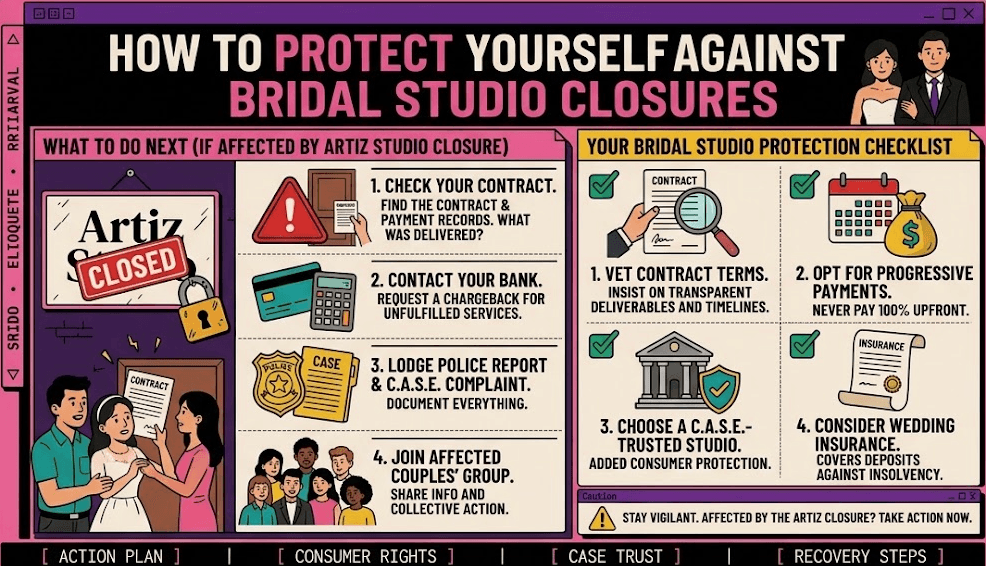
Save everything — your contract, invoices, payment receipts, WhatsApp conversations, emails, Instagram messages, appointment confirmations, photographs of notices at the studio and any evidence showing what services have already been delivered.
You want a clear record of:
- How much you paid
- What you purchased
- What has already been delivered
- What remains outstanding
- Your scheduled dates
- Every attempt you made to contact the company
If the studio is still technically operating, communicate with them in writing and ask for a clear position on whether they will honour your package or refund the undelivered portion.
Go to CASE
Affected consumers can approach the Consumers Association of Singapore (CASE) for assistance.
CASE has dealt with bridal businesses that suddenly closed before. In the Aisle Bridal case, CASE specifically advised affected consumers to seek assistance and pursue claims while the company was still live.
CASE cannot guarantee that your money will be recovered, particularly if the company has become insolvent, but it is one of the appropriate first places to seek help.
Consider the Small Claims Tribunals
If your dispute falls within the Small Claims Tribunals' jurisdiction, this can be a relatively accessible route without having to immediately engage a lawyer.
The Singapore Courts provide a process for checking whether your dispute qualifies as a small claim and for subsequently filing and enforcing an order.
But there is an important distinction:
Getting an order that the company owes you money is not the same as actually receiving the money.
If the company has no meaningful assets left, enforcement may still be difficult.
That is why timing matters.
Don't forget about your wedding itself
While you are trying to recover your money, you also need to protect the wedding.
If your photoshoot, gown fitting, album, makeup or other service is scheduled in the coming months, don't wait until the original appointment date to find out that the vendor cannot perform.
Start getting quotes from alternative vendors now.
It may feel painful to spend more money when you have already paid the original studio, but there are really two separate problems:
Problem one: recovering the money you may have lost.
Problem two: making sure your wedding still happens.
Don't let the first problem cause the second one.
This is the bigger problem with wedding packages
The Artiz situation highlights something uncomfortable about the wedding industry.
Couples are often asked to make large upfront payments for services that may only be delivered months later.
That means the couple is effectively giving the vendor an interest-free loan while taking on the vendor's business risk.
If the vendor performs perfectly, nobody notices.
But if the vendor collapses halfway through the journey, the couple can be left with a large financial loss and a very short amount of time to find someone else.
CASE has previously warned consumers about exactly this kind of prepayment risk, and has encouraged consumers to consider protection such as insurance against business insolvency when purchasing bridal packages.
What couples can do differently
The safest approach is to avoid putting too much money at risk before the service is delivered.
Instead of paying $4,000 upfront, a couple could structure the payment around actual milestones:
Booking → gown selection → photoshoot → photo selection → album production → final delivery.
The couple pays progressively as the vendor progresses.
That way, if something goes wrong halfway through, the couple is not necessarily trying to recover the entire $4,000.
There is still risk, but the exposure is much smaller.
Where do we go from here?
For couples affected by Artiz, the immediate priority is simple:
Document everything. Contact the company in writing. Approach CASE. Check whether your claim qualifies for the Small Claims Tribunals. Check your insurance and payment-provider protections. And, importantly, start making contingency plans for the wedding itself.
For the wider wedding industry, the bigger question is whether couples should really have to take on this much vendor risk in the first place.
A wedding is already expensive and stressful enough. Couples should be spending their time choosing their photos, gowns and flowers — not wondering whether the company holding their $5,000 deposit will still exist six months from now.
The Artiz situation is a painful reminder that vendor failure is not just a business problem. For a couple, it can become a wedding problem, a financial problem and an emotional problem all at once.