
Blog
Singapore Wedding Day Checklist: What to Do on the Actual Day
August 29, 2026 · Updated September 3, 2026
Use this Singapore wedding day checklist to stay organised from morning preparations to your solemnisation, tea ceremony, banquet and final vendor handover.
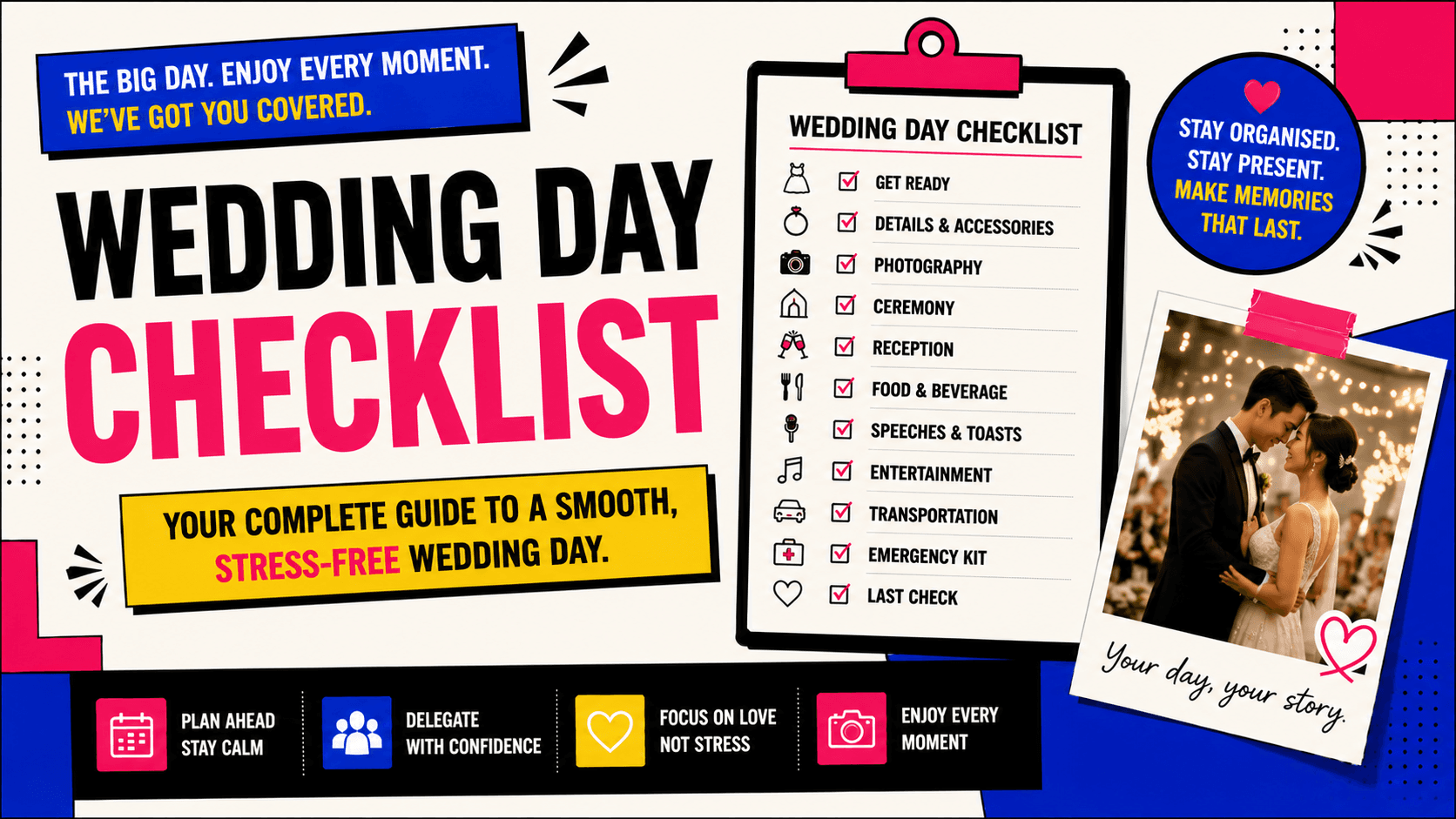
What should you do on your wedding day?
After months of planning, your wedding day should not feel like another planning session.
By the actual day, most major decisions should already be made.
Your job is to follow the plan, stay present and let your assigned helpers and vendors handle the logistics.
For most Singapore weddings, the actual day may include several moving parts:
- Morning preparations
- Gatecrash
- Bride fetching
- Tea ceremony
- Couple portraits
- Solemnisation
- Reception
- Wedding lunch or dinner
- Speeches
- Table-to-table photos
- Vendor payments
- Gift and ang bao handling
- End-of-day item collection
This checklist is designed to help you keep track of the essentials without turning your wedding day into a minute-by-minute admin exercise.
If you are still planning the overall wedding, start with the Ultimate Singapore Wedding Planning Guide.
Wedding day checklist at a glance
Use this as your quick actual-day overview.
- Wake up with enough time for preparation
- Eat and drink before the day becomes busy
- Confirm phones are charged
- Keep wedding rings in the assigned person's care
- Prepare red packets if required
- Prepare identification and ceremony documents if needed
- Ensure outfits and accessories are ready
- Confirm bouquet and boutonnières have arrived
- Check that photographer and videographer know where to begin
- Complete morning preparation
- Complete gatecrash if applicable
- Complete bride fetching if applicable
- Complete tea ceremony if applicable
- Travel according to the planned schedule
- Complete solemnisation if held that day
- Take essential family and couple photographs
- Check in with the venue coordinator
- Ensure reception table is ready
- Confirm ang bao box responsibility
- Confirm guest registration team
- Begin wedding reception
- Follow the planned programme
- Complete speeches and special segments
- Complete table photographs if planned
- Confirm vendor balances or payment arrangements
- Collect personal items
- Collect gifts and ang bao box
- Confirm nothing is left at the venue
- Hand over rented items where required
- Go home and rest
You do not need to personally supervise every item.
Where possible, assign tasks to trusted family members, bridesmaids, groomsmen, your coordinator or your vendors.
Start your wedding morning without rushing
The first few hours of your wedding can affect the pace of the entire day.
Avoid creating a schedule where the morning begins already behind time.
Before hair and makeup starts:
- Wake up with sufficient buffer
- Drink water
- Eat something
- Shower if required
- Put on preparation-friendly clothing
- Remove anything that may interfere with hair or makeup
- Check that important belongings are nearby
- Keep the preparation room reasonably tidy
A cluttered preparation space can slow everyone down and may also make photography and videography more difficult.
If you have several bridesmaids, groomsmen or family members preparing in the same location, decide beforehand where bags, outfits and personal belongings should be placed.
Keep your wedding essentials together
Create one clearly identified wedding essentials bag.
Depending on your wedding, it may contain:
- Wedding rings
- Identification
- Ceremony documents
- Red packets
- Vows
- Speech notes
- Phone chargers
- Portable power bank
- Medication normally required
- Touch-up makeup
- Tissues
- Safety pins
- Fashion tape
- Small sewing kit
- Comfortable shoes
- Water
- Light snacks
Do not carry everything yourselves.
Assign the bag to one trusted person who knows where it should be at each stage of the day.
The couple should not be searching through multiple bags for rings, vows or red packets five minutes before a ceremony begins.
Assign responsibility for the wedding rings
Wedding rings are small, important and surprisingly easy to misplace during a busy wedding morning.
Choose one person to be responsible for them.
That person should know:
- Where the rings are stored
- When they need to be brought out
- Who receives them during the ceremony
- Where they go immediately afterwards
Avoid repeatedly passing the rings between different people.
The fewer handovers involved, the easier they are to keep track of.
Check your wedding outfits before getting dressed
Before putting on your wedding outfits, quickly check that everything is present.
For the bride, this may include:
- Wedding gown
- Veil
- Shoes
- Jewellery
- Hair accessories
- Undergarments
- Traditional attire
- Evening gown
- Second pair of shoes
For the groom:
- Suit
- Shirt
- Trousers
- Tie or bow tie
- Belt
- Socks
- Shoes
- Cufflinks
- Pocket square
- Boutonnière
If you have multiple outfit changes, keep each complete outfit together rather than storing individual pieces in different bags.
Make time for wedding morning photography and videography
Do not schedule hair and makeup to finish at exactly the same time you need to leave.
Your photographer and videographer may want time to capture:
- Wedding outfit
- Rings
- Shoes
- Accessories
- Invitations
- Bouquet
- Preparation
- Bridesmaids
- Groomsmen
- Family interactions
- Final portraits before leaving
Even a short buffer can prevent your morning from becoming rushed.
If specific items are important to you, place them together beforehand so your photo and video team does not need to search for them.
Gatecrash checklist for Singapore weddings
If you are having a gatecrash, keep it fun without allowing it to take over the entire morning.
Before it begins, confirm:
- Start time
- Maximum duration
- Location
- Bridesmaids know the programme
- Groomsmen know where to gather
- Required props are prepared
- Red packets are ready
- Cleanup responsibilities are assigned
- Photographer and videographer know the plan
- Transport remains on schedule
A gatecrash that runs significantly longer than expected can affect the tea ceremony, travel time, solemnisation and banquet later in the day.
Build in a clear finishing time.
Bride fetching checklist
If bride fetching is part of your wedding traditions, confirm the sequence beforehand.
Depending on your family customs, this may involve:
- Groom arriving at the bride's home
- Gatecrash
- Groom meeting the bride
- Couple leaving the bride's home
- Arrival at the groom's home
- Tea ceremony
- Returning to the bride's family
- Additional family traditions
The exact order differs between families.
Do not rely on assumptions.
Before the wedding day, make sure the couple, parents, bridal party, driver, photographer and videographer all understand the route and approximate timing.
Tea ceremony wedding day checklist
For couples having a Chinese tea ceremony, prepare the setup before the ceremony begins.
Check:
- Tea set is ready
- Tea is prepared
- Cups are available
- Seats are arranged
- Family order is understood
- Red packets or gifts are prepared
- Jewellery or family gifts are nearby if required
- A helper knows who should be called next
- Photographer and videographer have enough space
- Ceremony items are packed afterwards
One person should coordinate the family order.
This prevents the couple from trying to remember who comes next while simultaneously serving tea, greeting relatives and taking photographs.
Have one person manage family members during ceremonies
Family ceremonies can slow down when nobody knows who needs to be present.
Assign a family coordinator from each side.
Their job can be as simple as:
- Finding the next relatives
- Keeping family members nearby
- Confirming photograph combinations
- Explaining what happens next
- Helping elderly relatives move comfortably
This is especially useful during tea ceremonies and family portraits.
Your photographer should be focused on photographing the moment rather than searching the venue for missing relatives.
Build travel buffer into your actual wedding day
Singapore is compact, but travel can still become unpredictable.
Your wedding day may involve travelling between:
- Bride's home
- Groom's home
- Hotel
- Solemnisation venue
- Photo location
- Banquet venue
Do not plan each journey using only the best-case travel time.
Allow buffer for:
- Traffic
- Parking
- Loading and unloading
- Walking between locations
- Lift waiting times
- Outfit movement
- Family members travelling separately
- Unexpected delays
A 20-minute journey does not necessarily mean you should allocate only 20 minutes between programme items.
Who should keep track of the wedding day timeline?
The bride and groom should not be the main timekeepers.
Assign one person to track the overall timeline.
This could be:
- Wedding planner
- Actual-day coordinator
- Maid of honour
- Best man
- Trusted bridesmaid
- Trusted groomsman
That person should have the complete schedule and know which items are flexible.
Their role is not to make the wedding feel rigid.
It is to quietly prevent small delays from becoming major ones.
Solemnisation checklist for the wedding day
If your solemnisation takes place on the same day as your wedding reception, check the essentials before guests arrive.
Depending on your arrangements, confirm:
- Ceremony area is ready
- Required documents are available
- Identification is available if required
- Wedding rings are present
- Vows are ready if you prepared personal vows
- Witnesses know where to be
- Solemniser arrival has been coordinated
- Microphones are working if used
- Guests know where to sit
- Photographer and videographer know the ceremony timing
- Ceremony music is ready
- Wet-weather plan is activated if necessary
Avoid leaving ceremony essentials in the bridal room unless someone is specifically responsible for bringing them down.
What should happen before wedding guests arrive?
Before reception begins, your coordinator or assigned helpers should perform a quick venue check.
Confirm:
- Registration table is ready
- Guest list is available
- Seating plan is displayed if used
- Ang bao box is secured
- Pens are available
- Wedding favours are arranged
- Reception decorations are complete
- Signage is positioned correctly
- Guestbook is ready if used
- Photo display is ready
- Vendor setup is complete
- Audio and visual equipment is working
- Video montage is loaded if used
- Reserved tables are correctly marked
The couple does not necessarily need to perform this check themselves.
A trusted representative can report back only if something requires your attention.
Assign your wedding reception team
Your reception team is often the first group your guests interact with.
Give them clear responsibilities.
Possible roles include:
Guest registration
Checks names and attendance.
Seating assistance
Helps guests locate their tables.
Ang bao and gift handling
Receives gifts and monitors the gift box.
Family liaison
Helps parents and relatives with guest questions.
Venue liaison
Communicates with the venue coordinator when needed.
Avoid placing too many responsibilities on one person.
Reception can become busy when many guests arrive at the same time.
Keep your wedding ang bao box secure
For weddings where guests give ang baos, decide who is responsible for the box before reception begins.
Choose trusted people and establish a simple process.
They should know:
- Where the box will be located
- Who is allowed to handle it
- When it will be moved
- Where it will be stored after reception
- Who receives it at the end of the wedding
Avoid leaving the responsibility vague.
The couple should know exactly who has custody of the box at every stage of the celebration.
Take important family photographs early when possible
Large family photographs become harder once guests disperse around the venue.
Create a short list of essential family combinations.
For example:
- Couple with bride's immediate family
- Couple with groom's immediate family
- Couple with both sets of parents
- Couple with grandparents
- Couple with siblings
- Couple with bridal party
Share the list with your photographer and family coordinators.
Do not create an excessively long list unless those photographs genuinely matter to you.
The goal is to capture important people without turning your wedding into a prolonged photo session.
Check your banquet programme before the doors open
Before your wedding lunch or dinner begins, confirm the key programme items.
These may include:
- Couple entrance
- First march-in
- Cake cutting
- Champagne pouring
- Speeches
- Video montage
- Second march-in
- Outfit change
- Games
- Performances
- Table photographs
- Thank-you speech
- Final farewell
Your emcee, banquet manager, photographer, videographer and coordinator should all have the same programme.
If you decide to remove or change something during the day, tell the relevant vendors rather than assuming everyone has heard.
Do not overfill your wedding programme
A wedding does not need an activity every few minutes.
Guests also need time to:
- Eat
- Talk
- Visit the restroom
- Take photographs
- Catch up with friends and family
A programme that is too packed can create constant interruptions.
Focus on the moments that matter most to you and allow some breathing room between them.
The wedding should feel like a celebration, not a sequence of compulsory segments.
Prepare your wedding speech before the banquet
If you are giving a speech, keep a copy somewhere accessible.
You can use:
- Printed notes
- Phone notes
- Cue cards
Avoid relying entirely on memory if public speaking makes you nervous.
A simple wedding thank-you speech can acknowledge:
- Parents
- Family
- Bridal party
- Guests
- Vendors where appropriate
- Your partner
You do not need a lengthy speech.
A sincere and concise message is often more memorable than trying to mention every detail of the wedding planning journey.
Make time to actually eat during your wedding
This sounds obvious, but couples can become so busy greeting guests, changing outfits and taking photographs that they barely eat.
Ask your venue or coordinator when you are likely to have time for food.
If necessary, eat something before the banquet starts.
The same applies to water.
Long wedding days, warm weather, heavy outfits and constant movement can become tiring.
Looking after yourself is part of keeping the day running smoothly.
Wedding table photo checklist
If you plan to take photographs with every table, decide beforehand how the process will work.
Consider:
- Number of tables
- Available time
- Whether guests remain seated
- Whether the couple moves table to table
- Whether the photographer follows a fixed route
- Whether your coordinator announces upcoming tables
- Whether you want formal or casual photographs
Table photographs can take longer than expected.
If your wedding has many tables, make sure enough time is allocated or consider prioritising selected groups instead.
Keep your photographer and videographer updated if the schedule changes
Wedding timelines rarely run exactly to the minute.
That is normal.
However, if something important changes, tell your photo and video team.
Examples include:
- Ceremony moved earlier
- Speech delayed
- Surprise performance added
- Second march-in changed
- Outfit change cancelled
- Family photograph moved
- Couple leaving venue earlier
Your vendors can only capture moments they know are happening.
A coordinator can act as the communication point so the couple does not need to individually update every vendor.
Wedding vendor payment checklist
Avoid dealing with multiple payments during the celebration itself.
Before the wedding, identify which vendors still require payment.
Prepare:
- Amount due
- Payment method
- Deadline
- Person responsible
You may maintain a simple list:
| Vendor | Balance Due | Payment Method | Responsible Person | Paid |
|---|---|---|---|---|
| Photographer | ||||
| Videographer | ||||
| Makeup artist | ||||
| Florist | ||||
| Coordinator | ||||
| Entertainment |
Where possible, complete payments before or after the wedding rather than during a major programme segment.
Keep track of rented wedding items
Many wedding items may need to be returned after the celebration.
These can include:
- Bridal gown
- Suit
- Kua
- Jewellery
- Decorations
- Props
- Audio equipment
- Photobooth equipment
- Rental signage
- Ceremony items
Create a return list before your wedding day.
Assign one person to confirm that rental items are collected and stored properly.
This reduces the chance of discovering the next morning that an expensive rental item was left behind.
What should you collect before leaving the wedding venue?
Before leaving, your assigned team should check for personal belongings.
Typical items include:
- Wedding rings
- Identification
- Phones
- Chargers
- Wallets
- Gifts
- Ang bao box
- Guestbook
- Wedding signage
- Photo displays
- Personal decorations
- Spare outfits
- Shoes
- Accessories
- Speech notes
- Ceremony items
- Leftover wedding favours
- Rental items
Check:
- Bridal room
- Reception table
- Banquet hall
- Solemnisation area
- Vendor holding areas
Do not rely on the couple to perform the final sweep.
You will probably be tired by this stage of the day.
Who should take your gifts and wedding items home?
Decide this before the wedding.
The bride and groom may not have enough vehicle space to transport everything themselves.
Assign family members or trusted helpers to take responsibility for:
- Gifts
- Decorations
- Flowers
- Remaining alcohol if applicable
- Guestbook
- Signage
- Personal belongings
- Wedding outfits
- Ceremony items
Tell each person exactly what they are taking.
A clear handover is much better than placing everything in one corner and deciding after the banquet.
What should the bride and groom avoid doing on the wedding day?
Where possible, avoid becoming the main problem-solving team.
The couple should not be:
- Calling every vendor
- Tracking guest RSVPs
- Chasing late family members
- Carrying the ang bao box
- Managing table assignments
- Coordinating transport
- Watching the clock every five minutes
- Troubleshooting audiovisual equipment
- Collecting rental items
- Packing the venue after the wedding
Those tasks should already have owners.
Your role is to participate in your wedding.
Delegation is not losing control.
It is what allows the plan you created to function without requiring your constant involvement.
Singapore wedding day roles checklist
Before the wedding, assign these responsibilities where relevant.
| Responsibility | Assigned Person |
|---|---|
| Overall timeline | |
| Wedding rings | |
| Bride's belongings | |
| Groom's belongings | |
| Tea ceremony coordination | |
| Bride's family coordination | |
| Groom's family coordination | |
| Transport coordination | |
| Guest registration | |
| Seating assistance | |
| Ang bao box | |
| Vendor communication | |
| Vendor payments | |
| Ceremony documents | |
| Gifts and belongings | |
| Venue final sweep |
One person can handle more than one role if your wedding is small.
For larger weddings, spreading responsibilities across several trusted people can make the day significantly easier.
Complete Singapore actual-day wedding checklist
Use this master checklist for the wedding day.
Morning
- Wake up on time
- Eat breakfast
- Drink water
- Charge phones
- Prepare wedding rings
- Prepare identification
- Prepare ceremony documents if required
- Prepare vows
- Prepare red packets
- Check outfits
- Check accessories
- Confirm bouquet
- Confirm boutonnières
- Begin hair and makeup
- Clear preparation area for photography
- Capture preparation photos and video
Traditional wedding activities
- Gatecrash
- Bride fetching
- Tea ceremony
- Family photographs
- Pack ceremonial items
- Leave according to schedule
Before solemnisation
- Rings ready
- Documents ready
- Witnesses present
- Vows ready
- Ceremony setup complete
- Solemniser coordinated
- Photographer ready
- Videographer ready
- Microphone checked
- Wet-weather plan confirmed if applicable
Before reception
- Registration table ready
- Guest list ready
- Seating plan ready
- Ang bao box secured
- Guestbook ready
- Wedding favours arranged
- Decorations checked
- AV equipment checked
- Wedding montage tested
- Bridal room organised
- Family photo list ready
During the banquet
- Follow programme
- Complete march-in
- Complete speeches
- Complete planned traditions
- Complete outfit changes
- Take table photographs if planned
- Eat
- Drink water
- Spend time with guests
- Allow yourself to enjoy the wedding
Before leaving
- Collect ang bao box
- Collect gifts
- Collect guestbook
- Collect personal decorations
- Collect wedding outfits
- Collect accessories
- Check bridal room
- Check solemnisation area
- Check reception table
- Check banquet hall
- Confirm rental items
- Confirm vendor payment status
- Hand belongings to assigned family members
- Confirm transport home
Then stop planning.
Your wedding is over.
Go home, rest and enjoy the fact that you are finally married.
The most important wedding day checklist item
The most important thing on your wedding day is not whether every minute runs perfectly.
Something may start late.
Someone may forget where they are supposed to stand.
A decoration may look slightly different from the reference image.
A programme segment may need to change.
That does not mean your wedding has gone wrong.
Good wedding planning gives you structure, but the purpose of that structure is to make the celebration easier to enjoy.
Prepare the important details.
Assign the right people.
Give your vendors the information they need.
Then allow the wedding day to happen.
If you are still building your overall plan, continue with the Ultimate Singapore Wedding Planning Guide to organise the rest of your wedding journey.