
Blog
The Ultimate Singapore Wedding Planning Guide
August 29, 2026 · Updated September 3, 2026
Plan your Singapore wedding from engagement to actual day with this complete guide to budgets, venues, vendors, ROM, traditions, guests, timelines and wedding-day preparation.
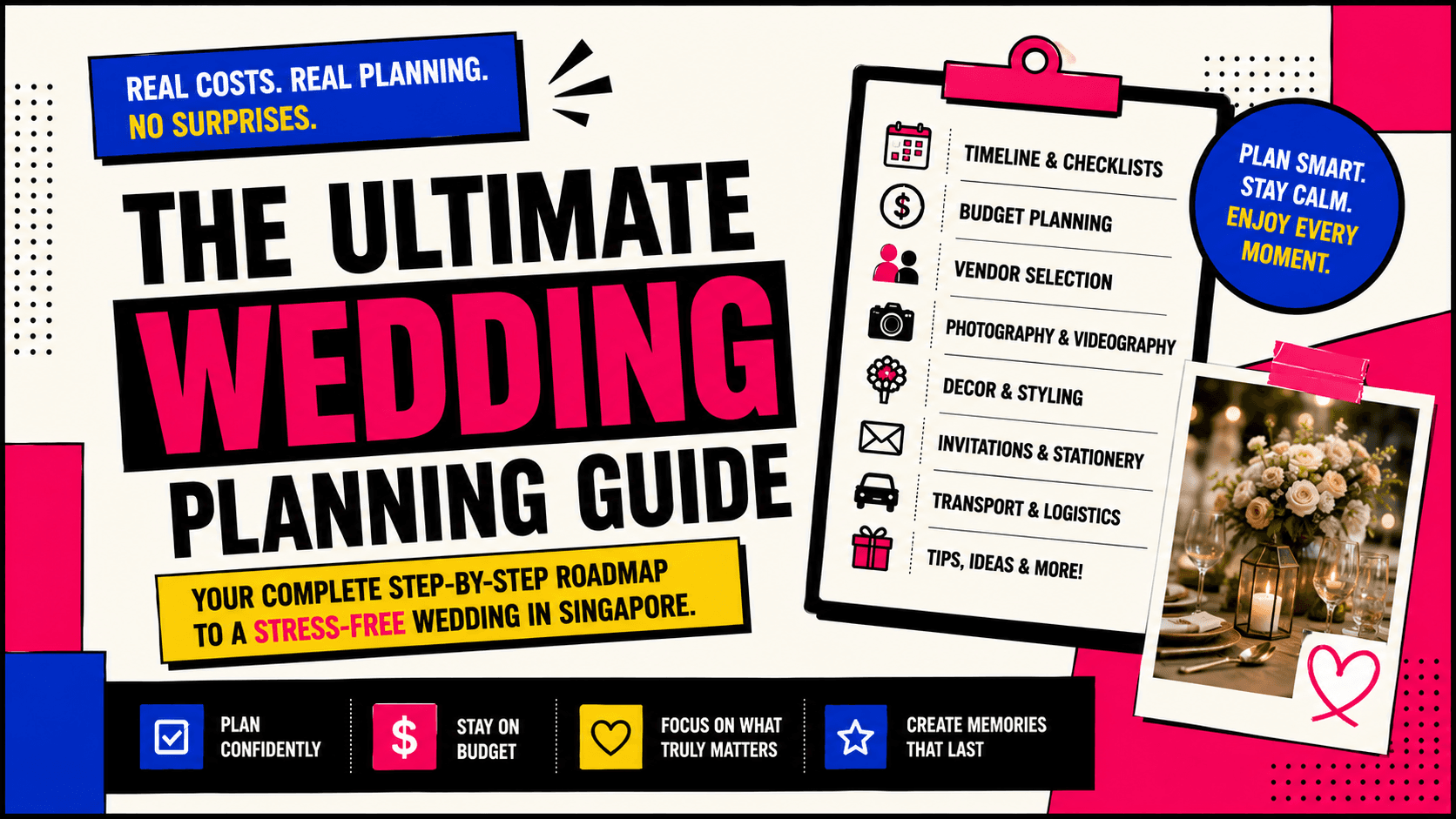
How to plan a wedding in Singapore
Planning a wedding in Singapore can feel overwhelming because dozens of decisions quickly become connected.
Your guest count affects your venue.
Your venue affects your date.
Your date affects vendor availability.
Your traditions affect your actual-day schedule.
And almost every decision affects your budget.
The easiest way to approach wedding planning is therefore not to plan everything at once.
Instead, work through the wedding in stages:
- Decide what kind of wedding you want
- Set your budget
- Estimate your guest count
- Choose your date and venue
- Book priority vendors
- Plan your solemnisation and traditions
- Choose your outfits
- Organise guests and invitations
- Build your wedding programme
- Create your actual-day timeline
- Confirm vendors and logistics
- Prepare for your final wedding week
- Enjoy your wedding day
If you prefer to plan chronologically, start with the Complete Singapore Wedding Planning Timeline, which takes you from 18 months before the wedding all the way to the actual day.
How far in advance should you start planning a wedding in Singapore?
There is no single planning period that every couple must follow.
Starting 12 to 18 months ahead can give you more time to research venues, compare vendors and make decisions gradually.
But weddings can also be planned on shorter timelines.
Use the checklist that matches where you are now:
- 18 Months Before Your Wedding
- 12 Months Before Your Wedding
- 9 Months Before Your Wedding
- 6 Months Before Your Wedding
- 3 Months Before Your Wedding
- 1 Month Before Your Wedding
- Wedding Week Checklist
- Wedding Day Checklist
If you are starting late, do not try to recreate an 18-month planning process.
Prioritise the decisions that affect availability and other tasks, then move forward from there.
Step 1: Decide what kind of wedding you want
Before comparing wedding packages, talk about the experience you actually want.
Discuss:
- Wedding size
- Formality
- Lunch or dinner
- Traditional or modern
- Indoor or outdoor
- Solemnisation format
- Banquet style
- Family involvement
- Overall atmosphere
Then ask each other:
What are the three things we care about most?
For example:
- Food
- Photography
- Videography
- Venue
- Guest experience
- Outfits
- Decorations
- Entertainment
These priorities become extremely useful later when your budget requires trade-offs.
You do not need to create someone else's idea of the perfect Singapore wedding.
You need to understand what would make the celebration meaningful to both of you.
Step 2: Set your Singapore wedding budget
Set a total amount you are comfortable spending before vendor quotations begin influencing your expectations.
Break the budget into categories.
| Category | Budget | Quoted | Booked | Paid |
|---|---|---|---|---|
| Venue and catering | ||||
| Photography | ||||
| Videography | ||||
| Bridal | ||||
| Groom's attire | ||||
| Hair and makeup | ||||
| Florals and decor | ||||
| Entertainment | ||||
| Transport | ||||
| Stationery | ||||
| Other expenses |
Track committed spending, not only payments already made.
A vendor may collect a deposit today while most of the balance remains payable later.
Keep some contingency for expenses that appear closer to the wedding.
Most importantly, build your wedding around money you are comfortable spending rather than assuming future wedding gifts will solve an oversized budget.
Step 3: Estimate your wedding guest count
Your guest count is one of the most important numbers in your wedding plan.
Start by listing:
- Immediate family
- Relatives
- Close friends
- School friends
- University friends
- Colleagues
- Parents' guests
- Children
- Plus-ones
Ask both families for approximate numbers early.
Then divide guests into categories if necessary:
Must invite
People you definitely want there.
Would like to invite
Guests you hope to include if capacity allows.
Optional
Guests who may be reconsidered if your list becomes too large.
You do not need final attendance yet.
You need a realistic estimate that can guide your venue search and budget.
Step 4: Choose your wedding date
Your wedding date affects venue availability, vendors, family arrangements and the overall planning timeline.
Consider:
- Preferred months
- Weekday vs weekend
- Family availability
- Important personal dates
- Public holidays
- Long weekends
- School holidays where relevant
- Venue availability
- Family traditions
If auspicious dates matter to either family, discuss them before paying venue deposits.
Having several acceptable dates can also make your search easier.
Once the date is confirmed, record it consistently across contracts, vendor bookings and planning documents.
Step 5: Choose your wedding venue in Singapore
Your venue is usually one of the biggest wedding decisions.
Possible options include:
- Hotels
- Restaurants
- Country clubs
- Event spaces
- Heritage venues
- Outdoor venues
- Intimate private spaces
When comparing venues, consider:
- Capacity
- Minimum attendance or spending
- Location
- Accessibility
- Parking
- Menu
- Drinks
- Solemnisation space
- Reception area
- Bridal room
- Stage
- AV equipment
- Decoration inclusions
- Vendor access
- Wet-weather arrangements
Do not compare venues using only the headline package price.
Compare what your wedding would actually require after accounting for inclusions and additional costs.
If you are at the beginning of your venue search, the 18-Month Wedding Checklist covers the early research stage, while the 12-Month Wedding Checklist covers moving from research into confirmed bookings.
Step 6: Book your priority wedding vendors
Once your date and venue are established, prioritise vendors that are important to you and limited by availability.
Common categories include:
- Photographer
- Videographer
- Makeup artist
- Bridal boutique
- Florist
- Decorator
- Emcee
- Entertainment
- Photobooth
- Transport
You do not need every vendor simply because another wedding had one.
Separate vendors into:
Essential
Your wedding genuinely needs the service.
Important to us
Not essential, but personally valuable.
Optional
Something you would enjoy if your budget allows.
The 9-Month Wedding Checklist covers vendor selection, outfits and pre-wedding planning in more detail.
Step 7: Organise all your wedding planning information
Wedding information can quickly become scattered across WhatsApp, emails, screenshots, spreadsheets and contracts.
Create one master wedding planning system containing:
Budget
Estimated, quoted, committed and paid expenses.
Guests
Names, groups, contact details and eventual RSVPs.
Vendors
Contacts, quotations, contracts, payments and deliverables.
Venue
Package details, floor plans and deadlines.
ROM and solemnisation
Marriage information and ceremony planning.
Traditions
Family decisions and responsibilities.
Timeline
Your eventual actual-day schedule.
Documents
Contracts, receipts and important files.
The best system is not necessarily the most complicated one.
It is the one both of you consistently update.
Step 8: Plan your ROM and solemnisation
Decide how your solemnisation fits into your celebration.
Possible structures include:
- Solemnisation on a separate date
- Solemnisation before lunch
- Solemnisation before dinner
- Small ceremony before a larger banquet
Consider:
- Venue
- Guest count
- Ceremony timing
- Solemniser
- Witnesses
- Rings
- Photography
- Videography
- Indoor or outdoor setup
- Wet-weather backup
Singapore's legal marriage procedures and requirements can change, and individual circumstances can affect the process.
Always verify the current official requirements when completing your legal steps.
For a dedicated walkthrough, use the Singapore ROM & Solemnisation Guide.
Step 9: Discuss Chinese wedding traditions early
If Chinese wedding traditions are relevant to your families, discuss expectations before the final months.
Depending on your families, traditions may include:
- Guo Da Li
- Hui Li
- Pin jin
- Dowry
- An Chuang
- Hair combing ceremony
- Gatecrash
- Bride fetching
- Tea ceremony
- Auspicious dates or timings
There is no single universal checklist followed by every family.
Ask:
Which traditions matter to us?
Who is responsible for each one?
Does anything affect our wedding date or actual-day schedule?
Early alignment is especially useful for traditions involving multiple homes, family members or specific timings.
Step 10: Choose your wedding gown, suit and outfits
Start by identifying what outfits your wedding actually requires.
The bride may consider:
- Wedding gown
- Solemnisation dress
- Tea ceremony outfit
- Evening gown
- Traditional outfit
The groom may consider:
- Main suit
- Additional jacket
- Shirt
- Shoes
- Tie or bow tie
- Accessories
When comparing bridal packages, check:
- Number of outfits
- Alterations
- Accessories
- Veil
- Fittings
- Collection
- Return arrangements
Remember that every actual-day outfit change also requires time.
Choose outfits that fit your celebration rather than assuming more outfit changes automatically create a better wedding.
Step 11: Plan your pre-wedding photoshoot
A pre-wedding photoshoot is optional.
If you want one, decide what you want from it.
Possible styles include:
- Studio
- Urban
- Nature
- Editorial
- Casual
- Cinematic
- Destination
You may use the photographs for:
- Invitations
- Wedding website
- Welcome signage
- Guestbook
- Banquet display
- Personal memories
Work backwards if the photographs need to be edited and printed for other wedding materials.
The 9-Month Wedding Checklist is a useful point to begin turning your pre-wedding ideas into a real plan.
Step 12: Finalise your guest list and wedding invitations
As the wedding approaches, transform your rough guest list into a structured RSVP tracker.
Record:
- Guest name
- Side or group
- Contact
- Invitation status
- RSVP
- Plus-one
- Children
- Dietary requirements
- Notes
Your invitations should clearly communicate the information guests need, which may include:
- Couple's names
- Date
- Venue
- Address
- Solemnisation details
- Reception timing
- Banquet timing
- Dress code if applicable
- RSVP instructions
Around the six- to three-month stages, guest management becomes increasingly important.
Use the 6-Month Wedding Checklist to prepare your guest and invitation process, then the 3-Month Wedding Checklist as invitations and RSVPs become active.
Step 13: Create your wedding seating plan
Do not try to finalise seating before you have a reliable picture of attendance.
Once RSVPs are clearer, group guests based on relationships.
Common groups include:
- Immediate family
- Relatives
- Close friends
- School friends
- University friends
- Colleagues
- Parents' guests
Consider:
- Elderly guests
- Children
- Accessibility
- Family dynamics
- VIP arrangements
- Stage visibility
Keep your seating plan editable because last-minute guest changes are common.
For the complete process, use the Singapore Wedding Seating Plan Guide.
Step 14: Plan your wedding programme
Decide what you actually want guests to experience.
Your programme might include:
- Solemnisation
- Guest reception
- First march-in
- Cake cutting
- Wedding film
- Second march-in
- Toast
- Speeches
- Performances
- Games
- Table photographs
- Couple thank-you
- Farewell
Separate activities into:
Must have
Moments that genuinely matter.
Nice to have
Activities you can remove if the programme becomes too crowded.
Your banquet does not need to contain every wedding activity you have ever seen.
Leaving space in the programme can make the celebration feel more relaxed.
Step 15: Create your actual-day wedding timeline
Your actual-day timeline connects every part of the wedding.
Start with major blocks:
- Hair and makeup
- Gatecrash
- Bride fetching
- Tea ceremony
- Travel
- Solemnisation
- Photography
- Guest reception
- Banquet
- Farewell
Then add:
- Vendor arrival
- Outfit changes
- Makeup touch-ups
- Family photographs
- Speeches
- Videos
- Performances
- Table photographs
- Travel buffer
Avoid creating a schedule where every activity begins immediately after the previous one.
Real weddings need buffer.
Use the Singapore Actual-Day Wedding Timeline for a detailed guide and example schedules.
Step 16: Assign wedding-day responsibilities
You should not spend your wedding day answering every operational question.
Assign trusted people to important responsibilities.
Possible roles include:
- Main wedding-day contact
- Vendor coordinator
- Ring holder
- Family coordinator
- Tea ceremony helper
- Transport coordinator
- Reception team
- Ang bao box handler
- Wedding belongings coordinator
Match responsibilities to people's strengths.
Someone organised and calm may be ideal for vendors.
Someone familiar with your relatives may be better for family coordination.
By the final month, every important responsibility should have a clear owner.
The 1-Month Wedding Checklist covers these final assignments and logistics.
Step 17: Confirm your wedding vendors
As the wedding approaches, reconfirm every vendor rather than assuming everyone has the same information.
Confirm:
- Date
- Arrival time
- Location
- Contact person
- Services
- Deliverables
- Setup
- Meals if applicable
- Payment
- Overtime
- Emergency contact
Make sure vendors have the latest timeline information relevant to them.
Your photographer, makeup artist and venue may need different parts of the schedule.
For a full confirmation workflow, use the Wedding Vendor Confirmation Checklist.
Step 18: Plan your wedding ang bao box and gift handling
Decide how wedding ang baos and gifts will be received, protected and handed over.
Assign trusted people to:
- Reception
- Ang bao box
- Gift collection
- Secure storage
- Handover
- End-of-night collection
Avoid leaving this responsibility unclear.
The couple may be busy with guests, photographs, speeches and outfit changes.
Your reception team should know exactly who takes responsibility for valuables and when each handover occurs.
Use the Wedding Ang Bao Box & Gift Handling Guide to plan the process.
Step 19: Prepare for your final wedding month
One month before your wedding, move away from major new ideas and focus on closing open loops.
Priorities include:
- Final guest count
- Seating plan
- Vendor confirmations
- Actual-day timeline
- Solemnisation details
- Outfit fittings
- Hair and makeup schedule
- Transport
- Payments
- Speeches
- AV files
- Wedding-day roles
- Ang bao and gift handling
Use the Singapore Wedding Checklist: 1 Month Before as your complete month-out checklist.
The objective is to enter your final week with as little unfinished planning as possible.
Step 20: Prepare for your final wedding week
Your wedding week should be about preparation rather than invention.
Focus on:
- Final guest changes
- Seating updates
- Vendor confirmations
- Outstanding payments
- Outfits
- Rings
- Solemnisation items
- Wedding belongings
- Transport
- Weather
- Speeches
- AV files
- Timeline distribution
Try not to introduce major new ideas unless something genuinely needs to change.
The closer you get to the wedding, the more valuable simplicity becomes.
Use the Wedding Week Checklist: 7 Days Before Your Singapore Wedding to work through the final week systematically.
Step 21: Prepare your wedding day emergency kit
Prepare a compact kit for common last-minute problems.
Useful categories can include:
- Outfit fixes
- Beauty touch-ups
- Comfort
- Weather
- Personal essentials
- Tech accessories
Keep the kit organised and give it to someone who knows where it is.
The purpose is not to prepare for every imaginable disaster.
It is to solve small problems quickly without distracting the couple.
Use the Wedding Day Emergency Kit Checklist when packing yours.
Step 22: Follow your wedding day checklist
By the actual day, planning should give way to execution.
Your priorities are simple:
- Eat
- Hydrate
- Keep essential belongings together
- Follow the broad schedule
- Allow your helpers to coordinate vendors
- Complete your solemnisation requirements
- Keep reasonable travel buffer
- Be present with your families
- Spend time with your guests
- Let small imperfections go
You have spent months planning the celebration.
You should not spend the wedding managing it.
For your final reference, use the Singapore Wedding Day Checklist.
Complete Singapore wedding planning checklist
Use this master checklist as your overview.
Foundations
- Decide wedding size and style
- Identify your priorities
- Set budget
- Estimate guest count
- Choose date
- Book venue
Vendors
- Photographer
- Videographer
- Makeup artist
- Bridal boutique
- Groom's attire
- Florist or decorator if needed
- Emcee or entertainment if needed
- Other important vendors
Marriage and traditions
- Plan solemnisation
- Review current marriage requirements
- Discuss Chinese wedding traditions if applicable
- Plan tea ceremony if applicable
- Plan gatecrash if applicable
Guests
- Build guest list
- Prepare invitations
- Track RSVPs
- Collect dietary requirements
- Finalise attendance
- Create seating plan
Actual day
- Plan programme
- Create timeline
- Plan transport
- Assign responsibilities
- Confirm vendors
- Confirm payments
- Plan ang bao and gift handling
- Prepare emergency kit
- Pack wedding belongings
Final week
- Complete final confirmations
- Distribute timeline
- Check rings
- Check solemnisation items
- Charge devices
- Rest
- Enjoy the wedding
What are the most important things to book first for a Singapore wedding?
Start with decisions that affect everything else.
A practical sequence is:
- Budget
- Guest estimate
- Wedding date
- Venue
- Priority vendors
Once your venue and date are secured, focus on vendors that are especially important to you and limited by availability.
For many couples, that includes:
- Photographer
- Videographer
- Makeup artist
- Bridal boutique
Your priorities may be different.
The principle is more important than the exact order:
Secure important, availability-sensitive decisions before spending too much time on details that can wait.
How can couples make wedding planning less stressful?
The biggest improvement is often not another checklist.
It is reducing how many things you are trying to think about simultaneously.
Try these principles:
Plan by stage
Do what matters now instead of constantly worrying about wedding-week tasks months in advance.
Keep one source of truth
Store your latest guest list, vendor information, payments and timeline together.
Give every task an owner
If both partners assume the other person is handling something, it may not happen.
Stop reopening completed decisions
Once you have chosen a vendor or design you are happy with, resist endless comparison.
Separate essential from optional
Not every wedding trend needs to become part of your celebration.
Delegate the actual day
Your wedding should not require the couple to personally coordinate every moving part.
For a chronological view of exactly what to focus on at each stage, use the Complete Singapore Wedding Planning Timeline.
Your Aven Singapore wedding planning roadmap
Use this guide as your central wedding planning hub.
Then move into the detailed guide that matches what you are working on.
Planning by countdown
- Complete Singapore Wedding Planning Timeline
- 18 Months Before
- 12 Months Before
- 9 Months Before
- 6 Months Before
- 3 Months Before
- 1 Month Before
- Wedding Week
- Wedding Day
Planning specific parts of the wedding
- Singapore ROM & Solemnisation Guide
- Singapore Wedding Seating Plan Guide
- Singapore Actual-Day Wedding Timeline
- Wedding Vendor Confirmation Checklist
- Wedding Day Emergency Kit Checklist
- Wedding Ang Bao Box & Gift Handling Guide
You do not need to read every guide today.
Start with the stage you are currently in, complete the decisions that matter now, and move forward from there.
Start your Singapore wedding planning one step at a time
A wedding can involve hundreds of decisions.
But you never need to make all of them at once.
Start with the foundations:
What kind of wedding do we want?
How much do we want to spend?
Who do we want there?
When and where will it happen?
Then work forward.
Venue.
Vendors.
Solemnisation.
Traditions.
Outfits.
Guests.
Programme.
Timeline.
Final confirmations.
Wedding day.
If you ever feel unsure about what comes next, return to the Complete Singapore Wedding Planning Timeline and find the stage you are currently in.
The goal is not to plan a perfect wedding.
It is to build a celebration that feels like yours, one clear decision at a time.