
Blog
Singapore Wedding Seating Plan Guide: How to Arrange Your Guests
August 29, 2026 · Updated September 3, 2026
Planning your wedding seating arrangement? Use this Singapore wedding seating plan guide to organise tables, families, friends, colleagues, VIPs and last-minute guest changes.
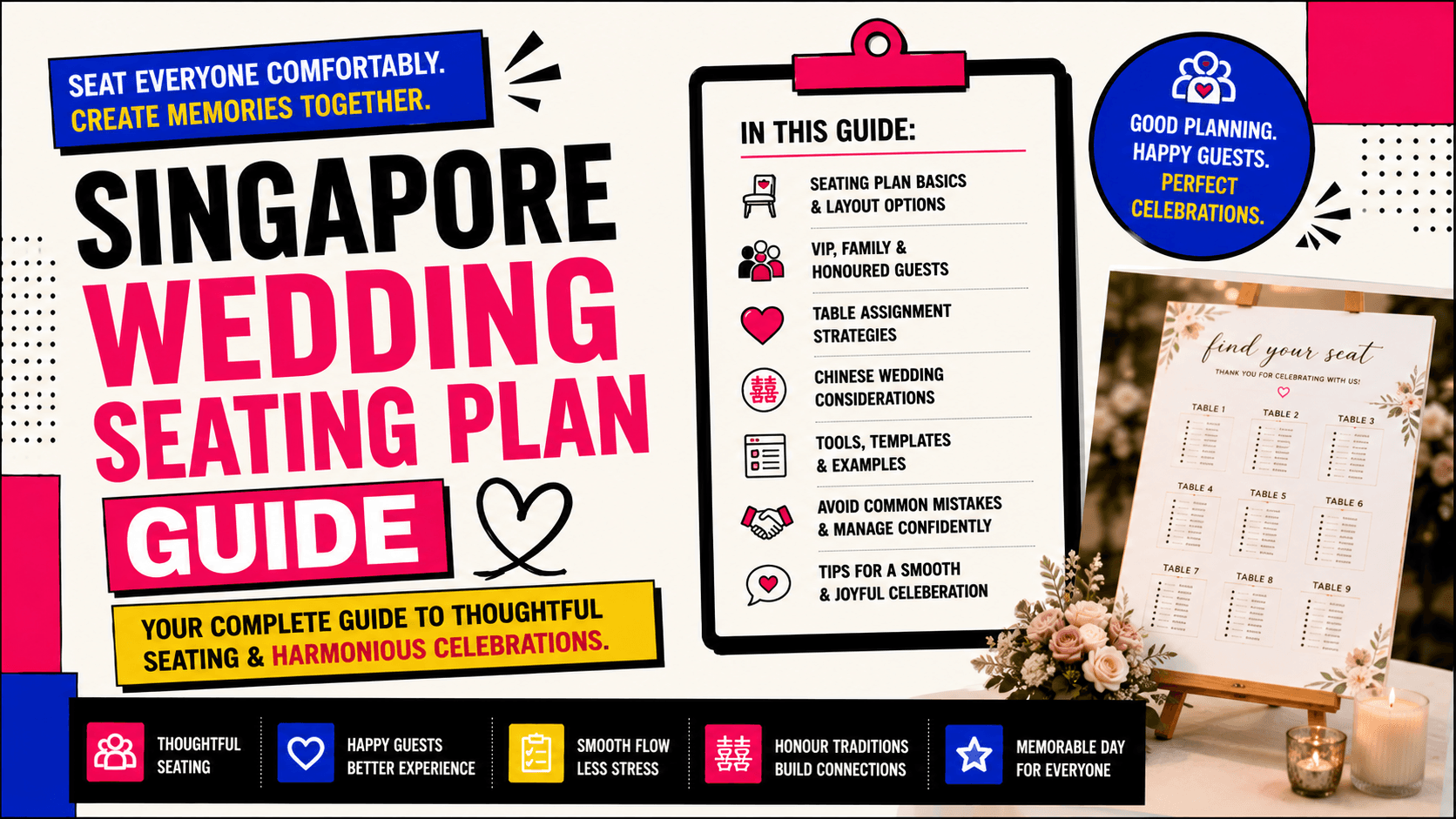
How do you create a wedding seating plan in Singapore?
Creating your wedding seating plan can feel surprisingly difficult.
You start with a guest list.
Then suddenly you are trying to work out:
- Who knows whom
- Which relatives should sit together
- Which relatives should definitely not sit together
- Where your parents' friends should go
- Whether colleagues should share a table
- Where elderly guests should sit
- What happens when someone cancels
- What to do with a table containing nine people when your venue expects ten
The good news is that your wedding seating arrangement does not need to be perfect.
It needs to be comfortable, practical and easy for guests to understand.
The easiest way to create it is to stop thinking about individual seats initially.
Start with groups.
Then build tables from those groups.
For the complete planning process leading up to your wedding, use the Ultimate Singapore Wedding Planning Guide.
When should you start planning your wedding seating arrangement?
You can begin thinking about table groups once your guest list is reasonably established.
However, avoid finalising the seating plan too early.
Your arrangement depends heavily on:
- RSVPs
- Final venue layout
- Table capacity
- Family requirements
- Children's seating
- Guest cancellations
- Last-minute additions
A useful approach is to create a draft seating plan first.
Then finalise it after your RSVP deadline when you have a much clearer idea of who is actually attending.
This prevents you from repeatedly rebuilding every table whenever one guest changes their response.
What information do you need before making a seating plan?
Before arranging tables, gather:
- Confirmed guest list
- RSVP status
- Venue floor plan
- Number of available tables
- Number of seats per table
- Reserved table requirements
- Stage location
- Entrance location
- Screens
- Speakers
- Accessible routes
- High-chair requirements
- Children's seating requirements
- Family requests
Ask your venue for the latest floor plan.
Do not create your final seating arrangement using a floor plan you found in an old wedding photograph or online review.
The setup used for your wedding may be different.
Confirm how many guests can sit at each wedding table
Before grouping anyone, confirm your venue's table capacity.
Do not assume every Singapore wedding banquet uses exactly the same number of guests per table.
Ask your venue:
- Standard number of guests per table
- Maximum number of guests per table
- Whether smaller tables are possible
- Whether children's seats affect capacity
- How high chairs are handled
- Whether partially filled tables affect your package
- Whether different table sizes are available
This information determines how you should build your groups.
If your tables accommodate ten guests, for example, your planning problem becomes much easier when you start identifying natural groups of approximately that size.
Start your wedding seating plan by grouping guests
Do not immediately assign everyone to Table 1, Table 2 and Table 3.
First divide your guests into natural social groups.
For example:
Bride's side
- Immediate family
- Extended family group A
- Extended family group B
- Secondary school friends
- University friends
- Current colleagues
- Former colleagues
- Other friends
Groom's side
- Immediate family
- Extended family group A
- Extended family group B
- School friends
- National Service friends
- University friends
- Current colleagues
- Other friends
Parents' guests
- Bride's parents' friends
- Groom's parents' friends
- Family friends
- Business contacts where applicable
Once these groups exist, start combining compatible groups into tables.
This is much easier than treating 200 individual names as one giant puzzle.
Who should sit at the main wedding table?
There is no single seating arrangement that every Singapore wedding must follow.
The main or VIP table may include:
- Bride and groom
- Both sets of parents
- Grandparents
- Immediate family
- Other important family members
Some couples choose to sit with their bridal party.
Others have separate family tables.
Some venues or family traditions may also influence the arrangement.
Discuss the main table with both families before finalising it.
This is one area where assumptions can create unnecessary disagreements later.
Where should parents sit at a wedding banquet?
Parents are often seated prominently, but the exact arrangement depends on your wedding format.
Consider:
- Whether both families share one table
- Whether each family has its own table
- Which relatives should sit with them
- Whether they need easy access to the stage
- Whether they will frequently greet guests
- Whether elderly relatives are seated with them
Ask both sets of parents what they prefer.
They may also know family dynamics that you are unaware of.
A five-minute conversation can prevent hours of rearranging later.
How should you seat relatives at your wedding?
Family tables can be straightforward until extended relatives become involved.
Start with family branches.
For example:
- Maternal relatives
- Paternal relatives
- Bride's extended family
- Groom's extended family
Then ask your parents whether there are natural subgroups.
Try to seat guests with people they already know or would comfortably speak with.
Also ask discreetly whether there are any family relationships that require consideration.
You do not need the complete family history.
You simply need enough information to avoid creating an unnecessarily uncomfortable table.
How should you seat friends at a wedding?
Friends are usually easiest to group according to where they know you from.
For example:
- Secondary school
- Junior college or polytechnic
- University
- National Service
- Current workplace
- Previous workplace
- Sports
- Hobbies
- Mutual friend groups
Keep established friend groups together where possible.
If a group is too large for one table, split it based on closer relationships rather than randomly.
For example, a group of 16 university friends might become:
Table A: Eight friends who regularly meet.
Table B: Eight friends from the wider university group.
If the groups know each other, placing their tables nearby can also help.
How should you seat wedding guests who do not know anyone?
Sometimes a guest does not naturally belong to a large group.
Avoid placing them at a completely random table simply because one seat is available.
Instead, look for compatibility.
Consider:
- Similar age group
- Shared interests
- Common friends
- Similar work background
- Similar relationship to the couple
- Personality
For example, if one friend knows only the groom but has met several members of another friend group before, that may be a better fit than placing them with unrelated colleagues.
The objective is not to manufacture friendships.
It is simply to give guests a comfortable table for a few hours.
Should couples be seated together?
Where possible, avoid unnecessarily separating couples who attend together.
This is especially relevant when one person knows very few other guests.
Keeping couples together generally makes the seating arrangement more comfortable.
However, larger friend groups may naturally contain several couples, which can make table capacity challenging.
Treat each couple as a two-person unit while drafting your tables.
This makes it less likely that you accidentally fill a table with nine people and later realise someone's partner still needs a seat.
How should you seat colleagues at your wedding?
Workplace guests can usually be grouped according to:
- Team
- Department
- Current colleagues
- Former colleagues
- Seniority where relevant
- Existing friendships
Avoid overcomplicating workplace seating.
If your colleagues already socialise together, seat them together.
If you are inviting managers or senior colleagues, you do not automatically need a separate "VIP work table" unless that arrangement makes sense for your workplace culture.
Comfort matters more than creating artificial status categories.
How should you arrange your parents' guests?
For some Singapore weddings, parents may invite their own friends, colleagues or family acquaintances.
Instead of trying to arrange these guests yourself, ask your parents to propose the initial grouping.
They know:
- Who knows each other
- Which guests are couples
- Existing friend groups
- Family relationships
- Any social considerations
Give your parents the table capacity and ask them to organise their allocated guests into groups.
You can then fit those groups into the overall floor plan.
This is usually easier than trying to reverse-engineer relationships between people you barely know.
Where should elderly guests sit?
Consider comfort and accessibility when seating elderly guests.
Where possible, think about:
- Distance from entrance
- Walking distance
- Steps
- Accessible routes
- Restrooms
- Speaker locations
- Air-conditioning
- Stage visibility
A table directly beside a loudspeaker may not be ideal.
Neither is a table requiring a long walk through a crowded ballroom if mobility is a concern.
Ask your venue about accessible routes and appropriate table locations if needed.
How should you seat families with young children?
Families with young children may have different needs.
Confirm:
- High chairs
- Children's seats
- Stroller space
- Easy access to exits
- Distance from loudspeakers
- Children's meals where applicable
Ask parents whether they need a high chair during RSVP collection.
Do not wait until the banquet begins to discover that several additional chairs need to fit around an already-full table.
Should children have their own wedding table?
This depends on their ages, the number of children attending and what their parents prefer.
A separate children's table may work for older children who already know each other.
For very young children, sitting with their parents is usually more practical.
Before creating a children's table, consider:
- Ages
- Supervision
- Meals
- Seating
- Whether the children know one another
Do not create one simply because it looks tidy on the seating chart.
The arrangement should make the wedding easier for both the children and their parents.
Consider the stage when assigning tables
Not every table has the same view.
Use your venue floor plan to identify:
- Stage
- Screens
- Pillars
- AV equipment
- Service areas
- Entrances
- Exits
If there are tables with particularly good visibility, you may want to prioritise them for:
- Immediate family
- Grandparents
- Close relatives
- Important guests
However, avoid obsessing over ranking every table from "best" to "worst".
Most guests will spend much of the wedding eating and talking to the people around them.
Avoid seating elderly guests beside loudspeakers
Ask your venue where the main speakers will be located.
Tables close to speakers may experience much higher sound levels during:
- March-ins
- Videos
- Live music
- Performances
- Speeches
If you have guests who may be particularly sensitive to loud sound, consider placing them farther away.
This small detail can significantly improve their experience.
Do you need assigned seats or assigned tables?
There are two common approaches.
Assigned tables
Guests are told which table to sit at but choose their own seat.
Assigned seats
Every guest receives a specific seat.
Assigned tables are generally simpler.
Assigned seats can be useful for formal dinners or situations where exact placement matters.
For many wedding banquets, assigning tables provides enough organisation without creating unnecessary work.
Ask your venue whether there are any requirements before deciding.
How to number your wedding tables
The simplest system is numerical:
- Table 1
- Table 2
- Table 3
- Table 4
You can also use table names based on something meaningful to you.
For example:
- Travel destinations
- Flowers
- Places from your relationship
- Favourite films
- Shared interests
Creative table names can add personality, but make sure they remain easy for guests and reception staff to identify.
"Table 12" is easier to communicate across a crowded reception than an obscure reference nobody can pronounce.
If you use names, consider displaying them clearly alongside an organised seating chart.
Create a wedding seating plan spreadsheet
A simple table can make seating arrangements much easier.
Track:
| Guest | Side | Group | RSVP | Table | Dietary Needs | Notes |
|---|---|---|---|---|---|---|
| Guest A | Bride | University | Yes | 8 | ||
| Guest B | Groom | Colleague | Yes | 12 | ||
| Guest C | Bride | Family | Pending |
Once RSVPs are confirmed, filter guests by group and begin building tables.
This is much easier than maintaining separate guest lists, RSVP lists and seating documents.
Build your seating plan in rounds
Do not try to create the perfect seating arrangement in one attempt.
Use several rounds.
Round 1: Obvious groups
Seat immediate family and complete friend groups.
Round 2: Large groups
Split groups that exceed table capacity.
Round 3: Small groups
Combine compatible smaller groups.
Round 4: Individual guests
Place guests who do not naturally belong to a larger group.
Round 5: Review
Check couples, children, elderly guests and family requests.
Round 6: Floor plan
Assign the completed groups to physical tables.
Separating guest grouping from table placement makes the process much easier.
What should you do with partially filled wedding tables?
Eventually you may end up with something like:
Table A: 10 guests
Table B: 10 guests
Table C: 7 guests
Table D: 4 guests
Instead of randomly filling empty seats, look for compatible combinations.
Could Table C and part of Table D be reorganised?
Could a couple move from another table without breaking a close group?
Could two smaller friend groups comfortably share one table?
Also ask your venue what flexibility exists.
You may not need every table to contain exactly the same number of guests.
What should you do when a guest cancels?
Guest cancellations are normal.
Do not rebuild the entire seating plan every time someone cancels.
First ask:
Does this cancellation actually create a problem?
If a table goes from ten guests to nine, you may be able to leave it alone.
If several guests cancel from the same table, then reorganising may make sense.
Avoid constantly moving guests because repeated changes increase the chance of mistakes.
Once your venue's final deadline approaches, make only changes that are genuinely necessary.
How should you handle last-minute wedding guests?
Occasionally, someone who was previously unavailable may become able to attend.
Before saying yes, check:
- Venue capacity
- Final guest deadline
- Available seats
- Meal arrangements
- Table placement
Do not simply add someone to a full table because "one more chair should fit".
Ask your venue what is possible.
If the seating plan has already been printed, also consider whether the guest can be added without creating confusion at registration.
Keep a small amount of flexibility in your seating plan
Your final guest count may still experience minor changes.
Where possible, avoid creating a seating arrangement so rigid that one cancellation causes a chain reaction across ten tables.
Some flexibility makes last-minute adjustments easier.
This does not necessarily mean leaving empty tables or paying for unnecessary seats.
It means recognising which groups can tolerate a small change without needing the entire ballroom rearranged.
Create a final wedding floor plan
Once your groups are stable, place them onto the venue floor plan.
Consider:
- Main table
- Family tables
- Elderly guests
- Children
- Stage visibility
- Speakers
- Entrances
- Accessible routes
- Service areas
- Guest flow
Label every table clearly.
Then check that the table numbers in your floor plan match:
- Seating chart
- Guest list
- Reception list
- Venue's plan
One numbering mistake can create unnecessary confusion during registration.
Create a seating chart for your wedding guests
Your seating chart should help guests answer one simple question:
Where am I sitting?
Possible formats include:
- Alphabetical guest list with table numbers
- Tables with guest names underneath
- Printed seating board
- Digital display
- Individual escort cards
For larger weddings, alphabetical organisation can make names easier to find.
Whatever design you choose, prioritise readability over decoration.
Guests should not need to solve a puzzle to discover their table.
Should your seating chart be alphabetical or by table?
Both approaches can work.
Alphabetical
Guest finds their name and sees their table number.
This can be particularly convenient for larger weddings.
By table
Guest looks through each table until they find their name.
This also allows guests to immediately see who else is sitting with them.
You can even combine the two digitally if your wedding planning system supports it.
The best format is whichever helps guests find their table quickly.
Give your reception team the final seating plan
Your reception team needs more information than the decorative seating chart.
Give them a working guest list containing:
- Guest name
- Table number
- RSVP status
- Plus-one name where applicable
- Notes where necessary
If someone arrives and cannot find their name, the reception team should be able to resolve the issue without calling the bride or groom.
Include one person who understands the seating arrangement well enough to make minor decisions if necessary.
Share the final seating plan with your venue
Send your venue the final arrangement by its required deadline.
Confirm:
- Number of tables
- Number of guests
- Main table
- Reserved tables
- High chairs
- Children's meals
- Dietary requirements
- Accessibility requirements
- Final floor plan
Make sure your coordinator is using the same version.
You can include this as part of your Wedding Vendor Confirmation Checklist.
Avoid having one seating plan with the venue and another newer version sitting only on your laptop.
Common wedding seating plan mistakes
Avoid these common problems:
Starting before RSVPs
You will spend unnecessary time rearranging guests.
Ignoring table capacity
Confirm the venue's actual requirements first.
Separating couples unnecessarily
Treat couples as a unit when drafting tables.
Randomly filling empty seats
Try to create socially comfortable groups.
Ignoring elderly guests
Consider accessibility and speaker locations.
Forgetting high chairs
Collect this information during RSVPs.
Using an outdated floor plan
Ask your venue for the correct layout.
Different table numbers across documents
Keep your guest list, floor plan and seating chart aligned.
Printing too early
Last-minute guest changes happen.
Trying to satisfy everyone perfectly
Your seating plan needs to work well. It does not need to solve every social relationship in your extended family.
Singapore wedding seating plan checklist
Use this checklist before finalising your seating arrangement.
Before you start
- Collect RSVPs
- Get venue floor plan
- Confirm table capacity
- Confirm number of tables
- Identify main table requirements
- Collect high-chair requests
- Collect dietary requirements
- Identify accessibility requirements
Group guests
- Immediate family
- Extended family
- Bride's friends
- Groom's friends
- Colleagues
- Parents' guests
- Couples
- Children
- Individual guests
Review tables
- Couples remain together where appropriate
- Friend groups are comfortable
- Family dynamics considered
- Elderly guests appropriately placed
- Children accommodated
- High chairs accounted for
- Table capacity checked
Review floor plan
- Main table placed
- Family tables placed
- Stage visibility considered
- Speaker locations considered
- Accessibility considered
- Entrances considered
- Table numbers checked
Before printing
- Latest RSVPs updated
- Venue confirms layout
- Final table numbers checked
- Guest names checked
- Reception list matches seating chart
- Venue receives final plan
- Coordinator receives final plan
Then stop moving people unless something actually changes.
Frequently asked questions about Singapore wedding seating plans
When should we finalise our wedding seating plan?
Finalise it after most RSVPs are confirmed and before your venue's required deadline. Avoid printing the final seating chart too early.
How many people sit at a Singapore wedding table?
Table capacity varies by venue and setup. Confirm the standard and maximum capacity directly with your wedding venue.
Should couples always sit together?
Where practical, yes. This is especially helpful when one partner does not know many other guests.
Should we assign exact seats?
Not necessarily. Assigned tables are often sufficient unless your wedding format or venue requires specific seats.
What if someone cancels after the seating chart is printed?
A single empty seat usually does not require rebuilding the entire arrangement. Coordinate with your venue and reception team if the cancellation affects table numbers or meal arrangements.
Should friends from different groups sit together?
They can if the groups are socially compatible. Try to avoid using unrelated guests merely to fill empty seats.
Who should make the final decision when families disagree about seating?
Discuss the arrangement together and focus on practical guest comfort. Parents can be especially helpful when arranging extended relatives and their own invited guests.
Your wedding seating plan does not need to be perfect
There is a point during wedding planning when moving one name from Table 14 to Table 16 begins to feel like a major strategic decision.
It probably is not.
Your guests need:
- A seat
- People they can comfortably talk to
- A clear way to find their table
Start with natural social groups.
Keep couples together where appropriate.
Ask your parents for help with relatives and their own guests.
Consider accessibility.
Then stop rearranging once the plan works.
Before your wedding, confirm the final arrangement with your venue using the Wedding Vendor Confirmation Checklist.
Add the final seating information to your Singapore Wedding Day Checklist so your reception team knows exactly what to do.
And for everything else you still need to plan, return to the Ultimate Singapore Wedding Planning Guide.