
Blog
Singapore Actual-Day Wedding Timeline: Complete Example & Template
August 29, 2026 · Updated August 29, 2026
Plan your Singapore wedding day hour by hour with this practical actual-day wedding timeline covering gatecrash, tea ceremony, solemnisation, photos and banquet.
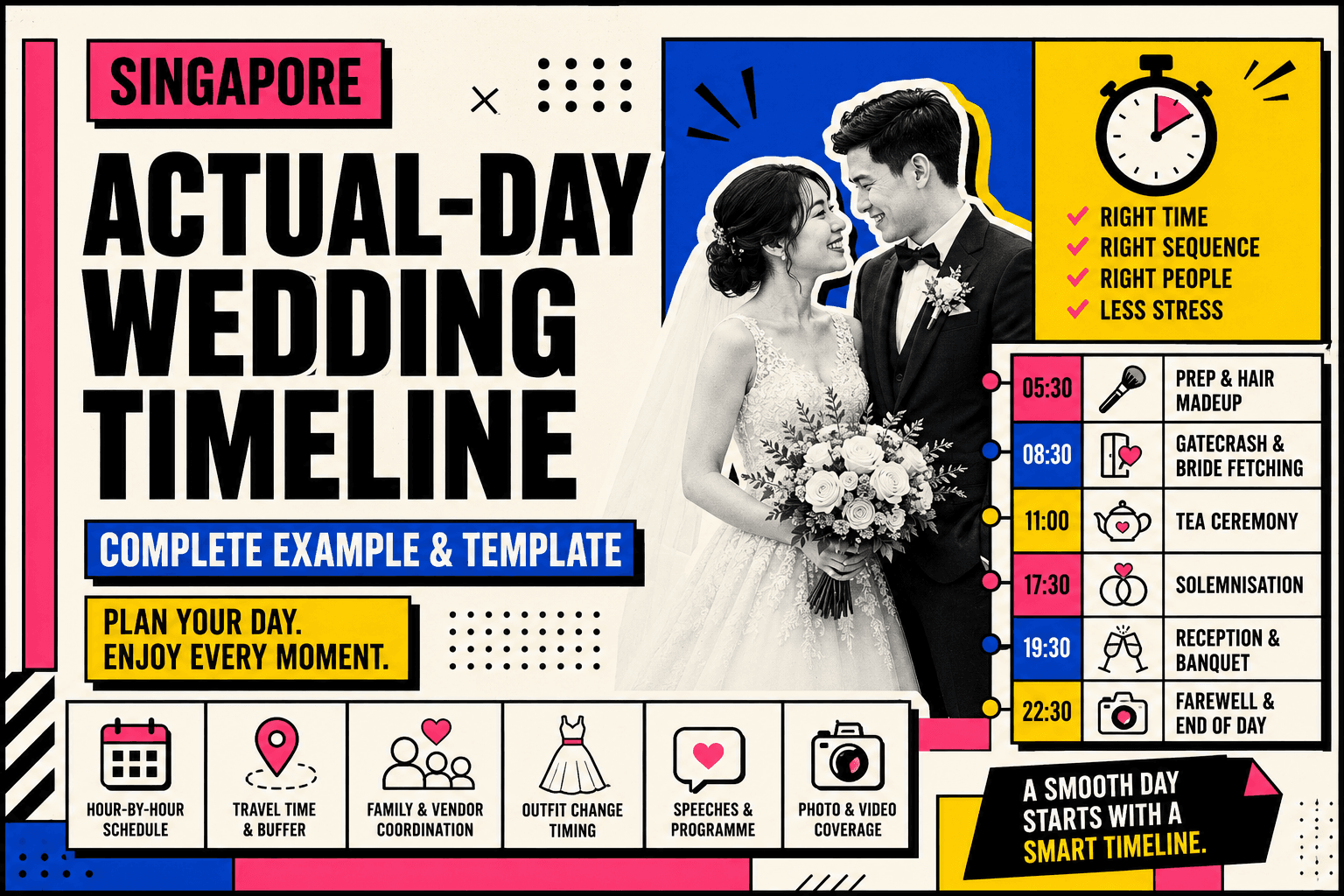
How do you plan an actual-day wedding timeline in Singapore?
A good wedding timeline does more than tell you what time everything happens.
It connects your people, venues, traditions, vendors and programme into one realistic schedule.
This is especially important for Singapore weddings because a single wedding day may include:
- Hair and makeup
- Groom preparation
- Gatecrash
- Bride fetching
- Tea ceremonies
- Travel between family homes
- Couple portraits
- Solemnisation
- Wedding reception
- Lunch or dinner banquet
- Outfit changes
- Speeches
- Table photographs
Trying to fit everything together without a proper timeline can result in a wedding that feels rushed even when every individual activity seems reasonable.
The goal is not to schedule every minute.
The goal is to create enough structure that everyone knows where they need to be, what happens next and how much buffer exists if something runs late.
For the broader planning process, start with the Ultimate Singapore Wedding Planning Guide.
What should be included in your wedding day timeline?
Your master wedding timeline should include more than the bride and groom's programme.
Include:
- Bride's preparation
- Groom's preparation
- Photographer arrival
- Videographer arrival
- Hair and makeup
- Gatecrash
- Bride fetching
- Tea ceremonies
- Family photographs
- Travel
- Couple portraits
- Lunch breaks
- Venue setup
- Vendor arrival
- Solemnisation
- Guest registration
- Wedding reception
- March-ins
- Speeches
- Videos
- Performances
- Outfit changes
- Table photographs
- Banquet ending
- Vendor teardown
- Collection of personal belongings
The final timeline should allow your coordinator and vendors to understand the entire day without needing separate explanations from the couple.
Start with the fixed timings first
Do not build your timeline chronologically from the moment you wake up.
Start with events whose timings cannot easily move.
These might include:
- Solemnisation
- Venue access time
- Guest registration
- Banquet start
- Catering
- Hotel check-in
- Venue curfew
- Vendor coverage ending time
- Auspicious timings where relevant
Put these fixed points into the timeline first.
Then work backwards.
For example, if your solemnisation begins at 5:30 PM, ask:
What time should guests arrive?
When must the couple be ready?
How much time is needed for portraits?
When should hair and makeup begin?
When must you arrive at the venue?
How long does travelling there take?
Working backwards prevents you from creating an attractive morning schedule that becomes impossible once the afternoon programme is added.
How much buffer should you add to a wedding timeline?
Do not plan your wedding using perfect conditions.
If an activity normally takes 30 minutes, scheduling the next activity exactly 30 minutes later leaves no room for anything unexpected.
Delays can come from:
- Hair and makeup
- Gatecrash games
- Family members
- Traffic
- Parking
- Lift waiting times
- Outfit changes
- Photography
- Venue movements
- Guests arriving late
Add buffer around transitions and important fixed events.
The more people involved in a movement, the more buffer you should consider.
Moving the bride and groom between two hotel rooms is very different from moving 15 family members between two locations.
Sample Singapore wedding timeline with dinner banquet
Here is an example of how a Singapore actual-day wedding timeline might look.
This is not a universal schedule. Adjust it according to your venues, family traditions, travel requirements and wedding programme.
| Time | Activity |
|---|---|
| 5:30 AM | Bride wakes and prepares |
| 6:00 AM | Bridal hair and makeup begins |
| 6:30 AM | Photographer and videographer begin coverage |
| 7:00 AM | Groom and groomsmen prepare |
| 8:00 AM | Groom departs |
| 8:30 AM | Groom arrives at bride's location |
| 8:40 AM | Gatecrash begins |
| 9:20 AM | Groom meets bride |
| 9:30 AM | Couple portraits and family photographs |
| 10:00 AM | Bride fetching / departure |
| 10:30 AM | Travel |
| 11:00 AM | Tea ceremony |
| 12:00 PM | Family photographs |
| 12:30 PM | Lunch / break |
| 1:30 PM | Travel to hotel or wedding venue |
| 2:00 PM | Check-in / rest / preparation |
| 3:00 PM | Hair and makeup touch-up |
| 4:00 PM | Couple portraits |
| 4:45 PM | Solemnisation preparation |
| 5:15 PM | Guests arrive for solemnisation |
| 5:30 PM | Solemnisation |
| 6:00 PM | Group photographs |
| 6:15 PM | Reception begins |
| 7:15 PM | Guests enter ballroom |
| 7:30 PM | First march-in |
| 7:40 PM | Dinner begins |
| 8:15 PM | Outfit change |
| 8:40 PM | Second march-in |
| 8:50 PM | Speeches / programme |
| 9:15 PM | Table photographs |
| 10:15 PM | Final programme / thank-you |
| 10:30 PM | Wedding concludes |
| 10:45 PM | Couple farewell / belongings collected |
Treat this as a framework rather than a timetable you must copy exactly.
Sample Singapore wedding lunch timeline
A wedding lunch usually requires a more compressed morning.
For example:
| Time | Activity |
|---|---|
| 4:30 AM | Bride wakes |
| 5:00 AM | Hair and makeup begins |
| 5:45 AM | Photographer / videographer arrives |
| 6:30 AM | Groom prepares |
| 7:15 AM | Groom departs |
| 7:45 AM | Gatecrash |
| 8:20 AM | Groom meets bride |
| 8:30 AM | Couple and family photographs |
| 9:00 AM | Bride fetching / travel |
| 9:30 AM | Tea ceremony |
| 10:15 AM | Travel to venue |
| 10:45 AM | Couple refreshes / changes if required |
| 11:00 AM | Solemnisation preparation |
| 11:15 AM | Guests arrive |
| 11:30 AM | Solemnisation |
| 12:00 PM | Reception |
| 12:30 PM | Guests enter |
| 12:45 PM | First march-in |
| 1:00 PM | Lunch |
| 1:45 PM | Outfit change |
| 2:00 PM | Second march-in |
| 2:15 PM | Speeches / programme |
| 2:30 PM | Table photographs |
| 3:30 PM | Final programme |
| 4:00 PM | Wedding concludes |
A lunch wedding can work very well, but the morning generally has less room for delays.
If you want several traditional activities before lunch, calculate the schedule carefully before confirming everything.
Sample wedding timeline without a gatecrash
Not every Singapore wedding needs a gatecrash.
Removing it can create a much more relaxed morning.
For example:
| Time | Activity |
|---|---|
| 7:00 AM | Bride hair and makeup |
| 8:00 AM | Groom preparation |
| 8:30 AM | Photographer / videographer coverage |
| 9:30 AM | Couple meets |
| 9:45 AM | Couple portraits |
| 10:30 AM | Tea ceremony |
| 11:30 AM | Family photographs |
| 12:00 PM | Lunch / rest |
| 1:00 PM | Travel |
| 2:00 PM | Hotel check-in / break |
| 3:30 PM | Makeup touch-up |
| 4:15 PM | Portraits |
| 5:15 PM | Solemnisation guests arrive |
| 5:30 PM | Solemnisation |
| 6:00 PM | Reception |
| 7:30 PM | Wedding dinner |
| 10:30 PM | Wedding concludes |
This gives you significantly more breathing room.
Wedding traditions should be included because they matter to you and your families, not simply because they appear in other couples' timelines.
How long should bridal hair and makeup take?
Ask your makeup artist for the timing rather than estimating it yourself.
The required time can depend on:
- Hairstyle
- Makeup style
- Hair length
- Accessories
- Veil
- Number of looks
- Additional people receiving makeup
- Whether photography begins during preparation
Also clarify whether your makeup artist needs time to set up before the stated start time.
Your timeline should show both:
Makeup artist arrival
and
Bride ready
These are not the same thing.
Always give yourself some buffer between being fully ready and needing to leave.
How much time should you allocate for a wedding gatecrash?
A gatecrash does not need to last for hours.
The appropriate duration depends on the number of games and how elaborate they are.
When planning it:
- Set a start time
- Set a finishing time
- Limit the number of games
- Prepare props beforehand
- Tell bridesmaids how much time is available
- Keep cleanup simple
- Allow time for photographs afterwards
If your schedule says the gatecrash finishes at 9:00 AM, avoid designing activities that require every game to go perfectly for that to happen.
Leave some flexibility.
How much time should you allocate for a tea ceremony?
Tea ceremony duration depends heavily on the number of relatives participating.
A ceremony involving only parents and grandparents may be relatively short.
A ceremony involving a large extended family can take considerably longer.
Before creating the timeline:
- List everyone participating.
- Confirm the serving order with both families.
- Estimate how many groups will be involved.
- Include time for photographs.
- Add some buffer.
Assign someone who knows the relatives to coordinate the order.
This can save considerable time compared with stopping after every serving to work out who should come next.
Remember travel time between family homes
For weddings involving bride fetching and tea ceremonies at multiple homes, map the route before finalising the schedule.
Consider:
- Actual driving time
- Morning traffic
- Parking
- Walking from the vehicle
- Waiting for lifts
- Moving family members
- Loading wedding items
- Photography before departure
If an online map estimates a journey at 20 minutes, that does not necessarily mean the entire transition takes only 20 minutes.
Your schedule should account for getting everyone out of one location and ready at the next, not simply the vehicle's travel time.
Should you schedule couple portraits on the actual wedding day?
Yes, if couple portraits matter to you.
Do not assume they will somehow happen naturally between activities.
Allocate a specific photography window.
Possible opportunities include:
- After bride fetching
- After tea ceremony
- Before solemnisation
- Around your hotel
- Around your wedding venue
- During a quieter period before reception
You do not necessarily need a long portrait session.
A focused period with your photographer can be enough, particularly if the location has already been planned.
Tell your photographer how much time is realistically available so they can plan accordingly.
Do you need a lunch break in your wedding timeline?
Yes.
Wedding schedules often include every ceremony but forget that the couple and bridal party need to eat.
If you have a dinner banquet, schedule a proper break during the afternoon.
This gives everyone time to:
- Eat
- Drink water
- Rest
- Charge phones
- Refresh makeup
- Organise belongings
- Prepare for the evening programme
A break can also act as useful schedule recovery time.
If the morning runs slightly late, you may be able to shorten the break without affecting your solemnisation or banquet.
When should you arrive at your wedding venue?
Avoid arriving just before your guests.
The couple may need time to:
- Check into the bridal room
- Change outfits
- Refresh hair and makeup
- Eat
- Take photographs
- Review the ceremony
- Check the ballroom
- Speak with the coordinator
- Prepare for solemnisation
- Rest
Your vendors may also need access before you arrive.
Confirm venue access and setup times with:
- Photographer
- Videographer
- Florist
- Decorator
- Photobooth vendor
- Entertainment
- Emcee
- Coordinator
The master timeline should include vendor setup even if the couple is not directly involved.
How much time should you allow before solemnisation?
Avoid finishing another major activity immediately before your solemnisation begins.
Create a buffer.
Before the ceremony, you may need to:
- Touch up makeup
- Change outfits
- Prepare rings
- Review vows
- Confirm witnesses
- Meet the solemniser
- Check microphones
- Position family members
- Brief the photographer
- Brief the videographer
- Allow guests to arrive
You also deserve a few minutes to settle before walking into an important moment.
A calmer ceremony often begins with a calmer schedule.
Plan guest arrival separately from the programme start
If your solemnisation begins at 5:30 PM, do not tell your reception team to begin preparing at 5:30 PM.
Guests will arrive beforehand.
Your timeline should distinguish between:
Setup complete
Everything is ready.
Registration opens
Reception team is in position.
Guest arrival
Guests begin appearing.
Doors open
Guests enter the ceremony or ballroom.
Programme begins
The actual event starts.
These distinctions help vendors and helpers understand when they genuinely need to be ready.
Sample wedding dinner banquet timeline
Your venue will help determine the final banquet programme, but a simplified example might look like this:
| Time | Activity |
|---|---|
| 6:30 PM | Reception |
| 7:15 PM | Guests invited into ballroom |
| 7:30 PM | First march-in |
| 7:35 PM | Opening / cake cutting |
| 7:45 PM | First course |
| 8:15 PM | Couple outfit change |
| 8:35 PM | Second march-in |
| 8:45 PM | Speech / toast |
| 9:00 PM | Dinner continues |
| 9:15 PM | Table photographs begin |
| 10:00 PM | Couple thank-you speech |
| 10:15 PM | Final course |
| 10:30 PM | Guest farewell |
Your actual programme may be much simpler.
There is no need to include every traditional banquet segment if it does not suit your wedding.
How much time should you allocate for an outfit change?
Changing from one wedding outfit to another takes more time than simply putting on a new dress or suit.
You may need:
- Hair adjustment
- Makeup touch-up
- Jewellery change
- Shoes
- Accessories
- Microphone preparation
- Photography
- Walking between the ballroom and bridal room
Ask your makeup artist or bridal team for a realistic estimate.
Then tell your emcee and banquet coordinator how long you expect to be away.
Your programme should continue naturally while you are changing rather than leaving guests waiting for the next segment.
How long do wedding table photographs take?
Table photographs can consume a significant portion of a banquet.
The total time depends on:
- Number of tables
- Number of guests
- Distance between tables
- Whether guests remain seated
- Whether people request additional photographs
- Whether the couple stops to speak with each table
If you have many tables, discuss the process with your photographer and coordinator beforehand.
You can make it more efficient by:
- Following a fixed route
- Alerting tables before the couple arrives
- Keeping guests near their seats
- Assigning someone to guide the couple
- Avoiding unnecessary backtracking
If table photographs are not important to you, you can also spend that time interacting with guests more naturally.
Coordinate your photographer and videographer timeline
Photography and videography coverage should be considered when building the schedule.
Tell both teams:
- Where coverage begins
- What time preparation starts
- Gatecrash timing
- Tea ceremony timing
- Travel arrangements
- Portrait timing
- Solemnisation timing
- Banquet programme
- Surprise segments
- Planned speeches
- Final coverage time
If the photographer and videographer travel separately from the couple, account for their travel and parking as well.
They need to arrive before the moments they are expected to capture.
Check how many hours your wedding vendors are booked for
Before finalising the timeline, review vendor coverage.
A beautiful schedule is not useful if your photographer's contracted coverage ends before your final speech.
Check:
| Vendor | Start | End | Total Coverage |
|---|---|---|---|
| Photographer | |||
| Videographer | |||
| Makeup artist | |||
| Coordinator | |||
| Emcee | |||
| Entertainment |
Also check:
- Overtime rates
- Whether breaks count towards coverage
- Whether split-hour coverage is available
- Transport arrangements
- Early-morning charges
If your wedding day is extremely long, discuss the schedule with your vendors rather than assuming continuous coverage is necessary.
Create separate timelines for different people
Not everyone needs the entire master timeline.
Your photographer may need detailed photo timings.
Your parents may only need family ceremony and banquet timings.
Your bridesmaids may need gatecrash, outfit and reception responsibilities.
Consider creating simplified versions for:
- Bride and groom
- Parents
- Bridesmaids
- Groomsmen
- Photographer
- Videographer
- Makeup artist
- Emcee
- Reception team
- Transport team
All versions should come from the same master timeline.
This prevents different people from working with conflicting schedules.
Who should manage the actual-day wedding timeline?
Ideally, not the bride and groom.
Choose one person who has authority to coordinate the schedule.
This may be your:
- Wedding planner
- Actual-day coordinator
- Maid of honour
- Best man
- Trusted bridesmaid
- Trusted groomsman
They should understand:
- Fixed timings
- Flexible timings
- Vendor contacts
- Transport arrangements
- Family responsibilities
- Programme sequence
If something runs late, that person can decide how to recover time without requiring the couple to solve every problem.
For more actual-day responsibilities, use the Singapore Wedding Day Checklist.
What happens if your wedding timeline runs late?
Do not panic.
Wedding timelines are planning tools, not exams.
If something runs late, identify what cannot move.
For example:
Fixed
- Solemnisation
- Venue requirements
- Banquet start
- Vendor end times
Potentially flexible
- Portrait duration
- Gatecrash duration
- Break duration
- Some photo combinations
- Optional programme segments
Your coordinator can recover time by adjusting flexible items while protecting the important fixed moments.
This is another reason not to pack your schedule too tightly.
Buffer gives you options.
Common Singapore wedding timeline mistakes
Avoid these common planning problems:
No travel buffer
Google Maps driving time is not the same as total transition time.
Hair and makeup finishes exactly when you need to leave
Leave room for dressing, portraits and unexpected delays.
Gatecrash has no end time
A fun morning activity should not derail the rest of the wedding.
Tea ceremony duration is guessed
Count the relatives involved before estimating the time required.
No meal break
The couple and bridal party need food and rest.
Too many photo locations
Travelling between locations can consume more time than the photography itself.
No solemnisation buffer
Give yourself time to prepare before the ceremony.
Every banquet minute is filled
Guests need time to eat and socialise.
Vendor coverage is ignored
Check contracted start and finish times.
Nobody owns the timeline
Assign one person to manage it.
Singapore actual-day wedding timeline template
Use this blank template to build your own schedule.
| Time | Activity | Location | Person Responsible | Vendors Required |
|---|---|---|---|---|
| Bride preparation | ||||
| Groom preparation | ||||
| Photographer arrival | ||||
| Videographer arrival | ||||
| Gatecrash | ||||
| Bride fetching | ||||
| Tea ceremony | ||||
| Family photographs | ||||
| Travel | ||||
| Lunch / break | ||||
| Venue arrival | ||||
| Hair and makeup touch-up | ||||
| Couple portraits | ||||
| Solemnisation setup | ||||
| Guest arrival | ||||
| Solemnisation | ||||
| Reception | ||||
| Ballroom doors open | ||||
| First march-in | ||||
| First course | ||||
| Outfit change | ||||
| Second march-in | ||||
| Speeches | ||||
| Table photographs | ||||
| Thank-you speech | ||||
| Guest farewell | ||||
| Belongings collected |
Once completed, share the final version with everyone who has an actual-day responsibility.
Final wedding timeline checklist
Before considering your actual-day timeline complete, check:
- Bride's preparation time confirmed
- Groom's preparation time confirmed
- Makeup artist timing confirmed
- Photographer timing confirmed
- Videographer timing confirmed
- Gatecrash duration confirmed
- Tea ceremony participants confirmed
- Family photo list prepared
- Travel times checked
- Travel buffers included
- Meal break included
- Venue access time confirmed
- Couple portrait time included
- Solemnisation timing confirmed
- Solemnisation buffer included
- Guest registration timing confirmed
- Banquet programme confirmed
- Outfit-change timing confirmed
- Speeches included
- Table photo timing included if required
- Vendor coverage hours checked
- Vendor overtime terms checked
- Person managing the timeline assigned
- Parents receive relevant timings
- Bridal party receives relevant timings
- Vendors receive final timeline
- Backup plans discussed
Do a final review with your key vendors before the wedding rather than making major timeline changes on the actual day.
Frequently asked questions about Singapore wedding timelines
What time does a Singapore wedding usually start?
There is no universal start time. Weddings involving morning traditions may begin very early, while weddings without gatecrash or bride fetching can start considerably later.
Should we have a wedding lunch or dinner?
Both can work. A lunch generally creates a tighter morning schedule, while a dinner can provide more time between morning traditions and the banquet.
How detailed should our wedding timeline be?
Your master timeline should be detailed enough for vendors and coordinators to understand the day's movements, but you do not need to schedule every interaction to the minute.
Should the bride and groom manage the timeline?
Ideally, no. Assign a coordinator or trusted member of your wedding party to keep track of timing.
How much buffer should we include?
There is no single amount suitable for every activity. Include more buffer around travel, large family movements, outfit changes and fixed events such as your solemnisation.
When should we finalise the actual-day timeline?
Build a draft early enough to identify scheduling problems, then refine it as vendor timings and programme details become confirmed.
A good wedding timeline should give you more freedom, not less
The purpose of an actual-day wedding timeline is not to make your wedding feel rigid.
It is the opposite.
When your family, bridal party and vendors know what is happening, you do not need to constantly tell everyone what to do next.
Start with your fixed timings.
Work backwards.
Add realistic travel.
Protect important moments with buffer.
Give every responsibility an owner.
Then share one final master schedule with the people who need it.
On the actual day, use the Singapore Wedding Day Checklist to make sure the important details are covered.
For everything leading up to the wedding, return to the Ultimate Singapore Wedding Planning Guide.
Your timeline should do the organising so that, when the day finally arrives, you can spend more time experiencing your wedding instead of managing it.