
Blog
Singapore Wedding Checklist: 6 Months Before Your Wedding
August 29, 2026 · Updated August 29, 2026
Six months to your wedding? Use this Singapore wedding checklist to organise vendors, outfits, guests, solemnisation, traditions, invitations and your actual-day plans.
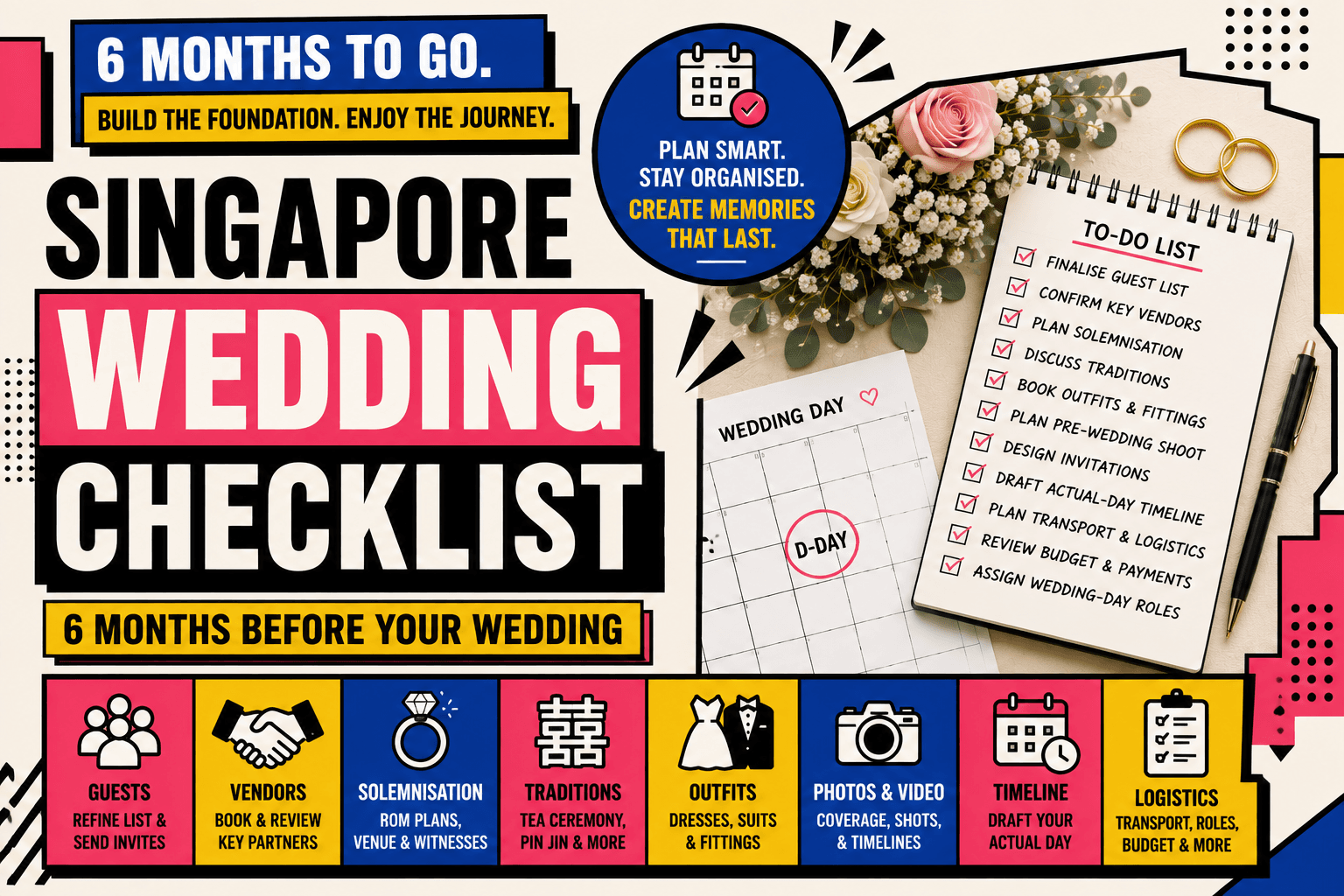
What should you do 6 months before your wedding?
Six months before your wedding is an important transition point.
Your biggest decisions should be taking shape, but you still have enough time to make thoughtful choices without treating everything as urgent.
At this stage, focus on:
- Filling important vendor gaps
- Reviewing your wedding budget
- Refining your guest list
- Planning your solemnisation
- Discussing family traditions
- Confirming wedding outfits
- Planning your pre-wedding shoot
- Preparing invitations
- Thinking through your wedding programme
- Starting the logistics behind your actual day
You do not need a minute-by-minute wedding schedule yet.
But you should increasingly understand what your wedding will actually look like.
For the complete planning journey, start with the Ultimate Singapore Wedding Planning Guide.
6 months before your wedding checklist at a glance
Use this as your six-month planning overview:
Wedding foundations
- Review wedding budget
- Review guest count
- Confirm venue arrangements
- Identify missing major vendors
Vendors
- Confirm photographer
- Confirm videographer
- Confirm makeup artist
- Confirm bridal boutique
- Confirm florist or decorator if required
- Research remaining vendors
ROM and traditions
- Review solemnisation plans
- Understand current marriage requirements
- Plan solemnisation venue
- Discuss Chinese wedding traditions if applicable
- Discuss tea ceremony arrangements
Attire and beauty
- Confirm wedding gown
- Confirm groom's attire
- Plan fittings
- Review accessories
- Discuss bridal hair and makeup looks
Guests and invitations
- Refine guest list
- Collect contact information
- Decide invitation format
- Start invitation design
Wedding-day planning
- Plan pre-wedding shoot
- Start banquet programme ideas
- Identify major wedding-day locations
- Consider transportation
- Start thinking about wedding-day roles
The objective is to enter the three-month mark with your major wedding structure already in place.
Review your wedding budget at the halfway point
Your original wedding budget was probably based partly on estimates.
By six months before the wedding, you should have more real numbers.
Review:
| Category | Budgeted | Committed | Paid | Remaining |
|---|---|---|---|---|
| Venue | ||||
| Photography | ||||
| Videography | ||||
| Bridal | ||||
| Groom's attire | ||||
| Hair and makeup | ||||
| Decor and florals | ||||
| Entertainment | ||||
| Transport | ||||
| Other expenses |
Pay attention to committed costs, not only amounts already paid.
A vendor may only have collected a deposit, but the remaining balance is still part of your wedding cost.
This review helps you decide how much flexibility remains for optional additions later.
Check whether your major wedding vendors are booked
By six months before your wedding, try to have your important limited-availability vendors secured.
Depending on your wedding, these may include:
- Venue
- Photographer
- Videographer
- Makeup artist
- Bridal boutique
- Florist
- Decorator
- Emcee
- Entertainment
- Photobooth
- Transport
Not every wedding needs every category.
Prioritise vendors based on how essential they are to your celebration and how difficult they would be to replace.
For every confirmed vendor, store:
- Contract
- Contact details
- Package
- Deposit information
- Remaining balance
- Service hours
- Deliverables
- Next appointment
- Important deadlines
Organisation now makes final confirmation much easier later.
Closer to your wedding, use the Wedding Vendor Confirmation Checklist.
Review your wedding venue arrangements
Your venue should already be booked for most weddings at this stage.
Now make sure you understand what the package actually includes.
Review:
- Venue spaces
- Table capacity
- Menu
- Drinks
- Solemnisation space
- Reception area
- Bridal room
- AV equipment
- Screens
- Microphones
- Stage
- Basic decorations
- Parking
- Vendor access
- Setup time
Ask what you need to provide separately.
For example, couples sometimes assume that signage, solemnisation decorations, AV equipment or reception styling are included when they are not.
Understanding your venue package prevents duplicate spending and last-minute surprises.
Refine your Singapore wedding guest list
Your guest list does not need to be completely final six months ahead.
It should, however, be becoming realistic.
Separate guests into useful groups:
- Immediate family
- Relatives
- Close friends
- School friends
- University friends
- Colleagues
- Parents' guests
- Children
- Plus-ones
Compare your estimated attendance against:
- Venue capacity
- Number of tables
- Catering commitments
- Budget
This is also the time to resolve major disagreements about guest numbers.
Adding guests affects much more than chairs.
It can affect tables, food, invitations, seating and the overall cost of the wedding.
Start collecting wedding guest information
Begin organising the information you will eventually need for invitations and RSVPs.
Useful fields include:
| Guest | Side | Contact | Invitation | RSVP |
|---|---|---|---|---|
You may also want to track:
- Plus-one
- Children
- Dietary needs
- Accessibility needs
- Table group
- Notes
If both sets of parents are inviting guests, ask them to provide their lists in the same format.
A structured guest database now will save considerable work when invitations are sent.
Start planning your wedding invitations
Decide how guests will receive your invitation.
Options may include:
- Printed invitations
- Digital invitations
- Wedding website
- WhatsApp invitation
- Combination of digital and printed formats
Think about what information guests will need:
- Couple's names
- Wedding date
- Venue
- Address
- Solemnisation details if applicable
- Reception time
- Banquet time
- Dress code if applicable
- RSVP instructions
- RSVP deadline
You do not necessarily need to send invitations six months ahead.
The objective now is to decide the format, gather information and begin any design or printing process that requires lead time.
Review your Singapore ROM and solemnisation plan
If you are planning a civil marriage in Singapore, understand the current process well before your wedding date.
Depending on your circumstances, this may involve:
- Marriage application
- Solemniser
- Witnesses
- Required declarations or verification
- Ceremony venue
- Ceremony timing
- Required documentation
Marriage procedures and eligibility requirements can change.
Always verify your current requirements through Singapore's official marriage guidance and your own application rather than relying solely on an old wedding checklist.
For the planning process, use the Singapore ROM & Solemnisation Guide.
Decide what your solemnisation will look like
Your solemnisation can be integrated into your wedding in different ways.
For example:
Separate solemnisation
The legal ceremony happens on another date.
Before your banquet
Guests attend the solemnisation before lunch or dinner.
Intimate ceremony
Only immediate family and close friends attend before the larger celebration.
Start deciding:
- Location
- Approximate guest count
- Ceremony style
- Seating
- Rings
- Personal vows if desired
- Photography
- Videography
- Indoor or outdoor setup
If you want an outdoor ceremony, include a wet-weather option from the beginning rather than treating it as an afterthought.
Discuss Chinese wedding traditions with both families
If your families plan to observe Chinese wedding customs, six months before the wedding is a good time to begin detailed discussions.
Depending on your families, topics may include:
- Guo Da Li
- Hui Li
- Pin jin
- Dowry
- An Chuang
- Hair combing ceremony
- Gatecrash
- Bride fetching
- Tea ceremony
- Auspicious dates or timings
Traditions can differ between families, generations and dialect groups.
Instead of searching for one universal checklist and assuming everyone follows it, ask both families:
Which traditions matter to us?
Who is responsible for preparing each item?
When does it need to happen?
Record the decisions so the same questions do not need to be settled repeatedly.
Start planning your wedding tea ceremony
If a tea ceremony is part of your wedding, decide its basic structure.
Think about:
- Bride's family
- Groom's family
- Ceremony location
- Whether there are one or two locations
- Family order
- Approximate number of participants
- Travel
- Tea set
- Person assisting with tea
You do not need the final sequence yet.
You do need to understand whether the tea ceremony requires 20 minutes or significantly longer.
This becomes important when you build your actual-day schedule later.
Confirm your wedding gown and bridal outfits
By six months before the wedding, your bridal attire should ideally be well underway.
Depending on your celebration, you may need:
- Wedding gown
- Solemnisation outfit
- Tea ceremony outfit
- Evening gown
- Shoes
- Veil
- Jewellery
- Hair accessories
Confirm:
- Selected outfits
- Fitting schedule
- Alterations
- Collection date
- Return arrangements
- Included accessories
If you plan several outfit changes, remember that each change consumes time on the wedding day.
More outfits do not automatically create a better wedding experience.
Choose the looks that matter most to you.
Confirm the groom's wedding attire
The groom's outfit deserves its own planning rather than becoming a final-week task.
Consider:
- Suit
- Shirt
- Trousers
- Tie or bow tie
- Shoes
- Belt
- Cufflinks
- Pocket square
- Socks
- Accessories
If tailoring is required, leave enough time for fittings and adjustments.
Try the complete outfit together rather than checking each item separately.
This is also useful for making sure the groom's attire works visually with the bride's outfits and the overall wedding style.
Review your bridal hair and makeup plans
If your makeup artist is already booked, start refining the look you want.
Collect references for:
- Makeup
- Hairstyle
- Hair accessories
- Veil
- Different looks for outfit changes
Choose references that are useful rather than creating an enormous inspiration folder.
Discuss what works with:
- Your features
- Your hair
- Your outfits
- Your wedding schedule
- Singapore's climate
- Your preferred level of maintenance
If a trial is included or planned, confirm when it should happen.
Plan your pre-wedding photoshoot
If you are having a pre-wedding shoot, six months before the wedding is a useful time to get it organised.
Decide:
- Photographer
- Videographer if applicable
- Shoot date
- Locations
- Outfits
- Hair and makeup
- Transport
- Props if relevant
- Wet-weather alternative
If you need the photographs for:
- Invitations
- Wedding website
- Welcome signage
- Guestbook
- Banquet slideshow
work backwards from the production deadlines.
Do not schedule your shoot so late that editing, selection and printing become rushed.
Start planning your wedding decorations and florals
Your visual direction should begin becoming concrete.
Think about the areas that matter most:
- Solemnisation
- Stage
- Reception
- Guest tables
- Welcome area
- Bridal bouquet
- Photo area
Before buying or booking anything, check what your venue already provides.
Then identify what your florist or decorator needs to add.
A simple approach is to prioritise areas where guests spend time and where important moments happen.
You do not need to decorate every empty surface.
A consistent wedding can feel intentional without being overloaded.
Start shaping your wedding banquet programme
You do not need exact timings yet.
Start deciding what you actually want guests to experience.
Possible elements include:
- First march-in
- Cake cutting
- Wedding video
- Second march-in
- Champagne or toast
- Speeches
- Performances
- Games
- Table photographs
- Couple thank-you
- Farewell
Separate activities into:
Must have
Moments that genuinely matter to you.
Nice to have
Activities you are happy to remove if the programme becomes too crowded.
This distinction becomes extremely useful when your actual-day timeline is built.
Start thinking about your actual-day wedding timeline
Six months before the wedding is too early for some exact timings, but not too early to understand the structure of the day.
Write down the major blocks.
For example:
- Hair and makeup
- Gatecrash
- Bride fetching
- Tea ceremony
- Travel
- Solemnisation
- Couple portraits
- Guest reception
- Banquet
You may immediately discover that your wedding contains more activities than you expected.
That is useful.
You now have several months to simplify or rearrange the schedule.
At three months, turn this outline into a proper first draft using the Singapore Actual-Day Wedding Timeline.
Map the major locations in your wedding day
Write down every location you may need to visit.
For example:
- Groom's home
- Bride's home
- Family home for tea ceremony
- Solemnisation venue
- Photography location
- Hotel
- Banquet venue
Then ask:
How many times are we travelling?
A wedding with several locations can create significant logistical pressure.
Each additional location introduces:
- Travel time
- Parking
- Loading
- Delays
- Transport coordination
- Possibility of leaving belongings behind
You do not need to eliminate meaningful traditions.
But understanding the geography of your wedding early helps you build a realistic schedule later.
Start planning wedding-day transport
Once you know your major locations, think about transport.
You may need vehicles for:
- Bride
- Groom
- Bridal party
- Parents
- Photographer
- Videographer
- Wedding belongings
Consider:
- Number of vehicles
- Drivers
- Passenger capacity
- Parking
- Space for gowns
- Elderly family members
- Equipment
- Travel buffer
You do not need the final vehicle assignment six months ahead.
You should know whether the wedding requires one simple transfer or a coordinated movement of several groups.
Review your wedding photography and videography coverage
Now that your wedding structure is clearer, check whether your booked coverage still makes sense.
Review:
- Coverage hours
- Number of photographers
- Number of videographers
- Morning start
- Solemnisation
- Tea ceremony
- Banquet
- Estimated end time
- Overtime terms
- Same-day edit if applicable
For example, an eight-hour package may sound generous until you realise your wedding begins with an early gatecrash and ends after a dinner banquet.
You do not necessarily need to extend anything now.
You need to understand the trade-offs before the final timeline is created.
Start identifying your wedding-day helpers
Think about the people who will help the wedding run.
Possible roles include:
- Maid of honour
- Best man
- Bridesmaids
- Groomsmen
- Siblings
- Family representatives
- Wedding coordinator
Do not assign every operational task yet.
Instead, identify who is:
- Organised
- Calm under pressure
- Comfortable talking to vendors
- Familiar with your families
- Good with guests
- Reliable with valuables
Later, these people may handle responsibilities such as rings, transport, reception, family coordination and the ang bao box.
Choosing the right person for each role is more important than distributing tasks evenly.
Review your wedding stationery, signage and small details
Start identifying physical items you may eventually need.
For example:
- Invitations
- Welcome sign
- Seating chart
- Table numbers
- Guestbook
- Solemnisation signage
- Directional signs
- Programme cards
- Ang bao box
Do not buy everything immediately.
First check what is:
- Provided by the venue
- Provided by your decorator
- Included in another package
- Actually necessary
Small wedding purchases can quietly become a large category when bought individually.
Keep one list instead of purchasing items whenever they appear on social media.
Build one wedding planning master document
By six months before the wedding, information may already be scattered across contracts, chats, screenshots and spreadsheets.
Start consolidating it.
Your wedding master document can include:
- Guest list
- Vendor list
- Budget
- Payment tracker
- Venue information
- ROM and solemnisation notes
- Family traditions
- Outfit appointments
- Programme
- Timeline
- Transport
- Wedding-day roles
- Important files
The exact tool matters less than having one reliable source of truth.
When both partners, families and vendors are working from different information, small misunderstandings become much harder to catch.
What should already be booked 6 months before your wedding?
There is no universal booking timeline because availability varies by wedding date, vendor and venue.
However, by six months before your wedding, it is useful to have most of the major limited-availability services secured.
Priorities often include:
- Venue
- Photographer
- Videographer
- Makeup artist
- Bridal attire
- Important ceremony requirements
- Florist or decorator if required
- Other vendors central to your programme
If one of your preferred vendors is unavailable, do not panic.
Focus on finding an option that:
- Fits your budget
- Can deliver what you need
- Communicates clearly
- Has availability
- Works with the rest of your wedding
Your wedding does not depend on securing every first-choice vendor.
What should you avoid doing 6 months before your wedding?
Six months can feel far away.
That can create two opposite problems.
Problem one: doing nothing
You assume there is plenty of time and postpone important decisions until everything becomes urgent.
Problem two: doing everything
You become anxious and try to finalise details that genuinely cannot be confirmed yet.
Avoid:
- Ignoring major vendor gaps
- Constantly changing your wedding concept
- Buying decorations without a plan
- Sending invitations before details are confirmed
- Creating an exact minute-by-minute timeline too early
- Leaving family traditions undiscussed
- Ignoring your committed wedding costs
Focus on decisions that unlock the next stage of planning.
Complete 6-month-before Singapore wedding checklist
Use this master checklist to track your progress.
Budget and venue
- Review committed spending
- Update remaining budget
- Review venue package
- Check venue inclusions
- Identify missing requirements
Vendors
- Confirm major vendors
- Store contracts
- Track deposits
- Record payment deadlines
- Review photography coverage
- Review videography coverage
Guests
- Refine guest list
- Collect contact details
- Estimate table requirements
- Decide invitation format
- Start invitation preparation
ROM and traditions
- Review solemnisation plan
- Check current marriage requirements
- Discuss family traditions
- Start tea ceremony planning
Attire and beauty
- Confirm bride's outfits
- Confirm groom's attire
- Schedule fittings
- Review accessories
- Review hair and makeup plans
Wedding experience
- Plan pre-wedding shoot
- Review decorations
- Draft banquet programme
- Identify important wedding-day locations
- Start transport planning
- Identify wedding-day helpers
Organisation
- Build master wedding document
- Organise vendor information
- Track upcoming appointments
- Track payment deadlines
Complete these well and your three-month planning stage becomes much easier.
What happens between 6 months and 3 months before your wedding?
The next stage is about turning your wedding structure into specific plans.
Between six and three months, you will gradually move from:
Guest estimates → invitations and RSVPs
Wedding-day ideas → a draft programme
Multiple locations → transport planning
Family traditions → actual ceremony arrangements
Vendor bookings → detailed deliverables
Wedding outfits → fittings and final looks
Solemnisation concept → ceremony plan
You do not need to rush all of this today.
Instead, keep moving each area forward so there are fewer unresolved decisions later.
When you reach your next milestone, continue with the Singapore Wedding Checklist: 3 Months Before Your Wedding.
Frequently asked questions about 6 months before a wedding
Is 6 months enough time to plan a wedding in Singapore?
It can be, especially if you are flexible about dates, venues and vendors. Popular options may have been booked earlier, so prioritise the major pieces first.
Should all my wedding vendors be booked 6 months before?
Ideally, your most important limited-availability vendors should already be secured or actively being finalised. Smaller or optional services may be booked later.
Should I send wedding invitations 6 months before?
Not necessarily. At this stage, focus on confirming your guest list, invitation format and information so you are ready when it is time to send them.
Should my wedding seating plan be ready?
No. Your guest list should be becoming realistic, but final seating is better handled after RSVPs provide a clearer attendance picture.
Do I need an actual-day timeline 6 months before?
You do not need exact timings. Create a high-level outline of the day so you understand the order of events, locations and likely logistical challenges.
What is the biggest priority 6 months before a wedding?
Make sure the foundations are stable. Your venue, major vendors, guest count, budget, solemnisation, outfits and family expectations should all be moving in a clear direction.
Six months to go: build the structure before the details
At six months, you do not need to know where every guest will sit or what happens at 7:42 PM on your wedding day.
You need a strong structure.
Know who you are inviting.
Know what you have booked.
Know what you can afford.
Know which traditions matter.
Know how you want to solemnise your marriage.
Know what you are wearing.
Know roughly how the wedding day flows.
Then build the details on top of that foundation.
When you reach three months to go, continue with the Singapore Wedding Checklist: 3 Months Before.
Later, move into the Singapore Wedding Checklist: 1 Month Before and the Wedding Week Checklist.
For your ceremony, use the Singapore ROM & Solemnisation Guide.
For your eventual schedule, use the Singapore Actual-Day Wedding Timeline.
And keep the Ultimate Singapore Wedding Planning Guide as your roadmap throughout the entire process.
Six months is close enough to get organised.
And far enough away to do it without rushing.