
Blog
Singapore Wedding Checklist: 3 Months Before Your Wedding
August 29, 2026 · Updated August 29, 2026
Three months to your wedding? Use this Singapore wedding checklist to organise invitations, guests, outfits, vendors, solemnisation, traditions, timelines and actual-day logistics.
What should you do 3 months before your wedding?
Three months before your wedding is when your plans should start becoming much more specific.
The big pieces are hopefully already in place.
You may already have your:
- Wedding date
- Venue
- Photographer
- Videographer
- Bridal outfits
- Makeup artist
- Major vendors
Now you need to connect those pieces.
During the next three months, your focus should shift towards guests, invitations, solemnisation arrangements, family traditions, your programme and the first proper version of your actual-day timeline.
This is also a useful checkpoint.
If an important vendor or decision is still missing, you have time to address it before your final month becomes busy.
For the complete planning journey, start with the Ultimate Singapore Wedding Planning Guide.
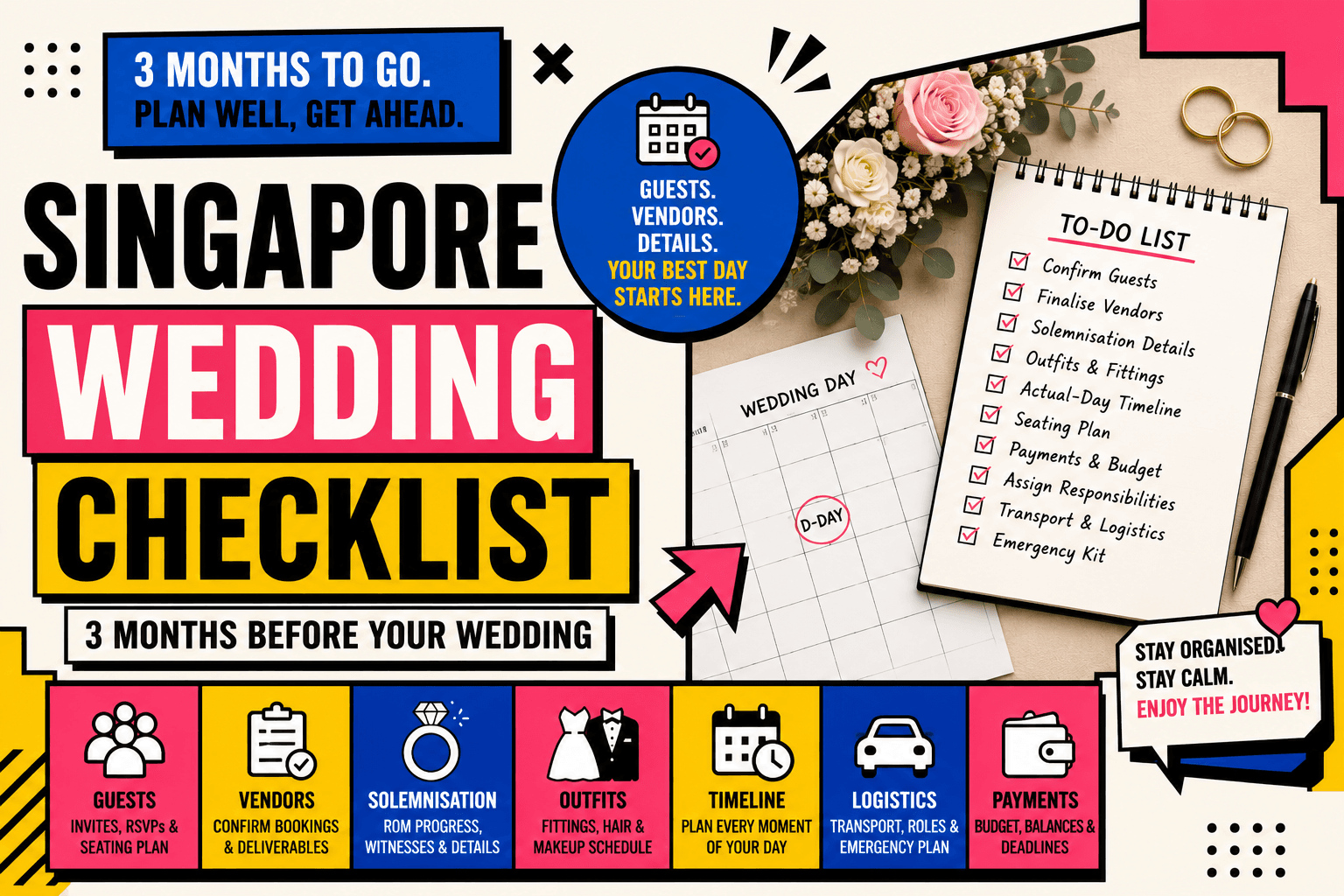
3 months before your wedding checklist at a glance
Here are the major tasks to work through:
- Review your wedding budget
- Review all vendor bookings
- Send or finalise wedding invitations
- Start tracking RSVPs
- Update your guest list
- Begin grouping guests for seating
- Review your ROM and solemnisation progress
- Confirm your solemniser arrangements
- Confirm your witnesses
- Discuss Chinese wedding traditions if applicable
- Plan your tea ceremony
- Plan your gatecrash if applicable
- Confirm wedding outfits
- Schedule remaining fittings
- Confirm hair and makeup plans
- Start planning your banquet programme
- Draft your actual-day timeline
- Plan wedding transport
- Review photography and videography plans
- Review wedding decorations and styling
- Start planning wedding-day responsibilities
- Review vendor payments
- Identify anything still missing
Your goal is not to finish the entire wedding today.
Your goal is to enter the final month with the major decisions already made.
Review your wedding budget before the final spending begins
Three months out is a good time to compare your original wedding budget with what you have actually committed to.
Review:
- Venue
- Photography
- Videography
- Bridal outfits
- Groom's attire
- Hair and makeup
- Florals
- Decorations
- Entertainment
- Transport
- Solemnisation
- Wedding stationery
- Gifts
- Miscellaneous expenses
Separate expenses into:
Already paid
Money that has left your account.
Committed
Amounts you have contractually agreed to pay.
Estimated
Expenses you expect but have not confirmed.
This gives you a more realistic picture than simply looking at your bank balance.
It also helps you decide whether optional additions during the final months genuinely fit your budget.
Review every wedding vendor booking
You do not need to perform your final vendor confirmation yet.
Instead, check whether every important part of the wedding has someone responsible for it.
Review vendors such as:
- Venue
- Photographer
- Videographer
- Makeup artist
- Bridal boutique
- Florist
- Decorator
- Emcee
- Entertainment
- Photobooth
- Transport
- Wedding cake if applicable
For each vendor, check:
- Contract signed
- Deposit paid
- Package selected
- Deliverables understood
- Service hours understood
- Outstanding decisions
- Next payment date
- Next appointment
If something important is still unbooked, prioritise it now rather than carrying the uncertainty into your final month.
Closer to your wedding, use the Wedding Vendor Confirmation Checklist for your final checks.
Finalise and send your wedding invitations
By this stage, your invitation process should be moving.
Depending on your wedding, you may be using:
- Printed invitations
- Digital invitations
- Wedding website
- Personal messages
- A combination of these
Before sending invitations, check:
- Couple's names
- Wedding date
- Day of the week
- Venue name
- Venue address
- Solemnisation time if guests are invited
- Reception time
- Banquet time
- Dress code if applicable
- RSVP deadline
- RSVP method
Ask someone else to proofread the final version.
A fresh pair of eyes can catch mistakes you have stopped noticing.
Start tracking your wedding RSVPs properly
Once invitations go out, guest management becomes an active part of wedding planning.
Create one master guest list.
Useful columns include:
| Guest | Side | RSVP | Table Group | Dietary Needs |
|---|---|---|---|---|
You can also track:
- Plus-one
- Children
- Contact details
- Accessibility needs
- Invitation sent
- Notes
Avoid maintaining separate versions between the couple and both families.
There should eventually be one reliable source of truth.
Your final RSVP information will feed directly into your seating plan one month before the wedding.
Start grouping guests for your wedding seating plan
You do not need to assign every guest to a numbered table yet.
Start with groups.
For example:
- Bride's immediate family
- Groom's immediate family
- Bride's relatives
- Groom's relatives
- University friends
- Secondary school friends
- Work friends
- Parents' friends
- Children
This gives you an early picture of how your tables may work.
It can also reveal awkward numbers.
For example, you may discover that one friend group is too large for one table but too small for two.
You have plenty of time to solve that now.
Closer to the wedding, use the Singapore Wedding Seating Plan Guide to build your final arrangement.
Review your Singapore ROM and solemnisation progress
If you are having a civil marriage, make sure you understand where you are in the marriage process.
Depending on your circumstances and wedding date, you may need to review:
- Marriage application
- Solemniser
- Witnesses
- Required declarations or verification
- Solemnisation venue
- Ceremony time
- Required documents
Do not rely solely on an old wedding checklist for legal requirements.
Singapore's marriage procedures and digital processes can change, so always check your own application and current official guidance.
For the planning side, use the Singapore ROM & Solemnisation Guide.
Plan the details of your solemnisation ceremony
Once the administrative process is understood, think about what the ceremony itself will look like.
Decide:
- Venue
- Guest count
- Seating
- Couple's entrance
- Witnesses
- Rings
- Personal vows if applicable
- Ceremony music
- Microphones
- Photography
- Videography
- Family photographs afterwards
If the solemnisation is outdoors, establish a realistic wet-weather alternative.
Also decide whether your solemnisation happens:
- On a separate day
- Before your lunch banquet
- Before your dinner banquet
- As part of another wedding programme
That decision affects the entire actual-day timeline.
Discuss Chinese wedding traditions with both families
If your families are observing Chinese wedding traditions, clarify expectations before the final month.
Depending on your families, discussions may include:
- Guo Da Li
- Hui Li
- Pin jin
- Dowry
- An Chuang
- Hair combing ceremony
- Gatecrash
- Bride fetching
- Tea ceremony
- Auspicious timings
Not every family follows every tradition.
Practices can also differ between dialect groups, families and generations.
Instead of assuming there is one universal "correct" wedding process, ask both families which traditions matter to them.
Write down what has actually been agreed.
This helps prevent conflicting instructions close to the wedding.
Plan your wedding tea ceremony
If you are having a tea ceremony, start working out the logistics.
Confirm:
- Which families are participating
- Where each ceremony happens
- Approximate timing
- Travel between locations
- Family order
- Tea set
- Tea preparation
- Who will assist
- Where family members will sit
If ceremonies are happening at two family homes, include travel time when building your wedding schedule.
Large families may also require significantly more time than a small ceremony.
The tea ceremony should be treated as a proper part of the timeline rather than something squeezed between other activities.
Plan your gatecrash without letting it take over the morning
If you are having a gatecrash, start discussing it with your bridal party.
Decide:
- Who is participating
- Location
- Approximate start time
- Duration
- Number of games
- Props required
- Cleanup
- Photography and videography considerations
You do not need every game finalised immediately.
But you should know how much time the gatecrash is allowed to occupy.
A 30-minute activity and a 90-minute activity create very different wedding schedules.
Set boundaries early so the rest of your wedding morning remains realistic.
Confirm your wedding outfits and fitting schedule
Review everything the bride and groom intend to wear.
For the bride, this may include:
- Wedding gown
- Solemnisation outfit
- Tea ceremony outfit
- Evening gown
- Shoes
- Veil
- Jewellery
- Hair accessories
For the groom:
- Suit
- Shirts
- Trousers
- Shoes
- Tie or bow tie
- Belt
- Cufflinks
- Other accessories
Confirm any remaining fitting, alteration, collection and return dates.
If you have several outfit changes, start thinking about where those changes happen and how much time they require.
They will eventually need to be included in your actual-day timeline.
Confirm your hair and makeup plan
Review your booking with your makeup artist.
Check:
- Wedding date
- Preparation location
- Number of people receiving services
- Bride's looks
- Hair requirements
- Touch-up arrangements
- Second-look arrangements if applicable
- Estimated preparation time
The exact wedding-day start time may depend on your final schedule.
However, you should already understand approximately how long preparation will take.
This matters because your makeup start time can determine how early your entire wedding morning begins.
Start planning your wedding banquet programme
You do not need a minute-by-minute banquet schedule yet.
Start by deciding what you actually want to include.
Possible programme items include:
- First march-in
- Cake cutting
- Childhood montage
- Pre-wedding video
- Second march-in
- Champagne or toast
- Speeches
- Table photographs
- Performances
- Games
- Couple thank-you
- Farewell
Ask whether each item contributes something meaningful.
The more activities you add, the less flexibility your banquet has.
Once the structure is clear, your venue and emcee can help turn it into a workable programme.
Draft your Singapore actual-day wedding timeline
Three months before the wedding is a good time to create your first detailed timeline.
Start with the major events:
| Activity | Estimated Time |
|---|---|
| Hair and makeup | |
| Gatecrash | |
| Bride fetching | |
| Tea ceremony | |
| Travel | |
| Solemnisation | |
| Couple portraits | |
| Reception | |
| Banquet |
Do not worry about getting every minute correct yet.
Your first draft is supposed to reveal how the pieces fit together.
As vendors confirm their requirements, refine it.
By one month before your wedding, the schedule should be much closer to final.
Use the Singapore Actual-Day Wedding Timeline for examples and a complete template.
Start planning your wedding transportation
Think about how everyone and everything moves between locations.
Depending on your wedding, you may need transport for:
- Groom
- Bride
- Bridal party
- Parents
- Photographer
- Videographer
- Wedding belongings
Map the major journeys.
For example:
Groom's home → bride's home → tea ceremony → solemnisation → banquet venue
Consider:
- Number of vehicles
- Drivers
- Parking
- Travel time
- Buffer
- Space for wedding outfits
- Elderly family members
- Equipment
You do not need every passenger assigned yet.
But you should know whether your transport plan is realistic.
Review your wedding photography and videography plans
Three months out is a good time to revisit what you actually booked.
Check:
- Number of coverage hours
- Number of photographers or videographers
- Start time assumptions
- End time assumptions
- Same-day edit if applicable
- Pre-wedding deliverables if applicable
- Overtime terms
Start telling your team about important moments such as:
- Gatecrash
- Tea ceremony
- Solemnisation
- Personal vows
- Surprise performances
- Family traditions
- Private gift exchanges
Your detailed shot and family-photo planning can happen later.
For now, make sure the coverage you booked fits the wedding you are actually planning.
Review your wedding decorations, florals and styling
By now, your visual direction should be fairly clear.
Review:
- Stage
- Solemnisation setup
- Reception table
- Welcome sign
- Florals
- Table styling
- Photo area
- Signage
- Bridal bouquet
- Boutonnieres
- Car decorations if applicable
Confirm what is provided by:
- Venue
- Decorator
- Florist
- Bridal boutique
- Couple
This avoids paying twice for similar items or discovering that everyone assumed someone else was providing something.
Focus on the areas guests will actually experience rather than adding decorations simply because there is still empty space.
Start preparing your wedding speeches, vows and media
You do not need polished speeches three months ahead.
You should, however, start collecting ideas.
Possible items include:
- Personal vows
- Couple thank-you speech
- Parent speeches
- Emcee script
- Childhood montage
- Pre-wedding video
- Entrance music
- Solemnisation music
For speeches and vows, write down meaningful stories as you remember them.
For videos, determine who is producing them and when they need to be completed.
For music, create a shortlist rather than waiting until the final week to search for every track.
Review your wedding vendor payments and upcoming deadlines
Three months before the wedding is a useful financial checkpoint.
Review each contract for:
- Remaining balance
- Payment deadline
- Security deposit
- Refundable deposit
- Additional charges
- Overtime rates
- Final confirmation deadline
Create a tracker:
| Vendor | Next Payment | Due Date | Final Details Due |
|---|---|---|---|
This prevents several large balances from unexpectedly appearing during your final wedding week.
It also helps you understand how much of your remaining wedding budget is genuinely available.
Start deciding who will help on your wedding day
You do not need to assign every tiny responsibility yet.
Start identifying the people you trust to handle important areas.
Possible roles include:
- Maid of honour
- Best man
- Main wedding coordinator
- Family coordinator
- Vendor contact
- Reception lead
- Ang bao box custodian
- Transport coordinator
- Ring holder
Think about people's personalities when assigning roles.
The friend who gives an amazing speech may not be the person you want managing a detailed vendor schedule.
By one month before your wedding, each important responsibility should have a specific owner.
Plan how your wedding ang baos and gifts will be handled
You do not need to prepare the physical ang bao box yet, but you should know how reception will work.
Think about:
- Reception location
- Number of reception helpers
- Ang bao box
- Person responsible for it
- Backup person
- Physical gifts
- Secure storage
- End-of-night handover
Avoid making the bride or groom responsible for managing the box during the celebration.
Closer to your wedding, use the Wedding Ang Bao Box & Gift Handling Guide to create the full process.
Check what is still missing from your wedding plan
At three months, do a deliberate gap check.
Ask:
Guests
Are invitations and RSVPs under control?
Venue
Are the main arrangements confirmed?
Vendors
Is every important role covered?
ROM
Do we understand the remaining marriage requirements?
Traditions
Have both families agreed on what we are doing?
Outfits
Is everything ordered and scheduled?
Programme
Do we know what the wedding roughly looks like?
Timeline
Can all of this realistically fit into one day?
Logistics
Can everyone and everything get where they need to go?
Any major "we haven't thought about that yet" answer becomes a priority for the next few weeks.
What should already be booked 3 months before your wedding?
For most weddings, the major limited-availability vendors should ideally be settled well before the three-month mark.
Depending on your celebration, this may include:
- Wedding venue
- Photographer
- Videographer
- Makeup artist
- Bridal boutique
- Florist or decorator
- Emcee
- Entertainment
- Transport
That does not mean your wedding is doomed if something is still missing.
It simply means you should prioritise essential gaps before optional additions.
At this stage, reliability matters more than endlessly searching for the theoretically perfect option.
What should you avoid doing 3 months before your wedding?
Avoid creating unnecessary work for your future selves.
Be cautious about:
- Changing your wedding concept without a strong reason
- Replacing vendors impulsively
- Adding too many programme segments
- Expanding your guest list without checking capacity
- Starting ambitious DIY projects
- Buying decorations without checking what the venue provides
- Leaving family discussions unresolved
- Ignoring payment deadlines
- Waiting until the final month to create your timeline
Three months may sound like a long time.
Once invitations, RSVPs, fittings, family discussions and vendor appointments begin happening simultaneously, it can move quickly.
Use this period to reduce uncertainty.
Complete 3-month-before Singapore wedding checklist
Use this master checklist to track your progress.
Guests
- Finalise invitations
- Send invitations
- Track RSVPs
- Update guest list
- Collect important guest requirements
- Start grouping guests for seating
Vendors and finances
- Review every vendor booking
- Check contracts
- Review deliverables
- Review coverage hours
- Check payment deadlines
- Identify missing vendors
ROM and traditions
- Review marriage application progress
- Confirm solemniser arrangements
- Confirm witnesses
- Plan solemnisation
- Discuss family traditions
- Plan tea ceremony
- Plan gatecrash if applicable
Outfits and styling
- Review bride's outfits
- Review groom's outfits
- Confirm fittings
- Confirm hair and makeup plan
- Review florals and decorations
Programme
- Draft banquet programme
- Start vows
- Start speeches
- Plan wedding videos
- Shortlist music
Actual-day planning
- Draft timeline
- Plan transport
- Review photography coverage
- Review videography coverage
- Identify wedding-day helpers
- Start reception and ang bao planning
If most of these are under control, you are in a strong position for your final month.
What happens between 3 months and 1 month before your wedding?
During the next two months, broad plans become final details.
Your guest list becomes confirmed attendance.
Guest groups become a seating plan.
Your rough schedule becomes an actual-day timeline.
Your vendor bookings become confirmed logistics.
Your solemnisation plan becomes a ceremony.
Your wedding outfits reach their final fittings.
Your bridal party becomes an actual-day support team.
The goal is to avoid carrying major unresolved decisions into the final month.
When you reach one month to go, continue with the Singapore Wedding Checklist: 1 Month Before Your Wedding.
Frequently asked questions about 3 months before a wedding
Is 3 months enough time to finish planning a wedding?
If your major venue and vendors are already booked, three months gives you meaningful time to organise guests, ceremony details, outfits, programme and logistics. Starting an entire wedding from scratch in this period may require more flexibility.
Should wedding invitations be sent by 3 months before?
Your invitation and RSVP process should be actively underway with enough time for guests to respond before final venue and seating deadlines.
Should I have a seating plan 3 months before my wedding?
You do not need a final table arrangement yet. Start grouping guests so the final seating plan becomes easier once RSVPs arrive.
Should my wedding timeline be finished 3 months before?
Create a detailed first draft now. It can be refined as vendor timings and guest arrangements become clearer.
What should I prioritise if I am behind?
Prioritise anything that affects whether the wedding can operate: venue, essential vendors, marriage requirements, guests, outfits and major logistics.
What comes after the 3-month checklist?
Your next major planning checkpoint is the 1-Month-Before Singapore Wedding Checklist, followed by the Wedding Week Checklist.
Three months to go: turn your wedding ideas into a real plan
At this stage, your wedding should stop feeling like a collection of separate bookings.
The pieces need to start working together.
Your guests affect your seating.
Your traditions affect your timeline.
Your outfits affect your preparation schedule.
Your solemnisation affects your programme.
Your vendors affect your logistics.
And your timeline connects everything.
Use the Singapore Actual-Day Wedding Timeline to begin building the day.
Review the Singapore ROM & Solemnisation Guide for your ceremony planning.
Start organising guests with the Singapore Wedding Seating Plan Guide.
Then continue to the Singapore Wedding Checklist: 1 Month Before when you reach your next milestone.
You still have time.
Use it to make the final month easier.