
Blog
Singapore ROM & Solemnisation Guide: How to Get Married in Singapore
August 29, 2026 · Updated August 29, 2026
Planning your solemnisation? This Singapore ROM guide covers the civil marriage process, solemniser, witnesses, application timeline and actual-day planning.
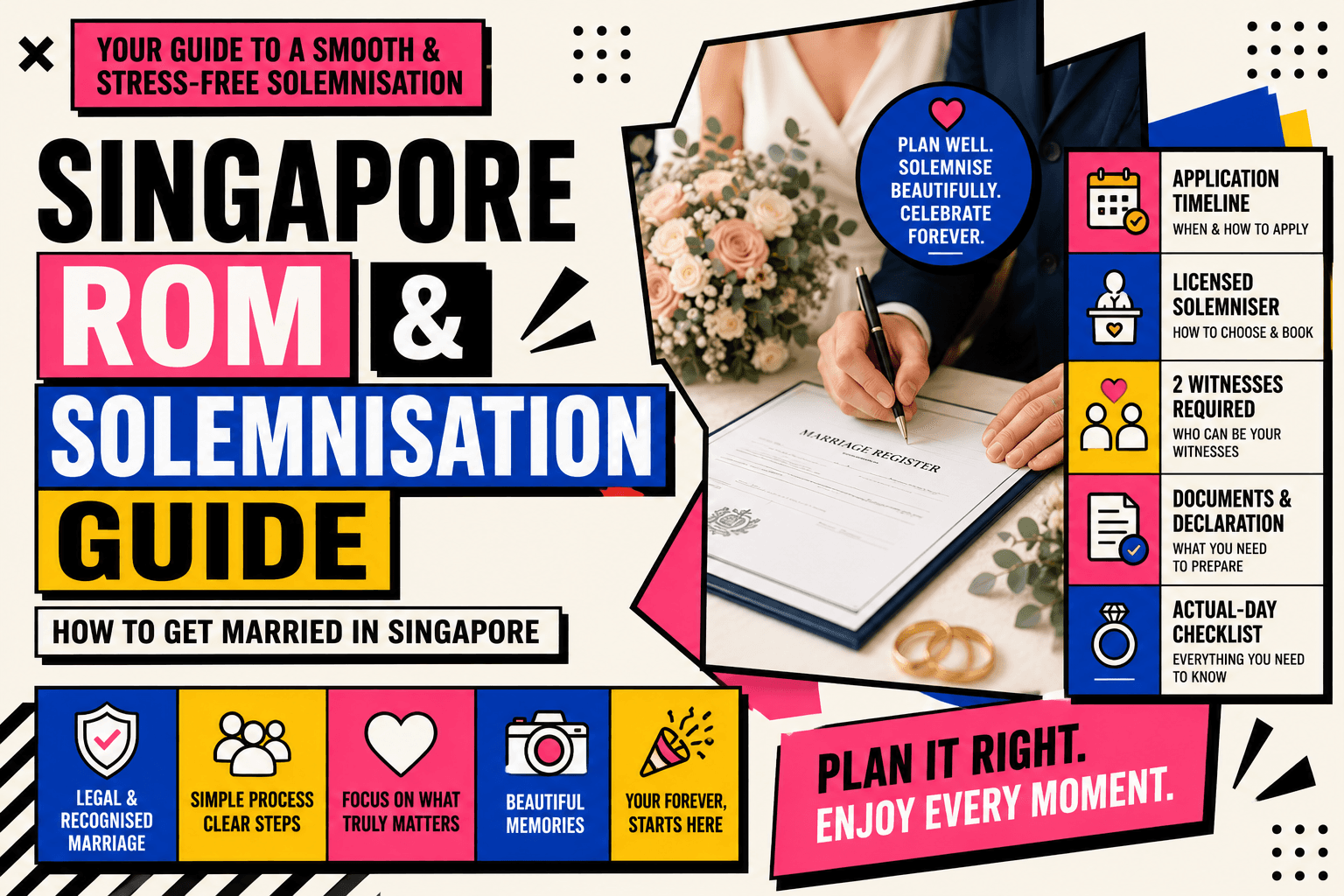
How do you get legally married in Singapore?
For many couples, wedding planning involves two things happening at the same time: planning the celebration and completing the legal marriage process.
Your banquet, photography, flowers and wedding outfits form the celebration, while your solemnisation is the ceremony through which your marriage is legally registered.
For a standard civil marriage in Singapore, the process generally involves:
- Confirming that you meet the marriage requirements
- Choosing your solemnisation date, time and venue
- Choosing two witnesses
- Booking a licensed solemniser
- Submitting your marriage application
- Completing the required declaration and document verification
- Attending your solemnisation
- Receiving your digital marriage certificate after the marriage is registered
This guide focuses primarily on the civil marriage process through the Registry of Marriages (ROM).
Muslim marriages follow a separate process through the Registry of Muslim Marriages (ROMM), so couples following that process should refer directly to the official Our Marriage Journey portal.
Government procedures can change. Always verify the latest requirements on the official Singapore marriage portal before submitting your application.
For everything beyond your solemnisation, use the Ultimate Singapore Wedding Planning Guide.
Singapore ROM process at a glance
For a typical civil marriage, your planning journey can be organised like this:
- Check that you meet the marriage requirements
- Decide your solemnisation date
- Decide your solemnisation venue
- Choose two witnesses
- Find a licensed solemniser
- Prepare the information required for your marriage application
- Submit your marriage application within the permitted period
- Complete your declaration and document verification
- Confirm your solemnisation arrangements
- Prepare your wedding rings if exchanging them
- Prepare your vows if having personalised vows
- Confirm your witnesses
- Confirm your solemniser
- Attend your solemnisation
- Complete the marriage ceremony
- Receive your digital marriage certificate after registration
Treat the legal process and the ceremony-planning process as two connected checklists.
That makes it much harder to forget an important administrative step while planning the celebration.
What is ROM in Singapore?
ROM stands for the Registry of Marriages.
It administers civil marriages in Singapore.
Couples planning a civil marriage should use Singapore's official Our Marriage Journey portal for the current marriage process, requirements and application services.
Do not rely entirely on wedding blogs, old forum discussions or advice from couples who married several years ago.
Wedding inspiration can remain relevant for years. Government procedures can change.
What is a solemnisation?
Your solemnisation is the marriage ceremony where your marriage is formally solemnised by an authorised solemniser.
Depending on your plans, it might be:
- A simple ROM ceremony
- A ceremony at home
- A hotel solemnisation
- An outdoor solemnisation
- A ceremony immediately before your banquet
- A separate celebration held on another date
Some couples hold their solemnisation and wedding banquet on the same day.
Others legally marry first and hold their larger wedding celebration later.
There is no need to make your solemnisation elaborate simply because you are planning a larger wedding.
Choose a format that fits your priorities.
What are the basic requirements for a civil marriage in Singapore?
The standard civil marriage process generally applies where both parties meet the applicable age requirements and at least one party is non-Muslim.
Important requirements include:
- Neither party can currently be married to another person
- Any previous marriage must have been legally dissolved
- The parties cannot fall within prohibited degrees of relationship
- At least one party must be non-Muslim for the civil marriage process
- Applicable age and consent requirements must be satisfied
Additional requirements can apply depending on circumstances such as:
- Either party being below 21
- Foreign nationality
- Current or previous Work Permit status
- Previous marriages
- Immigration status
Do not assume the standard process applies to every couple.
Check your circumstances directly through Our Marriage Journey before making your plans.
How early can you submit a marriage application in Singapore?
For the standard civil marriage process, marriage applications can currently be submitted up to six months before the intended solemnisation date.
There is also a legally required notice period.
Your marriage application must currently be submitted at least 21 days before your intended solemnisation date.
That means you should not treat the marriage application as something to complete during your final wedding week.
Build it into your planning timeline much earlier.
Check the latest permitted application period directly on Our Marriage Journey before submitting because official requirements may change.
When should you book your solemniser?
If you are having a solemnisation outside ROM, finding your solemniser should be treated as an important wedding-planning task.
Current official guidance indicates that couples may approach a solemniser around three to six months before the solemnisation date.
Popular wedding dates can naturally create greater demand.
Once you know your intended date, begin checking the current process and availability rather than leaving your solemniser until the final weeks.
Use the official list and current process available through Our Marriage Journey.
What does a licensed solemniser do?
A licensed solemniser conducts your civil marriage ceremony and facilitates the legal solemnisation of your marriage.
For your wedding planning purposes, your solemniser is therefore not simply another wedding vendor.
Their role is connected to the legal marriage process.
Confirm:
- Availability
- Date
- Ceremony time
- Venue
- Arrival expectations
- Ceremony arrangements
- Required documentation
- Witness arrangements
- Any instructions they provide
Follow your solemniser's instructions carefully and make sure your coordinator knows when the solemniser is expected to arrive.
How do you choose a solemniser in Singapore?
Start with the official list of licensed solemnisers available through the Singapore marriage portal.
Once you identify someone suitable:
- Check whether they are available.
- Contact them according to the current official process.
- Confirm your intended date, time and location.
- Complete the required invitation or booking process.
- Make sure their acceptance is properly reflected where required.
Do not assume an informal conversation means every administrative step has been completed.
Follow the current instructions shown in your marriage application process.
Choose your solemnisation date before building the ceremony
Your solemnisation date affects several other decisions.
Before confirming it, consider:
- Venue availability
- Solemniser availability
- Wedding banquet date
- Family availability
- Photographer availability
- Videographer availability
- Guest availability
- Your overall wedding timeline
If the solemnisation and banquet happen on the same day, the ceremony becomes one of the fixed points around which your Singapore Actual-Day Wedding Timeline should be built.
Where can you hold your solemnisation in Singapore?
Your solemnisation does not necessarily need to look like a traditional ballroom ceremony.
Depending on the applicable arrangements and approvals, couples may choose settings such as:
- ROM
- Hotel
- Restaurant
- Wedding venue
- Home
- Private event space
- Suitable outdoor location
Before choosing an offsite venue, consider:
- Seating
- Weather
- Accessibility
- Privacy
- Sound
- Photography
- Videography
- Guest capacity
- Solemniser requirements
- Wet-weather backup
If your ceremony is outdoors, have a realistic rain plan.
Singapore weather should never be treated as a minor detail in an outdoor wedding.
Should you solemnise at ROM or at your wedding venue?
Both can work.
The right choice depends on the wedding you want.
Solemnisation at ROM
May suit couples who want the legal ceremony to remain simple and separate from their larger celebration.
Solemnisation at your wedding venue
Can allow your guests to witness the ceremony immediately before another part of your wedding programme.
Consider:
| Question | Think About |
|---|---|
| Guest count | Who do you want present? |
| Atmosphere | Intimate or part of the larger celebration? |
| Logistics | Will another location create extra travel? |
| Timeline | How does the ceremony fit into the day? |
| Photography | Do you want the ceremony documented? |
| Weather | Is the ceremony outdoors? |
| Family | Who needs to attend? |
Choose based on your wedding plans rather than what other couples appear to be doing.
Who can be your witnesses for a civil marriage?
You need two witnesses for your civil solemnisation.
Choose them early and make sure they understand that they are not simply ceremonial guests.
Their information is required as part of the marriage process and they need to be present for the solemnisation.
Couples commonly choose:
- Parents
- Siblings
- Close relatives
- Close friends
Confirm your witnesses before submitting information that requires their particulars.
Also remind them again during your final wedding confirmations.
What information should you prepare for your marriage application?
The exact information and documents required depend on your circumstances.
For a typical application, be prepared to provide information relating to:
- Bride
- Groom
- Two witnesses
- Solemnisation date
- Solemnisation time
- Solemnisation venue
- Solemniser
Additional documentation may be required for particular circumstances.
Before starting your application, use the preparation checklist shown by the official Our Marriage Journey portal for your specific marriage process.
Preparing everything first can make the application much smoother.
What if one or both people getting married are foreigners?
Additional requirements can apply where one or both parties are foreigners.
Current official guidance includes physical-presence requirements in Singapore for certain applications involving foreigners.
The exact requirements depend on the couple's circumstances, so do not rely on a general wedding checklist to determine your eligibility.
Other documentation or requirements may also apply depending on immigration and employment circumstances.
Check the current foreigner requirements directly through Our Marriage Journey before making travel or solemnisation arrangements.
What if one person is a current or former Work Permit holder?
Special requirements may apply where current or former Work Permit holders are involved.
If this applies to your relationship, verify the current requirements directly with the relevant Singapore authorities before making assumptions about your application timeline.
This is one reason couples should check marriage eligibility early rather than waiting until the final month.
Use the eligibility guidance provided through Our Marriage Journey for the latest requirements relevant to your circumstances.
What happens after you submit your marriage application?
Submitting the application is not necessarily the final administrative step before your wedding.
For the standard civil marriage process, couples must complete the required verification and declaration before solemnisation.
The exact process depends on your eligibility and circumstances.
Your marriage application will indicate what applies to you.
Follow the instructions and deadlines provided by ROM rather than assuming your process will be identical to another couple's.
Can the ROM declaration be completed online?
Some couples may be eligible to complete parts of the verification and declaration process online.
Eligibility depends on your circumstances and the current ROM process.
If offered an online option, follow the instructions and complete every required step by the stated deadline.
Do not assume you qualify simply because another couple completed their process online.
Always use the instructions displayed in your own marriage application.
What should you confirm with your solemniser before the wedding?
As your wedding approaches, reconfirm:
- Wedding date
- Ceremony time
- Venue
- Exact ceremony location
- Solemniser arrival time
- Witnesses
- Required documents
- Ceremony format
- Any instructions from the solemniser
- Main actual-day contact
- Parking or access information if relevant
Add your solemniser to your Wedding Vendor Confirmation Checklist, while remembering that their legal role is different from that of a normal wedding vendor.
How long should you allocate for your solemnisation?
Do not schedule your wedding timeline so tightly that the next activity begins immediately after your ceremony.
Your solemnisation block may need to include:
- Guest seating
- Solemniser arrival
- Final preparation
- Ceremony
- Required formalities
- Ring exchange
- Vows if included
- Photography
- Family congratulations
- Group photographs
Your actual ceremony may be relatively short, but the entire programme surrounding it takes longer.
Build buffer into the schedule.
Sample solemnisation timeline before a dinner banquet
Here is an example structure:
| Time | Activity |
|---|---|
| 4:15 PM | Couple prepares |
| 4:30 PM | Solemnisation setup checked |
| 4:45 PM | Witnesses arrive |
| 5:00 PM | Solemniser arrival window |
| 5:10 PM | Guests begin taking seats |
| 5:30 PM | Solemnisation begins |
| 5:50 PM | Ceremony concludes |
| 5:55 PM | Family photographs |
| 6:15 PM | Couple portraits / short break |
| 6:30 PM | Evening reception continues |
This is an illustrative planning example, not an official ROM schedule.
Your actual timing should follow your solemniser, venue and wedding arrangements.
Use the Singapore Actual-Day Wedding Timeline to build the rest of your day around it.
What should be prepared at the solemnisation table?
Keep the setup clean and functional.
Depending on your ceremony, you may need space for:
- Required ceremonial materials
- Wedding rings
- Vow cards
- Pens where required
- Floral arrangement
- Microphones
- Water
- Small personal items
Your solemniser may provide specific instructions about what needs to be available.
Follow those instructions first.
Decoration should never make the practical parts of the ceremony harder.
Who should be responsible for the wedding rings?
Assign one person.
Do not simply say:
"The rings are with the bridal party."
Choose a specific person such as:
- Best man
- Maid of honour
- Sibling
- Trusted family member
- Ring bearer with appropriate supervision where needed
Before the ceremony, confirm:
- Both rings are present
- Ring box is present
- Responsible person knows when they are needed
This responsibility should also appear on your Singapore Wedding Day Checklist.
Do you need wedding rings for your solemnisation?
Wedding rings are a meaningful part of many solemnisation ceremonies, but couples should distinguish ceremonial traditions from legal requirements.
If you plan to exchange rings, prepare them and assign someone to keep them safe.
For the current legal requirements of your marriage ceremony, follow the instructions provided by ROM and your solemniser.
Do not assume something is legally required simply because it commonly appears in wedding ceremonies.
Should you write your own solemnisation vows?
Some couples choose to include personal vows as part of their ceremony.
If you do, keep them manageable.
A useful personal vow might include:
- What you appreciate about your partner
- What your relationship means to you
- A meaningful shared memory
- What you hope to build together
- A few promises for married life
Avoid turning your vows into a long biography of your relationship.
If personalised vows form part of your ceremony, check the format with your solemniser beforehand.
Should you print your wedding vows?
Yes, if you are using personalised vows.
Even if you memorise them, keep a backup.
Possible formats include:
- Vow cards
- Small vow book
- Printed sheet
- Secure digital backup
Do not rely entirely on a phone.
A phone can lock, run out of battery, display notifications or simply be left somewhere else.
Your vow card can also become a meaningful wedding keepsake afterwards.
Do you need microphones for a solemnisation?
For a very small ceremony, amplification may not be necessary.
For larger ceremonies, microphones can help guests hear:
- Solemniser
- Couple
- Personal vows
- Important announcements
Confirm with your venue:
- Number of microphones
- Microphone stands
- Speaker system
- Soundcheck
- Backup microphone
- Person controlling audio
If the ceremony is outdoors, test the sound in the actual environment where possible.
Wind and surrounding noise can make speech much harder to hear than expected.
What music do you need for a solemnisation?
Music is optional, but common moments include:
- Guest arrival
- Processional
- Bride's entrance
- Ceremony transition
- Recessional
- Post-ceremony photographs
Keep your music plan simple.
For each track, identify:
| Moment | Song | Person Playing It |
|---|---|---|
| Guest arrival | ||
| Processional | ||
| Bride entrance | ||
| Ceremony transition | ||
| Recessional |
Do not simply send a playlist to your coordinator and expect them to know which track belongs to which moment.
What should your photographer know about the solemnisation?
Tell your photographer:
- Ceremony start time
- Venue
- Couple entrance
- Ring exchange
- Vows
- Important family members
- Witnesses
- Group photograph requirements
- Any restrictions at the venue
If you want photographs with your solemniser, witnesses, parents or grandparents, include these in your family photo list.
Photographers can document the ceremony more effectively when they understand what will happen next.
What should your videographer know about the solemnisation?
Your videographer may need additional preparation for audio.
Tell them about:
- Ceremony timing
- Venue
- Solemniser
- Personal vows
- Microphone setup
- Important speakers
- Ring exchange
- Any special ceremony moments
Good ceremony audio can become one of the most meaningful parts of your wedding film.
Include these details during your final vendor confirmations.
Plan your solemnisation seating arrangement
For a small ceremony, seating can be straightforward.
For a larger one, decide:
- Where the couple will be
- Where the solemniser will be
- Where witnesses sit
- Where parents sit
- Where grandparents sit
- Guest seating
- Photography positions
- Videography positions
- Entrance route
- Exit route
Reserve appropriate seats for important family members rather than hoping they naturally find the correct places.
For larger arrangements, use the principles in the Singapore Wedding Seating Plan Guide.
Plan a wet-weather backup for outdoor solemnisations
If your ceremony is outdoors, your backup plan should be decided before the wedding day.
Confirm:
- Indoor alternative
- Decision deadline
- Person making the weather decision
- How guests will be informed
- How vendors will be informed
- Whether decorations can be moved
- Whether AV equipment can be moved
- Whether seating can be relocated
- Whether the solemniser needs updated instructions
Do not wait until rain begins before deciding what everyone should do.
Your backup ceremony should be a real plan, not simply "we'll move inside somehow."
What should happen immediately before the solemnisation?
Around 15 to 30 minutes before your planned ceremony, your coordinator should check:
- Couple ready
- Solemniser present
- Witnesses present
- Required items ready
- Rings ready
- Vows ready
- Guests being seated
- Parents seated
- Microphones working
- Music ready
- Photographer ready
- Videographer ready
- Entrance route clear
The couple should not personally be checking every item.
That is what your coordinator and assigned helpers are for.
What should you prepare for ROM appointments and solemnisation?
Follow the latest preparation checklist provided for your specific ROM application, appointment and solemnisation.
Depending on your circumstances, identification and supporting documents may be required for the couple and witnesses.
Different circumstances can require additional documents, particularly where foreign nationals, previous marriages or specific immigration and employment statuses are involved.
Check your application dashboard and the official Our Marriage Journey instructions before attending any appointment or ceremony.
Do not rely on an old screenshot or checklist saved months earlier.
What happens after your solemnisation?
After the solemnisation has taken place and the marriage has been registered, the official marriage process provides for a digital marriage certificate.
The certificate is issued according to the current ROM process.
From a wedding-planning perspective, your next activity may be:
- Family photographs
- Couple portraits
- Reception
- Tea ceremony
- Lunch
- Dinner banquet
- Private celebration
Avoid scheduling the next activity immediately after the ceremony.
Give yourselves a little time to celebrate what just happened.
Singapore solemnisation actual-day checklist
Use this checklist for the ceremony itself.
Couple
- Bride ready
- Groom ready
- Required identification and documents prepared
- Rings prepared
- Vows prepared if applicable
- Phones silenced
People
- Solemniser confirmed
- Witness 1 confirmed
- Witness 2 confirmed
- Parents informed
- Coordinator briefed
- Photographer briefed
- Videographer briefed
Venue
- Ceremony area ready
- Seating ready
- Solemnisation table ready
- Microphones checked
- Music checked
- Entrance route clear
- Wet-weather plan ready if applicable
Ceremony
- Required items available
- Rings available
- Vow cards available
- Witnesses ready
- Photography team ready
- Videography team ready
After ceremony
- Family photographs
- Witness photographs
- Solemniser photograph if desired and appropriate
- Ceremony belongings collected
- Rings accounted for
- Couple given time before next programme
Singapore ROM planning checklist
Keep the legal and administrative planning separate from your ceremony styling.
Marriage planning
- Check marriage requirements
- Check whether additional requirements apply
- Choose solemnisation date
- Choose solemnisation venue
- Choose two witnesses
- Find licensed solemniser
- Confirm solemniser
- Prepare marriage application information
- Submit marriage application within the current permitted timeframe
- Complete required declaration and verification
- Follow all instructions provided by ROM
- Reconfirm ceremony arrangements
Wedding planning
- Decide ceremony format
- Confirm guest count
- Plan seating
- Plan ceremony styling
- Prepare rings
- Prepare vows if applicable
- Choose music
- Confirm microphones
- Brief photographer
- Brief videographer
- Build ceremony into wedding timeline
- Prepare wet-weather backup if applicable
- Assign actual-day coordinator
Check the official requirements again as your solemnisation approaches.
Common Singapore ROM and solemnisation mistakes
Avoid these planning mistakes:
Leaving the marriage application too late
The standard civil marriage process includes a legal notice period.
Assuming your solemniser is confirmed
Follow the official booking and acceptance process.
Forgetting your witnesses
Choose and confirm both witnesses early.
Using outdated ROM information
Government procedures can change.
Planning the ceremony before checking legal requirements
Administrative requirements come first.
No buffer in the wedding timeline
Give your ceremony room to breathe.
No wet-weather plan
Especially risky for outdoor solemnisations in Singapore.
Nobody has the rings
Assign one specific person.
Vendors do not know the ceremony timing
Brief your photographer, videographer, venue and coordinator.
The couple is coordinating everything
Delegate the actual-day logistics.
Frequently asked questions about Singapore ROM and solemnisation
How early can we submit our marriage application?
For the standard civil marriage process, marriage applications can currently be submitted up to six months before the intended solemnisation date.
What is the minimum notice period for a civil marriage?
The standard process currently requires the marriage application to be submitted at least 21 days before the intended solemnisation date.
Do we need a solemniser?
A civil marriage must be solemnised by an authorised solemniser under the applicable process.
How many witnesses do we need?
A civil solemnisation requires two witnesses.
Can our solemnisation be held outside ROM?
Offsite solemnisations are possible, subject to the applicable requirements and arrangements with your solemniser and venue.
Can we solemnise and hold our wedding banquet on the same day?
Yes. Couples may incorporate their solemnisation into the same day's wedding programme.
Can we complete parts of the declaration process online?
Some eligible couples may be offered online options. Follow the process shown in your own marriage application.
What if one or both of us are foreigners?
Additional requirements may apply depending on nationality, immigration status and other circumstances. Check the current official requirements before applying.
Where should we check the latest ROM requirements?
Use the Singapore Government's official Our Marriage Journey portal.
Your solemnisation is more than another item on your wedding checklist
Wedding planning can easily become dominated by flowers, guest lists, banquet menus, photography, timelines and seating plans.
But your solemnisation is the moment at the centre of all that planning.
Handle the legal requirements early.
Confirm your solemniser.
Confirm your witnesses.
Build enough time around the ceremony.
Then allow yourself to experience it instead of worrying about what comes next.
Use the Singapore Actual-Day Wedding Timeline to fit the ceremony into your day.
Use the Wedding Vendor Confirmation Checklist to align everyone involved.
Use the Singapore Wedding Day Checklist for your final actual-day preparation.
And continue your complete planning journey with the Ultimate Singapore Wedding Planning Guide.