
Blog
Singapore Wedding Checklist: 12 Months Before Your Wedding
August 29, 2026 · Updated August 29, 2026
One year to your wedding? Use this Singapore wedding checklist to set your budget, build your guest list, book your venue and secure your most important wedding vendors.
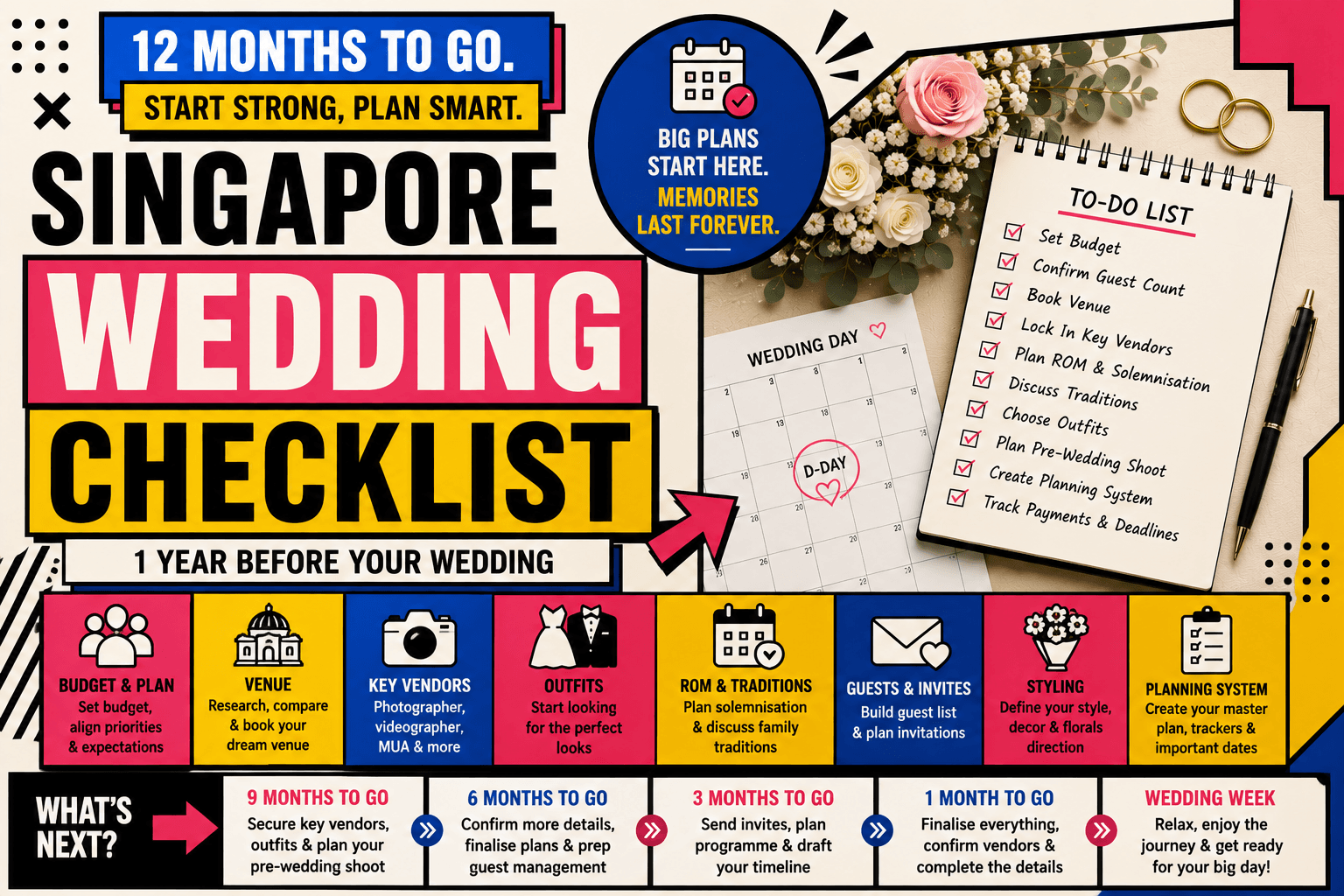
What should you do 12 months before your wedding?
One year before your wedding is when the biggest pieces of your celebration should start falling into place.
You do not need to know your table numbers, march-in song or exact wedding-day schedule yet.
Your priorities are much bigger:
- Decide what kind of wedding you want
- Set a realistic wedding budget
- Estimate your guest count
- Confirm your wedding date
- Secure your venue
- Book priority vendors
- Decide how solemnisation fits into the celebration
- Start researching wedding outfits
- Discuss important family expectations
- Create one organised planning system
Decisions made now affect almost everything that follows.
A larger guest list changes your venue options.
Your venue affects your date.
Your date affects vendor availability.
Your budget determines which choices are realistic.
For the complete planning journey, keep the Ultimate Singapore Wedding Planning Guide alongside this checklist.
12 months before your wedding checklist at a glance
Start with these priorities.
Wedding foundations
- Discuss what kind of wedding you both want
- Set an initial wedding budget
- Estimate guest count
- Confirm or shortlist wedding dates
- Decide your main priorities
Venue
- Research Singapore wedding venues
- Attend venue viewings
- Compare packages
- Check capacity
- Confirm your venue
Key vendors
- Research photographer
- Research videographer
- Research makeup artist
- Research bridal boutiques
- Book priority vendors when ready
Marriage and family
- Discuss solemnisation plans
- Familiarise yourself with the Singapore marriage process
- Discuss important family traditions
- Identify any date or timing considerations
Planning
- Create a master planning workspace
- Create a budget tracker
- Create a working guest list
- Create a vendor tracker
- Record important payment dates
The goal is not to complete your wedding.
It is to build a strong foundation for everything that comes next.
Decide what kind of wedding you actually want
Before comparing venues and packages, discuss the experience you want to create.
Ask each other:
How big should the wedding be?
An intimate celebration and a large banquet require very different plans.
How formal should it feel?
Do you imagine a traditional ballroom banquet, restaurant celebration, outdoor solemnisation or something more relaxed?
Which traditions matter to us?
Consider solemnisation, tea ceremony, gatecrash and other family customs.
What matters most to each of us?
Your priorities might include:
- Food
- Photography
- Videography
- Venue
- Guest experience
- Outfits
- Decorations
- Entertainment
You do not need identical priorities.
You need to understand where each person cares most before the spending begins.
Set your Singapore wedding budget
Before booking vendors, decide how much you are comfortable spending.
Start with a total figure and divide it into categories.
| Category | Initial Budget | Actual Quote | Booked |
|---|---|---|---|
| Venue and catering | |||
| Photography | |||
| Videography | |||
| Bridal | |||
| Groom's attire | |||
| Hair and makeup | |||
| Florals and decor | |||
| Entertainment | |||
| Transport | |||
| Stationery | |||
| Other expenses |
Your first version will not be perfect.
That is fine.
The purpose is to create boundaries before quotations begin influencing your expectations.
Also keep a contingency instead of allocating every dollar immediately.
Wedding expenses can appear later through alterations, overtime, transport, printing and other smaller items.
Decide who is contributing to the wedding
If parents or other family members are contributing financially, clarify expectations early.
Discuss:
- Who is contributing
- Whether the contribution is a fixed amount
- What the contribution covers
- Whether it comes with expectations
- Who makes final decisions
Money and family expectations can become closely connected.
For example, financial contributions may be linked to:
- Guest invitations
- Traditions
- Venue preferences
- Banquet arrangements
Having respectful conversations early is easier than discovering different assumptions after deposits have been paid.
Build your first wedding guest list
You do not need a final guest list one year ahead.
You do need a realistic estimate.
Create separate groups such as:
- Bride's immediate family
- Groom's immediate family
- Bride's relatives
- Groom's relatives
- Close friends
- School friends
- University friends
- Colleagues
- Parents' guests
- Children
- Plus-ones
Then categorise guests if necessary:
Must invite
People you definitely want at the wedding.
Would like to invite
People you hope to include if capacity allows.
Optional
Guests who may be reconsidered if numbers become too large.
Your guest count will strongly influence your venue and budget.
Estimate how many wedding tables you may need
Once you have a rough guest count, translate it into approximate venue requirements.
Do not assume every venue uses the same table capacity.
Ask each venue directly.
Your estimate should also allow for the fact that:
- Not every invited guest will attend
- Some guests may bring children
- Plus-ones may change
- Family lists may grow
- Final table arrangements may not divide perfectly
At this stage, you are not creating a seating plan.
You are simply making sure the venues you consider can realistically accommodate the wedding you are planning.
Your detailed arrangement comes much later using the Singapore Wedding Seating Plan Guide.
Choose your Singapore wedding date
Your wedding date affects almost every major booking.
Consider:
- Venue availability
- Family availability
- Important personal dates
- Public holidays
- Long weekends
- School holidays where relevant
- Family traditions
- Preferred season or setting
- Vendor availability
If your families consider auspicious dates important, discuss this before signing venue contracts.
It can also help to have more than one acceptable date while searching.
Flexibility may give you significantly more venue and vendor options.
Once the date is confirmed, record it consistently across every booking and planning document.
Start researching Singapore wedding venues
Your venue is one of the most influential wedding decisions.
Possible options include:
- Hotels
- Restaurants
- Country clubs
- Event spaces
- Heritage venues
- Outdoor venues
- Intimate private spaces
When researching, consider more than appearance.
Check:
- Capacity
- Minimum attendance
- Location
- Accessibility
- Parking
- Menu
- Solemnisation options
- Reception space
- Bridal room
- AV
- Decoration inclusions
- Vendor restrictions
- Setup access
- Wet-weather alternatives
Create a shortlist before scheduling too many viewings.
Comparing five suitable venues is easier than visiting fifteen without clear criteria.
What should you ask during a wedding venue viewing?
Bring a consistent list of questions so you can compare venues properly.
Ask about:
Capacity
How many guests and tables can the space comfortably accommodate?
Package
What exactly is included?
Food and drinks
What are the menu and beverage arrangements?
Solemnisation
Can the ceremony happen at the venue?
AV
Are microphones, screens and sound equipment included?
Decor
What existing setup is provided?
Access
When can external vendors enter?
Weather
What happens if an outdoor ceremony cannot proceed?
Payments
What are the deposit and payment milestones?
Take photographs and notes after each viewing.
Several ballrooms can start blending together surprisingly quickly.
Compare wedding venue packages properly
Do not compare venue packages using only the headline price.
Create a comparison table.
| Item | Venue A | Venue B | Venue C |
|---|---|---|---|
| Capacity | |||
| Minimum commitment | |||
| Menu | |||
| Drinks | |||
| Solemnisation space | |||
| AV | |||
| Decor | |||
| Bridal room | |||
| Parking | |||
| Additional charges |
A package that initially appears more expensive may include items you would otherwise need to source separately.
Likewise, a lower headline price may not represent your eventual total.
Compare the wedding you would actually receive.
Book your wedding venue
Once you have found the right venue, review the agreement carefully before paying your deposit.
Confirm:
- Wedding date
- Venue
- Spaces included
- Minimum attendance or spending
- Package inclusions
- Payment schedule
- Amendment terms
- Cancellation terms
- Important deadlines
Save:
- Signed contract
- Receipt
- Venue contact
- Package documents
- Floor plans
- Important email or message confirmations
Once the venue and date are secured, many other planning decisions become easier.
You now have a fixed point around which the rest of the wedding can be built.
Identify which wedding vendors matter most to you
You do not need to book every wedding vendor immediately.
Prioritise the categories that are:
- Important to you
- Limited in availability
- Difficult to replace
- Necessary for other planning decisions
Common priority vendors may include:
- Venue
- Photographer
- Videographer
- Makeup artist
- Bridal boutique
Your priorities may differ.
If live music is central to your wedding, your band may rank higher.
If elaborate styling is essential, your decorator may become a priority.
Spend your early planning energy where availability and personal importance overlap.
Start researching your wedding photographer
Photography is one of the few wedding purchases that remains with you after the celebration ends.
When researching photographers, look at:
- Complete wedding galleries
- Candid moments
- Family photographs
- Ceremony coverage
- Low-light images
- Banquet photography
- Editing consistency
Also compare:
- Coverage hours
- Number of photographers
- Deliverables
- Turnaround time
- Overtime terms
- Communication style
Do not choose based on a handful of spectacular Instagram posts.
Look for consistency across an entire wedding day.
Start researching your wedding videographer
Videography styles can differ dramatically.
You may prefer:
- Cinematic
- Documentary
- Emotional
- Energetic
- Comedic
- Interview-driven
- Natural and candid
Watch longer wedding films where available.
Pay attention to:
- Storytelling
- Audio
- Speeches
- Ceremony moments
- Editing
- Music
- Colour
- Pacing
Then compare practical details:
- Coverage hours
- Number of videographers
- Deliverables
- Same-day edit if applicable
- Audio recording
- Turnaround time
Choose the team whose work feels closest to how you want your wedding remembered.
Research your bridal makeup artist and bridal boutique
Start exploring both your bridal looks and the professionals who will create them.
For makeup artists, review:
- Real brides
- Makeup style
- Hairstyling
- Package structure
- Number of looks
- Trial availability
- Touch-up options
- Morning start arrangements
For bridal boutiques, review:
- Gown selection
- Package inclusions
- Number of outfits
- Alterations
- Accessories
- Fittings
- Collection
- Returns
Do not judge a package solely by the number of items included.
A smaller package containing exactly what you want may be more useful than a larger package filled with things you will not use.
Start thinking about your wedding outfits
You do not need every outfit selected immediately.
Begin understanding what your wedding actually requires.
The bride may consider:
- Wedding gown
- Solemnisation dress
- Tea ceremony outfit
- Evening gown
- Traditional outfit
The groom may consider:
- Main suit
- Additional jacket
- Shirt
- Shoes
- Tie or bow tie
- Accessories
Think about the schedule as well.
Multiple outfit changes require:
- Changing locations
- Assistance
- Hair or makeup adjustments
- Additional timeline buffer
Choose outfits because they add something meaningful, not because you feel every wedding must have several looks.
Decide how your solemnisation fits into the celebration
Start discussing when and where you want your legal ceremony.
Possible structures include:
- Solemnisation on a separate date
- Solemnisation before a lunch banquet
- Solemnisation before a dinner banquet
- Small ceremony before a larger celebration
Think about:
- Guest count
- Venue
- Indoor or outdoor setting
- Photography
- Videography
- Makeup
- Programme flow
You do not need every ceremony detail one year ahead.
You do need to know whether your solemnisation is part of the main wedding day because that decision affects venue and vendor planning.
Use the Singapore ROM & Solemnisation Guide when you begin planning the ceremony in detail.
Understand Singapore ROM requirements early
Familiarise yourself with Singapore's current marriage process before deadlines become relevant.
Depending on your circumstances, requirements may relate to:
- Marriage application
- Eligibility
- Application timing
- Solemniser
- Witnesses
- Declarations or verification
- Required documents
Do not rely solely on an old wedding article for legal requirements.
Marriage processes can change, and individual circumstances can affect what is required.
Use current official Singapore marriage guidance when it is time to complete the legal steps.
At the 12-month stage, your goal is simply to understand the process well enough to know what needs to happen later.
Discuss Chinese wedding traditions with your families
If your families want to observe Chinese wedding traditions, begin discussing expectations early.
Depending on your families, this may include:
- Guo Da Li
- Hui Li
- Pin jin
- Dowry
- An Chuang
- Hair combing ceremony
- Gatecrash
- Bride fetching
- Tea ceremony
- Auspicious timings
Not every family follows every tradition.
There can also be different practices between families and generations.
At this stage, identify:
Which traditions matter?
Who needs to be involved?
Do any traditions affect the wedding date or schedule?
The detailed logistics can be planned later.
Early alignment prevents surprises.
Decide whether you want a pre-wedding photoshoot
A pre-wedding photoshoot is optional.
Discuss whether it is something you genuinely want.
Couples may use the photographs for:
- Invitations
- Wedding website
- Welcome signage
- Guestbook
- Banquet display
- Personal memories
Possible styles include:
- Studio
- Urban
- Nature
- Editorial
- Casual
- Cinematic
- Destination
If you want an overseas pre-wedding shoot, earlier planning may be helpful because travel, outfits, vendors and weather can add complexity.
If you prefer something simple, a local shoot at a meaningful location can work just as well.
Create your wedding planning system
Wedding information can become scattered surprisingly quickly.
Create one master workspace containing:
Budget
Planned, quoted, committed and paid expenses.
Guests
Names, groups, contacts and eventual RSVP information.
Vendors
Contacts, packages, contracts and payments.
Venue
Package details and important deadlines.
ROM
Marriage and solemnisation information.
Traditions
Family discussions and agreed arrangements.
Timeline
Eventually, your complete actual-day schedule.
Documents
Contracts, invoices and important files.
The exact tool matters less than having one place both of you trust as the latest version.
Create a wedding vendor tracker
As enquiries begin, track them rather than relying on chat history.
| Vendor | Category | Status | Quote | Deposit | Notes |
|---|---|---|---|---|---|
| Researching | |||||
| Contacted | |||||
| Shortlisted | |||||
| Booked |
Useful statuses include:
- Researching
- Contacted
- Quoted
- Shortlisted
- Booked
- Declined
This makes comparisons easier and prevents you from forgetting which vendors have already replied.
Once a vendor is booked, add their payment deadlines to your financial tracker.
What should you book first for a Singapore wedding?
Prioritise anything that is essential and limited by availability.
A practical order may be:
- Wedding date
- Venue
- Photographer
- Videographer
- Makeup artist
- Bridal arrangements
- Other vendors important to your celebration
This is not a universal rule.
For example, if your dream venue has several available dates but your preferred photographer only has one, your priorities may change.
The principle matters more than the exact order:
Book the things you care about most before spending time on details that can be decided later.
What should you avoid doing 12 months before your wedding?
One year can feel like both a long time and no time at all.
Avoid creating unnecessary urgency.
You probably do not need to:
- Finalise your seating plan
- Confirm your final guest attendance
- Build a minute-by-minute actual-day timeline
- Prepare your emergency kit
- Print your seating chart
- Pack wedding belongings
At the same time, avoid delaying decisions that affect availability.
Do not spend three months choosing fonts while your preferred venue or photographer remains unbooked.
Focus on the decisions that unlock everything else.
Complete 12-month-before Singapore wedding checklist
Use this master checklist to track your progress.
Vision
- Discuss wedding size
- Discuss wedding style
- Identify your top priorities
- Discuss important traditions
Budget
- Set total budget
- Discuss family contributions if applicable
- Create category budgets
- Keep a contingency
- Create payment tracker
Guests
- Build first guest list
- Estimate guest count
- Estimate venue capacity required
- Discuss parents' guest lists
Date and venue
- Shortlist wedding dates
- Research venues
- Attend viewings
- Compare packages
- Review contract
- Book venue
Priority vendors
- Research photographer
- Research videographer
- Research makeup artist
- Research bridal boutique
- Identify other priority vendors
- Book key vendors when ready
Marriage and traditions
- Decide how solemnisation fits into the wedding
- Familiarise yourself with the current marriage process
- Discuss family traditions
- Identify date or timing requirements
Planning
- Decide whether to have a pre-wedding shoot
- Create wedding planning workspace
- Create vendor tracker
- Store contracts and receipts
- Record upcoming deadlines
If these foundations are in place, you are entering the next stage from a strong position.
What happens between 12 months and 9 months before your wedding?
Once the foundations are established, your planning becomes more specific.
Over the next few months:
Venue research becomes a confirmed booking.
Vendor research becomes contracts.
Your rough guest count becomes a structured guest list.
Wedding inspiration becomes an actual visual direction.
Outfit research becomes bridal and suit appointments.
Your solemnisation idea becomes a clearer plan.
Your pre-wedding shoot becomes a real concept and timeline.
The goal is steady progress, not constant wedding planning.
When you reach nine months to go, continue with the Singapore Wedding Checklist: 9 Months Before Your Wedding.
Frequently asked questions about 12 months before a wedding
Is 12 months enough time to plan a wedding in Singapore?
For many couples, yes. A year provides substantial planning time, although availability for specific venues or vendors depends on your wedding date and preferences.
What should I book first?
Start with your date and venue, followed by the vendors that are most important to you and have limited availability.
Do I need a final guest list one year before my wedding?
No. You need a realistic estimate so you can choose an appropriate venue and build a sensible budget.
Should I already have my wedding gown?
Not necessarily. However, this is a good time to begin researching boutiques, styles and packages so there is enough time for selection and fittings.
Should I apply for marriage one year before my wedding?
Do not assume that you should apply simply because you are at the 12-month mark. Check current official Singapore marriage requirements and the applicable application window for your intended solemnisation date.
Do I need an actual-day wedding timeline yet?
No. At this stage, understanding the broad structure of your wedding is enough. Your detailed timeline will become more useful closer to the wedding.
What is the biggest priority 12 months before a wedding?
Build the foundations: budget, guest estimate, date, venue and priority vendors.
One year to go: build the wedding from the big decisions down
The first year-to-go checklist should not leave you with hundreds of tiny tasks.
It should give you clarity.
Know what kind of wedding you want.
Know roughly how many people you are inviting.
Know what you can comfortably spend.
Choose your date.
Secure your venue.
Book the people whose work matters most to you.
Understand how solemnisation and family traditions fit into the celebration.
Then let the smaller decisions follow.
Your next milestone is the Singapore Wedding Checklist: 9 Months Before.
After that, continue with the Singapore Wedding Checklist: 6 Months Before, Singapore Wedding Checklist: 3 Months Before and Singapore Wedding Checklist: 1 Month Before.
For your solemnisation, keep the Singapore ROM & Solemnisation Guide handy.
For the complete planning journey, return to the Ultimate Singapore Wedding Planning Guide.
One year gives you time.
Use it first on the decisions that matter most.