
Blog
Singapore Wedding Checklist: 9 Months Before Your Wedding
August 29, 2026 · Updated August 29, 2026
Nine months to your wedding? Use this Singapore wedding checklist to secure key vendors, refine your budget, plan your solemnisation, outfits, guest list and pre-wedding shoot.
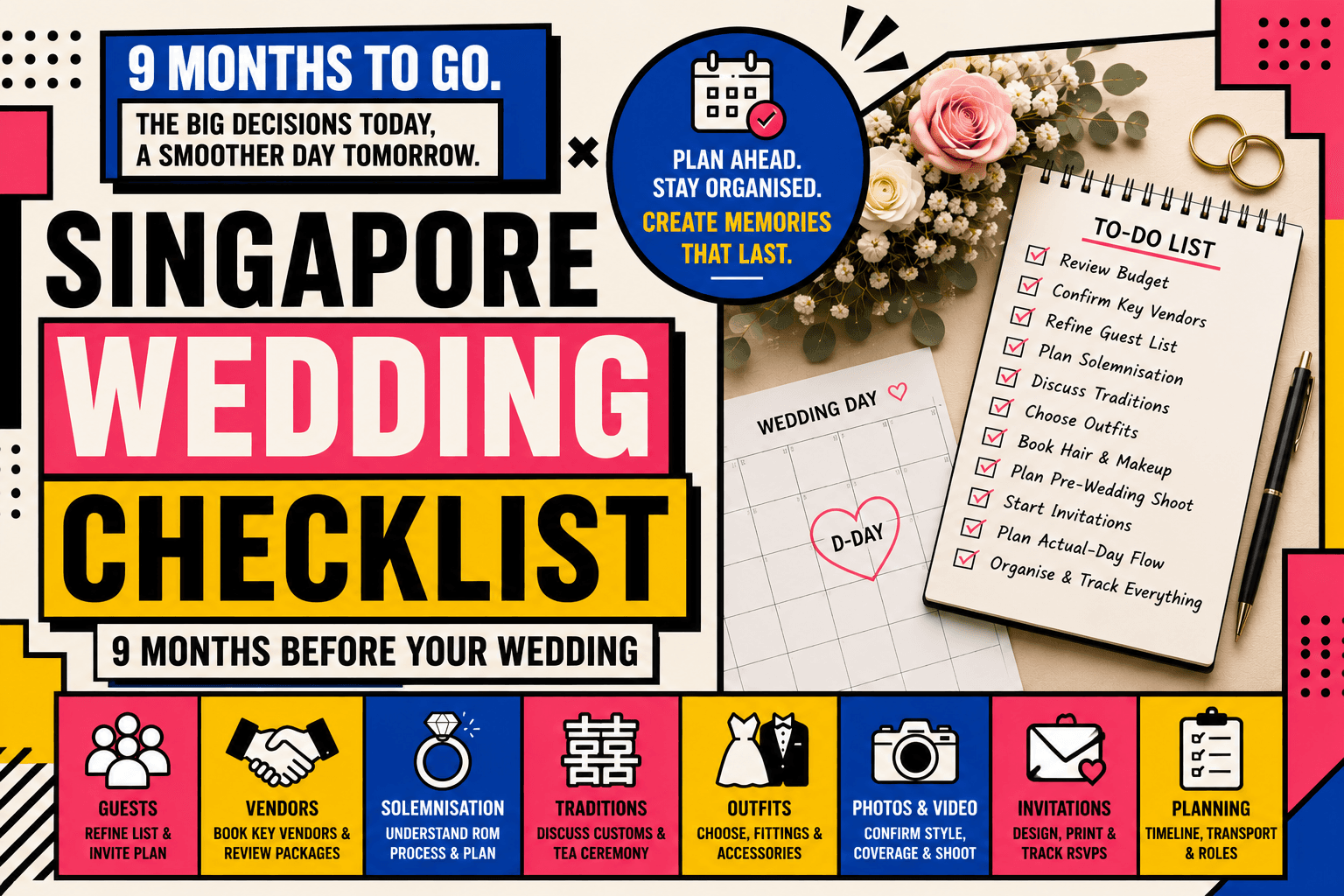
What should you do 9 months before your wedding?
Nine months before your wedding is when the celebration should begin moving from ideas into confirmed plans.
You may already have your date and venue.
Now your attention should turn towards the people and services that will shape the wedding itself.
Your priorities usually include:
- Reviewing your wedding budget
- Refining your guest count
- Booking important vendors
- Planning photography and videography
- Choosing wedding outfits
- Booking bridal hair and makeup
- Thinking about your solemnisation
- Discussing family traditions
- Planning your pre-wedding shoot
- Establishing your wedding style
- Organising all your wedding information
You do not need to know every detail yet.
At nine months, the goal is to secure the decisions that become harder to change later.
For the complete planning journey, use the Ultimate Singapore Wedding Planning Guide.
9 months before your wedding checklist at a glance
Use this as your nine-month overview.
Wedding foundations
- Review wedding budget
- Refine guest count
- Confirm venue booking
- Review venue package
- Create a wedding planning system
Key vendors
- Book photographer
- Book videographer
- Book makeup artist
- Confirm bridal boutique
- Research florist or decorator
- Research emcee and entertainment if needed
ROM and traditions
- Decide how solemnisation fits into the wedding
- Understand the current Singapore marriage process
- Start discussing family traditions
- Identify major tea ceremony requirements
Attire and styling
- Research wedding gowns
- Research groom's attire
- Define wedding style
- Start thinking about florals and decorations
Pre-wedding
- Decide whether to have a pre-wedding shoot
- Choose possible locations
- Consider photography style
- Think about how the images will be used
Complete these foundations now and your six-month planning stage becomes much easier.
Review your Singapore wedding budget
Your wedding budget should become more detailed as real quotations replace estimates.
Break your budget into categories such as:
| Category | Estimated | Quoted | Booked |
|---|---|---|---|
| Venue | |||
| Photography | |||
| Videography | |||
| Bridal | |||
| Groom's attire | |||
| Hair and makeup | |||
| Florals and decor | |||
| Entertainment | |||
| Transport | |||
| Other expenses |
Remember that deposit paid does not mean fully paid.
Track the total amount you have committed to each vendor.
Also keep a buffer for expenses that may appear later, such as:
- Alterations
- Additional hours
- Transport
- Printing
- Accessories
- Small wedding-day items
A realistic budget now helps you make better decisions when optional upgrades appear later.
Refine your wedding guest count
You probably do not need a final guest list nine months before the wedding.
You do need a realistic estimate.
Start dividing guests into groups:
- Immediate family
- Relatives
- Close friends
- School friends
- University friends
- Colleagues
- Parents' friends
- Children
- Plus-ones
You can also create three categories:
Must invite
People you definitely want there.
Would like to invite
Guests you would include if capacity and budget allow.
Optional
Guests who may be reconsidered if numbers become too large.
Your guest count affects:
- Venue
- Tables
- Catering
- Invitations
- Decorations
- Budget
It is one of the most important numbers in your wedding plan.
Review your wedding venue booking
If your venue is already secured, revisit your contract and package.
Check:
- Wedding date
- Venue spaces
- Minimum attendance
- Maximum capacity
- Table size
- Menu
- Drinks
- Solemnisation space
- Reception area
- Bridal room
- Stage
- AV equipment
- Parking
- Decoration inclusions
- Payment schedule
- Cancellation or amendment terms
Create a list of questions that can wait until your next venue discussion.
You do not need every operational detail today.
You do need to understand what you booked and which important items still need to come from other vendors.
Book your wedding photographer
If wedding photography matters to you, prioritise finding a photographer whose work matches how you want the day remembered.
Look beyond individual Instagram photographs.
Review complete wedding galleries where available.
Consider:
- Documentary vs posed approach
- Editing style
- Low-light work
- Ceremony coverage
- Family photographs
- Banquet coverage
- Communication
- Package hours
- Number of photographers
- Deliverables
- Turnaround time
Ask yourself:
Would I still like these photographs years from now?
Your photographer will spend a large part of your wedding day around you.
Style matters, but so does whether you feel comfortable working with them.
Book your wedding videographer
Wedding videography can vary significantly in style.
Some teams create:
- Cinematic films
- Documentary films
- Emotional highlights
- Fast-paced edits
- Interview-led stories
- Same-day edits
Watch full films or longer samples rather than judging a videographer from a few short social media clips.
Check:
- Coverage hours
- Number of videographers
- Audio recording
- Highlight film
- Full ceremony coverage if desired
- Same-day edit if applicable
- Delivery timeline
- Music and editing approach
Photography captures individual moments.
Video can preserve movement, voices, speeches and atmosphere.
Choose based on the memories you actually want to keep.
Book your bridal hair and makeup artist
Popular wedding makeup artists can have limited availability, especially on popular wedding dates.
When comparing options, look at:
- Makeup style
- Hairstyling
- Different skin tones
- Different face shapes
- Real brides
- Indoor and outdoor work
- Package inclusions
- Number of looks
- Touch-up options
- Trial availability
Think about your wedding schedule too.
If you have:
- Early gatecrash
- Morning tea ceremony
- Solemnisation
- Lunch banquet
your preparation may begin very early.
Understanding approximate preparation time will become important when your actual-day timeline is created.
Start choosing your wedding gown and bridal outfits
Nine months gives you useful time to explore bridal options without rushing.
Depending on your wedding, you may want:
- Main wedding gown
- Solemnisation dress
- Tea ceremony outfit
- Evening gown
- Traditional outfit
When comparing bridal packages, check:
- Number of outfits
- Alterations
- Accessories
- Veil
- Trial sessions
- Collection
- Return
- Damage terms
- Additional outfit charges
Think about movement as well as appearance.
A gown may need to work for:
- Walking
- Sitting
- Stairs
- Vehicles
- Solemnisation
- Banquet tables
The best outfit is not simply the one that looks impressive while standing still.
Start planning the groom's wedding attire
Do not leave the groom's outfit until the final months.
Start considering:
- Suit style
- Colour
- Shirt
- Shoes
- Tie or bow tie
- Cufflinks
- Pocket square
- Accessories
Decide whether you prefer:
- Bespoke
- Made-to-measure
- Rental
- Off-the-rack
If tailoring is involved, earlier planning gives you more room for fittings and adjustments.
The groom's attire should also work with the overall wedding style rather than being chosen completely independently.
Define your wedding style before buying decorations
Before purchasing individual decorations, establish a simple visual direction.
You might define:
- Colour palette
- Floral direction
- Overall mood
- Formality
- Typography
- Materials
You do not need a complicated wedding theme.
A simple direction such as:
Modern, clean, warm neutrals with white florals
can be more useful than saving hundreds of unrelated inspiration images.
Your visual direction can guide:
- Invitations
- Solemnisation
- Florals
- Stage
- Reception
- Signage
- Table styling
Consistency usually matters more than the number of decorations.
Research your wedding florist and decorator
Once your visual direction is clearer, start exploring what professional styling you actually need.
Possible areas include:
- Solemnisation arch
- Aisle
- Stage
- Reception
- Welcome sign
- Photo area
- Guest tables
- Bridal bouquet
- Boutonnieres
Before requesting quotations, check what your venue already provides.
Then prepare references showing the overall feeling you want.
When comparing quotations, look at what is actually included rather than comparing only the final price.
Two decoration packages can have very different scopes.
Decide how your solemnisation fits into your wedding
If you are having a civil solemnisation, decide how it relates to the rest of your celebration.
Common structures include:
Separate-day solemnisation
The legal ceremony happens before the main wedding celebration.
Solemnisation before lunch
The ceremony flows into a lunch banquet.
Solemnisation before dinner
Guests arrive earlier for the ceremony before evening reception and dinner.
Small solemnisation before a larger banquet
Only selected family and friends attend the ceremony.
This decision affects:
- Venue
- Guest invitations
- Photography
- Videography
- Makeup
- Programme
- Wedding timeline
Use the Singapore ROM & Solemnisation Guide to understand the wider planning process.
Understand the Singapore marriage process early
Do not wait until the final weeks to learn how your legal marriage process works.
Depending on your circumstances, there may be requirements relating to:
- Marriage application
- Timing
- Eligibility
- Solemniser
- Witnesses
- Declarations or verification
- Required documentation
Singapore's marriage procedures can change.
Always check current official guidance and your own application for the requirements that apply to you.
At nine months, you may not be completing every administrative step yet.
The important thing is understanding what will eventually be required and when.
Start discussing Chinese wedding traditions
If Chinese wedding traditions are important to either family, start the conversation early.
Possible topics include:
- Guo Da Li
- Hui Li
- Pin jin
- Dowry
- An Chuang
- Hair combing ceremony
- Gatecrash
- Bride fetching
- Tea ceremony
- Auspicious timings
You do not necessarily need to finalise everything nine months ahead.
You should identify which traditions matter to each family.
Different families can have different expectations.
Early conversations give everyone time to discuss those expectations without turning them into last-minute wedding problems.
Decide whether you want a pre-wedding photoshoot
A pre-wedding shoot is optional.
If you want one, decide what purpose it serves.
You may want photographs for:
- Invitations
- Wedding website
- Welcome signage
- Guestbook
- Banquet display
- Personal memories
Think about the style you prefer:
- Urban
- Nature
- Studio
- Editorial
- Casual
- Cinematic
- Destination
You do not need to copy traditional pre-wedding photographs if that does not feel like you.
A simple shoot somewhere meaningful to both of you can be just as valuable.
Start planning your pre-wedding shoot timeline
If you want a pre-wedding shoot, work backwards from when you need the final images.
Consider time for:
- Booking
- Planning
- Outfit preparation
- Hair and makeup
- Photoshoot
- Editing
- Photo selection
- Printing or design
For outdoor shoots, consider weather and backup dates.
For overseas shoots, add travel planning and additional buffer.
If the images will appear on wedding invitations or printed materials, schedule the shoot early enough that those later tasks are not delayed.
Research your remaining wedding vendors
Once the most important vendors are covered, identify what else your celebration needs.
Depending on your wedding, this might include:
- Emcee
- Live band
- Singer
- DJ
- Photobooth
- Wedding cake
- Dessert table
- Transport
- Stationery
- Live-streaming service
- Additional styling
Do not book vendors simply because they appear on someone else's wedding checklist.
Ask:
Does this improve the experience we are trying to create?
If the answer is no, you may not need it.
Every additional vendor also creates another contract, payment, contact and actual-day coordination point.
Start thinking about your wedding programme
You do not need an actual-day timeline yet.
Start by imagining the guest experience.
For example:
- Guests arrive
- Solemnisation
- Reception
- Banquet begins
- First march-in
- Meal service
- Wedding video
- Second march-in
- Speeches
- Table photographs
- Farewell
Your actual programme may be completely different.
The exercise is simply to understand how many activities you are considering.
This makes it easier to identify whether your wedding is becoming too crowded before the programme is locked in.
Think about your wedding-day locations and logistics
List the locations that may be part of your actual day.
For example:
- Groom's home
- Bride's home
- Tea ceremony location
- Solemnisation venue
- Photography location
- Hotel
- Banquet venue
The number of locations has a major effect on your wedding schedule.
Every additional location introduces:
- Travel
- Parking
- Loading
- Coordination
- Potential delays
If you have several meaningful traditions or locations, that is completely workable.
You simply need to recognise the logistical impact early enough to plan around it.
Start thinking about your actual-day wedding timeline
At nine months, you only need a high-level outline.
For example:
Morning
Hair and makeup → gatecrash → bride fetching
Late morning
Tea ceremony → travel
Afternoon
Rest → preparation → solemnisation
Evening
Reception → banquet → speeches → table photographs
This is not your final timeline.
It is a test.
If the outline already looks extremely crowded, you have discovered that early enough to simplify it.
Closer to the wedding, build the detailed schedule with the Singapore Actual-Day Wedding Timeline.
Create one system for your wedding planning information
Nine months before the wedding, information can start multiplying quickly.
You may have:
- Venue contract
- Vendor quotations
- Payment receipts
- Guest lists
- Inspiration images
- Family notes
- Outfit appointments
- ROM information
Create one organised system.
Your master wedding workspace might contain:
Budget
All planned and committed spending.
Guests
Names, contacts and eventual RSVP information.
Vendors
Contracts, contacts, payments and deliverables.
Timeline
Your eventual wedding-day schedule.
Documents
Important files and confirmations.
Ideas
Inspiration that has not yet become a decision.
The exact app or spreadsheet matters less than both of you knowing where the latest information lives.
Start a wedding payment calendar
Vendor payments rarely happen all at once.
You may have:
- Booking deposits
- Progress payments
- Final balances
- Security deposits
Record upcoming payments now.
| Vendor | Next Payment | Due Date | Final Balance |
|---|---|---|---|
This helps prevent payment deadlines from being buried inside old contracts or chat messages.
It also shows how much cash you need to keep available as the wedding approaches.
Update the calendar whenever you confirm a new vendor.
What should already be booked 9 months before your wedding?
There is no universal booking deadline.
Availability depends on your wedding date, preferences and vendor.
However, nine months before the wedding is a useful checkpoint for major limited-availability bookings.
Prioritise:
- Venue
- Photographer
- Videographer
- Makeup artist
- Bridal arrangements
- Other vendors that are essential to your specific wedding
If your wedding falls on a particularly popular date, earlier bookings can provide more choice.
If you are planning on a shorter timeline, focus on availability and fit rather than worrying that you have missed an imaginary deadline.
A wedding can still be planned successfully with flexibility.
What should you avoid doing 9 months before your wedding?
Nine months gives you time.
Use that time to make good decisions rather than more decisions.
Avoid:
- Booking vendors without understanding packages
- Constantly changing your wedding concept
- Buying decorations before checking venue inclusions
- Expanding the guest list without checking your budget
- Ignoring family expectations
- Forgetting future vendor balances
- Planning every minute of the actual day too early
- Comparing your wedding endlessly with social media
Focus on decisions that are expensive, important or availability-sensitive.
Smaller details can wait.
Complete 9-month-before Singapore wedding checklist
Use this master checklist to track your progress.
Wedding foundations
- Review budget
- Refine guest count
- Review venue contract
- Create planning workspace
- Create payment calendar
Key vendors
- Book photographer
- Book videographer
- Book makeup artist
- Confirm bridal arrangements
- Research florist or decorator
- Research remaining important vendors
ROM and traditions
- Decide solemnisation structure
- Understand current marriage process
- Discuss family traditions
- Identify tea ceremony expectations
Outfits and style
- Research or confirm bridal outfits
- Start groom's attire
- Define visual direction
- Research florals and decorations
Pre-wedding
- Decide whether to have a pre-wedding shoot
- Choose style
- Research locations
- Plan approximate timing
Actual day
- Think about programme
- List major locations
- Consider transport requirements
- Draft a high-level wedding-day flow
If these foundations are progressing well, you are setting yourself up for a much easier six-month stage.
What happens between 9 months and 6 months before your wedding?
The next three months are about turning research into decisions.
Your vendor shortlist becomes confirmed bookings.
Your guest estimate becomes a more structured list.
Your wedding style becomes actual outfit, floral and decoration choices.
Your solemnisation idea becomes a clearer ceremony plan.
Your pre-wedding shoot becomes a date and location.
Your rough wedding-day concept becomes a sequence of real events.
Do not try to finish everything immediately.
Instead, steadily close the decisions that affect other decisions.
When you reach the next milestone, continue with the Singapore Wedding Checklist: 6 Months Before Your Wedding.
Frequently asked questions about 9 months before a wedding
Is 9 months enough time to plan a wedding in Singapore?
Yes, many weddings can be planned within nine months, especially if you are flexible about your venue, date and vendors. Availability will depend on your requirements.
What vendors should I prioritise 9 months before my wedding?
Prioritise vendors that are important to you and have limited availability, commonly including your venue, photographer, videographer, makeup artist and bridal arrangements.
Should I have my final guest list 9 months before?
No. You should have a realistic estimate and a structured working list. Final attendance will come later through RSVPs.
Should I have my wedding timeline ready?
No. A high-level flow is enough. Your detailed actual-day timeline becomes more useful once vendor and ceremony timings are clearer.
Should I start planning my solemnisation?
Yes. Decide how the solemnisation fits into your wedding and familiarise yourself with the current marriage process.
What is the biggest priority at nine months?
Secure the parts of your wedding that are important, expensive or availability-sensitive before spending too much time on smaller details.
Nine months to go: secure the decisions that matter most
Nine months before your wedding is not about perfecting every detail.
It is about creating certainty around the big things.
Your venue.
Your budget.
Your guest count.
Your photographer and videographer.
Your outfits.
Your solemnisation.
Your family traditions.
Your overall wedding experience.
Once these foundations are stable, the smaller decisions become easier.
When you reach six months to go, continue with the Singapore Wedding Checklist: 6 Months Before.
Then move into the Singapore Wedding Checklist: 3 Months Before, followed by the Singapore Wedding Checklist: 1 Month Before.
For your ceremony, use the Singapore ROM & Solemnisation Guide.
For the complete journey, return to the Ultimate Singapore Wedding Planning Guide.
Build the foundations now.
The details can follow.