
Blog
Singapore Wedding Checklist: 18 Months Before Your Wedding
August 29, 2026 · Updated August 29, 2026
18 months to your wedding? Use this Singapore wedding checklist to align your priorities, estimate your budget and guest list, explore dates, research venues and start planning with confidence.
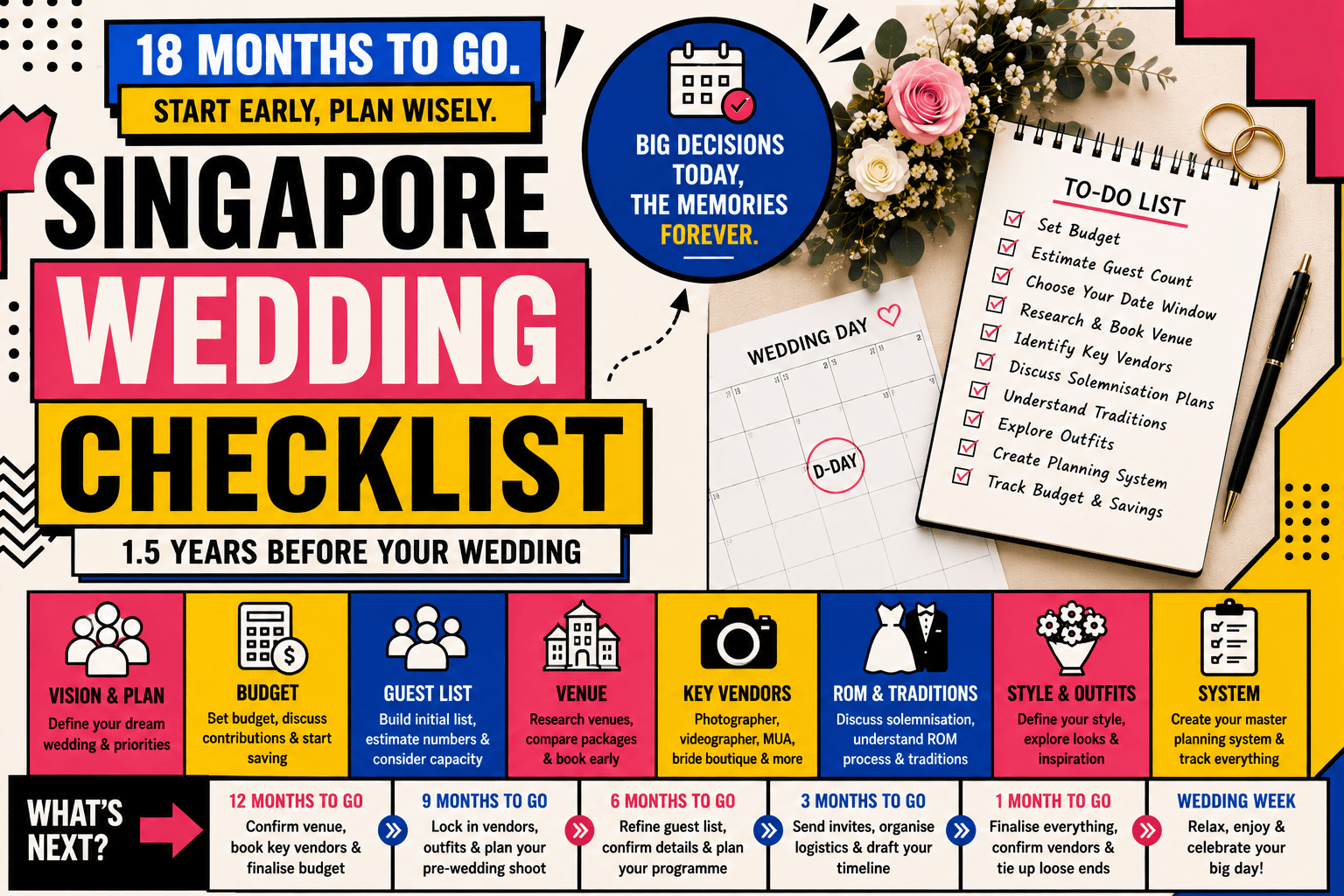
What should you do 18 months before your wedding?
Eighteen months before your wedding can feel incredibly early.
That is exactly why it can be such a useful planning stage.
You have time to make the big decisions without rushing into deposits, packages and tiny details.
Your priorities should be:
- Discuss what kind of wedding you both want
- Decide what matters most
- Estimate your wedding budget
- Build an initial guest list
- Discuss possible wedding dates
- Research Singapore wedding venues
- Understand major vendor categories
- Discuss solemnisation plans
- Talk to your families about important traditions
- Create a wedding planning system
You do not need to organise every detail.
At this stage, clarity is more valuable than completion.
For an overview of the entire journey, use the Ultimate Singapore Wedding Planning Guide.
18 months before your wedding checklist at a glance
Start with these foundations.
Your wedding
- Discuss the type of wedding you want
- Identify your top priorities
- Discuss wedding size
- Discuss possible dates
- Decide how involved each partner wants to be
Money
- Discuss a comfortable overall budget
- Identify possible family contributions
- Create an initial budget
- Start a wedding fund if needed
- Keep a contingency
Guests
- Create a rough guest list
- Ask parents for estimated guest numbers
- Estimate total attendance
- Consider venue capacity requirements
Research
- Explore Singapore wedding venues
- Understand major vendor categories
- Save photographers and videographers you like
- Research bridal options
- Start gathering useful inspiration
Marriage and traditions
- Discuss solemnisation preferences
- Familiarise yourself with the Singapore marriage process
- Discuss family traditions
- Identify any date considerations
The goal is simple: understand the wedding before you start buying the wedding.
Start by defining what your wedding means to both of you
Before budgets and vendor quotations, talk about the celebration itself.
Ask each other:
What do we want our wedding to feel like?
You might imagine something:
- Intimate
- Energetic
- Traditional
- Relaxed
- Elegant
- Modern
- Family-focused
- Party-focused
Then ask:
What do we want to remember most?
One partner may care deeply about photography.
The other may care most about bringing everyone together over great food.
Neither answer is wrong.
Understanding these priorities helps you spend your time and money on the parts of the wedding that actually matter to you.
Decide how big you want your Singapore wedding to be
You do not need an exact guest count yet.
Start with the scale.
For example:
Intimate
Mostly immediate family and close friends.
Medium-sized
Family, relatives and your main friendship groups.
Large
Extended relatives, friends, colleagues, parents' guests and broader social circles.
The size of your wedding influences:
- Budget
- Venue
- Catering
- Number of tables
- Invitations
- Reception
- Seating
- Logistics
A wedding for 60 people and a wedding for 300 people are fundamentally different events.
Agreeing on the approximate scale early makes almost every later decision easier.
Build your first wedding guest list
Once you have discussed the size of the wedding, put actual names into a working list.
Separate guests into groups:
- Bride's immediate family
- Groom's immediate family
- Bride's relatives
- Groom's relatives
- Close friends
- School friends
- University friends
- Colleagues
- Parents' guests
- Children
- Plus-ones
Do not worry about table assignments.
You are simply trying to answer:
Are we planning for approximately 80 people, 180 people or 300 people?
That number will become extremely important when you begin comparing venues.
Your final seating arrangements come much later with the Singapore Wedding Seating Plan Guide.
Talk to both families about guest expectations
If your parents will be inviting relatives, friends or colleagues, involve them in the guest-count conversation early.
Ask each side for an approximate number rather than assuming.
You can separate the guest list into:
| Group | Estimated Guests |
|---|---|
| Couple's guests | |
| Bride's family | |
| Groom's family | |
| Parents' friends | |
| Children and plus-ones | |
| Estimated total |
The first number does not need to be final.
Its purpose is to reveal whether everyone has similar expectations.
Finding out now that one family expects 30 guests while another expects 100 is much easier than discovering it after a venue has been booked.
Set an initial Singapore wedding budget
You do not need perfect numbers 18 months before your wedding.
You do need a financial boundary.
Start with:
What can we comfortably afford without depending on uncertain money?
Then create an initial allocation.
| Category | Initial Budget |
|---|---|
| Venue and catering | |
| Photography | |
| Videography | |
| Bridal | |
| Groom's attire | |
| Hair and makeup | |
| Florals and decor | |
| Entertainment | |
| Transport | |
| Stationery | |
| Traditions | |
| Other expenses | |
| Contingency |
These amounts will change as you receive real quotations.
That is expected.
Your initial budget is a decision-making tool, not a prediction that must remain perfectly accurate.
Discuss family contributions and expectations early
Some couples fund the wedding themselves.
Others receive contributions from parents or relatives.
If family contributions are expected, clarify:
- Whether a contribution is confirmed
- Approximately how much it is
- What it is intended to cover
- Whether there are expectations attached
- Who makes decisions about that portion of the wedding
For example, contributions may come with expectations relating to:
- Guest numbers
- Venue
- Banquet style
- Traditions
- Wedding date
There is nothing inherently wrong with families having preferences.
The important thing is understanding those preferences before financial commitments are made.
Start saving for your wedding if needed
With 18 months available, you have time to spread wedding expenses across a longer period.
Once you have an approximate budget, calculate:
Target wedding fund - existing wedding savings = remaining amount
Then divide the remaining amount across the months available.
Remember that vendor payments may not occur evenly.
A typical planning journey can involve:
- Deposits when booking
- Progress payments
- Final balances closer to the wedding
- Additional wedding-week expenses
Your savings plan should therefore consider both the total amount and when you expect to need the money.
Avoid assuming future wedding gifts will cover expenses that must be paid beforehand.
Identify your top three wedding priorities
Ask each partner to independently choose three things that matter most.
For example:
Partner A
- Photography
- Food
- Intimate atmosphere
Partner B
- Videography
- Venue
- Great party
Compare the lists.
Anything appearing on both deserves particular attention.
These priorities can help when the budget eventually requires trade-offs.
Instead of asking:
Which package gives us the most things?
you can ask:
Does this help us create the wedding we actually care about?
That is a much more useful question.
Discuss possible wedding dates
You may not need to choose the exact date immediately.
Start defining the acceptable window.
Consider:
- Preferred year
- Preferred months
- Weekday vs weekend
- Family availability
- Important personal dates
- Public holidays
- Long weekends
- School holidays where relevant
- Venue availability
- Family traditions
If auspicious dates are important to either family, discuss this before your venue search becomes too specific.
It can be helpful to have several acceptable dates.
More flexibility can mean more venue and vendor options.
Decide whether auspicious dates matter to your families
For some Singapore couples and families, choosing an auspicious wedding date is important.
For others, it is not part of their planning.
Find out early.
Ask both families whether there are:
- Preferred dates
- Dates to avoid
- Timing considerations
- Traditional consultation requirements
You do not need to follow traditions that are not relevant to your families.
But if they are important, knowing before you pay a venue deposit can prevent unnecessary conflict or changes later.
Start researching Singapore wedding venues
With your approximate guest count, budget and preferred dates, venue research becomes much more useful.
Explore options such as:
- Hotels
- Restaurants
- Country clubs
- Event spaces
- Heritage venues
- Outdoor venues
- Smaller private venues
Create a shortlist based on:
- Capacity
- Location
- Style
- Catering
- Solemnisation options
- Accessibility
- Package
- Budget
Do not shortlist venues purely because photographs look impressive.
The venue needs to work for the wedding you are actually planning.
Compare wedding venues using the same criteria
Create a simple comparison sheet.
| Item | Venue A | Venue B | Venue C |
|---|---|---|---|
| Capacity | |||
| Location | |||
| Minimum commitment | |||
| Food | |||
| Drinks | |||
| Solemnisation | |||
| AV | |||
| Decor | |||
| Bridal room | |||
| Parking | |||
| Overall fit |
This prevents your decision from becoming:
Which ballroom photograph do we like most?
A venue is both a visual choice and an operational one.
The right venue should fit your guests, budget, programme and priorities.
Do you need to book your wedding venue 18 months ahead?
Not every couple needs to book a venue exactly 18 months before the wedding.
However, starting your research this early can be useful if:
- You have a specific date
- You want a popular venue
- Your wedding is large
- Your preferred period is limited
- You have little flexibility
If you are highly flexible, you may have more time.
Avoid booking simply because you feel pressured by a countdown.
But avoid assuming that every preferred venue will still be available whenever you eventually decide.
Research early enough to understand your options, then book when you are confident about the date, budget, guest count and venue.
Start learning about the wedding vendors you may need
You do not need to contact every vendor yet.
First understand the categories.
Depending on your wedding, you may eventually need:
- Photographer
- Videographer
- Makeup artist
- Bridal boutique
- Suit tailor or rental
- Florist
- Decorator
- Emcee
- Entertainment
- Photobooth
- Transport
- Stationery
- Wedding cake
- Other specialists
Separate them into:
Essential
Your wedding genuinely needs this.
Important to us
Not technically necessary, but personally valuable.
Optional
Nice additions if budget allows.
This prevents someone else's wedding checklist from becoming your shopping list.
Start saving photographers and videographers you genuinely like
You do not necessarily need to book immediately.
Start learning what visual style appeals to you.
For photography, you might prefer:
- Documentary
- Editorial
- Bright and airy
- Moody
- Natural
- Highly posed
- Candid
For videography, you might prefer:
- Cinematic
- Documentary
- Emotional
- Comedic
- Energetic
- Interview-driven
- Natural and candid
Save complete portfolios where possible, not only individual social media posts.
By the time you are ready to enquire, you should understand why you like a particular team's work.
That makes vendor comparisons much easier.
Start exploring bridal boutiques and wedding outfits
There is no need to choose your final gown immediately.
Start learning what options exist.
For bridal boutiques, compare:
- Gown styles
- Package structure
- Number of outfits
- Alterations
- Accessories
- Veils
- Fittings
- Collection and return arrangements
For the groom, begin thinking about:
- Bespoke suit
- Made-to-measure
- Rental
- Off-the-rack
This early research helps you understand how much of your budget should be allocated to attire before you commit that money elsewhere.
Start defining your wedding style
You do not need a complicated theme.
Create a simple visual direction.
Think about:
- Colours
- Formality
- Florals
- Materials
- Typography
- Overall mood
Instead of collecting hundreds of unrelated images, try describing your wedding in one sentence.
For example:
Modern and playful with bright colours and relaxed florals.
Or:
Elegant evening celebration with warm lighting, neutral tones and classic white flowers.
This sentence can later guide your:
- Venue
- Outfits
- Florals
- Invitations
- Solemnisation
- Decorations
A clear direction reduces random purchases later.
Discuss your Singapore ROM and solemnisation plans
You do not need to complete your legal marriage arrangements 18 months ahead.
You should discuss how you imagine the solemnisation fitting into the wedding.
Possible options include:
- Solemnisation on another date
- Solemnisation before a lunch banquet
- Solemnisation before a dinner banquet
- Small ceremony followed by a larger celebration
Think about:
- Approximate guest count
- Indoor or outdoor setting
- Venue
- Photography
- Videography
- Ceremony atmosphere
Marriage procedures and application requirements can change, so use current official Singapore guidance when completing the legal process.
For the planning side, keep the Singapore ROM & Solemnisation Guide for later.
Start discussing Chinese wedding traditions with both families
If Chinese wedding traditions are relevant to your families, you do not need to plan every ceremony today.
Start by identifying expectations.
Depending on your families, discussions may eventually include:
- Guo Da Li
- Hui Li
- Pin jin
- Dowry
- An Chuang
- Hair combing ceremony
- Gatecrash
- Bride fetching
- Tea ceremony
- Auspicious dates or timings
Ask:
Which traditions are important to us?
Are there traditions that affect our wedding date?
Are there expectations we should know before choosing the venue or schedule?
Traditions vary between families.
Early conversations are more useful than assuming there is one universal set of rules.
Decide how much help you want from family and friends
Wedding planning can involve many people.
Before that happens, discuss how you want decisions to work.
You might prefer:
Couple-led planning
The two of you make most decisions and update your families.
Family collaboration
Parents are actively involved in areas such as guest lists, traditions and banquet planning.
Shared responsibilities
Different people take responsibility for specific areas.
There is no correct model.
The important thing is avoiding a situation where several people believe they are responsible for the same decision.
You can always adjust roles later.
Create one master wedding planning system
Start organised before the information becomes overwhelming.
Your wedding workspace can include:
Overview
Wedding date, venue and major milestones.
Budget
Estimated, quoted, committed and paid expenses.
Guests
Names, groups and eventual RSVP information.
Vendors
Research, quotations, contracts and contacts.
ROM
Solemnisation and marriage information.
Traditions
Family decisions and responsibilities.
Inspiration
Ideas you genuinely want to revisit.
Documents
Contracts, receipts and important files.
The best planning system is not necessarily the most complicated.
It is the one both of you will actually keep updated.
Create a wedding research shortlist instead of endless inspiration boards
Early wedding planning can easily turn into endless scrolling.
Create structured shortlists instead.
For example:
Venues
Maximum five serious options.
Photographers
Maximum five teams to investigate.
Videographers
Maximum five teams.
Bridal boutiques
Maximum five options.
For each one, record why you like it.
This forces inspiration to become useful information.
Instead of saving 200 posts, you begin identifying patterns:
We consistently like candid photography.
We prefer intimate venues.
We keep choosing colourful styling.
Those patterns help define your actual wedding.
What should you avoid doing 18 months before your wedding?
Having extra time does not mean every decision should be made immediately.
Avoid:
- Finalising a seating plan
- Creating a minute-by-minute actual-day timeline
- Buying large amounts of decor
- Ordering items before your wedding style is clear
- Sending invitations too early
- Fixating on tiny details before choosing a venue
- Booking vendors without comparing packages
- Assuming your guest count will somehow work itself out
- Planning solely around social media trends
Most importantly, avoid turning an 18-month planning window into 18 months of constant wedding stress.
Make the big decisions.
Then allow yourself to stop thinking about the wedding occasionally.
Complete 18-month-before Singapore wedding checklist
Use this master checklist to track your early planning.
Wedding vision
- Discuss wedding size
- Discuss atmosphere
- Identify top three priorities
- Discuss level of formality
- Decide how involved each partner wants to be
Budget
- Set initial budget
- Discuss family contributions
- Create category estimates
- Keep contingency
- Start savings plan if needed
Guests
- Create first guest list
- Ask parents for estimated numbers
- Estimate total attendance
- Identify likely venue capacity
Date
- Discuss preferred period
- Identify possible dates
- Check important family considerations
- Discuss auspicious dates if relevant
Venue
- Research venue types
- Create venue shortlist
- Compare capacity and packages
- Begin enquiries when ready
Vendors and style
- Understand vendor categories
- Save preferred photographers
- Save preferred videographers
- Explore bridal boutiques
- Start defining wedding style
Marriage and family
- Discuss solemnisation format
- Familiarise yourself with the marriage process
- Discuss family traditions
- Identify expectations affecting date or schedule
Organisation
- Create wedding workspace
- Create budget tracker
- Create guest tracker
- Create vendor shortlist
- Store important research
If these foundations are clear, you are already making meaningful progress.
What happens between 18 months and 12 months before your wedding?
The next stage turns your early ideas into real decisions.
Your approximate budget becomes a working budget.
Your rough guest estimate becomes a structured list.
Your possible dates become a preferred date.
Your venue research becomes viewings and comparisons.
Your vendor inspiration becomes serious shortlists.
Your discussions about traditions become clearer family expectations.
Your wedding style begins influencing real choices.
You do not need to rush through these steps.
Use the time to make decisions you are comfortable keeping.
When you reach one year to go, continue with the Singapore Wedding Checklist: 12 Months Before Your Wedding.
Frequently asked questions about planning a wedding 18 months ahead
Is 18 months too early to plan a wedding?
No. It can be a useful time to establish your budget, guest estimate, date preferences and venue shortlist without rushing. You simply do not need to finalise every small detail yet.
What should I book 18 months before my wedding?
There is no universal requirement to book specific vendors exactly 18 months ahead. If you have a fixed date or highly preferred venue or vendor, early enquiries may be useful. Otherwise, begin with research and your biggest priorities.
Should I have my wedding venue booked 18 months before?
Not necessarily. However, couples with specific dates, large guest lists or particular venue preferences may benefit from starting their search early.
Do I need a final guest list?
No. You need an approximate guest count that is realistic enough to guide your venue and budget decisions.
Should I buy my wedding gown now?
You do not necessarily need to. Start exploring boutiques, packages and styles so you understand your preferences and likely budget.
Should I start planning my ROM now?
You can decide how solemnisation fits into your wedding and familiarise yourself with the process. Complete legal steps according to the current official requirements and applicable timelines closer to your intended solemnisation.
What is the most important thing to do 18 months before a wedding?
Get aligned as a couple on your wedding size, priorities, budget, guest expectations and preferred dates before making major financial commitments.
18 months to go: create clarity before commitments
The advantage of starting 18 months before your wedding is not that you can complete more tasks.
It is that you have more time to make better decisions.
Decide what matters.
Understand what you can afford.
Estimate who you want there.
Talk to your families.
Explore dates.
Research venues.
Learn which vendors fit your style.
Then start committing when the foundations make sense.
Your next milestone is the Singapore Wedding Checklist: 12 Months Before.
From there, continue through the 9-Month Wedding Checklist, 6-Month Wedding Checklist, 3-Month Wedding Checklist and 1-Month Wedding Checklist.
As the wedding approaches, move into the Wedding Week Checklist and Singapore Wedding Day Checklist.
For the complete planning framework, return to the Ultimate Singapore Wedding Planning Guide.
Start with clarity.
The rest of the wedding can grow from there.