
Blog
Wedding Florist vs Decorator Singapore: What's the Difference?
September 8, 2026 · Updated September 8, 2026
Wedding florist or decorator? Learn the difference between florals and wedding styling in Singapore, where their services overlap, who handles what and whether you need one or both.
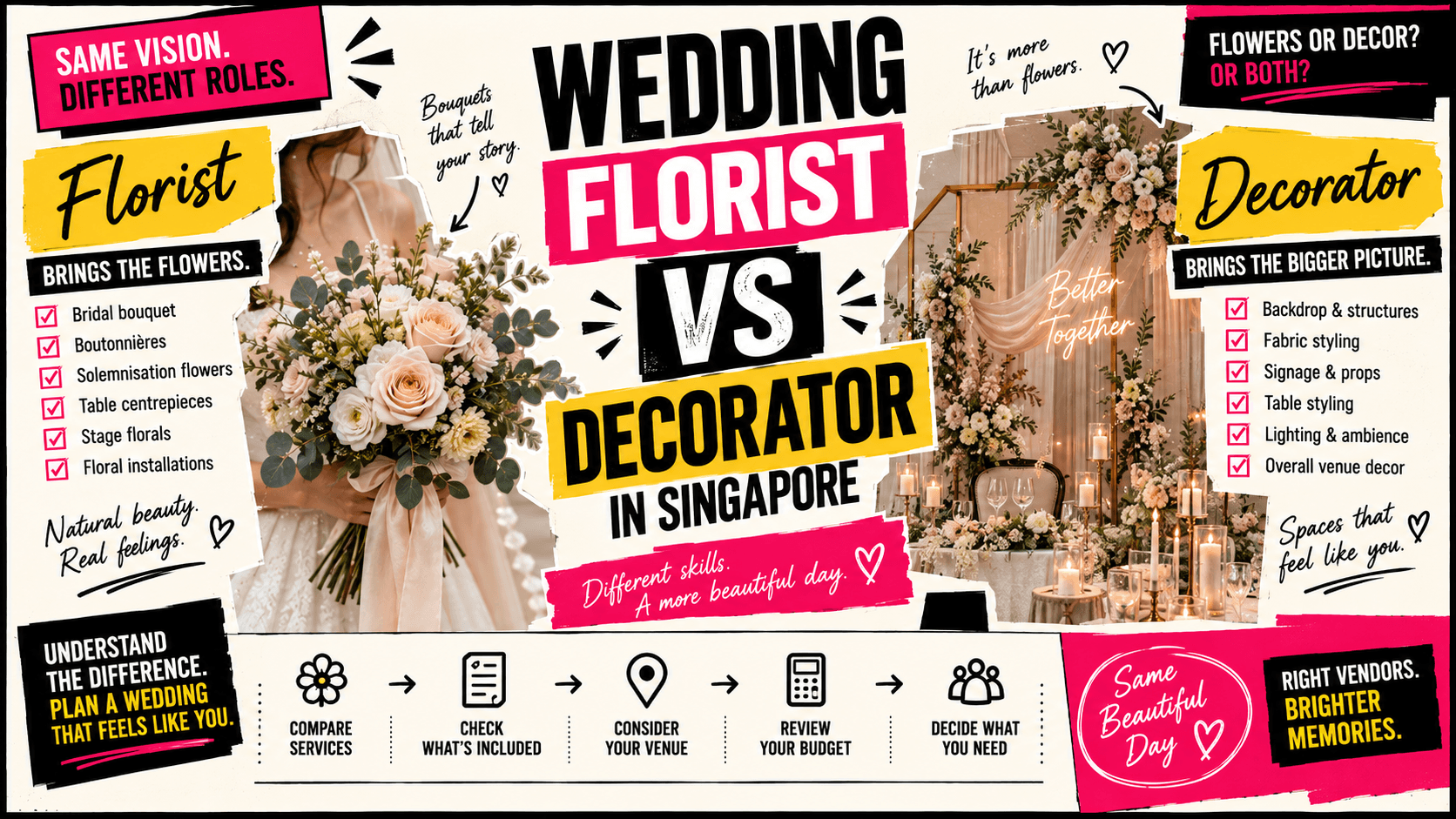
Wedding florist vs decorator: what's actually the difference?
You have saved photographs of a beautiful wedding setup.
There are flowers around the solemnisation arch, fabric behind the couple, candles on the tables, a welcome sign at the entrance and decorative structures around the reception.
So who creates all of that?
The florist? The decorator? Both?
The answer depends on the vendor.
In general:
Wedding florists focus primarily on flowers and floral arrangements.
Wedding decorators focus more broadly on styling the physical wedding space.
But their services can overlap significantly.
This wedding florist vs decorator Singapore guide explains what each vendor may handle, where their responsibilities overlap and how to decide what your wedding actually needs.
If you are still building your vendor team, start with Aven's Singapore Wedding Vendor Checklist.
Wedding florist vs decorator at a glance
Here is a simple comparison.
| Wedding Element | Florist | Decorator |
|---|---|---|
| Bridal bouquet | Common | Usually not primary service |
| Boutonnières | Common | Usually not primary service |
| Floral arch | Common | May coordinate or provide |
| Aisle flowers | Common | May coordinate |
| Centrepiece flowers | Common | May coordinate |
| Stage flowers | Common | May coordinate |
| Backdrop structures | Sometimes | Common |
| Fabric styling | Sometimes | Common |
| Signage | Sometimes | Common |
| Props | Sometimes | Common |
| Furniture styling | Sometimes | Common |
| Candles | Sometimes | Common |
| Overall venue styling | Sometimes | Common |
| Floral design | Primary focus | May outsource or include |
These are general distinctions rather than strict rules.
Some Singapore wedding vendors provide both floral design and complete venue styling.
Always compare the actual scope of service.
What does a wedding florist usually handle?
A wedding florist primarily works with flowers and related botanical arrangements.
Their scope may include:
Personal flowers
- Bridal bouquet
- Bridesmaid bouquets
- Groom boutonnière
- Groomsmen boutonnières
- Parent corsages
Solemnisation flowers
- Floral arch
- Aisle arrangements
- Signing-table flowers
- Chair flowers
Reception flowers
- Guest-table centrepieces
- Couple-table arrangements
- Stage flowers
- Welcome-table flowers
- Cake-table flowers
Some florists also provide structures, candles, styling and other decorative elements.
For a complete florist-selection guide, read Aven's How to Choose a Wedding Florist in Singapore.
What does a wedding decorator usually handle?
A wedding decorator typically works with the broader visual environment of the wedding.
Depending on the vendor, this could include:
- Backdrops
- Fabric draping
- Signage
- Welcome areas
- Decorative structures
- Pedestals
- Candles
- Props
- Table styling
- Furniture
- Stage styling
- Photo areas
- Aisle styling
The decorator may also help translate your wedding concept into a consistent visual direction across different spaces.
Some decorators provide flowers themselves.
Others work alongside a florist.
The exact arrangement varies considerably between vendors.
Why do florist and decorator services overlap?
Modern wedding setups often combine multiple visual elements into one installation.
Consider a solemnisation backdrop containing:
- Floral arrangements
- Metal arch
- Fabric
- Pedestals
- Candles
- Signage
The flowers may traditionally fall under the florist.
The structure and styling may traditionally fall under the decorator.
But couples usually want the entire installation to look cohesive.
As a result, many vendors have expanded their services.
A florist may offer styling.
A decorator may provide florals.
A studio may provide both.
This is why the vendor's actual proposal matters more than their business category.
Who handles the bridal bouquet?
The bridal bouquet generally falls within the florist's scope.
The florist may also create:
- Groom boutonnière
- Bridesmaid bouquets
- Groomsmen boutonnières
- Parent flowers
These personal floral items need to complement:
- Wedding gown
- Suit
- Colour palette
- Wedding style
If you are using a separate decorator, share the overall styling direction with your florist so the bouquet and venue still feel connected.
Who handles the solemnisation backdrop?
It depends on what the backdrop contains.
A floral-focused backdrop might be primarily created by your florist.
A larger styled installation could involve:
- Structure
- Fabric
- Signage
- Props
- Flowers
- Lighting
In this case, your decorator may lead the overall setup while coordinating with the florist.
Alternatively, one vendor may provide the complete installation.
Before booking, ask:
Who is responsible for the finished solemnisation backdrop?
You want one clear answer rather than discovering on the wedding day that each vendor expected the other to provide a particular element.
Who handles wedding table styling?
Guest tables can involve several vendors.
Your venue may already provide:
- Linen
- Tableware
- Chairs
- Basic centrepieces
Your florist may provide:
- Floral centrepieces
- Greenery
Your decorator may provide:
- Candles
- Decorative objects
- Table styling
- Special linens
- Signage
Before adding anything, understand what your venue package already includes.
This prevents unnecessary duplication and helps you identify what actually needs upgrading.
Who handles wedding signage?
Wedding signage generally sits closer to the styling and decor side.
Examples include:
- Welcome sign
- Seating chart
- Directional signs
- Table numbers
- Menu displays
- Photo-area signage
However, stationery designers, decorators and other vendors may all provide different parts of this.
If your signage needs to be incorporated into a floral installation, coordinate the dimensions and placement with your florist before production.
Who handles the wedding stage?
The answer depends partly on your venue.
Hotel and restaurant wedding packages may already include a stage or backdrop.
You may then choose to:
- Use it as provided
- Add flowers
- Add decorative elements
- Replace parts of the design
- Create a custom setup
Your florist may handle floral additions.
Your decorator may handle the broader styling.
Before commissioning anything, check your venue's:
- Existing setup
- Stage dimensions
- Restrictions
- Installation rules
- Setup window
Use Aven's Wedding Venue Contract Checklist Singapore when reviewing what your venue allows.
Do you need both a florist and a decorator?
Not necessarily.
You may only need a florist if:
- Flowers are your main decorative priority
- Your venue already provides sufficient styling
- You prefer a simple setup
- Your florist can handle the additional styling you want
You may need both if:
- You want significant custom decor
- Your concept involves more than flowers
- You have multiple spaces to transform
- Your preferred florist focuses specifically on florals
- Your decorator does not provide floral design
You may also find one vendor capable of handling both.
The objective is not to hire more vendors.
It is to make sure every part of your intended setup has a clear owner.
When might you only need a florist?
Imagine your venue already includes:
- Attractive ballroom
- Stage
- Table settings
- Chairs
- Basic decor
You only want to add:
- Bridal bouquet
- Boutonnière
- Solemnisation flowers
- Selected centrepieces
- A few stage flowers
A florist may be sufficient.
Adding a separate decorator simply because other weddings use one may create unnecessary complexity.
Start with what your venue already provides, then fill the actual gaps.
When might you only need a decorator?
A decorator may be enough if flowers are not a major part of your concept.
For example, your styling could focus on:
- Fabric
- Lighting
- Signage
- Structures
- Candles
- Props
- Furniture
- Non-floral installations
You might also use flowers already provided by the venue.
Again, this depends entirely on the decorator's scope.
If you still need personal flowers such as a bridal bouquet, you may need to arrange those separately.
When does hiring both make sense?
Using separate specialists can make sense for weddings with more elaborate styling.
For example:
Florist
Handles:
- Bouquet
- Personal flowers
- Floral arch
- Centrepieces
- Stage florals
Decorator
Handles:
- Structures
- Fabric
- Signage
- Furniture
- Candles
- Overall styling
The two vendors then coordinate their work.
This approach can give each specialist a focused role while still creating one cohesive wedding environment.
Can one vendor handle both flowers and decor?
Yes.
Some wedding styling companies offer both.
This can simplify:
- Communication
- Concept development
- Quotation
- Setup
- Teardown
- Vendor coordination
But convenience should not replace portfolio quality.
If you are considering an all-in-one vendor, review examples showing both:
- Floral work
- Complete venue styling
Make sure you genuinely like both parts of their portfolio.
Start with the venue before planning elaborate decor
Your venue should strongly influence how much additional styling you need.
Some venues already have:
- Strong architecture
- Attractive interiors
- Statement lighting
- Decorative walls
- Garden surroundings
- Existing stage designs
In those spaces, adding too many decorative elements may not be necessary.
Other venues may provide a relatively neutral canvas that allows more transformation.
Use Aven's Singapore Wedding Venue Guide when comparing your venue options.
Check venue restrictions before confirming your concept
A beautiful concept is only useful if your venue allows it.
Before confirming decor, ask about:
- Setup access
- Teardown deadline
- Hanging installations
- Wall attachments
- Open flames
- Confetti
- Large structures
- Electrical requirements
- Loading access
- Storage
- Vendor restrictions
Your florist and decorator should understand these limitations before finalising the proposal.
This is particularly important for installations that require substantial construction or setup time.
How should your florist and decorator work together?
If you hire separate vendors, establish responsibilities clearly.
Create a simple division of scope.
| Wedding Element | Responsible Vendor |
|---|---|
| Bridal bouquet | Florist |
| Boutonnières | Florist |
| Floral arch | Florist |
| Arch structure | Decorator |
| Welcome sign | Decorator |
| Reception flowers | Florist |
| Candles | Decorator |
| Stage structure | Decorator |
| Stage florals | Florist |
| Teardown | Confirm |
Your actual division may be different.
What matters is eliminating gaps and duplicated work.
Who should lead the overall visual direction?
If several vendors are involved, someone should understand the complete concept.
That could be:
- You as the couple
- Wedding planner
- Decorator
- Stylist
- Florist offering full styling
Share the same core references with everyone.
These might include:
- Colour palette
- Venue photographs
- Moodboard
- Floor plan
- Floral direction
- Signage design
Without a shared direction, individually beautiful elements can still feel disconnected when placed together.
Compare combined costs, not individual quotations
If you are deciding between one full-service vendor and separate florist and decorator teams, compare the complete expected cost.
| Cost | Combined Vendor | Separate Vendors |
|---|---|---|
| Personal flowers | ||
| Venue florals | ||
| Structures | ||
| Styling | ||
| Rentals | ||
| Delivery | ||
| Setup | ||
| Teardown | ||
| Transport | ||
| Other charges | ||
| Total |
A lower individual quotation does not necessarily mean a lower overall setup cost.
Compare the final scope required to create the wedding you want.
Can you reuse decor between the solemnisation and banquet?
Potentially.
For example:
- Solemnisation flowers could move to the reception
- Pedestals could move to the stage
- Welcome signage could move between spaces
- Floral arrangements could be repositioned
But repurposing requires planning.
Ask:
- Who moves each item?
- How long does moving take?
- Are the spaces close together?
- Will guests be present during the transition?
- Does repositioning require additional labour?
Do not assume your bridal party will handle large decorative installations unless that has been deliberately planned.
Questions to ask your florist and decorator
If you are considering separate vendors, ask both:
- What exactly are you providing?
- Which parts of our references fall within your scope?
- Who provides structures?
- Who provides flowers?
- Who provides signage?
- Who handles setup?
- Who handles teardown?
- Which items are rentals?
- Will you coordinate directly with the other vendor?
- Who is responsible for moving decor?
- What venue information do you need?
- How much setup time do you require?
- What are the payment milestones?
- What happens if our design changes?
- What happens if the venue changes its requirements?
Clear answers make the final coordination much easier.
Florist vs decorator decision checklist
Use this checklist to determine what you need.
You may primarily need a florist if:
- Flowers are the main decorative element
- You need personal flowers
- Your venue already provides substantial decor
- You want floral centrepieces or installations
- Your florist can cover the styling you require
You may primarily need a decorator if:
- Your concept relies more on structures and styling
- You need signage and props
- You want fabric or furniture styling
- Flowers are a minor element
- Your venue requires significant visual transformation
You may need both if:
- Florals are a major priority
- Custom styling is also important
- Your preferred vendors specialise in different areas
- Your wedding has multiple decorated spaces
- Responsibilities can be clearly divided
Common mistakes when planning wedding flowers and decor
Avoid these planning problems:
Booking before checking the venue
Your design needs to work within the actual space and restrictions.
Assuming everything in a reference image is included
A photograph may combine work from several vendors.
Duplicating venue inclusions
Check what your venue already provides.
Not assigning responsibilities
Every installation should have a clear vendor responsible for it.
Ignoring teardown
Someone needs to remove or collect rental items after the wedding.
Designing without considering guest flow
Decor should enhance the space without making movement unnecessarily difficult.
Changing the concept repeatedly
Frequent major changes can complicate quotations, sourcing and production.
Frequently asked questions about wedding florists and decorators
Is a wedding florist the same as a decorator?
Not necessarily. Florists generally specialise in flowers, while decorators typically handle broader venue styling. Some vendors provide both.
Do I need both a florist and decorator?
No. It depends on your venue, concept and the services your chosen vendors provide.
Can my florist decorate my wedding venue?
Some florists offer complete styling services. Check their portfolio and exact scope.
Can a decorator provide wedding flowers?
Some do, while others work with separate florists.
Who provides the wedding arch?
It depends. The structure may come from a decorator while flowers come from a florist, or one vendor may provide the complete installation.
Who handles teardown after the wedding?
This should be specified in your vendor agreements. Do not assume setup automatically includes teardown.
Should I book the florist or decorator first?
Start by defining your overall concept and understanding your venue. Then identify whether one vendor can handle the complete scope or whether separate specialists are needed.
Choose vendors based on responsibilities, not labels
The distinction between wedding florist and decorator is useful, but vendor labels only tell you so much.
What matters is the actual scope.
Before booking, make sure you know:
- What your venue already provides
- Which floral elements you want
- Which non-floral decorative elements you want
- Who supplies every item
- Who installs everything
- Who coordinates the final setup
- Who handles teardown
If one vendor can confidently manage everything you need, you may not need another.
If your concept requires two specialists, give each vendor a clear role and shared visual direction.
For floral planning, continue with Aven's How to Choose a Wedding Florist in Singapore.
The next step in this vendor series is How to Choose a Wedding Decorator in Singapore.
For the rest of your vendor team, use the Singapore Wedding Vendor Checklist.
For your complete wedding-planning journey, return to the Ultimate Singapore Wedding Planning Guide.