
Blog
How to Build a Wedding Portfolio Before You Have Many Clients
October 3, 2026 · Updated October 3, 2026
Build a credible wedding portfolio even when you are new. A practical guide for Singapore vendors covering assisting, styled shoots, practice projects and presenting your role accurately.
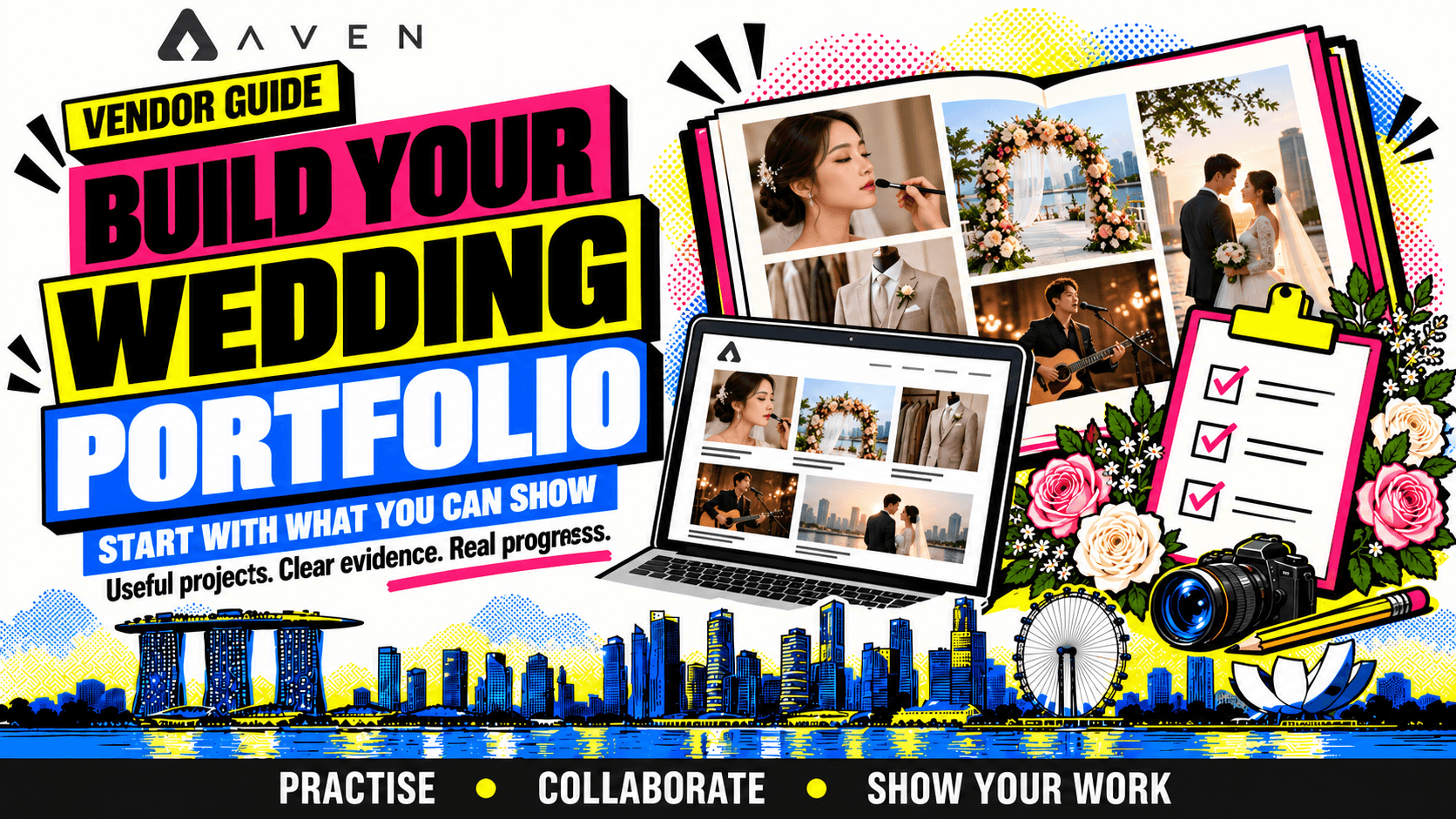
Your first portfolio needs to show what you can deliver
Getting your first wedding clients can feel circular. Couples want to see your work before booking, but you need opportunities to create that work.
You can break that cycle by building evidence in smaller, manageable steps. Assisting experienced vendors, creating practice projects and organising collaborations can help you demonstrate your skills before you have a large collection of client weddings.
The approach applies across vendor categories. A photographer needs relevant galleries. A makeup artist needs clear examples of their work. A florist needs arrangements shown at an understandable scale. A coordinator needs evidence of preparation and organisation.
This guide explains how to build an early wedding portfolio in Singapore and present it accurately.
Start with our guide to starting a wedding business if you are still setting up. For the broader roadmap, use the complete Singapore wedding vendor business guide.
1. Decide what your portfolio needs to prove
Before creating more material, define the service you intend to sell.
A portfolio should help couples answer three questions:
- Can this vendor produce the result we want?
- Does their experience relate to our wedding requirements?
- What will working with them involve?
Write down the specific evidence your offer needs.
For photography, that might include ceremony coverage, family photographs and portraits. For bridal attire, it might include fit, garment details and the appointment experience. For entertainment, it might include performance quality, repertoire and the setup.
Choose evidence that matches your current scope. A styled table arrangement does not demonstrate that you can manage a large venue installation.
Our wedding business niche guide can help you decide which work to focus on.
2. Audit the work and experience you already have
You may already have useful material from related projects.
Review previous work, training, assisted projects and personal practice. Identify what it demonstrates and where the gaps remain.
| Existing work | What it may demonstrate | What still needs to be tested |
|---|---|---|
| Event photography | Working with people, lighting and changing conditions. | Wedding-specific coverage and responsibilities. |
| Portrait makeup | Application skills and understanding preferences. | Bridal requirements, timing and wear under relevant conditions. |
| Small floral arrangements | Design, finish and material handling. | Transport, installation and larger-scale delivery. |
| Event coordination | Scheduling and communication. | The actual scope of wedding preparation and coordination. |
| Live performances | Musical or hosting ability. | Wedding programme cues, sound arrangements and audience fit. |
Use related work with a clear description. Explain what it shows rather than presenting it as wedding experience you do not yet have.
3. Assist an experienced vendor in a clearly defined role
Assisting can help you learn how real weddings operate while contributing within your current ability.
Agree on your role before the event. That could be assisting with lighting, preparing materials, supporting setup, handling agreed coordination tasks or performing a defined part of the service.
Clarify:
- What you are responsible for.
- Who supervises your work.
- The schedule and payment arrangements.
- Whether you may create or retain portfolio material.
- Whether client approval or another permission is needed.
- How your role must be credited.
Do not assume that participation gives you permission to publish the finished work.
When presenting an assisted project, describe your contribution accurately. “Assisted with floral preparation and installation” tells a couple more than a gallery that leaves your role unclear.
4. Create practice projects around specific gaps
A useful practice project answers a defined question.
For a photographer, that might mean practising portraits in a small room with limited light. For a makeup artist, it could mean documenting different looks under consistent lighting. A photobooth provider might test setup time, guest flow and output quality.
Define:
- The skill or process you want to test.
- The conditions you want to practise.
- What a successful result looks like.
- What you will document.
- What you need to improve afterwards.
Use volunteers or collaborators with clear expectations and permission arrangements.
Describe the resulting work as practice or a demonstration where appropriate. It can show a capability without implying a completed client booking.
Repeat the project if the first result reveals a gap. The learning matters as much as the images.
5. Organise a styled shoot with a useful objective
A styled shoot can help several vendors create coordinated portfolio material.
It works best when the concept supports a service you want to sell. An intimate solemnisation setup might provide relevant material for a florist, stylist, photographer, bridal attire provider and makeup artist.
Before proceeding, agree on the brief, participants, costs, schedule and expected outputs. Confirm who can use the material, where it can be published and how collaborators will be credited.
Think about the evidence each participant needs. A florist may need wider views and detail photographs. An attire provider needs the garment shown clearly. A venue needs images that accurately represent the space.
Label the project as a styled shoot when presenting it. For planning details, read how to organise a wedding styled shoot in Singapore.
6. Match the evidence to your vendor category
A wedding portfolio does not have to be a collection of photographs alone.
| Vendor category | Useful early portfolio evidence |
|---|---|
| Photography | Coherent galleries showing different parts of the event and your role. |
| Videography | Complete sample films demonstrating storytelling, sound and delivery style. |
| Bridal makeup and hair | Clear views of the finished look, with relevant context and consistent presentation. |
| Floristry and styling | Detail images, wider views, dimensions and an explanation of the scope. |
| Planning and coordination | Sample timelines, handover documents and clearly described project responsibilities. |
| Bridal attire | Garment details, fit examples and information about selection and fitting. |
| Entertainment | Performance recordings, repertoire examples and setup information. |
| Photobooth services | Actual setup photographs, sample outputs and operating requirements. |
| Venues | Accurate layouts, event setups and information about access and service arrangements. |
Choose material that helps a couple understand the actual offer. Where the work is a demonstration, label it accordingly.
7. Show complete examples as well as highlights
Highlights attract attention. Complete examples help couples assess consistency.
A photographer can show a selection that includes the ceremony, family interactions and portraits. A videographer can include a finished film instead of relying only on a short montage.
A florist can pair bouquet close-ups with wider installation views. An entertainer can show a sustained performance excerpt rather than only a few seconds from several songs.
Select the material thoughtfully. You do not need to publish every image or document.
Include enough information for the couple to understand what they are seeing, the conditions of the project and which parts you delivered. Avoid filling gaps with work that does not represent your own contribution.
8. Add context that makes each project useful
A short project description can turn attractive material into meaningful evidence.
Use this structure:
Brief: What the project required.
Role: What you personally or your business delivered.
Scope: The coverage, arrangement, performance or service involved.
Approach: How you handled the requirements.
Result: What the finished work demonstrates.
For example:
“Practice floral setup for an intimate solemnisation. We designed and installed the ceremony arrangement within the dimensions shown, then tested transport, assembly and collection.”
For a real client project, use the actual agreed scope and obtain permission before publishing relevant material.
A clear description also helps prevent couples from assuming that a small displayed project represents a much larger service.
9. Get permissions and credits agreed before publishing
Discuss portfolio use before the project rather than treating it as an automatic benefit afterwards.
Depending on the material, you may need agreement from the client, lead vendor, collaborators, participants or rights holder.
Clarify:
- Which images, recordings or documents you may use.
- Whether use includes your website, social media and advertising.
- Any restrictions on publication timing.
- The required credits.
- Whether personal information must be removed.
- Whether supplied music or other third-party material has appropriate usage rights.
Keep the agreed permissions organised with the project records.
Avoid sharing client contact details, private planning information or internal documents that have not been prepared for public use. Use fictional information in sample documents and label them as samples.
10. Choose early paid bookings within your capacity
Your first paid bookings should fit what you can deliver reliably.
A smaller, clearly defined service may be a sensible starting point, provided you understand its requirements. A short event can still involve important moments, tight access windows or complicated coordination.
Explain your experience and service scope honestly. Set clear expectations for deliverables, timing and responsibilities.
If you offer introductory pricing, account for the actual workload and costs. Define the offer rather than accepting unlimited requests in exchange for portfolio material.
Use the wedding vendor pricing guide to assess whether the booking is workable.
Where a brief exceeds your experience, consider a supervised role or collaboration with an experienced vendor instead of taking sole responsibility.
11. Make the portfolio easy to browse on a phone
Organise the portfolio around the decisions couples need to make.
Start with a concise introduction to your service, then show relevant examples with short descriptions. Group different services or project types where that improves clarity.
Check that:
- Images and videos load properly.
- Text is readable on a small screen.
- Project roles and labels are easy to find.
- Examples match your current offer.
- Contact details and the enquiry route are visible.
- The portfolio works without requiring a long explanation.
Avoid presenting a large collection of unrelated material just to make the business appear more established.
Our wedding business website checklist can help you prepare the rest of the experience.
12. Use feedback to decide what to create next
Pay attention to the questions couples ask after viewing your work.
If they repeatedly ask to see complete events, add fuller examples. If they cannot understand the scale of an arrangement, show wider views and dimensions. If your coordination service feels unclear, explain the process with a sample document.
Review completed projects too. Record what worked, what required support and what you would change.
Your next portfolio project should address a real gap rather than repeat an image you already have.
Keep the collection aligned with your ideal wedding clients and brand positioning. As your service develops, replace early examples that no longer represent your current work.
Frequently asked questions about early wedding portfolios
How many projects do I need?
There is no fixed number that proves readiness. Focus on whether your examples demonstrate the service you intend to provide, with enough variety and context to assess it fairly.
Can I use styled shoots in my portfolio?
Yes, with the necessary permissions and accurate labelling. They demonstrate work under planned conditions. Real event experience provides additional evidence of live delivery.
Can I show work completed while assisting another vendor?
Only where the relevant permissions allow it. Explain your contribution and credit the lead vendor or collaborators as agreed.
Should I offer free weddings to build a portfolio?
Free work still carries delivery responsibilities. Start with a clearly defined learning or portfolio objective and an appropriate scope. Do not accept a complex booking you cannot deliver simply because no fee is involved.
What can a planner show without many client weddings?
Clearly labelled sample timelines, planning tools and process explanations can help. Describe assisted event experience accurately and avoid presenting fictional documents as evidence of completed bookings.
What if my first projects do not match my intended niche?
Use relevant parts with honest context, then plan projects that fill the gap. Keep the main portfolio focused on the service you want couples to consider.
Your early wedding portfolio checklist
Before sharing the portfolio widely, confirm that:
- It supports a clearly defined service.
- Your role is accurately described.
- Practice projects and styled shoots are labelled.
- The collection shows more than isolated highlights.
- Project scope and scale are understandable.
- Relevant permissions and credits are agreed.
- Private information has been removed.
- The work is easy to view on a phone.
- Couples can find the next step.
- You know which evidence you still need to develop.
Build the portfolio one useful project at a time. Each addition should help a couple understand what you can deliver and whether your service suits their wedding.
Continue with how to organise a wedding styled shoot in Singapore, or return to the complete Singapore wedding vendor business guide for the wider business roadmap.