
Blog
Just Engaged? What to Discuss at Your First Wedding Planning Meeting
October 30, 2026 · Updated October 30, 2026
Just engaged and unsure where to start? Use this first wedding planning meeting guide to discuss priorities, budget, guests and next steps together.
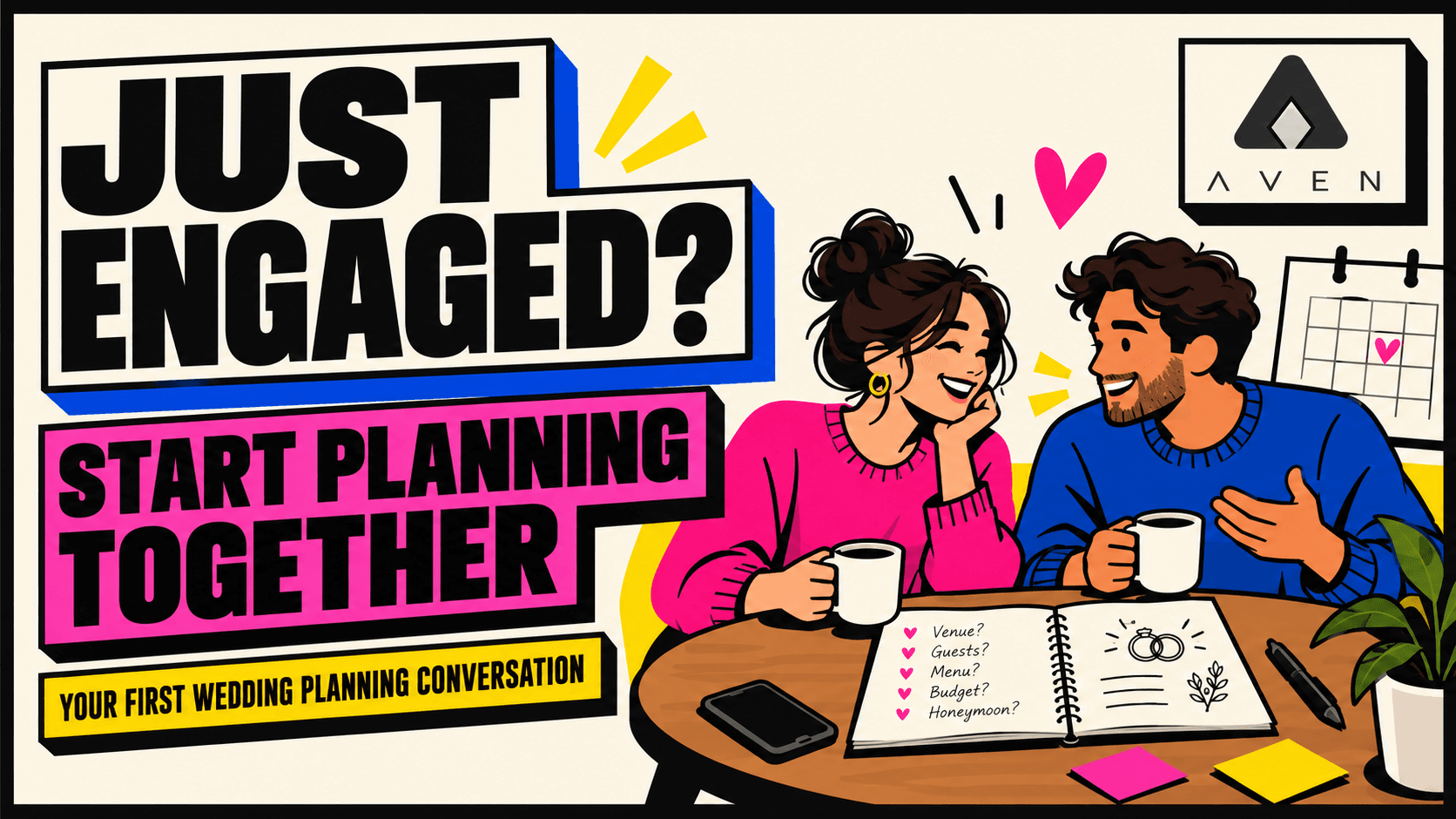
We just got engaged. What should we do first?
Give yourselves time to enjoy being engaged. When you are ready to start planning, have a conversation about the wedding you both want before making bookings.
Your first wedding planning meeting does not need to produce a confirmed date, a complete budget or a vendor shortlist. Its purpose is to establish a shared starting point.
Aim to leave with three things:
- An idea of what matters most to each of you.
- A few working boundaries around money, guests and timing.
- A short list of next actions with clear owners.
This guide focuses on that first conversation. For the full journey, read Aven’s Singapore wedding planning guide.
How should we prepare for our first wedding planning conversation?
Set aside around an hour when neither of you is rushing somewhere. Treat that as a suggested starting point, not a deadline to resolve everything.
Before sitting down, each write brief answers to:
- What am I most looking forward to?
- What part of wedding planning worries me?
- What are three things I care about?
- What am I comfortable keeping simple?
- Is there a family, cultural or religious expectation we need to discuss?
Answer separately first so one person’s ideas do not become the default before the other has had time to think.
Bring any information you already have, such as a possible wedding month or a family guest estimate. Leave uncertain figures clearly marked as estimates.
What should we discuss during the first meeting?
Use this sample agenda and adjust it to your situation.
| Time | Conversation | Useful result |
|---|---|---|
| 0–10 minutes | What we want the celebration to feel like | A shared description |
| 10–20 minutes | Spending comfort and financial questions | A working limit or research task |
| 20–30 minutes | Guests and family involvement | A rough size range |
| 30–40 minutes | Timing and celebration format | Possible months and arrangements |
| 40–50 minutes | How we will share the planning | Owners and a review routine |
| 50–60 minutes | What happens next | A short action list |
If money or family arrangements need more time, give them another conversation. There is little value in rushing to agreement just to finish the agenda.
How do we explain the kind of wedding we want?
Start with experiences rather than a list of purchases.
Try:
- “I want enough time to speak to our guests.”
- “I would love a proper celebration with our extended families.”
- “I want the ceremony to feel personal.”
- “I do not want to spend the whole day moving between locations.”
Then ask what those preferences mean in practice.
Wanting more time with guests might mean fewer programme items. Wanting extended family present might affect venue size. Wanting a relaxed morning might change how many activities you include.
Finish this sentence together:
“We want a wedding that feels _____, with _____, and enough room for _____.”
Keep this statement somewhere you can revisit when later decisions get difficult.
How should we talk about money before we have wedding quotations?
Begin with financial comfort, then research what different celebrations would cost.
Discuss:
- What can we contribute without creating pressure on essential expenses?
- What other commitments are we planning for?
- How much might we need available for deposits?
- Are family contributions confirmed, uncertain or not expected?
- What would we simplify if suitable quotations exceed our limit?
Do not turn a hoped-for contribution into money you assume is available.
If you are not ready to choose a final budget, agree on a research boundary. For example:
“Let’s find out what a restaurant lunch and a hotel lunch would involve before deciding our spending limit.”
Assign that research to someone and set a date to revisit it.
Use the Singapore wedding budget guide when you are ready to build the figures.
How do we estimate guest numbers without creating the final guest list?
Start with groups rather than debating every individual invitation.
Each partner can estimate:
- Immediate family.
- Extended family.
- Close friends.
- Other friends or colleagues.
- Guests your parents may hope to invite.
Mark which numbers are confirmed and which need a conversation.
An illustrative working note might say:
“About 100 guests from our own lists, with family estimates still pending.”
That is more useful than recording a confident total based on incomplete information.
Before approaching venues, ask both families for their expectations and understand whether partners and children are included in the estimates.
For the detailed process, use the Singapore wedding guest list guide.
Do we need to choose a wedding date during this conversation?
You can begin with a range of possible months.
Identify anything that genuinely limits your options: work commitments, essential guests travelling, religious arrangements or family traditions you intend to follow.
Separate those constraints from preferences.
| Type | Example | What to do |
|---|---|---|
| Fixed constraint | An essential family member is unavailable for a period | Exclude those dates |
| Strong preference | You would prefer a Saturday lunch | Research suitable options |
| Flexible detail | A date looks memorable | Consider it alongside practical choices |
If auspicious dates matter to either family, agree on how you will obtain and discuss them.
Your next action may simply be checking a few possible dates against venue availability.
What family expectations should we raise early?
Talk about who needs to be consulted and what you still need to ask.
In a Singapore wedding, that might include guest numbers, financial contributions, solemnisation arrangements, meals or traditions such as Guo Da Li and tea ceremony where relevant.
Avoid speaking for your family before checking.
Instead of “My parents will definitely want this,” try:
“I think this may matter to them. I’ll ask what they have in mind.”
If a contribution comes with an expectation, discuss both together before making commitments.
Record unresolved questions as questions. You do not have to settle every family preference during your first meeting.
How do we share wedding planning from the beginning?
Assign ownership of a complete next action.
“Help with venues” leaves the work unclear. A more useful task is:
“Shortlist three venues that fit our guest estimate and send enquiries by next Sunday.”
The owner should know:
- What information they need.
- What result they are working towards.
- When to bring it back for discussion.
- Which decisions require both partners.
Sharing ownership does not mean every task must be split exactly in half. It means both people understand the workload and agree on a practical arrangement.
Aven lets you keep tasks and expenses in a shared wedding workspace. Use it to make the next actions visible to both of you rather than relying on one person to remember and follow up on everything.
What if we disagree about the wedding?
Find the reason behind the preference before choosing a solution.
If one person wants a small wedding and the other wants a large one, ask what each option represents.
One might be worried about cost and attention. The other might be thinking about including important relatives.
Those concerns need different answers. A headcount compromise alone may not address them.
Try:
“What matters most to you about that option?”
Then record what you agree on, what remains open and what information could help.
If a conversation becomes unproductive, pause and choose a time to return to it. A supplier’s promotion should not become the reason you commit before reaching agreement.
What should we write down after the meeting?
Separate decisions, assumptions and open questions.
| Category | Example |
|---|---|
| Agreed decision | We prefer a lunch celebration |
| Working assumption | We may invite around 120 people |
| Open question | Does either family want a separate tea ceremony location? |
| Next action | Ask both families for guest estimates |
| Owner | Partner A |
| Review date | Our next planning session |
An assumption can change when new information arrives. A decision should only be recorded as agreed when both of you understand it.
Keep the summary short enough that you will actually read it before the next meeting.
Can we use a template for our first wedding planning meeting?
Copy this into your shared notes and fill it in together.
Our first wedding planning conversation
The experience we want:
We want our wedding to feel:
Our priorities:
Partner A’s three priorities:
Partner B’s three priorities:
What we are comfortable simplifying:
Money:
What we are comfortable contributing:
Other financial commitments to consider:
Confirmed family contributions, if any:
What we still need to research:
Guests:
Our initial guest estimate:
Family estimates still needed:
People we need to consult:
Timing and format:
Possible months or dates:
Fixed constraints:
Preferred celebration format:
Family, cultural or religious arrangements to discuss:
Our next actions:
| Action | Owner | Due date |
|---|---|---|
Our next planning conversation:
Date and topics:
What can wait until later?
Unless an upcoming booking requires the information, you can usually leave detailed styling and programme choices for later.
You probably do not need to finalise table names, wedding favours, march-in songs or invitation wording during the first conversation.
Keep ideas in a separate list so you can return to them without treating every idea as a task due now.
If you come across a vendor you like, save the details. Before making a booking, confirm that the date, scope, budget and terms suit your plans.
The useful question is:
“Do we need to decide this now for another important step to happen?”
What should we do after the first wedding planning meeting?
Complete the actions you agreed on before starting another round of open-ended research.
That may mean collecting family guest estimates, exploring a few venue options or checking the information you need to set a budget.
At the next meeting, review what you learned and choose the next decisions together.
Start your shared wedding workspace on Aven to organise those actions, track expenses and build your guest list as your plans develop. When you are ready to research suppliers, explore listed vendors, their portfolios and packages, and start relevant conversations through chat.
You do not need a finished wedding plan yet. You need a starting point you both understand.