
Blog
Singapore Wedding Guest List Guide: How to Build, Organise & Finalise Your List
September 9, 2026 · Updated September 9, 2026
Build your Singapore wedding guest list with a practical system for estimating numbers, splitting invitations between families, managing plus-ones, children, RSVPs and venue capacity.
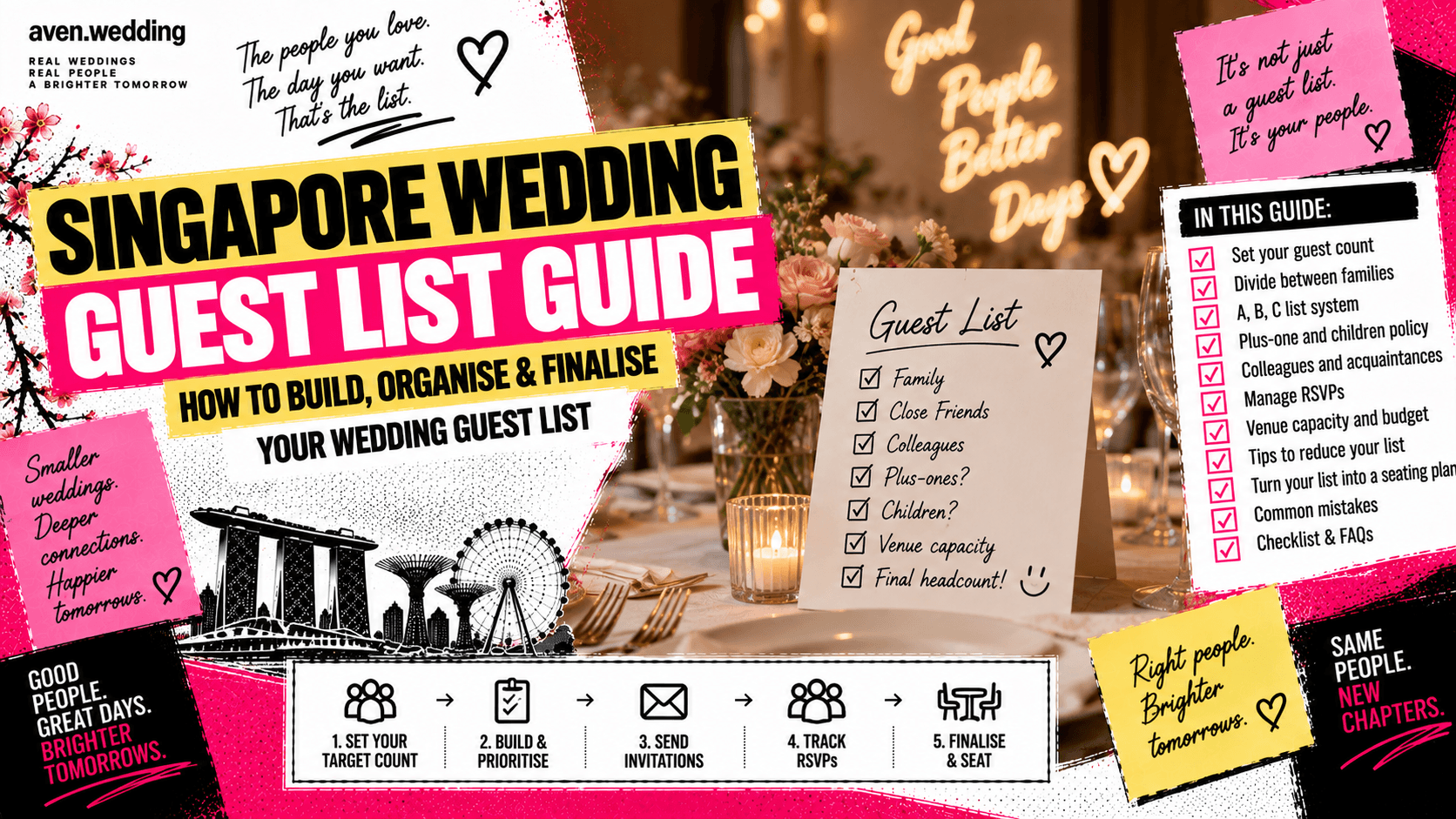
How do you build a wedding guest list in Singapore?
The guest list looks simple until you actually start writing names.
You add your closest friends.
Your partner adds theirs.
Your parents send over a list.
Then someone asks whether Uncle's three adult children are invited.
Someone else wants to invite colleagues.
And suddenly your intimate 120-person wedding has 238 potential guests.
A good Singapore wedding guest list needs more than a list of names.
You need a system for:
- Estimating your target guest count
- Dividing invitations between families
- Prioritising guests
- Handling plus-ones
- Deciding whether children are invited
- Matching your list to venue capacity
- Tracking RSVPs
- Managing declines
- Creating the final seating list
This guide walks through that process from your first rough list to the final confirmed headcount.
For the bigger picture, start with Aven's Ultimate Singapore Wedding Planning Guide.
Should you choose your venue or guest list first?
Ideally, create an estimated guest list before booking your venue.
You do not need every name confirmed.
But you should know whether your wedding is roughly:
- 50 guests
- 100 guests
- 150 guests
- 250 guests
- 400 guests
A venue suitable for 80 people may be completely wrong for a 250-person banquet.
At the same time, your budget may place a limit on how many people you can realistically invite.
So guest count, venue and budget should be planned together.
Use Aven's How to Choose a Wedding Venue Based on Guest Count before committing to a space.
Start with a maximum guest count
Before listing names, establish a ceiling.
For example:
Maximum invited guests: 180
This number should consider:
- Wedding budget
- Venue capacity
- Banquet format
- Desired atmosphere
- Family expectations
Without a ceiling, guest lists tend to grow because every individual invitation sounds reasonable in isolation.
The maximum forces you to look at the wedding as a whole.
Understand the difference between invited guests and confirmed guests
These are different numbers.
Invited guests
Everyone you send an invitation to.
Confirmed guests
Guests who have accepted your invitation.
Final attendance
The people who actually attend.
Not everyone invited will say yes.
And unfortunately, not everyone who says yes will necessarily appear on the day.
Keep these numbers separate in your planning sheet so you always know what each figure represents.
Create one master wedding guest list
Do not maintain separate WhatsApp messages, Notes app lists and spreadsheets.
Create one master list.
Useful columns include:
| Field | Example |
|---|---|
| Guest name | John Tan |
| Side | Bride |
| Group | University |
| Invited by | Couple |
| Priority | A |
| Plus-one | Yes |
| Children | 0 |
| Invitation sent | Yes |
| RSVP | Confirmed |
| Dietary needs | Vegetarian |
| Table | 12 |
This becomes the single source of truth for invitations, RSVPs and seating.
Build separate lists before combining them
A useful first step is creating four lists:
Bride
People the bride wants to invite.
Groom
People the groom wants to invite.
Bride's family
Guests requested by the bride's parents.
Groom's family
Guests requested by the groom's parents.
Do not negotiate every name immediately.
First, see the total.
You may discover that your supposed 150-person wedding currently contains 270 names.
That is when prioritisation begins.
How should wedding invitations be divided between families?
There is no universal formula.
Some couples split guest allocations evenly.
Others allocate based on:
- Family size
- Financial contribution
- Cultural expectations
- Number of relatives
- Couple's preferences
For example, a 200-person wedding might initially allocate:
| Group | Seats |
|---|---|
| Couple's shared guests | 60 |
| Bride's guests | 35 |
| Groom's guests | 35 |
| Bride's family | 35 |
| Groom's family | 35 |
This is only an example.
The useful part is having an agreed allocation rather than letting every list expand independently.
Use an A, B and C guest priority system
If your initial list is too large, classify guests.
A List
People you strongly want at the wedding.
Examples:
- Immediate family
- Close relatives
- Closest friends
- Important people in your life
B List
People you would genuinely like to invite if capacity allows.
C List
People being considered mainly because of social obligation, distant relationships or uncertainty.
This does not mean C-list guests are unimportant people.
It simply forces you to decide how closely each invitation connects to your actual wedding.
Who should definitely be on your wedding guest list?
There is no universal mandatory guest list.
But most couples begin with:
- Immediate family
- Grandparents
- Close relatives
- Closest friends
- Wedding party
- Important mentors or family figures
From there, invitations become increasingly personal.
A useful question is:
"Would our wedding feel incomplete if this person wasn't there?"
If the answer is immediately yes, they probably belong near the top of the list.
Do you have to invite all your relatives?
No.
But family expectations can make this complicated.
Parents may see a wedding as a family occasion involving extended relatives the couple rarely meets.
Instead of immediately rejecting the request, establish boundaries.
For example:
- Parents receive a fixed allocation
- Priority goes to relatives with an active relationship
- Entire branches of distant relatives are treated consistently
- Additional invitations require available capacity
Consistency can help reduce arguments about why one distant relative was invited while another was not.
Do you have to invite your parents' friends?
Not automatically.
However, parents' friends are common at Singapore weddings, particularly when parents have longstanding social or professional relationships.
Discuss:
- How many seats parents receive
- Whether these guests know the couple
- Whether parents are contributing financially
- Whether venue capacity allows them
The important thing is agreeing on the allocation before names keep appearing.
Should you invite colleagues?
You can, but you do not have to invite your entire workplace.
Possible approaches include:
- Immediate team only
- Close work friends
- Current manager and close colleagues
- Nobody from work
- A clearly defined group
Be consistent where possible.
Inviting six people from an eight-person team can create a more awkward situation than inviting only two colleagues you are genuinely close to.
You are allowed to have relationships outside the office hierarchy.
Should you invite old friends you rarely see?
Ask yourself:
If I met this person tomorrow, would we naturally sit down and catch up?
A long history does not automatically require a wedding invitation.
Some old friendships remain deeply meaningful despite infrequent contact.
Others exist mainly because you once went to school together.
Your wedding does not need to become a reunion for every stage of your life.
Do you have to invite someone because they invited you?
No.
Receiving an invitation to someone's wedding does not create a permanent wedding debt.
Circumstances may have changed.
Your wedding may be:
- Smaller
- More expensive per guest
- Family-focused
- Held at a different type of venue
Invite people because you want them to share the day with you, not because you are balancing an invisible invitation ledger.
How should plus-ones work?
Set a consistent policy before invitations go out.
You might give plus-ones to:
- Married guests
- Engaged guests
- Guests in established relationships
- Guests travelling alone
- Guests who know almost nobody else
Or you may give named invitations only.
There is no single correct rule.
The important thing is understanding how plus-ones affect capacity.
Twenty individual guests receiving plus-ones can potentially become forty seats.
Should every single guest receive a plus-one?
Not necessarily.
For a smaller wedding, unrestricted plus-ones can consume a large part of your venue capacity.
If someone already knows many people at the wedding, a plus-one may be less necessary.
If a guest knows nobody and is travelling specifically for your wedding, you may feel differently.
Whatever approach you choose, try to apply it consistently and respectfully.
Should children be invited to your wedding?
This is entirely up to you and your venue.
Possible approaches include:
Children welcome
All families may bring their children.
Immediate-family children only
For example, nieces and nephews.
Age threshold
Only children above or below a chosen age category, depending on your event format.
Adults-only
No children except specific necessary exceptions.
Before deciding, check whether your venue:
- Provides children's meals
- Provides high chairs
- Counts children toward capacity
- Has suitable space for prams
Make the invitation wording clear so parents can plan.
How do overseas guests affect your list?
Mark overseas guests separately.
They may need more notice to arrange:
- Flights
- Accommodation
- Leave
- Transport
- Family travel
Consider contacting important overseas guests before formal invitations so they can begin planning.
Do not assume they will decline simply because they live abroad.
If their attendance matters to you, invite them properly and let them decide.
How does your venue capacity affect invitations?
Know the difference between:
Maximum capacity
The largest number the venue can physically accommodate.
and
Comfortable capacity
The number that allows the layout you actually want.
A venue may technically fit 200 guests but feel very different once you add:
- Stage
- Aisle
- Photo booth
- Reception table
- AV equipment
- Decor
- Dance floor
Use Aven's Wedding Venue Floor Plan Guide Singapore before pushing your guest count to the absolute maximum.
How does your guest list affect your wedding budget?
Guest count is one of the biggest drivers of wedding cost.
More guests may mean more:
- Tables
- Food
- Drinks
- Invitations
- Favours
- Transport
- Rentals
- Staffing
If your budget is under pressure, reducing the guest count can have a larger effect than cutting dozens of small decorative expenses.
Use Aven's Wedding Budget Checklist Singapore to see how your guest count interacts with the rest of the wedding.
How do you reduce a wedding guest list?
If your list is too large, cut systematically.
Start with:
- People neither of you knows
- Distant acquaintances
- Former colleagues you no longer speak to
- Unnecessary plus-ones
- Very distant relatives
- Social-obligation invitations
- Guests you are inviting mainly to avoid awkwardness
Do not randomly remove names.
Use rules.
Rules make difficult decisions more consistent.
What is a B-list and should you use one?
A B-list contains people you would like to invite if space becomes available after initial declines.
It can work, but handle it carefully.
Do not send second-wave invitations so late that guests obviously feel like replacements.
If you use a B-list:
- Send first invitations early
- Set an appropriate RSVP deadline
- Contact second-wave guests with enough notice
- Never tell them they were on a backup list
Better yet, think of it as staged invitations based on capacity, not ranking human beings.
When should you finalise the guest list?
You will have several versions.
Early planning
Estimated list for budget and venue selection.
Before invitations
Full invitation list with addresses or contact details.
After RSVP deadline
Confirmed attendance list.
Before venue deadline
Final headcount and seating arrangement.
Your list is not truly final until the venue's required attendance deadline approaches.
Build enough buffer into the process so you are not chasing 40 unanswered invitations the night before numbers are due.
How should you track RSVPs?
Track every invitation in the same master list.
Useful statuses include:
- Not invited yet
- Invitation sent
- Awaiting response
- Confirmed
- Declined
- Maybe
- Follow-up required
Also record:
- Number attending
- Plus-one name
- Children's attendance
- Dietary requirements
- Accessibility needs
This information will later feed directly into your seating plan.
For the next stage, use Aven's upcoming RSVP planning guide alongside your guest list.
How do you turn the guest list into a seating plan?
Do not start assigning tables while half your guests are still undecided.
Once most RSVPs are confirmed, group guests by:
- Family
- Friend groups
- Workplace
- Age
- Existing relationships
- Accessibility needs
Then work within your venue's table configuration.
Your guest database should remain the master source, with table numbers added once seating is confirmed.
Use Aven's Singapore Wedding Seating Plan Guide for the full process.
Common wedding guest list mistakes
Avoid these problems:
Booking a venue before estimating guests
Your venue and guest count need to fit each other.
Giving parents unlimited invitations
Agree on allocations first.
Forgetting plus-ones
They can increase numbers quickly.
Not deciding your children policy
Ambiguous invitations create awkward questions.
Maintaining several guest lists
Use one master list.
Assuming everyone will attend
Invited count and confirmed count are different.
Cutting people randomly
Use consistent rules.
Starting seating too early
Wait until RSVPs are mostly confirmed.
Ignoring venue comfort
Maximum capacity is not always ideal capacity.
Singapore wedding guest list checklist
Use this checklist from your first estimate to final attendance.
Initial planning
- Set approximate wedding size
- Set maximum guest count
- Check budget implications
- Check venue requirements
Build the list
- Bride creates list
- Groom creates list
- Bride's family submits list
- Groom's family submits list
- Combine into one master list
- Remove duplicates
Set policies
- Decide family allocations
- Decide plus-one policy
- Decide children policy
- Decide colleague policy
- Identify overseas guests
Prioritise
- Mark A-list guests
- Mark B-list guests
- Review social-obligation invitations
- Reduce list if necessary
Invitations and RSVPs
- Contact important overseas guests
- Send invitations
- Track responses
- Follow up unanswered invitations
- Record dietary needs
- Record accessibility needs
Finalise
- Confirm attendance
- Send final headcount to venue
- Build seating plan
- Assign table numbers
- Share relevant guest information with venue or coordinator
Frequently asked questions about Singapore wedding guest lists
How many people should we invite to our wedding?
There is no ideal number. Your guest count should fit your budget, venue and preferred wedding atmosphere.
Should parents decide who gets invited?
Parents can contribute names, but couples should agree on allocations and the overall maximum guest count.
Do we have to invite all our relatives?
No. Family expectations vary, and couples can set reasonable boundaries.
Does every guest need a plus-one?
No. Create a consistent plus-one policy based on your wedding size and circumstances.
Can we have an adults-only wedding?
Yes, but communicate the policy clearly and consistently.
Do we have to invite colleagues?
No. Invite colleagues based on your relationships rather than workplace obligation.
Do we need to invite someone because they invited us to their wedding?
No. A previous wedding invitation does not automatically require a reciprocal invitation.
Should we invite more people than the venue capacity because some will decline?
Be cautious. Never create a situation where unexpectedly high acceptance leaves you above your venue's workable capacity.
When should we start the seating plan?
Once most RSVPs are confirmed.
Your guest list should reflect the people who matter to your wedding
Guest-list planning gets difficult because every name comes with a relationship.
A cousin.
An old friend.
A colleague.
Your parents' neighbour.
Someone whose wedding you attended seven years ago.
And when you look at people individually, almost everyone can feel like they deserve an invitation.
That is why you need boundaries.
Start with the wedding you can afford.
Choose a venue that fits.
Protect seats for the people you genuinely want beside you.
Give both families a clear way to contribute.
And remember that a smaller guest list is not automatically a less meaningful wedding.
The people in the room matter more than how many chairs you managed to fill.
Continue with the Singapore Wedding Seating Plan Guide, Wedding Venue Guest Count Guide and Wedding Venue Floor Plan Guide.
For budget planning, use the Wedding Budget Checklist Singapore.
For your complete planning journey, return to the Ultimate Singapore Wedding Planning Guide.