
Blog
Wedding RSVP Guide Singapore: How to Collect, Track & Follow Up Responses
September 10, 2026 · Updated September 10, 2026
Manage wedding RSVPs in Singapore with a practical system for invitations, response deadlines, plus-ones, dietary needs, follow-ups, final headcounts and seating.
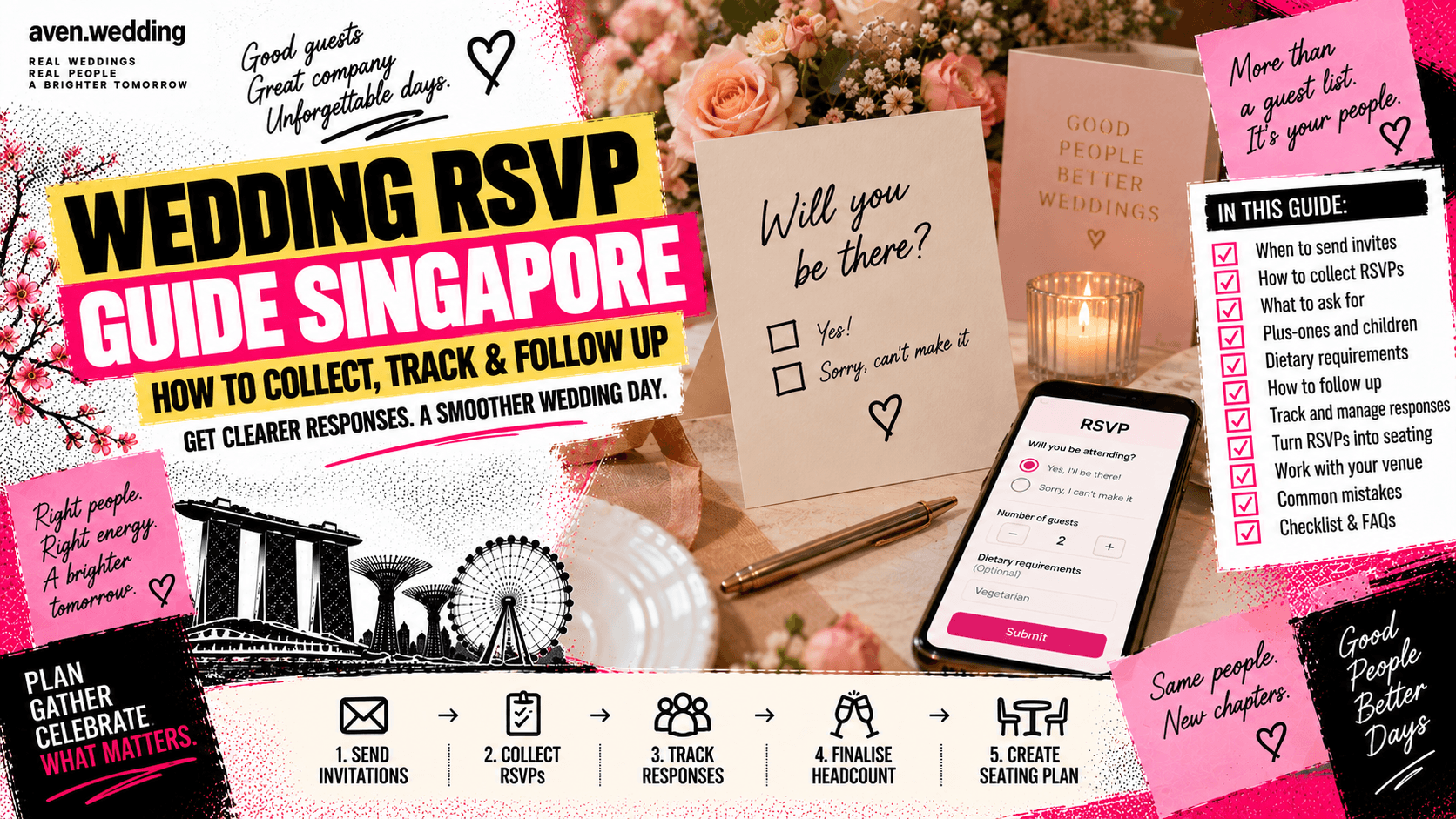
How do you manage wedding RSVPs in Singapore?
Wedding RSVPs sound simple.
Send invitation.
Wait for response.
Update list.
Done.
In reality, you will probably get:
- Fast yeses
- Fast noes
- "Let me check first"
- "Should be okay"
- No reply
- A plus-one you did not know about
- A dietary requirement mentioned three weeks later
- Someone replying to your mum instead of you
A good wedding RSVP system prevents all of that from becoming chaos.
This guide covers how to collect responses, track guests, follow up politely and turn your RSVP list into a final headcount and seating plan.
If you have not built your full guest list yet, start with Aven's Singapore Wedding Guest List Guide.
What does RSVP actually mean?
RSVP comes from the French phrase Répondez s'il vous plaît, meaning:
Please respond.
For wedding planning, it simply means you are asking invited guests to confirm whether they will attend.
A proper RSVP should ideally tell you more than yes or no.
You may also need:
- Number attending
- Plus-one name
- Children's attendance
- Dietary requirements
- Accessibility needs
- Contact details
When should guests RSVP by?
Set a clear deadline that gives you enough time to:
- Follow up unanswered guests
- Confirm your final headcount
- Finalise tables
- Inform your venue
- Update catering
- Prepare place cards or seating charts
Your venue may have its own final attendance deadline.
Work backwards from that.
For example:
Venue final numbers due: 14 days before wedding
You might set:
Guest RSVP deadline: 4 weeks before wedding
That gives you time to chase missing responses before the venue deadline.
Do not set the guest deadline on the same day your venue needs final numbers.
How early should wedding invitations be sent?
Timing depends on the wedding and your guests.
Send invitations earlier when:
- Many guests are overseas
- Guests need leave from work
- Wedding falls during a busy holiday period
- Accommodation is required
- The wedding involves travel
Local guests may require less notice than overseas guests, but important guests should still receive enough time to plan.
The goal is to give people a fair chance to attend rather than forcing everyone to decide at the last minute.
Use one RSVP system for everyone
Avoid collecting responses through:
- Your WhatsApp
- Your partner's WhatsApp
- Parents' chats
- Instagram messages
- Random phone calls
- Memory
Choose one master system.
This could be:
- Wedding website
- Online RSVP form
- Spreadsheet
- Planning app
- Guest management tool
Even if guests respond through different channels, every answer should end up in the same master list.
That is your source of truth.
What information should an RSVP form collect?
Keep it simple.
Useful fields include:
- Guest name
- Attending: yes or no
- Number attending
- Plus-one name if allowed
- Children's attendance
- Dietary requirements
- Accessibility requirements
- Contact number
- Optional message to the couple
Do not ask for information you will never use.
A shorter form is easier for guests to complete.
Should every guest receive an individual RSVP?
Not necessarily.
You can collect responses by household or invitation group.
For example:
Invitation: Mr and Mrs Tan + 2 children
The RSVP may ask:
How many from your party will attend?
This is especially useful for families.
For individual friends, one-person RSVPs may be simpler.
Your method should match how invitations are addressed.
How should plus-ones be handled in RSVPs?
Decide your plus-one policy before sending invitations.
If a guest has a plus-one, make that clear.
You can:
- Name the partner directly
- State "+1"
- Ask for the plus-one's name in the RSVP form
Avoid leaving it ambiguous.
If the invitation is for one person only, wording should not accidentally imply that they can bring someone.
Plus-ones can significantly affect your headcount, so track them carefully.
Use Aven's Singapore Wedding Guest List Guide for a full plus-one planning framework.
How should children's attendance be collected?
If children are invited, ask parents to confirm exactly how many will attend.
You may need:
- Child's name
- Age
- Children's meal
- High chair
- Baby chair
- Space for pram
If the wedding is adults-only, communicate this clearly before RSVPs open.
Do not rely on parents guessing from the invitation.
Should you ask about dietary requirements?
Yes, if your venue or caterer can accommodate them.
Common examples include:
- Vegetarian
- Vegan
- Halal requirements
- Food allergies
- Religious dietary restrictions
Ask guests to state genuine dietary needs rather than general preferences.
Then confirm with your venue what can actually be accommodated.
Do not promise a specific meal before checking with your caterer.
What about accessibility needs?
Give guests a way to tell you if they need assistance.
This could include:
- Wheelchair access
- Step-free route
- Seating near exits
- Easy access to toilets
- Space for mobility aids
You do not need an elaborate form.
A simple optional field such as:
"Anything we should know to make your visit more comfortable?"
can be enough.
Share relevant information with your venue or coordinator before the wedding.
How should RSVP statuses be tracked?
Use clear statuses.
For example:
| Status | Meaning |
|---|---|
| Not invited | Invitation not sent |
| Sent | Invitation delivered |
| Pending | Awaiting reply |
| Confirmed | Attending |
| Declined | Not attending |
| Maybe | Has not decided |
| Follow-up | Needs chasing |
| Finalised | Response locked |
Avoid writing vague notes like:
"Probably coming."
You want the list to be understandable at a glance.
What counts as a confirmed RSVP?
A confirmed guest should have clearly said yes.
Responses such as:
- "Should be okay"
- "Likely"
- "I'll try"
- "Probably coming"
are not strong confirmations.
You can respond with:
"No worries, just let us know by the RSVP deadline so we can confirm the final headcount."
That keeps things friendly without treating uncertainty as a confirmed seat.
How do you follow up with guests who have not replied?
Follow up after the RSVP deadline.
Keep it short and neutral.
For example:
"Hey! Just checking in on our wedding RSVP as we're finalising the guest list with the venue. Let us know if you'll be able to make it. Thank you!"
You do not need to apologise for asking.
You are not chasing them socially.
You need a final number for the wedding.
Should you follow up before the RSVP deadline?
Usually, give guests the full response window first.
But an earlier reminder can make sense if:
- The venue deadline is approaching
- You think they missed the invitation
- They are an important overseas guest
- Travel booking is required
- They previously asked you to remind them
Otherwise, avoid repeatedly chasing people before the stated deadline.
How many times should you chase an unanswered RSVP?
Generally, you should not need to chase endlessly.
A practical approach is:
- Send the invitation
- Send one reminder near or after the deadline
- Follow up personally if necessary
- Set a final response cut-off
If someone still cannot confirm, you may need to mark them as not attending for planning purposes.
Be clear and polite.
What if someone says yes and later cancels?
Cancellations happen.
Ask them to let you know as early as possible.
Then update:
- Headcount
- Seating
- Meal requirements
- Plus-one details
If your venue has already locked numbers, you may still have to pay for the seat.
That is part of the practical reality of wedding planning.
Do not turn a genuine cancellation into a relationship conflict unless there is a bigger issue.
What if someone asks to bring an extra guest?
Check whether your guest list and venue can accommodate it.
You can say no.
For example:
"We're keeping the wedding to a fixed guest list because of venue capacity, so unfortunately we can't add another guest."
You do not need a complicated excuse.
If you can accommodate the request and want to, update the RSVP properly instead of letting the extra person appear informally.
What if parents collect RSVPs separately?
This is common.
If parents are managing their own relatives or friends, give them the same structure.
Ask them to provide:
- Guest name
- Attending or not
- Number attending
- Dietary needs
- Plus-one details
- Children if relevant
Then consolidate everything into your master list.
Do not let four family WhatsApp groups become your guest database.
How do you handle verbal RSVPs?
Record them immediately.
If someone tells your father:
"Yes, we'll be there."
that is still an RSVP.
But somebody needs to update the master list.
If the information is incomplete, confirm:
- How many people
- Which family members
- Any children
- Dietary needs
The problem is not verbal RSVPs.
The problem is verbal RSVPs that never make it into the system.
When should you lock the final headcount?
Your venue or caterer should tell you when final numbers are due.
Before that deadline:
- Resolve pending responses
- Remove declines
- Confirm plus-ones
- Confirm children
- Check meal requirements
- Recheck family lists
Once numbers are locked, treat later changes as exceptions.
Avoid continuously changing the guest count unless the venue confirms it is possible.
How do RSVPs connect to the seating plan?
Only confirmed guests should go into the final seating plan.
Once responses are mostly complete, group guests by:
- Family
- Friend group
- Workplace
- Existing relationships
- Accessibility needs
Then assign tables.
This is why your RSVP system and guest list should be connected rather than maintained separately.
Use Aven's Singapore Wedding Seating Plan Guide once your attendance is stable.
How do RSVPs affect the venue and catering?
Your confirmed attendance may affect:
- Number of tables
- Meal quantities
- Children's meals
- Vegetarian meals
- Special dietary arrangements
- Seating layout
- Table linen
- Favours
- Place settings
Share final numbers in the format requested by your venue.
Do not assume the venue will extract everything from your guest spreadsheet automatically.
Common wedding RSVP mistakes
Avoid these problems:
No clear deadline
Guests do not know when to respond.
Collecting replies everywhere
Information gets lost.
Treating "maybe" as yes
Your headcount becomes unreliable.
Not tracking plus-ones
Guest numbers increase unexpectedly.
Forgetting children
Family invitations can contain more people than expected.
Ignoring dietary requirements
You discover them after catering is finalised.
Chasing too late
You have no time before the venue deadline.
Starting seating before RSVPs settle
You redo the seating plan repeatedly.
Not updating verbal responses
Everyone thinks someone else recorded them.
Wedding RSVP checklist Singapore
Before invitations
- Finalise initial guest list
- Decide plus-one policy
- Decide children policy
- Confirm venue headcount deadline
- Set RSVP deadline
- Create master tracking system
RSVP form
- Guest name
- Attending or declining
- Number attending
- Plus-one name
- Children's attendance
- Dietary requirements
- Accessibility needs
- Contact details if required
After sending
- Mark invitations sent
- Record responses immediately
- Update verbal RSVPs
- Track pending guests
- Follow up after deadline
- Confirm uncertain responses
Finalisation
- Lock confirmed guest count
- Confirm plus-ones
- Confirm children
- Finalise dietary requirements
- Submit venue headcount
- Start seating plan
- Share relevant information with coordinator
Frequently asked questions about wedding RSVPs in Singapore
When should we set the RSVP deadline?
Set it before your venue's final headcount deadline so you have time to follow up missing responses.
Can guests RSVP through WhatsApp?
Yes, but every response should still be recorded in one master system.
Should we include dietary requirements in the RSVP?
Yes, if the venue can accommodate them.
What if a guest says "maybe"?
Keep them as pending until they clearly confirm.
Can we chase guests who have not replied?
Yes. A polite follow-up after the deadline is completely reasonable.
What if someone wants to bring a plus-one we did not invite?
You can decline if capacity or your guest policy does not allow it.
When should we start the seating plan?
Once most guests have confirmed.
Do we need to track children separately?
Yes, especially if children's meals, high chairs or venue capacity are affected.
RSVPs are not about chasing people, they are about certainty
The stressful part of RSVPs is rarely the form itself.
It is uncertainty.
Are they coming?
How many?
Did they reply to your parents?
Are they bringing their partner?
Was that "should be okay" actually a yes?
A good RSVP system removes those questions one by one.
Set a deadline.
Track everything in one place.
Follow up when necessary.
Then turn your final answers into the headcount, seating plan and wedding day you can actually plan around.
Continue with the Singapore Wedding Guest List Guide and Singapore Wedding Seating Plan Guide.
For venue capacity planning, use the Wedding Venue Guest Count Guide and Wedding Venue Floor Plan Guide.
For your complete planning journey, return to the Ultimate Singapore Wedding Planning Guide.