
Blog
Wedding Budget Checklist Singapore: Every Cost to Plan For
August 29, 2026 · Updated August 29, 2026
Build your Singapore wedding budget with this complete checklist covering venue, vendors, outfits, solemnisation, traditions, guests, actual-day expenses and commonly forgotten costs.
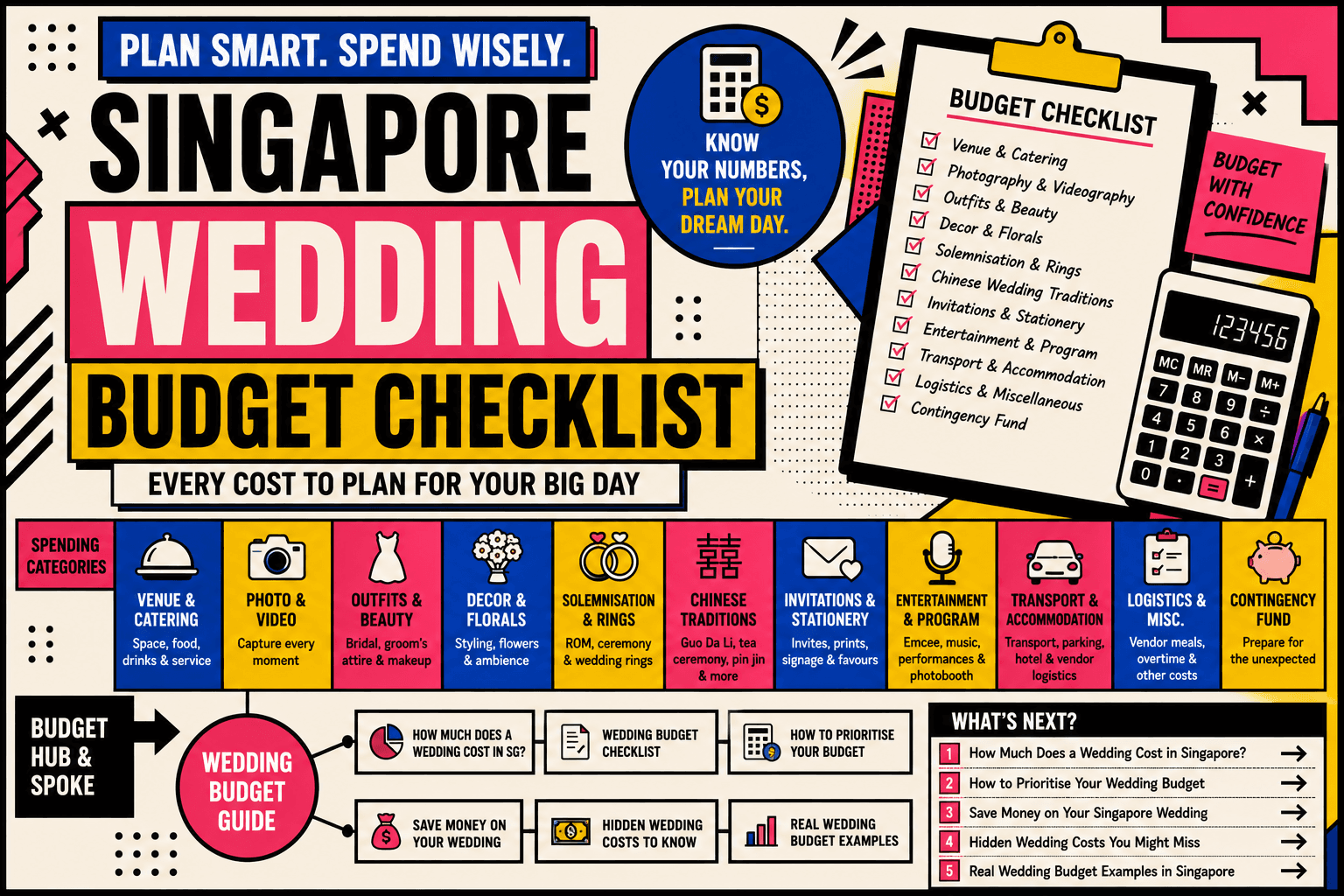
What should you include in a Singapore wedding budget?
A wedding budget is much easier to manage when you know what you may need to pay for before you start booking.
Your budget may include:
- Venue and catering
- Solemnisation
- Photography
- Videography
- Bridal outfits
- Groom's attire
- Hair and makeup
- Florals and decorations
- Invitations and stationery
- Chinese wedding traditions
- Entertainment
- Transport
- Wedding-day logistics
- Vendor payments
- Last-minute expenses
Not every couple needs every category.
The purpose of this checklist is not to convince you to spend more.
It is to help you see the complete financial picture so you can decide what belongs in your wedding and what does not.
For your overall planning journey, start with the Ultimate Singapore Wedding Planning Guide.
If you prefer planning chronologically, use the Complete Singapore Wedding Planning Timeline.
Singapore wedding budget checklist at a glance
Use these categories to build your first budget.
Venue and guests
- Venue
- Catering
- Drinks
- Solemnisation venue if separate
- Additional guest charges
Core vendors
- Photographer
- Videographer
- Makeup artist
- Florist
- Decorator
- Emcee
- Entertainment
Outfits
- Wedding gown
- Additional bridal outfits
- Groom's suit
- Shoes
- Accessories
- Alterations
Marriage and traditions
- Solemnisation-related expenses
- Wedding rings
- Guo Da Li if applicable
- Tea ceremony if applicable
- Other family traditions
Guest experience
- Invitations
- Wedding website if applicable
- Favours
- Photobooth
- Guestbook
- Signage
Actual day
- Transport
- Vendor meals
- Accommodation
- Overtime
- Emergency purchases
- Miscellaneous logistics
You may eventually remove several categories.
That is completely fine.
A good budget checklist shows your options without turning every option into a requirement.
Start with your total wedding budget
Before deciding how much each category receives, determine your overall spending boundary.
Ask:
How much can we comfortably spend on the wedding without compromising our other financial priorities?
Consider what else may be happening around the same period:
- Home purchase
- Renovation
- Honeymoon
- Moving expenses
- Savings goals
- Other major commitments
Then set three numbers.
Target budget
What you would ideally like to spend.
Maximum budget
The amount you do not want to exceed.
Contingency
Money reserved for unexpected or underestimated expenses.
This gives you boundaries before vendor quotations begin influencing your expectations.
Create your Singapore wedding budget tracker
Do not track only what you have already paid.
Track what you have committed to spend.
Use a table like this:
| Category | Budget | Quoted | Booked | Paid | Remaining |
|---|---|---|---|---|---|
| Venue | |||||
| Photography | |||||
| Videography | |||||
| Bridal | |||||
| Makeup | |||||
| Decor | |||||
| Entertainment | |||||
| Transport | |||||
| Other |
For example, if a vendor package costs $4,000 and you have paid a $1,000 deposit:
Paid: $1,000
Committed: $4,000
Your budget should recognise the full $4,000 commitment.
Otherwise, your remaining budget can look much larger than it really is.
Budget for your Singapore wedding venue and catering
For many weddings, the venue and catering form a major part of the overall budget.
Do not record only the initial package figure.
Check what the venue package includes.
Possible items include:
- Venue rental
- Food
- Drinks
- Tables and chairs
- Basic decor
- Stage
- AV equipment
- Bridal room
- Solemnisation space
- Parking
- Menu tasting
Then identify potential additional costs.
These may include:
- Additional tables
- Additional guests
- Upgraded menu
- Additional drinks
- External catering
- Additional venue hours
- Additional equipment
- Decoration upgrades
Compare venues based on the total wedding you would receive, not just the headline package price.
Budget for your wedding guest count
Guest count and wedding cost are closely connected.
More guests can mean more:
- Food
- Drinks
- Tables
- Invitations
- Favours
- Venue space
This is why your guest list should be considered a financial decision as well as a social one.
Start with a realistic estimate.
Then ask:
What happens to our budget if we add another 20 guests?
Understanding the marginal impact of additional guests can help when deciding whether to expand your invitation list.
Your guest list will continue evolving throughout planning, so update your budget whenever your expected attendance changes.
Budget for wedding photography
When budgeting for photography, compare the entire package rather than only the base rate.
Consider:
- Coverage hours
- Number of photographers
- Morning coverage
- Solemnisation
- Tea ceremony
- Banquet
- Overtime
- Pre-wedding photography
- Albums or prints if desired
- Travel if applicable
Ask yourself which parts of the wedding you genuinely want documented.
If your wedding begins early and ends after a dinner banquet, make sure the coverage you are budgeting for matches the actual length of your day.
Your eventual Singapore Actual-Day Wedding Timeline can help you check whether vendor coverage hours are realistic.
Budget for wedding videography
Videography packages can differ based on both coverage and deliverables.
Possible costs may relate to:
- Number of videographers
- Coverage hours
- Highlight film
- Longer documentary edit
- Same-day edit
- Solemnisation coverage
- Additional events
- Overtime
- Travel
Decide what you actually want to preserve.
For example, one couple may prioritise a cinematic highlight.
Another may care more about preserving:
- Vows
- Speeches
- Tea ceremony
- Family interactions
Budget according to the memories that matter to you rather than automatically selecting the largest package.
Budget for your wedding gown and bridal outfits
Your bridal budget may involve more than the main wedding gown.
Depending on your celebration, consider:
- Main gown
- Solemnisation dress
- Evening gown
- Tea ceremony outfit
- Traditional outfit
- Veil
- Accessories
- Shoes
- Alterations
- Cleaning or damage-related charges where applicable
When comparing bridal packages, check exactly what is included.
A package with more outfits is not automatically better value if you do not actually want to wear all of them.
Every additional actual-day outfit change also affects your timeline.
Choose outfits based on what you genuinely want to wear.
Budget for the groom's wedding attire
The groom's budget may include:
- Suit
- Additional jacket
- Shirt
- Trousers
- Tie or bow tie
- Shoes
- Belt
- Cufflinks
- Pocket square
- Alterations
The cost structure will differ depending on whether you choose:
- Bespoke
- Made-to-measure
- Rental
- Off-the-rack
Budget for the complete look rather than only the suit itself.
Shoes, tailoring and accessories can easily become separate purchases if they are not included.
Budget for bridal hair and makeup
When reviewing hair and makeup packages, consider:
- Number of looks
- Hair styling
- Makeup
- Trial
- Touch-ups
- Additional outfit changes
- Early start arrangements
- Travel
- Makeup for family members if required
Your wedding schedule matters.
A bride having a morning gatecrash, tea ceremony, solemnisation and dinner banquet may have different requirements from someone having a single evening celebration.
Avoid choosing a package before understanding roughly how many looks your wedding actually needs.
Budget for wedding florals and decorations
Decor can expand quickly because there are many possible areas to style.
These may include:
- Solemnisation arch
- Aisle
- Stage
- Reception
- Welcome area
- Photo area
- Guest tables
- Bridal bouquet
- Boutonnieres
- Signage
Before allocating a large decor budget, check what your venue already provides.
Then decide which areas matter most visually.
You do not need to decorate every empty corner.
Concentrating your budget on a few important areas can create a stronger overall result than spreading it thinly across everything.
Budget for your Singapore ROM and solemnisation
If your solemnisation is part of your wedding, include any related expenses in your overall plan.
Depending on your arrangements, these may involve:
- Ceremony venue
- Setup
- Chairs
- Florals
- Signage
- Rings
- Photography
- Videography
- Guest refreshments
- Other ceremony-related requirements
If the solemnisation happens at the same venue as your banquet, check what your package already includes.
Marriage procedures and fees can change, so verify current official requirements when completing the legal process.
For ceremony planning, use the Singapore ROM & Solemnisation Guide.
Budget for Chinese wedding traditions
If your families are observing Chinese wedding traditions, create a separate budget category rather than treating everything as miscellaneous.
Depending on your families, this may involve:
- Guo Da Li
- Hui Li
- Pin jin
- Dowry
- An Chuang
- Tea ceremony
- Traditional outfits
- Other customary items
The financial arrangements surrounding traditions can differ significantly between families.
Discuss expectations before entering figures into your budget.
The goal is not to determine what every Singapore couple should spend.
It is to understand what your families are planning so those expenses do not appear unexpectedly later.
Budget for wedding rings and jewellery
Keep wedding rings separate from engagement-ring spending if that makes your financial tracking clearer.
Consider:
- Bride's wedding band
- Groom's wedding band
- Engraving
- Resizing
- Other wedding jewellery
Decide whether rings come from:
- Your wedding budget
- Personal spending
- A separate jewellery budget
There is no need to follow a particular spending rule.
Choose rings you are comfortable wearing and paying for.
Most importantly, order them early enough to allow for production, engraving and resizing where necessary.
Budget for wedding invitations and stationery
Your stationery budget depends heavily on whether you choose digital, printed or mixed invitations.
Possible expenses include:
- Invitation design
- Printing
- Envelopes
- Delivery
- Wedding website
- Welcome sign
- Seating chart
- Table numbers
- Programme cards
- Guestbook
Before printing, confirm:
- Date
- Venue
- Timing
- Names
- RSVP details
Avoid ordering large quantities before your guest list and event information are stable.
Digital invitations can also reduce printing requirements if they suit your wedding.
Budget for your pre-wedding photoshoot
If you are planning a pre-wedding shoot, create a separate budget.
Possible costs include:
- Photographer
- Videographer
- Hair and makeup
- Outfits
- Location fees
- Studio
- Transport
- Props
- Travel
- Accommodation for destination shoots
Also think about what happens after the shoot.
You may spend additional money using the photographs for:
- Albums
- Invitations
- Welcome signage
- Guestbook
- Banquet displays
A simple local shoot can be just as meaningful as a complicated destination production.
Choose the experience that fits your priorities and budget.
Budget for your wedding banquet programme and entertainment
Your programme may introduce additional costs depending on what you include.
Possible categories include:
- Emcee
- Live band
- Singer
- DJ
- Performances
- Photobooth
- Wedding cake
- Dessert table
- AV requirements
- Special effects
Before booking, ask:
Does this improve the experience we want to create?
You do not need to fill every part of the banquet with an activity.
A simpler programme can also give couples more time to eat, talk to guests and enjoy the celebration.
Budget for wedding transport and accommodation
Transport is easy to underestimate because it may involve several groups.
Consider transport for:
- Bride
- Groom
- Bridal party
- Parents
- Photographer
- Videographer
- Wedding belongings
Possible expenses include:
- Wedding car
- Additional vehicles
- Parking
- Tolls
- Chauffeur
- Hotel accommodation
- Additional hotel nights
Map your wedding-day locations before estimating transport.
A wedding involving several homes, a solemnisation venue and a banquet venue may require more coordination than a wedding happening mostly in one location.
Budget for vendor meals, overtime and additional hours
Some costs only become obvious once the actual-day schedule is clearer.
Review vendor agreements for:
- Meals
- Overtime
- Additional coverage
- Early starts
- Late finishes
- Transport
- Additional locations
For example, your original photography package may appear sufficient until your timeline stretches from early-morning preparations to the end of a dinner banquet.
Do not automatically purchase more hours.
First understand what your existing package covers.
Closer to the wedding, use the Wedding Vendor Confirmation Checklist to reconfirm operational and payment details.
Budget for your wedding reception, ang bao box and guest experience
Small guest-facing expenses can accumulate.
Depending on your wedding, you may consider:
- Ang bao box
- Guestbook
- Reception stationery
- Signage
- Favours
- Photobooth
- Welcome drinks
- Children's activities
- Other guest amenities
Separate:
Useful
Something that solves a practical need.
Meaningful
Something you genuinely want guests to experience.
Optional
Something you are considering mainly because other weddings have it.
For the logistics surrounding valuables and gifts, use the Wedding Ang Bao Box & Gift Handling Guide.
What wedding costs are commonly forgotten?
The most easily forgotten costs are often not major vendors.
They are the small additions surrounding them.
Examples may include:
- Alterations
- Shoes
- Accessories
- Vendor overtime
- Transport
- Parking
- Additional hotel nights
- Printing
- Delivery
- Last-minute stationery
- Vendor meals
- Additional guests
- Makeup touch-ups
- Small ceremony items
- Emergency purchases
Create a miscellaneous and contingency category rather than expecting your original budget to predict every small expense perfectly.
Closer to the wedding, the Wedding Day Emergency Kit Checklist can also help you prepare useful items before they become last-minute purchases.
How much contingency should you keep in your wedding budget?
There is no single contingency percentage that suits every wedding.
The important principle is to avoid allocating your entire maximum budget before the final stages of planning.
Keep room for:
- Price changes
- Guest changes
- Overtime
- Alterations
- Additional logistics
- Forgotten items
- Genuine emergencies
Your contingency is not an invitation to spend more.
If you do not use it, that is a good outcome.
Treat it as financial breathing room rather than another category that needs to be exhausted.
How should you prioritise your wedding budget?
One useful approach is to separate spending into three levels.
Priority 1: Essential
Things required for your wedding to function.
For example:
- Venue
- Food
- Required ceremony arrangements
Priority 2: Personally important
Things that matter strongly to you.
For example:
- Photography
- Videography
- Particular outfits
- Guest experience
Priority 3: Optional
Things you would enjoy but can remove without changing the core wedding.
When your budget becomes tight, reduce Priority 3 before compromising the things that matter most.
This is more useful than trying to spend equally across every wedding category.
How do you keep your wedding budget under control?
Use a few simple rules throughout planning.
Track commitments immediately
The moment you book a vendor, update your total committed spending.
Review the budget before upgrades
Do not decide on an upgrade in isolation.
Check what it does to the entire wedding budget.
Know your guest-count impact
Adding guests can affect several categories simultaneously.
Avoid duplicate spending
Check what your venue and vendors already provide before buying separately.
Stop comparing after booking
Constantly reopening completed decisions can encourage unnecessary upgrades.
Separate wants from needs
Something can be beautiful without needing to become part of your wedding.
Review monthly
A short regular budget review is easier than discovering several months of forgotten spending at once.
Complete Singapore wedding budget checklist
Use this master checklist when building your budget.
Venue and guests
- Venue
- Catering
- Drinks
- Solemnisation venue if separate
- Additional guests
- Venue upgrades
Photography and video
- Actual-day photography
- Actual-day videography
- Pre-wedding shoot
- Additional hours
- Overtime
- Albums or prints if wanted
Attire and beauty
- Wedding gown
- Additional bridal outfits
- Groom's attire
- Alterations
- Shoes
- Accessories
- Hair and makeup
- Trial or touch-ups if applicable
Marriage and traditions
- Solemnisation
- Wedding rings
- Guo Da Li if applicable
- Tea ceremony if applicable
- Other traditions
Styling and programme
- Florals
- Decor
- Signage
- Emcee
- Entertainment
- Photobooth
- Other programme items
Guests and stationery
- Invitations
- Wedding website if applicable
- Guestbook
- Favours
- Reception materials
- Seating chart
Logistics
- Transport
- Parking
- Accommodation
- Vendor meals
- Delivery
- Overtime
Financial protection
- Track all deposits
- Track remaining balances
- Record payment deadlines
- Keep contingency
- Review committed spending regularly
When should you review your wedding budget?
Your wedding budget should evolve throughout planning.
Useful checkpoints include:
18 months before
Set your initial financial boundaries.
Use the 18-Month Wedding Checklist.
12 months before
Update your budget as venue and major vendor quotations become real.
Use the 12-Month Wedding Checklist.
9 to 6 months before
Review committed vendor spending and remaining categories.
Use the 9-Month Wedding Checklist and 6-Month Wedding Checklist.
3 months before
Check upcoming balances and actual-day expenses.
Use the 3-Month Wedding Checklist.
1 month before
Confirm outstanding payments and final logistics.
Use the 1-Month Wedding Checklist.
Regular reviews prevent the budget from becoming something you create once and never look at again.
Frequently asked questions about Singapore wedding budgets
What should a wedding budget include?
Include your venue, catering, vendors, outfits, beauty, solemnisation, traditions, stationery, entertainment, transport, guest-related expenses and a contingency for unexpected costs.
Should I include vendor balances I have not paid yet?
Yes. Once you have committed to a vendor package, track the entire amount rather than only the deposit already paid.
Should wedding rings be included in the wedding budget?
They can be. Some couples include them in the overall wedding budget while others track jewellery separately. The important thing is accounting for the expense somewhere.
Should I budget for wedding ang baos as income?
It is safer to build a wedding you can afford without depending on uncertain gifts to cover expenses that must be paid beforehand.
What should I cut first if my wedding budget is too high?
Start with expenses that are optional and least important to you. Protect the parts of the wedding that are essential or personally meaningful.
How often should we review our wedding budget?
Review it whenever you make a significant booking and periodically throughout planning so your committed spending remains accurate.
Build the wedding budget before building the wedding
A wedding budget is not there to remove the fun from planning.
It gives you permission to spend confidently on the things that matter because you understand what the entire wedding costs.
Start with your total budget.
Estimate your guests.
Identify your priorities.
Track every commitment.
Leave contingency.
Then make each new decision in the context of the whole wedding.
This checklist is the first supporting branch of Aven's wedding budget cluster.
As the cluster grows, it can connect into deeper guides covering wedding costs, venue spending, vendor budgeting and ways to prioritise your wedding expenses.
For now, continue your overall planning with the Ultimate Singapore Wedding Planning Guide or follow your current stage in the Complete Singapore Wedding Planning Timeline.
A good wedding budget does not tell you what your wedding should cost.
It helps you decide what your wedding is worth spending on.