
Blog
How to Prioritise Your Wedding Budget in Singapore
August 29, 2026 · Updated August 29, 2026
Not sure where your wedding budget should go? Use this practical Singapore guide to identify your priorities, divide your spending and decide where to spend, save or simplify.
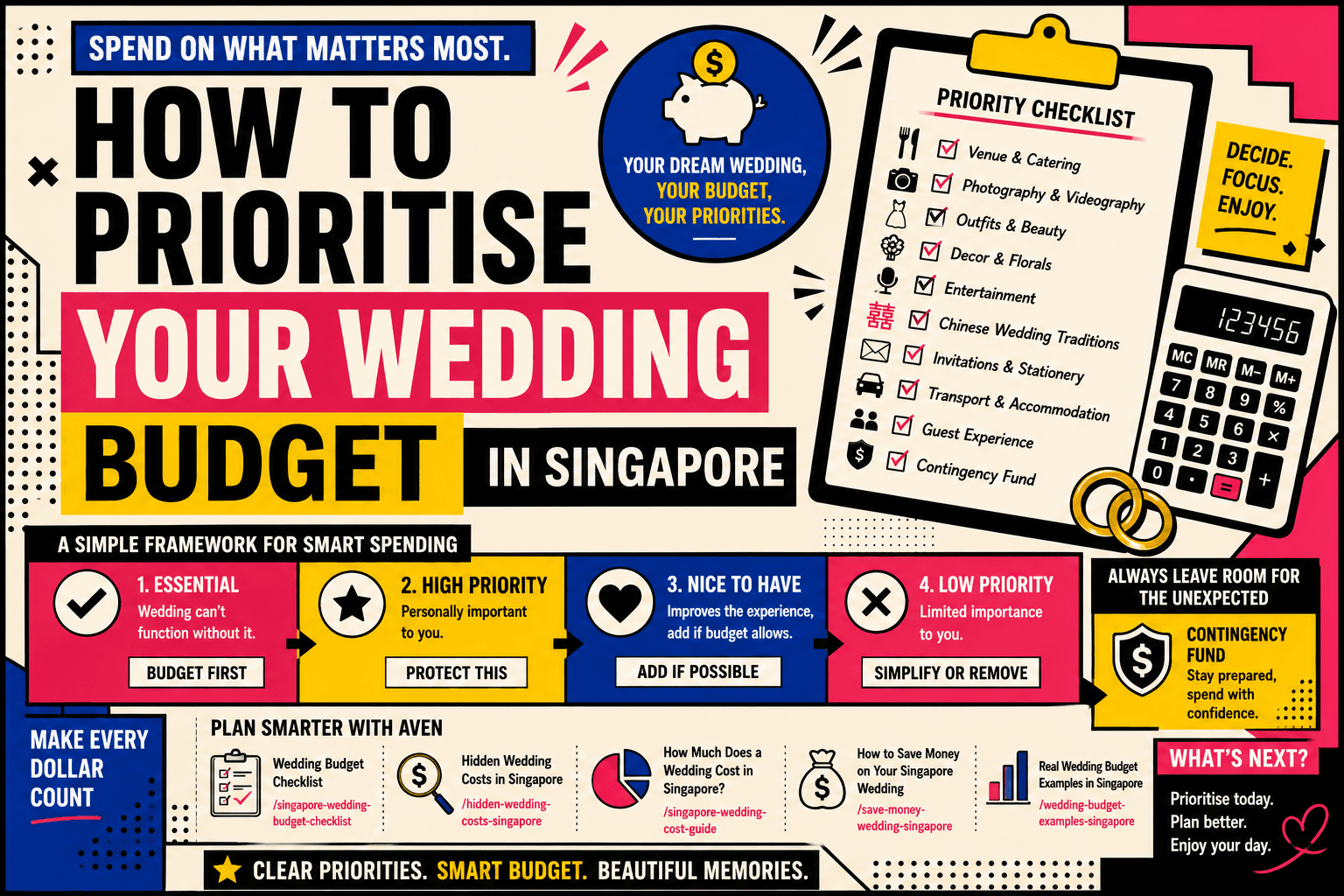
How should you prioritise your wedding budget?
There is no perfect percentage that every Singapore couple should spend on each part of a wedding.
One couple may care deeply about photography and videography.
Another may prioritise food and guest experience.
Another may want an intimate solemnisation with minimal decor and spend more on their honeymoon instead.
A useful wedding budget therefore starts with a different question:
What matters most to us?
Then divide your wedding expenses into:
- Essential
- High priority
- Nice to have
- Low priority
This gives every dollar a purpose instead of spreading your budget evenly across things you do not value equally.
Before prioritising, build your complete expense list using the Singapore Wedding Budget Checklist.
Then use this guide to decide where that money should actually go.
Wedding budget priorities at a glance
A simple framework looks like this:
| Priority | Meaning | Approach |
|---|---|---|
| Essential | Wedding cannot function without it | Budget first |
| High priority | Personally important to you | Protect spending |
| Nice to have | Improves the experience | Add if budget allows |
| Low priority | Limited importance to you | Simplify or remove |
| Contingency | Unexpected expenses | Keep unallocated |
For example:
Essential
- Venue
- Food
- Required ceremony arrangements
High priority
- Photography
- Videography
- Particular outfits
Nice to have
- Photobooth
- Additional decorations
- Entertainment
Low priority
- Anything you personally do not care about
Your categories may look completely different.
That is the point.
Your wedding budget should reflect your priorities rather than someone else's wedding checklist.
Step 1: Decide your total wedding budget first
Prioritisation only works when there is a boundary.
Start with:
Target budget
What you would ideally like to spend.
Maximum budget
The amount you do not want the wedding to exceed.
Contingency
Money deliberately left available for unexpected expenses.
Consider other financial priorities happening around your wedding:
- Home purchase
- Renovation
- Honeymoon
- Moving
- Savings
- Other major commitments
Your wedding does not exist separately from the rest of your financial life.
Choose a budget that allows you to enjoy the celebration without creating unnecessary pressure elsewhere.
Step 2: Each partner chooses their top three wedding priorities
Before discussing individual vendor packages, separately write down the three things each of you cares about most.
For example:
Partner A
- Photography
- Food
- Intimate atmosphere
Partner B
- Videography
- Venue
- Guest experience
Then compare your lists.
Anything appearing on both lists is clearly important.
Anything appearing on only one list deserves a conversation.
You may discover that some things you assumed were important to your partner actually are not.
This exercise gives you a much better foundation for budgeting than beginning with arbitrary percentages.
Step 3: Identify the wedding expenses that are essential
Start with the things your wedding actually requires.
Depending on your celebration, this might include:
- Venue
- Food
- Required marriage arrangements
- Basic attire
- Essential transport
Be careful with the word essential.
Something is not essential simply because it commonly appears at weddings.
For example:
A photobooth may be enjoyable.
It is not required for the wedding to happen.
Separating functional necessities from optional traditions and trends makes later budget decisions much easier.
Step 4: Identify your high-priority wedding expenses
High-priority spending is where personal preference matters most.
Ask:
What would we genuinely regret compromising on?
Possibilities include:
- Photography
- Videography
- Food
- Venue
- Bridal outfits
- Makeup
- Florals
- Entertainment
- Guest experience
- Solemnisation
These categories deserve more protection when your budget becomes tight.
For example, if preserving memories matters deeply to both of you, cutting photography to fund additional decorations may not align with your priorities.
There is no universally correct answer.
The objective is alignment.
Step 5: Create your nice-to-have list
Nice-to-have expenses improve your wedding but are not central to it.
Possible examples include:
- Photobooth
- Additional floral installations
- Live entertainment
- Additional outfit
- Wedding favours
- Dessert table
- Premium stationery
- Special effects
- Extra decor
Do not remove these automatically.
Instead, keep them separate from your core wedding.
Once essential and high-priority spending is understood, you can decide which optional additions still fit comfortably.
Step 6: Identify your low-priority wedding expenses
This is one of the most useful parts of wedding budgeting.
Ask:
What do we genuinely not care very much about?
Perhaps you do not care about:
- Elaborate florals
- Multiple outfits
- Physical invitations
- Wedding favours
- Entertainment
- Photobooth
- Large wedding cake
That does not mean those things are bad.
It means they are not important to you.
Low-priority categories are the first place to simplify when you need to protect the overall budget.
Use the must-have, meaningful and optional method
If four priority levels feel too complicated, use three.
Must-have
Required for the wedding or extremely important to you.
Meaningful
Not essential, but something that contributes strongly to the celebration you want.
Optional
Something you would enjoy if the budget allows.
Example:
| Expense | Priority |
|---|---|
| Venue | Must-have |
| Photographer | Must-have |
| Videographer | Meaningful |
| Florals | Meaningful |
| Photobooth | Optional |
| Favours | Optional |
This simple framework can be applied to almost every wedding decision.
Should you use fixed wedding budget percentages?
Budget percentages can be useful as rough planning references.
They become less useful when treated as rules.
Your wedding structure can dramatically change how money needs to be allocated.
For example:
A large hotel banquet may naturally place more of the total budget into venue and catering.
An intimate restaurant wedding may leave more room for photography, styling or other priorities.
A simple solemnisation may have a completely different spending structure.
Instead of asking:
What percentage should photography cost?
Ask:
Does this photography package fit our total budget and priorities after accounting for everything else we need?
Context matters more than a universal percentage.
How should you prioritise your wedding venue budget?
Your venue can influence:
- Guest capacity
- Catering
- Location
- Atmosphere
- Solemnisation
- Decor
- AV
- Logistics
Before upgrading your venue package, decide which features actually matter.
For example:
High priority
- Food
- Convenient location
- Comfortable capacity
Lower priority
- Premium decor upgrade
- Additional menu course
- Larger ballroom than required
Your priorities may be different.
Compare the total experience rather than assuming a more expensive package automatically produces a better wedding.
How should you prioritise your wedding guest budget?
Guest count can significantly influence wedding spending.
Ask yourselves:
Would we rather invite more people or spend more per guest?
There is no correct answer.
Some couples value a large celebration.
Others prefer a smaller guest list with a more intimate experience.
Before expanding your list, consider the wider impact.
Additional guests can affect:
- Catering
- Drinks
- Tables
- Invitations
- Favours
- Venue capacity
Guest-list decisions are therefore also budget decisions.
How should you prioritise photography and videography?
Photography and videography preserve different aspects of the wedding.
Photography captures individual moments visually.
Videography can preserve:
- Movement
- Voices
- Vows
- Speeches
- Reactions
- Atmosphere
Ask what you expect to value after the wedding.
Then decide:
- Whether you want both
- Desired coverage hours
- Number of photographers or videographers
- Deliverables
- Pre-wedding coverage
- Additional edits
Avoid selecting the largest package automatically.
Prioritise the coverage and memories that matter to you.
How should you prioritise bridal outfits and beauty?
More outfits do not automatically create a better wedding.
Decide which looks genuinely matter.
For example:
- Main wedding gown
- Solemnisation dress
- Tea ceremony outfit
- Evening gown
Then consider how each outfit affects:
- Rental or purchase cost
- Alterations
- Accessories
- Hair and makeup
- Actual-day timeline
If fashion is one of your biggest priorities, allocating more here may make sense.
If it is not, a simpler outfit plan can free budget for something you value more.
How should you prioritise wedding decor?
Instead of decorating every available area, identify the spaces that have the greatest impact.
Possible priorities include:
- Solemnisation backdrop
- Stage
- Reception
- Guest tables
- Bridal bouquet
- Photo area
Ask your venue what is already included.
Then focus additional styling on areas that:
- Guests experience prominently
- Appear frequently in photographs
- Contribute strongly to your desired atmosphere
Concentrated styling can be more effective than spreading the same budget thinly across many areas.
How should you prioritise Chinese wedding traditions?
If Chinese wedding traditions are part of your celebration, discuss them with both families before deciding what belongs in the budget.
Depending on family customs, this may involve:
- Guo Da Li
- Hui Li
- Pin jin
- Dowry
- An Chuang
- Tea ceremony
- Traditional outfits
Separate:
Traditions important to your families
from
Traditions you assumed every couple must follow.
Customs differ between families.
Clarifying expectations early helps you allocate both money and time more intentionally.
Prioritise experiences before wedding trends
Wedding inspiration can make every new idea feel important.
Before adding something because you saw it online, ask:
What experience does this create?
For example:
A live band may matter because you want an energetic celebration.
A photobooth may matter because your friends genuinely enjoy it.
An elaborate floral installation may matter because visual design is one of your biggest priorities.
Those are deliberate decisions.
But if you cannot explain why an addition matters to you, consider leaving it on the optional list.
A wedding does not need every current trend to feel complete.
Prioritise the things that cannot easily be changed later
Some wedding decisions are much harder to change than others.
Examples include:
- Venue
- Date
- Major vendors
- Guest capacity
Other decisions can often wait:
- Small decor details
- Signage
- Favours
- Minor accessories
When planning early, allocate attention and budget to the decisions that affect everything else.
This is why Aven's Complete Singapore Wedding Planning Timeline focuses on major foundations first and smaller execution details later.
Protect your wedding budget from hidden costs
Do not allocate every available dollar to visible wedding items.
Leave room for expenses that become clearer later.
Possible examples include:
- Overtime
- Alterations
- Transport
- Parking
- Vendor meals
- Additional guests
- Printing
- Delivery
- Last-minute purchases
Use the Hidden Wedding Costs in Singapore Guide to identify commonly overlooked expenses before they become surprises.
Contingency should be protected just like another priority category.
Use opportunity cost for difficult wedding decisions
When deciding whether to upgrade something, compare it with what the same money could fund elsewhere.
Instead of asking:
Can we afford this upgrade?
Ask:
Would we rather have this upgrade or use the money for something else?
For example:
Would you prefer:
- Additional decor or additional photography coverage?
- Another outfit or live entertainment?
- More guests or a smaller celebration with upgraded food?
- Premium invitations or more honeymoon spending?
This turns an abstract price into a meaningful choice.
Wedding budgeting becomes easier when you compare priorities rather than judging expenses individually.
Do not let sunk costs encourage more spending
After spending significantly on one category, it can become tempting to keep upgrading it.
For example:
"We already spent this much on decor, so we might as well add the upgraded backdrop."
Evaluate each additional expense independently.
Ask:
- Do we actually want it?
- Does it fit our priorities?
- Does it fit the remaining budget?
Money already committed should not automatically justify additional spending.
Create a wedding upgrade rule
A simple rule can prevent spontaneous upgrades from gradually expanding your wedding budget.
For example:
Any unplanned purchase above an amount we choose must be discussed together before booking.
Or:
Any new wedding expense must come from an existing category rather than increasing the total budget.
The exact rule is up to you.
The objective is to create a short pause between:
That looks nice
and
Let's buy it.
Small pauses can prevent many unnecessary expenses.
Review priorities whenever your wedding plan changes
Your priorities may evolve.
Review your budget when:
- Guest count changes significantly
- Venue changes
- A major vendor is booked
- Family expectations change
- New traditions are added
- Your actual-day timeline changes
- You receive significantly different quotations than expected
Do not protect an outdated budget simply because it was your first plan.
Update the allocation while keeping your overall financial boundary clear.
Wedding budget prioritisation worksheet
Use this table together.
| Category | Essential | High Priority | Nice to Have | Low Priority |
|---|---|---|---|---|
| Venue | [ ] | [ ] | [ ] | [ ] |
| Food | [ ] | [ ] | [ ] | [ ] |
| Photography | [ ] | [ ] | [ ] | [ ] |
| Videography | [ ] | [ ] | [ ] | [ ] |
| Bridal | [ ] | [ ] | [ ] | [ ] |
| Groom's attire | [ ] | [ ] | [ ] | [ ] |
| Makeup | [ ] | [ ] | [ ] | [ ] |
| Decor | [ ] | [ ] | [ ] | [ ] |
| Entertainment | [ ] | [ ] | [ ] | [ ] |
| Invitations | [ ] | [ ] | [ ] | [ ] |
| Favours | [ ] | [ ] | [ ] | [ ] |
| Photobooth | [ ] | [ ] | [ ] | [ ] |
Do not worry if you disagree initially.
The conversation created by the worksheet is often more valuable than the final labels.
What should you cut when your wedding budget is too high?
Start from the bottom of your priorities.
A practical sequence is:
1. Remove low-priority expenses
Things neither of you particularly values.
2. Reduce optional upgrades
Keep the category but choose the simpler version.
3. Simplify nice-to-have categories
Reduce quantity, scale or complexity.
4. Revisit guest count if appropriate
Only if this aligns with the celebration you want.
5. Compare alternatives for major expenses
Look for options that still satisfy the underlying priority.
Try to protect the things both of you identified as genuinely important.
Cutting randomly can reduce spending while also removing the parts of the wedding you cared about most.
Complete wedding budget priority checklist
Use this process before committing to major wedding expenses.
Set boundaries
- Agree on target budget
- Agree on maximum budget
- Keep contingency
- Consider other financial priorities
Identify priorities
- Partner A chooses top three
- Partner B chooses top three
- Compare priorities
- Identify shared priorities
Categorise spending
- Essential
- High priority
- Nice to have
- Low priority
Before booking
- Check total committed spending
- Check what is already included
- Compare alternatives
- Consider hidden costs
- Consider opportunity cost
Before upgrading
- Ask why the upgrade matters
- Compare against another priority
- Check remaining budget
- Follow your upgrade rule
Review regularly
- Update after major bookings
- Update after guest changes
- Track remaining vendor balances
- Protect contingency
Frequently asked questions about prioritising a wedding budget
What should we spend the most money on for our wedding?
There is no category every couple must prioritise. Start with essential expenses, then protect the categories that matter most to both of you.
Should venue and food always be the biggest wedding expense?
They may form a significant portion of some weddings, especially larger celebrations, but your spending structure depends on your venue, guest count and wedding format.
How many wedding priorities should we choose?
Three priorities each is a useful starting point because it forces you to distinguish what matters most from everything you merely like.
What should we cut first if we exceed our wedding budget?
Begin with low-priority expenses and optional upgrades before reducing the things you identified as genuinely important.
Should we spend more if our parents are contributing?
Treat family contributions according to whatever arrangements you agree on together. A larger available amount does not mean it must all be spent.
How do we stop wedding upgrades from getting out of control?
Set an agreed rule requiring both partners to approve significant unplanned purchases and continue tracking your total committed spending.
Build a wedding budget around what matters to you
A good wedding budget is not one where every category receives the "correct" percentage.
It is one where your spending reflects your priorities.
Start with the Singapore Wedding Budget Checklist to understand what you may need to pay for.
Then review the Hidden Wedding Costs in Singapore Guide so smaller expenses do not quietly undermine your plan.
From there:
- Set your total budget
- Identify your top priorities
- Protect essential spending
- Allocate more to what matters
- Simplify what does not
- Keep contingency
- Review as your wedding evolves
This guide forms another spoke in Aven's growing Singapore wedding budget cluster.
The next supporting guides can go deeper into saving money on your Singapore wedding and real wedding budget examples before everything connects into Aven's complete How Much Does a Wedding Cost in Singapore? budget hub.
For the broader planning journey, use the Ultimate Singapore Wedding Planning Guide.
Spend intentionally.
Not because a wedding checklist told you to.
Because you know what you want your wedding to mean.