
Blog
How to Choose SEO Keywords for Your Wedding Business in Singapore
October 3, 2026 · Updated October 3, 2026
Choose focused SEO keywords for your Singapore wedding business. Learn how to connect couples’ searches with your services, organise a practical keyword map and prioritise useful website improvements across vendor categories.
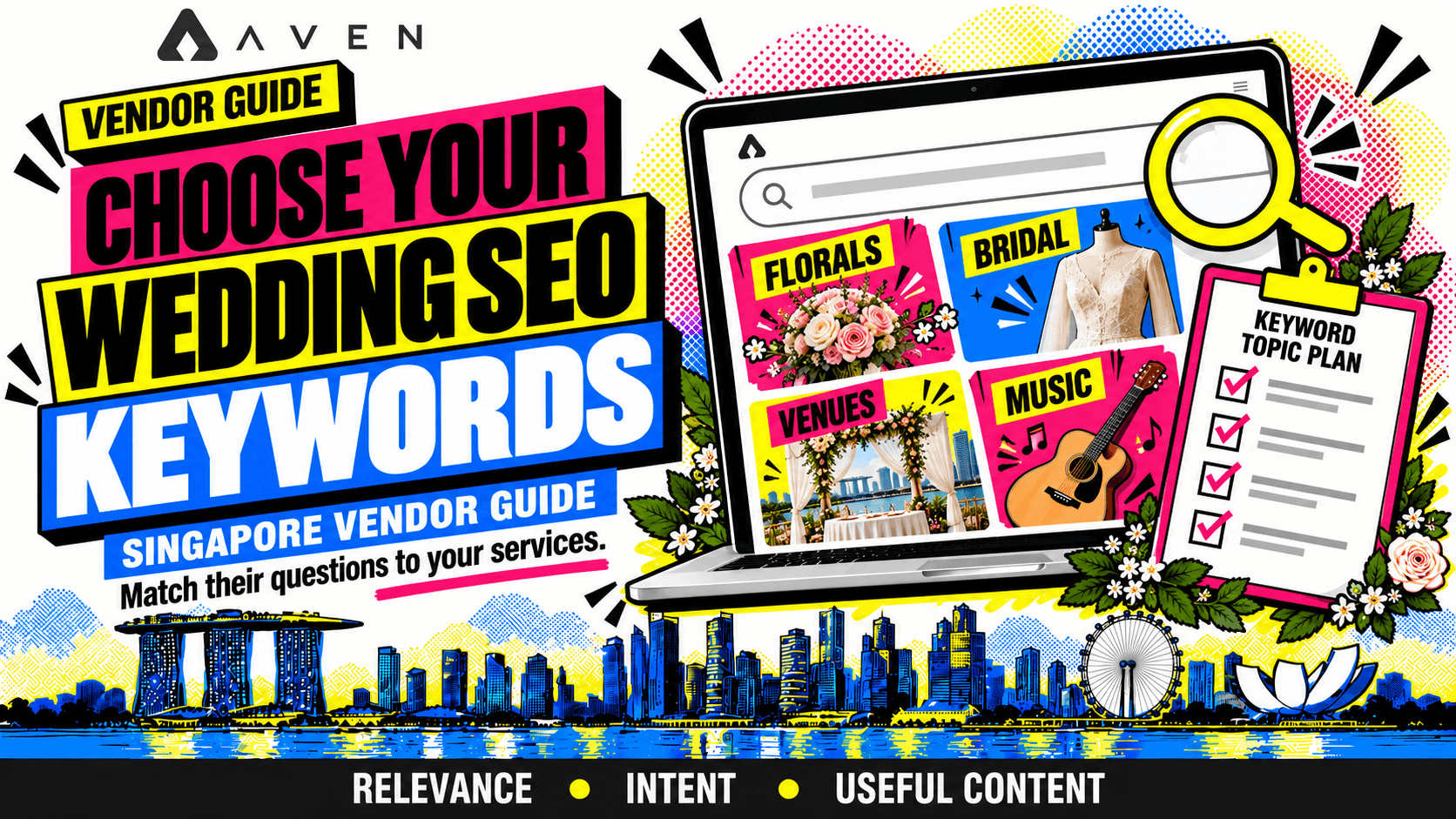
Choose keywords that connect with the work you want to book
A keyword is a word or phrase someone uses when searching.
For a Singapore wedding business, useful keywords connect a couple’s needs with a service you actually provide.
Start with your offering. A florist, bridal boutique and entertainment business will need different topics, even though they all serve weddings.
Your keyword plan should help you decide what each website page needs to explain and which enquiries you want it to support.
This guide applies to venues, bridal beauty businesses, planners, stylists, photographers, videographers, caterers, stationers, photobooth providers and other wedding vendors.
It belongs to our Singapore wedding vendor marketing guide. For the wider framework, explore the complete Singapore wedding vendor business guide.
List your actual services before researching phrases
Write down the services you currently offer and want to promote.
Be specific enough to distinguish meaningful differences.
A bridal beauty business might list:
- Bridal makeup and hair.
- Makeup and hair trials.
- Family makeup appointments.
A planning business might list:
- Full wedding planning.
- Partial wedding planning.
- Wedding day coordination.
A florist might list bridal flowers, ceremony arrangements and reception styling.
This list is your starting point. It keeps keyword research connected to your business rather than sending you towards unrelated topics.
If your offering needs more definition, use our wedding business niche guide.
Consider how couples describe what they need
The language you use internally may differ from the language couples use.
Review questions from enquiries and consultations. Note how people describe the service, their wedding arrangements and the result they want.
For example, couples might ask for help “running the wedding day” before learning the term “wedding day coordination”.
Use these observations to develop possible phrases. Then check whether the phrases describe the service accurately.
Google’s SEO Starter Guide recommends considering the terms readers may use while writing naturally.
You do not need to repeat every variation in your copy. Explain the service clearly and include terminology that helps readers understand it.
Separate service searches from planning questions
Different searches need different answers.
| Search type | Illustrative phrase | Likely information needed |
|---|---|---|
| Service discovery | Wedding florist Singapore | Providers, styles and service scope |
| Comparison | Wedding live band or DJ | Differences and practical considerations |
| Preparation | What to bring to a bridal fitting | A preparation checklist |
| Scope | What does wedding coordination include? | Responsibilities and boundaries |
| Business discovery | A vendor’s business name | Information about that business |
These are illustrative examples, not verified search volumes.
A service page can answer booking questions. A detailed guide can explain a comparison or preparation task.
Choose the format that helps the reader complete the decision behind the search.
Build a starting list for your vendor category
Begin with phrases that describe your core offering.
| Vendor category | Illustrative starting phrases |
|---|---|
| Venues | Wedding venue Singapore, restaurant wedding venue Singapore |
| Bridal boutiques | Bridal gown rental Singapore, wedding dress Singapore |
| Bridal beauty | Bridal makeup Singapore, wedding hair and makeup Singapore |
| Florists and stylists | Wedding florist Singapore, wedding floral styling Singapore |
| Planners | Wedding planner Singapore, wedding day coordination Singapore |
| Entertainment | Wedding live band Singapore, wedding emcee Singapore |
| Caterers | Wedding catering Singapore |
| Photobooths | Wedding photobooth Singapore |
| Photography | Wedding photographer Singapore |
| Videography | Wedding videographer Singapore |
| Stationery | Wedding invitation printing Singapore |
| Transport | Wedding car rental Singapore |
Treat this table as a starting exercise. Refine the phrases according to your actual services, audience and research.
Avoid targeting an offering you cannot reliably provide.
Add useful service details rather than unrelated modifiers
A more specific phrase may better reflect the work you want.
Relevant details could include:
- A service format.
- A wedding setting.
- An appointment type.
- A performance language.
- A particular product or deliverable.
For example, an entertainment business might investigate acoustic wedding performances. A venue might investigate intimate wedding settings. A boutique might investigate gown rental appointments.
Use a modifier only when it describes your offering.
Do not add neighbourhood names simply to create more pages. If location affects your service, explain the practical connection.
Our ideal wedding client guide can help you identify which details matter to your intended audience.
Review search results to understand the expected answer
Search a candidate phrase and examine the results as a research exercise.
Look at:
- The types of pages shown.
- The services or questions they address.
- The information readers are likely comparing.
- Whether the phrase fits your business.
- What useful detail you could contribute.
Results can vary, so avoid treating one search as a permanent ranking picture.
If a phrase mainly brings up service providers, consider whether your service page answers the same need. If it brings up preparation guides, a sales page alone may leave the question unresolved.
Use this review to improve relevance, not to copy another business’s wording.
Use research tools without treating estimates as guarantees
Keyword tools can help you explore phrases and compare estimated demand.
Check the selected location, date range and metric definitions before interpreting the figures.
A tool’s estimate does not tell you how many suitable couples will visit your website or book your service.
If your website already receives search traffic, Google Search Console can show queries associated with impressions and clicks.
Combine those observations with enquiry questions and knowledge of your offering.
Our marketing results guide explains how to assess search activity alongside business outcomes.
Prioritise relevance and your ability to answer well
Before choosing a phrase, ask:
- Does it describe a service or question relevant to my business?
- Does it relate to work I want to attract?
- Can I provide a useful answer?
- Do I have representative examples?
- Is there a clear next step for the reader?
A broad phrase may have limited value if you cannot satisfy the need behind it.
A more specific phrase can give you a clearer page subject and a more relevant enquiry route.
For example, a vendor specialising in ceremony music may have more useful information to offer on that service than on every form of wedding entertainment.
These questions are editorial priorities, not a formula for predicting rankings.
Create a simple keyword map
A keyword map connects a topic with the page responsible for explaining it.
For a hypothetical entertainment business:
| Page | Main topic | Supporting information | Next step |
|---|---|---|---|
| Entertainment overview | Wedding entertainment services | Available formats and approach | Explore a service |
| Live band service | Wedding live band in Singapore | Band options, sets and coordination | Send an enquiry |
| Emcee service | Wedding emcee in Singapore | Languages, briefing and programme support | Discuss the programme |
| Performance example | A representative wedding performance | Format, setting and contribution | View the related service |
The overview introduces the offering. The service pages explain distinct options. The example provides context.
Give each page a clear role rather than creating several pages that repeat the same information.
Group related phrases around a useful page
Closely related phrases may belong together.
For example, a bridal boutique might answer gown rental, fitting and appointment questions on a well-organised service page if they form one connected offering.
Separate pages become useful when the services or reader needs are meaningfully different.
Before adding a page, ask:
- What new question will it answer?
- What information makes it distinct?
- Will readers understand why it exists?
- How will it connect to the rest of the website?
If two drafts provide essentially the same answer, consider combining them.
Our service page guide explains how to organise a focused page.
Use your chosen topic naturally in the page
Once you choose a topic, write for the couple reading the page.
Use accurate wording in the title, main heading, opening description and relevant sections.
Then explain the details they need:
- Service scope.
- Options.
- Examples.
- Preparation.
- Quotation factors.
- Enquiry process.
Avoid forcing the same phrase into every paragraph.
For a wedding catering page, useful headings might cover menus, service formats, guest requirements and quotation preparation.
The page should remain clear when read aloud. If the wording sounds repetitive, revise it.
Connect topics through descriptive internal links
Link related pages when the destination helps answer the next question.
A venue overview can link to viewing information. A fitting preparation guide can link to the appointment page. A service page can link to a relevant project example.
Use descriptive link text.
For example, “explore our bridal appointment process” gives readers more context than “read more”.
Google’s link guidance covers descriptive anchor text and crawlable links.
Check that links point to published, working pages. If a slug changes, update its references.
Our wedding vendor SEO guide explains how page organisation and links fit the wider foundation.
Align your website and vendor profile
Your website and marketplace profile should describe the same core offering.
Use consistent service terminology, package information and practical details so couples can move between them without confusion.
The aven.wedding vendor marketplace allows couples to connect with vendors, send enquiries, make bookings and track their budgets directly.
A clear profile helps them understand your service after discovering it.
Use the fields available to explain your offering naturally. Avoid turning the profile into a repeated list of search phrases.
Our wedding vendor profile guide covers this preparation.
Review keywords alongside the quality of enquiries
After improving a page, review how people discover and use it.
Google Search Console’s Performance report includes queries, impressions, clicks and page information. Use these observations to investigate the searches associated with your website.
Then ask:
- Does the page receive enquiries for the intended service?
- Do couples understand the scope?
- Are recurring questions still unanswered?
- Is the next step clear?
- Does the page need a better example or explanation?
Avoid changing the page’s focus simply because an unrelated query appears in a report.
Our website conversion guide helps you review what happens after a search visit.
Frequently asked questions about wedding vendor keywords
Should I target the broadest wedding keywords?
Start with phrases relevant to your services and the needs you can answer well.
Do I need a separate page for every phrase?
No. Group related phrases where one page can provide a clear, complete answer.
Should every phrase include Singapore?
Use location wording where it helps describe your service. Keep the overall copy natural.
Can I target several vendor categories?
Yes, if your business genuinely provides those services. Explain each offering clearly.
What if I do not have keyword research software?
Begin with your service list and real enquiry questions. Review relevant searches and use Search Console when your website has data available.
Can a keyword plan guarantee bookings?
No. It helps organise relevant pages. Booking outcomes also depend on service fit, availability, scope, budget and the enquiry experience.
Choose your first topic and build its page
Start with one core service.
- Describe the service accurately.
- Identify the couple’s likely question or decision.
- Gather relevant phrases from enquiries and research.
- Select the page responsible for the topic.
- Add scope, examples and practical details.
- Connect relevant pages with descriptive links.
- Provide a clear enquiry route.
- Review search activity and suitable enquiries.
Next, use our wedding vendor service page guide to turn that topic into a useful page.
Return to the Singapore wedding vendor marketing guide for the discovery framework, or explore the complete Singapore wedding vendor business guide to connect marketing with pricing, sales and operations.