
Blog
SEO for Wedding Vendors in Singapore: A Practical Beginner’s Guide
October 3, 2026 · Updated October 3, 2026
Learn the foundations of SEO for Singapore wedding vendors, from choosing service topics and improving website pages to connecting internal links and reviewing search performance. Practical guidance across every vendor category.
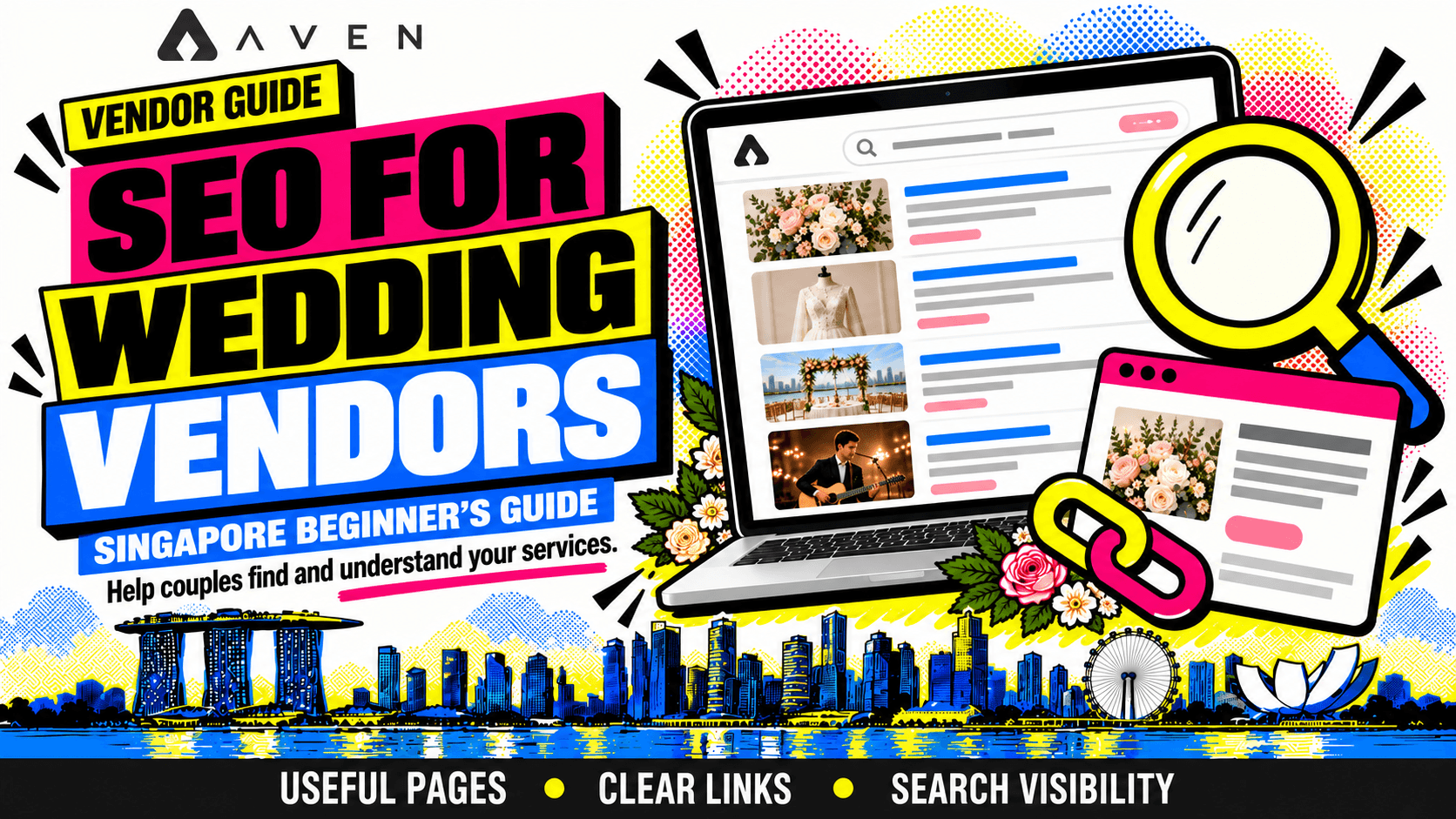
Help couples find and understand your wedding services
A couple searches for a wedding service in Singapore. Your website needs to explain whether you provide what they need and how they can take the next step.
SEO, or search engine optimisation, helps search engines understand your content and helps people discover it.
For a wedding business, a practical starting point is to make your services clear, organise your pages and answer the questions couples need resolved before enquiring.
This applies to venues, bridal boutiques, makeup artists, florists, stylists, planners, photographers, videographers, entertainers, caterers, photobooth providers and other wedding businesses.
This article belongs to our Singapore wedding vendor marketing guide. For the wider business framework, explore the complete Singapore wedding vendor business guide.
Start with a service you want couples to book
Choose one core service before trying to improve every page.
Consider:
- What you provide.
- Who the service suits.
- Which wedding settings you serve.
- What couples need to understand before enquiring.
- Which page should explain that service.
A boutique might begin with its bridal gown rental page. A catering business might begin with its wedding catering page. A musician might begin with ceremony and reception performances.
The page should reflect the work you can deliver and want to attract.
Our guide to identifying ideal wedding clients can help you clarify the audience before choosing a topic.
Understand the purpose behind a search
Couples search at different stages of their planning.
Some want to find providers. Others want to compare options or understand preparation.
| Search purpose | Illustrative search | Useful destination |
|---|---|---|
| Find a service | Wedding live band Singapore | Entertainment service page |
| Compare options | Wedding gown rental or purchase | Comparison guide |
| Understand scope | What does wedding coordination include? | Service explanation |
| Prepare | What to bring to a bridal fitting | Preparation guide |
| Find a business | A vendor’s business name | Homepage or relevant profile |
These examples illustrate possible search behaviour; they are not measured keyword-demand data.
Before creating a page, decide what the reader needs to learn or do. Then choose the page format that serves that purpose.
Choose focused topics for your main pages
Give each important page a clear subject.
A styling business might organise its services around bridal flowers, ceremony styling and reception styling, if these are genuinely distinct offerings.
A planning business might separate full planning from wedding day coordination.
Avoid creating several pages that repeat the same service description with minor wording changes.
A simple planning sheet can include:
- Page topic.
- Intended reader.
- Main question or service.
- Examples to include.
- Enquiry next step.
Our wedding business keyword guide explains how to develop a focused topic list.
Build service pages that answer booking questions
A useful service page explains more than the name of the service.
Include:
- What you provide.
- The weddings or requirements it suits.
- Package scope or quotation factors.
- Representative examples.
- Your process.
- Practical requirements.
- How to enquire.
For a photobooth business, this might mean booth options, session duration, deliverables and setup requirements.
For a bridal boutique, it might mean appointment arrangements, attire options, fittings and collection.
For an entertainer, it might mean performance formats, timing and coordination needs.
Use our wedding vendor service page guide to develop the page structure.
Make Singapore context useful
Explain how your service works in the settings you actually serve.
Relevant details might include:
- Appointments at your studio.
- Travel between wedding locations.
- Early preparation schedules.
- Venue setup and collection arrangements.
- Lunch receptions or evening banquets.
- Outdoor plans and alternatives.
- Languages offered for consultations or performances.
Select the details that affect your work.
A styling business can explain what venue access information it needs. A transport provider can explain how pickup locations affect planning. A makeup artist can explain what timing details are needed before confirming an appointment.
This gives couples practical local information they can use.
Write clear titles, headings and descriptions
Use wording that accurately describes the page.
For a hypothetical bridal boutique:
- Page title: Bridal Gown Rental in Singapore | Business Name
- Main heading: Bridal Gown Rental and Fitting Appointments
- Description: Explore our gown rental options, fitting process and appointment arrangements in Singapore.
Keep headings useful for readers scanning the page.
Possible sections include gown options, appointment preparation, fitting stages and collection arrangements.
Your search description should summarise what the page offers. Google may display different title or snippet text in search results, so treat your wording as useful input rather than a guaranteed display.
Use portfolio examples to explain the service
Choose examples that support the page’s main subject.
A floral styling page should show relevant arrangements and explain their scope. A catering page can show service setups and presentation. A venue page can show layouts and spaces.
Add context where useful:
- What your business provided.
- The brief or preferred approach.
- The setting.
- Relevant practical considerations.
- Whether the example includes optional additions.
Use images you have permission to publish. Label styled shoots clearly and explain your role in collaborative projects.
Our wedding vendor portfolio guide covers how to select and develop this material.
Organise image information thoughtfully
Give images descriptive filenames and useful alternative text.
For example, a filename could describe a bridal bouquet or reception table arrangement.
Alternative text should describe meaningful image content in context. Avoid filling it with a list of search phrases.
For your own review, ask:
- Does this image help explain the service?
- Is the important detail visible on a phone?
- Does the caption clarify the scope?
- Is the image appropriately sized for the page?
Keep essential package information in readable page text so couples can understand it without relying on an image.
Connect pages with useful internal links
Internal links help readers move between related information.
For example:
- A service page can link to relevant project examples.
- A preparation guide can link to the appointment page.
- A main guide can introduce and link to detailed supporting pages.
Use descriptive link text so readers know what to expect.
“Explore our gown fitting process” is clearer than an unexplained “click here”.
Google’s link guidance recommends crawlable links and descriptive anchor text.
Keep links relevant rather than linking every page to every other page. Check that destinations open correctly after publishing.
Use clear slugs and maintain working URLs
A slug is the identifying part of a page URL.
Choose a readable slug that describes the subject. Keep it stable once the page is published unless there is a reason to change it.
If your publishing system rejects a slug, check whether another entry already uses it. If a public link fails, check the saved URL and publication status.
When a published URL changes, arrange an appropriate redirect where your website supports it and update internal links.
For this series, each article has its own slug and connects to relevant guides. The overall Singapore wedding vendor business guide brings the wider business sections together.
Check whether important pages are accessible
Start with a practical publishing check:
- Open the page while signed out.
- Confirm it is published.
- Check that the text and images load.
- Test navigation and internal links.
- Confirm the enquiry route works.
- Review the page on a phone.
If an important page is not appearing in search, use Google Search Console’s URL Inspection tool to investigate.
A developer may need to review indexing settings, redirects or other technical issues. A sitemap can help Google discover URLs, but does not guarantee indexing.
Google’s SEO Starter Guide provides the official foundation for these checks.
Keep local profiles and marketplace information consistent
Your website is part of a wider discovery journey.
Keep service descriptions, contact details and appointment information consistent across the public channels you use.
If your business is eligible, our Google Business Profile guide explains how to approach that listing.
The aven.wedding vendor marketplace also allows couples to connect with vendors, send enquiries, make bookings and track their budgets directly.
Prepare clear information so couples can understand your offering wherever they discover it.
Our wedding vendor profile guide covers that preparation. The platforms versus your own website guide explains how these destinations can work together.
Make the next step clear after a search visit
A visit is the beginning of a conversation.
Once a couple has read your service information, explain how they can enquire and what details to send.
Depending on your category, ask for:
- Wedding date.
- Venue or location.
- Required service.
- Approximate scope or timing.
- Relevant preferences.
Match the invitation to the page.
A fitting page can lead to an appointment request. A venue page can lead to a viewing enquiry. A styling page can invite couples to share the areas they want styled.
Our website conversion guide explains how to make this step easier.
Review search performance alongside enquiries
Google Search Console’s Performance report includes information about search impressions, clicks, queries and pages.
Use it to investigate which pages are being discovered and which searches are bringing visitors.
Then review your business records:
- Which services receive enquiries?
- Are those enquiries suitable?
- Do couples mention a page they read?
- Where does the conversation stop progressing?
Search activity and booking outcomes answer different questions. Review them together without assuming every booking came from one channel.
Our marketing results guide helps connect channel activity with enquiries.
For metric definitions, refer to Google’s Search Console Performance report documentation.
Choose a manageable improvement sequence
Start with one important service page.
- Clarify the service and intended reader.
- Improve the description and scope.
- Add representative examples.
- Review titles and headings.
- Add relevant internal links.
- Test publication and the enquiry route.
- Review results before deciding what to improve next.
This is a suggested working sequence, not a ranking formula.
If several pages have the same problem, fix the underlying template or process where possible.
Keep a record of meaningful changes so you can understand what you adjusted when reviewing performance later.
Frequently asked questions about wedding vendor SEO
Does SEO apply to all wedding vendor categories?
Yes. The page topics, examples and practical details should reflect the service you provide.
Do I need a large website to start?
No. Begin with clear information for your core services and a working enquiry route.
Should I put “Singapore” in every heading?
Use it where it helps describe the service or context. Keep the wording natural.
Do I need many articles before improving my service pages?
Start with the pages couples need to understand and enquire about your offering. Add supporting material when it answers a useful question.
How quickly will SEO improvements work?
Google notes that changes can take different amounts of time to be reflected. Avoid treating a fixed timeframe as a promise.
Can anyone guarantee a first-place ranking?
Google’s guidance makes clear that there is no automatic route to ranking first. Focus on useful content and a functioning website.
Build a clear foundation for discovery
Before expanding your SEO work, check:
- Your main service pages have a clear purpose.
- The descriptions reflect your current offering.
- Portfolio examples explain your work.
- Titles and headings are understandable.
- Internal links lead to relevant, working pages.
- Published pages are accessible.
- Couples have a clear enquiry route.
- You have a way to review search activity and enquiries.
Next, use our wedding business keyword guide to plan your topics, or improve your service pages.
Return to the wedding vendor marketing guide for the discovery framework, or explore the complete Singapore wedding vendor business guide to connect marketing with pricing, sales and operations.