
Blog
Wedding Makeup Trial Guide Singapore: What to Prepare & Ask
September 6, 2026 · Updated September 6, 2026
Preparing for your bridal makeup trial? Use this Singapore wedding makeup trial guide to plan references, hairstyles, accessories, questions and what to review before your actual day.
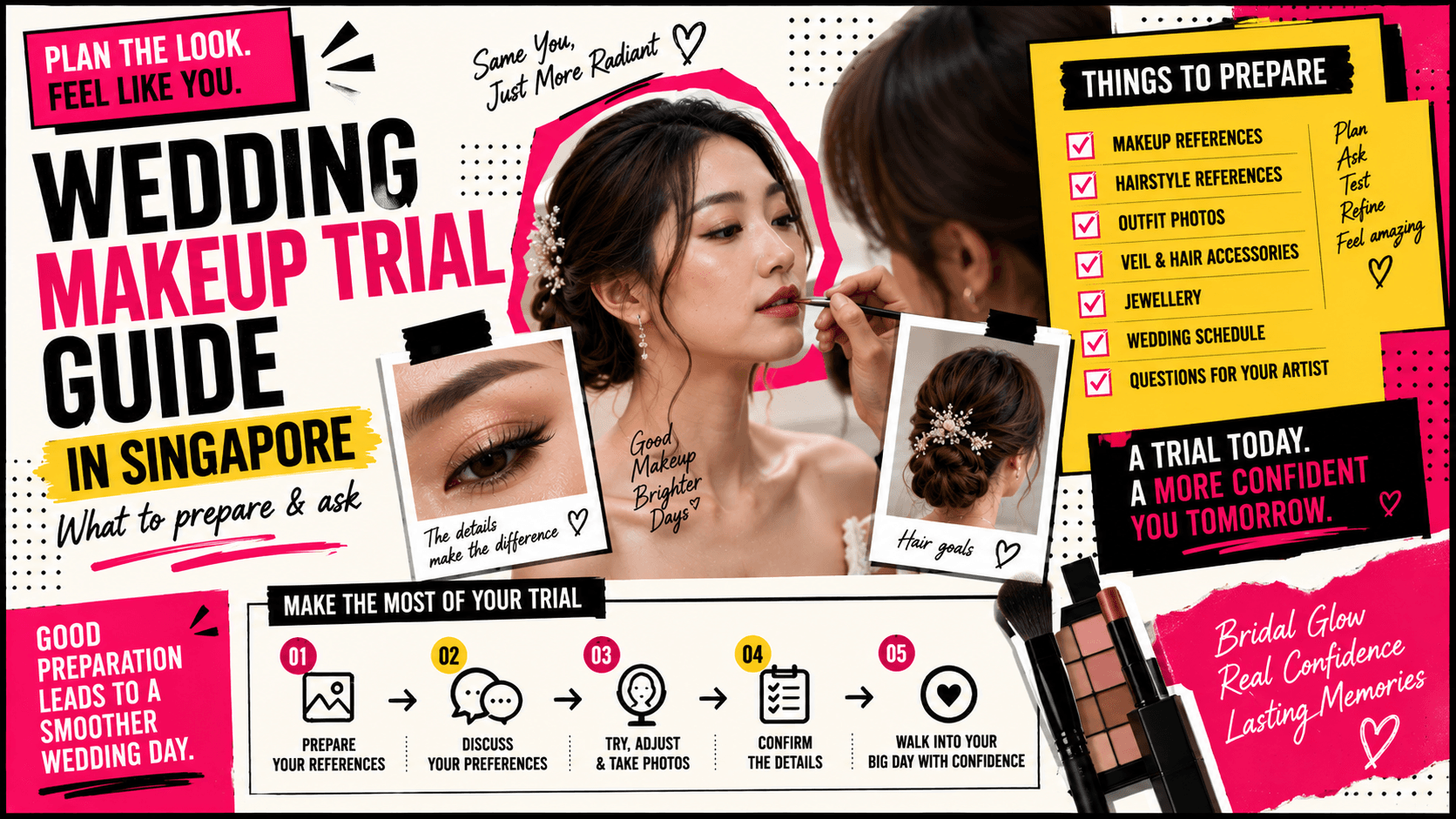
What should you expect from a wedding makeup trial?
A wedding makeup trial is your opportunity to test your bridal look before the actual day.
Instead of discovering your preferences on your wedding morning, you can use the trial to work through decisions such as:
- Makeup intensity
- Skin finish
- Eye makeup
- Lip colour
- Hairstyle
- Hair accessories
- Veil placement
- Overall bridal style
But simply turning up and asking your makeup artist to "make me look nice" does not make the most of the session.
A little preparation can make the trial much more useful.
This wedding makeup trial guide Singapore takes you through what to prepare, what to bring, what to ask and what to review before confirming your actual-day look.
If you are still choosing your artist, start with Aven's How to Choose a Wedding Makeup Artist in Singapore.
What is the purpose of a bridal makeup trial?
A bridal trial is not simply a preview of how beautiful you will look.
It is a planning session.
You can use it to determine:
- What you like
- What you do not like
- What feels comfortable
- What photographs well
- Which hairstyle works with your outfit
- Whether accessories work together
- How long preparation may take
It also gives you and your makeup artist a shared reference for the actual day.
By the end of the trial, you should ideally have a much clearer idea of the direction you want.
When should you have your wedding makeup trial?
There is no single timing that works for every bride.
Your makeup artist may have their own recommendations depending on their booking process.
The trial should generally happen early enough that you still have time to:
- Adjust your intended look
- Purchase accessories
- Change hairstyle plans
- Discuss additional services
- Finalise your wedding schedule
At the same time, having useful information about your gown, accessories and wedding style can make the trial more productive.
Ask your artist when they recommend scheduling the session after you book.
Decide what you want to learn from the trial
Before attending, write down your biggest uncertainties.
For example:
- I don't know whether I want my hair up or down.
- I don't normally wear much makeup.
- I am unsure whether stronger eye makeup suits me.
- I want to know whether my veil works with a low bun.
- I have two hairstyles shortlisted.
- I am worried about looking too different from myself.
These are useful questions to solve during the session.
Your goal does not need to be reproducing one exact reference photograph.
Use the trial to make decisions.
Prepare bridal makeup reference photos
Create a small collection of makeup references before your appointment.
Look for examples showing:
- Skin finish
- Brows
- Eyes
- Lashes
- Blush
- Lip colour
- Overall makeup intensity
Try to identify what specifically attracts you to each image.
Instead of simply saying:
"I like this."
You could explain:
"I like how soft the eye makeup looks."
or:
"I like the skin finish but would prefer a softer lip."
Specific feedback gives your artist much more useful information.
Bring references of looks you do not like too
Knowing what you dislike can be just as useful.
Perhaps you prefer to avoid:
- Very strong brows
- Heavy eye makeup
- Dramatic lashes
- Very matte skin
- Strong contouring
- Bright lip colours
- Particular hairstyles
You do not need a long collection.
A few references can help demonstrate your boundaries.
This is particularly useful because words such as natural, soft and glam can mean different things to different people.
Prepare hairstyle references separately
Create another small collection specifically for hair.
Possible directions include:
- Low bun
- High bun
- Ponytail
- Half-up hairstyle
- Hair down
- Soft waves
- Braided styles
Consider whether your references actually work with:
- Your hair length
- Hair texture
- Fringe
- Gown neckline
- Veil
- Hair accessories
Your makeup artist can help you assess what is realistic and how the hairstyle might be adapted for you.
Show your makeup artist your wedding outfits
Bring photographs of the outfits you expect to wear.
These may include:
- Wedding gown
- Solemnisation dress
- Tea ceremony outfit
- Evening gown
- Traditional outfit
The neckline, colour, shape and overall style can influence your hair and makeup direction.
You do not necessarily need to bring the physical gown to your makeup trial.
Clear photographs can help your artist understand the complete look you are planning.
Bring your veil and hair accessories if appropriate
If you already have your wedding accessories, ask your artist whether you should bring them.
Possible items include:
- Veil
- Hair pins
- Hair comb
- Tiara
- Headpiece
- Decorative clips
The trial can help you determine:
- Where the accessory should sit
- Whether it works with the hairstyle
- Whether it feels secure
- How it looks from different angles
This is especially useful if your hairstyle has been chosen partly around a particular accessory.
Consider your earrings and jewellery
Jewellery can change the overall balance of your bridal look.
If your wedding jewellery is already chosen, bring it or show your artist clear photographs.
Pay particular attention to:
- Earrings
- Necklace
- Hair accessories
Large earrings may look different with:
- Hair down
- Hair behind the ears
- Low bun
- High bun
Your makeup, hair, gown and accessories should feel like one complete look rather than separate decisions.
Tell your artist what makeup you normally wear
Your normal routine provides useful context.
Tell your makeup artist whether you usually wear:
- No makeup
- Light everyday makeup
- Foundation
- Eyeliner
- Lashes
- Stronger makeup regularly
Also explain what you feel comfortable with.
For example:
"I almost never wear foundation, so I don't want my skin to feel too heavy."
or:
"I regularly wear eyeliner and would like my wedding makeup to feel more defined."
The goal is to help your artist understand your starting point.
Tell your artist about your wedding environment
Your trial should take the actual wedding into account.
Explain whether your wedding includes:
- Outdoor solemnisation
- Indoor solemnisation
- Hotel ballroom
- Restaurant
- Church
- Garden
- Outdoor portraits
- Multiple locations
Singapore's warm and humid weather can be especially relevant if significant parts of your day happen outdoors.
Your artist can then consider the wedding environment when discussing your look and hairstyle.
Discuss every bridal look you are planning
If you have multiple outfits, explain the complete sequence.
For example:
Morning gown → tea ceremony outfit → solemnisation gown → banquet gown
Then discuss whether each transition requires:
- Full hairstyle change
- Small hairstyle adjustment
- Accessory change
- Lip colour change
- Makeup touch-up
You may discover that you do not need a completely new look for every outfit.
This can simplify your actual-day schedule considerably.
Test how the makeup looks in photographs
Do not evaluate your trial only by looking in the mirror.
Take photographs.
Where practical, look at the makeup:
- From the front
- From both sides
- Close up
- From further away
- In natural light
- In indoor light
Your wedding will be heavily photographed.
Something that feels slightly stronger in person may appear differently through a camera, while certain details may be less noticeable from a distance.
The objective is not to obsess over every photograph.
It is to understand the overall result from multiple perspectives.
Record the hairstyle from every angle
A hairstyle can look very different from the front and back.
Take photographs or short videos showing:
- Front
- Left side
- Right side
- Back
- Hair accessories
- Veil placement
This is particularly useful for buns and other updos where much of the styling is behind you.
These references can also help when you review the look later instead of relying entirely on memory.
Pay attention to how the makeup feels
Appearance is only part of the trial.
Consider comfort too.
Ask yourself:
- Do the lashes feel comfortable?
- Does anything feel unusually heavy?
- Am I comfortable with the hairstyle?
- Does the hairstyle feel secure?
- Can I move naturally?
- Do I still feel like myself?
You will potentially wear your wedding look for many hours.
If something feels uncomfortable during the trial, tell your makeup artist rather than assuming you simply need to tolerate it.
Do not be afraid to request adjustments
The trial exists partly so you can refine the look.
If something does not feel right, say so respectfully.
For example:
- "Could we soften the eye makeup?"
- "Can we try a slightly different lip colour?"
- "Could we make the hairstyle less structured?"
- "Can we see how this looks without the accessory?"
- "Could we try a little more volume?"
Your feedback helps the artist understand you better.
Silently accepting a look you dislike defeats much of the purpose of having a trial.
Ask how long your actual-day preparation will take
The trial is a useful time to discuss timing.
Ask approximately how much time should be reserved for:
- Makeup
- Hairstyling
- Outfit preparation
- Veil placement
- Final touch-ups
Then work backwards from the time you need to be ready.
For example:
Photography begins → bridal portraits → family photos → gatecrash
Your makeup should be scheduled around the wedding programme rather than treated as a separate appointment.
Use Aven's Singapore Actual-Day Wedding Timeline to build the full schedule.
Discuss early-morning arrangements
If your wedding starts early, confirm what your actual-day call time means for the makeup arrangement.
Clarify:
- Expected start time
- Artist arrival time
- Transport arrangements
- Any early-start considerations
- Whether additional artists are required
This becomes particularly important when your morning also includes bridesmaids or family members who need makeup.
Resolve these logistics before the wedding week.
Ask how second-look changes will work
If your makeup artist is returning later, understand exactly what will happen.
Ask:
- What time will you return?
- How long should we reserve?
- Will makeup be refreshed?
- Will the hairstyle change completely?
- Will accessories be changed?
- Do I need to prepare anything beforehand?
Then add that time to your programme.
A 30-minute change that has only been given 10 minutes in the wedding schedule can create unnecessary pressure for everything that follows.
Questions to ask during your bridal makeup trial
Use your trial to clarify anything still uncertain.
Questions may include:
- Does this makeup style suit the look I described?
- How would you adjust it for the actual day?
- Which hairstyle works best with my gown?
- Will my veil work with this hairstyle?
- Should I use these hair accessories?
- How long will actual-day preparation take?
- How should I prepare my hair beforehand?
- How should I prepare my skin beforehand?
- How will the second look work?
- How much time should we reserve for a hairstyle change?
- What should I keep with me for touch-ups?
- What happens if we are running late?
- What information do you need from me before the wedding?
Write down anything important instead of relying on memory several months later.
Take notes immediately after the trial
After the appointment, record your thoughts while the experience is still fresh.
Write down:
What I loved
- Makeup
- Hair
- Accessories
What I want changed
- Eyes
- Lips
- Skin
- Hair
- Accessories
Questions still outstanding
- Timing
- Second look
- Touch-ups
- Family makeup
Save your trial photographs together with these notes.
This creates a simple reference for your final discussion with the makeup artist.
Wear the trial makeup for a while if appropriate
If your schedule allows, keeping the trial look on for some time can give you additional perspective.
You may notice:
- How comfortable it feels
- How the hairstyle holds
- Whether you still like the makeup after seeing it repeatedly
- How it looks in different environments
Follow any guidance your makeup artist provides.
The objective is simply to gather useful information that can improve the actual-day plan.
Bridal makeup trial checklist
Use this before leaving for your appointment.
References
- Makeup inspiration
- Makeup dislikes
- Hairstyle inspiration
- Gown photos
- Other outfit photos
Accessories
- Veil if requested
- Hair accessories
- Earrings or jewellery if useful
Wedding information
- Wedding venue
- Solemnisation setting
- Actual-day schedule
- Number of outfits
- Number of intended looks
Questions
- Makeup preferences
- Hairstyle
- Actual-day preparation time
- Early start
- Second look
- Touch-ups
- Family makeup
- Final preparation instructions
What should you confirm after your makeup trial?
Once you are happy with the direction, make sure the actual-day plan is clear.
Confirm:
- Final makeup direction
- Final hairstyle direction
- Hair accessories
- Veil
- Number of looks
- Second hairstyle
- Makeup touch-ups
- Preparation start time
- Artist arrival
- Location
- Family or bridesmaid services
- Additional artists if needed
- Outstanding payment arrangements
- Any preparation instructions
Closer to your wedding, include your makeup artist in your Wedding Vendor Confirmation Checklist.
Frequently asked questions about wedding makeup trials
Do I have to know exactly what makeup I want before the trial?
No. References and preferences are useful, but the trial can help you determine what works for you.
Should I bring my wedding gown?
Usually photographs of your gown can provide useful context, but follow your makeup artist's specific instructions.
Should I bring my veil?
Ask your artist. If you want to test veil placement with your intended hairstyle, bringing it may be useful.
Can I try more than one hairstyle?
This depends on the artist and trial arrangement. If you are undecided between styles, ask beforehand what can realistically be tested.
Should I take photographs during the trial?
Photographs can help you review the look from different angles and lighting conditions.
What if I dislike part of the makeup?
Tell your artist during the trial. The session is an opportunity to make adjustments before the actual day.
Should I recreate the trial look exactly on my wedding day?
The trial provides a reference, but your artist can advise whether small adjustments are appropriate for the actual wedding.
Your makeup trial should remove uncertainty, not create more of it
A successful bridal makeup trial should leave you with a clearer plan for your wedding day.
You should understand:
- How you want your makeup to look
- How you want your hair styled
- Which accessories you will use
- How long preparation should take
- How additional looks will work
- What still needs to be confirmed
Most importantly, you should feel comfortable communicating with the person who will be with you during one of the first parts of your wedding day.
If you have not booked your artist yet, return to Aven's How to Choose a Wedding Makeup Artist in Singapore.
For the wider wedding-day schedule, use the Singapore Actual-Day Wedding Timeline.
For every other vendor category, continue with the Singapore Wedding Vendor Checklist.
And for your complete planning journey, use the Ultimate Singapore Wedding Planning Guide.