
Blog
Chinese Wedding Tea Ceremony Guide Singapore: Order, Etiquette & Checklist
September 8, 2026 · Updated September 8, 2026
Plan your Chinese wedding tea ceremony in Singapore with this practical guide to the serving order, who participates, what to prepare, red packets, jewellery, etiquette and timing.
How does a Chinese wedding tea ceremony work in Singapore?
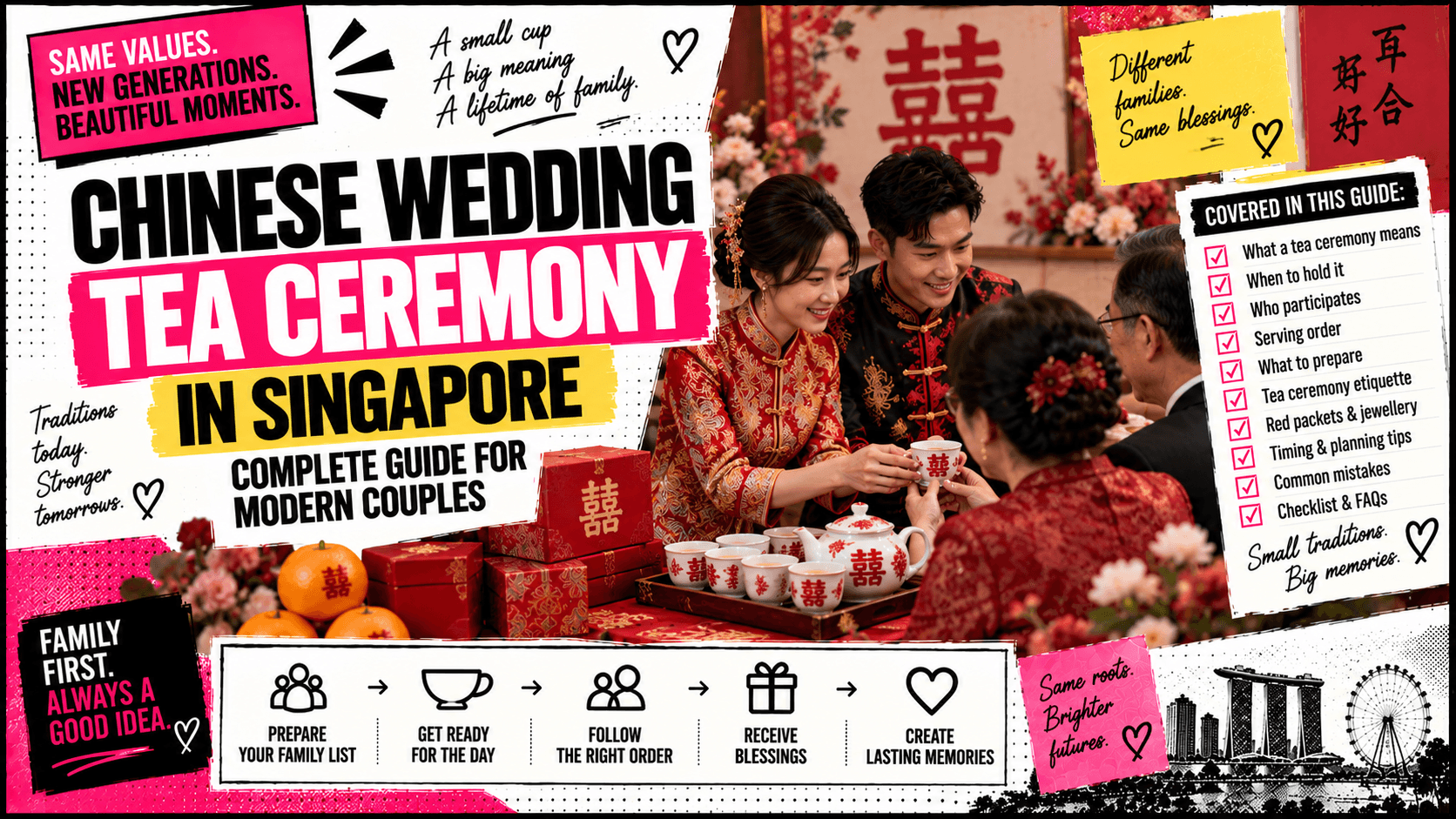
The Chinese wedding tea ceremony is one of the most meaningful family traditions in many Singapore Chinese weddings.
The couple serves tea to their parents and senior relatives as a gesture of respect and to formally acknowledge their new family relationships.
In return, relatives may offer:
- Blessings
- Red packets
- Jewellery
- Other gifts
Although the basic idea is simple, planning the ceremony can become confusing when you start asking:
- Who gets served first?
- Which relatives participate?
- Where should everyone sit?
- What tea should you use?
- Who prepares the tea?
- What happens to the red packets?
- How much time should you allocate?
This Chinese wedding tea ceremony guide for Singapore couples walks you through the practical details.
For the wider cultural context, start with Aven's Chinese Wedding Traditions in Singapore.
What does the Chinese wedding tea ceremony symbolise?
The tea ceremony is more than serving a drink.
It can symbolise:
- Respect for parents and elders
- Gratitude to family
- Acceptance of the bride or groom into a new family
- Blessings for the marriage
- Connection between generations
For many couples, it also becomes one of the quieter and more emotional parts of an otherwise busy wedding day.
The exact customs may vary between families, but the focus remains on family relationships rather than performing the ceremony perfectly.
Is a tea ceremony compulsory for Chinese weddings in Singapore?
No.
A Chinese wedding tea ceremony is a cultural tradition rather than a requirement for the legal validity of your marriage.
Some Singapore Chinese families consider it extremely important.
Others may:
- Simplify it
- Combine both families into one ceremony
- Hold it at the wedding venue
- Include only immediate family
- Skip it entirely
Discuss expectations with both families before building it into your actual-day schedule.
When does the wedding tea ceremony usually happen?
For couples following a traditional-influenced wedding morning, the tea ceremony may happen after the bride is fetched.
A possible sequence is:
Bride preparation → Groom arrives → Gatecrash → Bride's family tea ceremony → Travel → Groom's family tea ceremony
But this is only one possible arrangement.
Modern Singapore couples may hold their tea ceremony:
- In the morning
- Before solemnisation
- At a hotel
- Before the banquet
- On another day
- At one combined location
Build the ceremony around your actual wedding logistics.
Use Aven's Singapore Actual-Day Wedding Timeline when planning the full day.
Where can you hold the Chinese wedding tea ceremony?
Common locations include:
- Bride's family home
- Groom's family home
- Couple's home
- Hotel room
- Solemnisation venue
- Wedding venue
- Private function room
Holding separate ceremonies at each family home can preserve a traditional flow.
Holding both at one location can reduce:
- Travel
- Parking
- Schedule pressure
- Moving equipment
- Coordination
There is no need to create unnecessary logistical stress if both families are comfortable with a simpler arrangement.
Can both families have the tea ceremony at the same location?
Yes, if both families are comfortable with the arrangement.
This can be particularly practical when:
- Family homes are far apart
- Elderly relatives have mobility considerations
- The wedding schedule is tight
- The couple is already staying at a hotel
- Solemnisation and banquet happen at the same venue
You can still keep the two family sequences separate.
For example:
Bride's family tea ceremony
followed by:
Groom's family tea ceremony
The important part is agreeing on the arrangement beforehand.
Who participates in a Chinese wedding tea ceremony?
The exact list depends on your family structure and traditions.
Participants may include:
- Parents
- Grandparents
- Great-grandparents
- Uncles and aunts
- Older married siblings
- Other senior relatives
Younger relatives may sometimes receive tea or participate differently according to family custom.
Do not build the sequence using a generic internet family tree.
Ask both sets of parents to confirm who should participate.
What is the correct tea ceremony order?
There is no single serving order that applies identically to every family.
A common principle is to begin with the most senior family members before moving through other relatives according to seniority and family structure.
Your sequence might therefore begin with:
- Grandparents or senior generation
- Parents
- Senior uncles and aunts
- Other older relatives
- Older siblings or other family members where applicable
However, family traditions can differ.
Ask your parents or elders to approve the final order before the wedding.
Prepare a tea ceremony family list before the wedding
Do not try to remember the order on the day.
Create a simple list.
| Order | Name | Relationship | Family Side | Attending? |
|---|---|---|---|---|
| 1 | ||||
| 2 | ||||
| 3 | ||||
| 4 |
Ask both families to review it.
This can prevent:
- Missing relatives
- Incorrect order
- Confusion over names
- Long pauses
- Family members searching for someone mid-ceremony
Give a copy to whoever will coordinate the ceremony.
Who should coordinate the tea ceremony?
Assign someone who knows the family well.
For each side, this might be:
- Sibling
- Cousin
- Aunt or uncle
- Bridesmaid
- Groomsman
- Family representative
Their role can include:
- Calling relatives forward
- Confirming the order
- Helping people sit
- Passing cups
- Keeping the ceremony moving
- Alerting the photographer
A wedding coordinator can manage logistics, but a family member is often better at identifying relatives.
If you have an actual-day coordinator, brief them on the family sequence beforehand.
What do you need for a Chinese wedding tea ceremony?
Your basic setup may include:
- Tea set
- Tea cups
- Tea
- Hot water
- Kettle or flask
- Serving tray
- Chairs
- Family order list
- Tissues
- Secure container for gifts
- Person responsible for preparing tea
You may also want:
- Decorative tea set
- Traditional wedding backdrop
- Double Happiness decorations
- Small table
Keep the setup functional.
A beautiful tea set is useful only if someone remembers to prepare the tea.
What tea should you serve?
Families may have different preferences for the tea used during the ceremony.
Rather than worrying about finding one universally "correct" tea, consider:
- Family tradition
- Ease of preparation
- Taste
- Whether elderly relatives will enjoy it
- Whether additional ingredients are normally used in your family's custom
Ask your parents if they expect a particular preparation.
Whatever you choose, test it beforehand so the person preparing the tea knows the appropriate quantity and method.
Who prepares and pours the tea?
Do not make the couple responsible for everything.
Assign one or two helpers to:
- Prepare tea
- Refill the pot
- Refill hot water
- Place cups on the tray
- Collect used cups
- Keep the serving area tidy
This can be handled by:
- Bridesmaid
- Groomsman
- Sibling
- Cousin
- Family member
If you have many relatives, having dedicated helpers can make a major difference to the pace of the ceremony.
Should the couple kneel during the tea ceremony?
Whether the couple kneels, bows or serves tea while standing can depend on family custom.
Some families may expect kneeling when serving parents or senior elders.
Others may be comfortable with a more simplified approach.
Practical considerations can also matter, particularly for:
- Elderly relatives
- Tight spaces
- Restrictive wedding attire
- Mobility limitations
Confirm family expectations beforehand instead of discovering them while everyone is waiting.
What happens when tea is served?
The exact etiquette varies, but the basic sequence can be kept simple.
For each relative:
- Coordinator calls them forward
- Relative takes their place
- Couple serves tea
- Relative accepts the tea
- Relative offers blessings
- Red packet or gift may be presented
- Photographer captures the interaction
- Next relative is called
Avoid rushing the meaningful moments simply to finish faster.
At the same time, good preparation prevents unnecessary pauses between relatives.
What gifts are given during the tea ceremony?
After receiving tea, relatives may give the couple:
- Red packets
- Gold jewellery
- Other jewellery
- Family gifts
- Verbal blessings
What is given depends entirely on the family.
Couples should not treat the tea ceremony as an exchange based on expected monetary value.
The focus is the family ritual and the blessings attached to it.
Who should handle tea ceremony red packets and jewellery?
Assign this job before the wedding.
Choose a trusted:
- Sibling
- Bridesmaid
- Groomsman
- Close family member
Prepare:
- Secure bag
- Jewellery pouch or box
- Separate compartment for red packets
- Clear handover plan
The couple will be busy greeting relatives and taking photographs.
They should not be trying to remember where each necklace or red packet was placed.
For wider actual-day gift handling, use Aven's Wedding Ang Bao Box & Gift Handling Guide.
How much time should you allocate for a tea ceremony?
The amount of time depends largely on how many relatives are participating.
Do not schedule it based only on the number of cups of tea.
Allow time for:
- Calling relatives
- Serving tea
- Blessings
- Jewellery
- Red packets
- Photographs
- Tea refills
- Elderly relatives moving into position
A smaller immediate-family ceremony may move quickly.
A large extended-family ceremony can take considerably longer.
Count the expected participants before finalising your timeline.
How can you make the tea ceremony run faster without rushing it?
Preparation is more effective than trying to make everyone move faster.
Before starting:
- Arrange chairs
- Prepare tea
- Have spare cups ready
- Brief the coordinator
- Finalise family order
- Gather participating relatives nearby
- Prepare the gift handler
- Tell photographer and videographer what is happening next
The objective is to remove dead time while preserving the actual family interaction.
How should photographers and videographers cover the tea ceremony?
Tell your photographer and videographer:
- Where the ceremony will happen
- How many relatives are involved
- Whether there are two separate ceremonies
- Whether the couple will kneel
- Whether jewellery will be presented
- Approximate ceremony duration
If possible, avoid squeezing the ceremony into the smallest corner of the room.
Give your visual team enough space to capture:
- Couple
- Relatives
- Tea serving
- Reactions
- Jewellery
- Family photographs
For vendor selection, use Aven's How to Choose a Wedding Photographer in Singapore and How to Choose a Wedding Videographer in Singapore.
What should you wear for the tea ceremony?
There is no single required outfit for every modern Singapore Chinese tea ceremony.
Some couples choose traditional attire.
The bride might wear:
- Qun Kwa
- Cheongsam
- Chinese-inspired wedding outfit
The groom may wear corresponding traditional or Chinese-inspired attire.
Other couples simply wear their main wedding outfits.
If you plan to change clothing specifically for the ceremony, include changing time in your schedule.
Also consider whether your outfit allows you to sit, kneel or move comfortably according to your family's customs.
Can you have your tea ceremony at the hotel?
Yes, if it works for your family and venue arrangements.
A hotel tea ceremony can reduce travel if you are already holding your:
- Solemnisation
- Lunch banquet
- Dinner banquet
at the same property.
Before deciding, check:
- Room size
- Number of relatives
- Seating
- Hot-water access
- Photography space
- Timing
- Hotel access
A function room may work better than a hotel bedroom for a large family.
Common Chinese wedding tea ceremony mistakes
Avoid these common planning problems:
No family order
Everyone spends time debating who goes next.
No dedicated coordinator
The couple ends up calling relatives themselves.
No tea helper
The ceremony stops every time the pot needs refilling.
No gift handler
Red packets and jewellery end up scattered around the room.
Not enough time
The ceremony becomes rushed.
Forgetting travel time
The second family ceremony starts late.
Not briefing your photographer
Important interactions are missed.
Assuming family customs
Parents discover on the day that they expected a different procedure.
Most of these problems can be solved with a short family discussion before the wedding.
Chinese wedding tea ceremony checklist
Use this checklist before your wedding.
Family planning
- Confirm whether both families want a tea ceremony
- Confirm ceremony location
- Prepare bride's family list
- Prepare groom's family list
- Confirm serving order
- Check family-specific customs
- Confirm whether kneeling is expected
Tea setup
- Tea set
- Cups
- Tea
- Hot water
- Kettle or flask
- Serving tray
- Chairs
- Small table if needed
- Tissues
- Spare cups if needed
People
- Family coordinator
- Tea helper
- Gift handler
- Photographer briefed
- Videographer briefed
- Coordinator briefed
Valuables
- Red packet bag
- Jewellery pouch or box
- Trusted person assigned
- Handover plan confirmed
Timeline
- Start time confirmed
- Duration estimated
- Travel time included
- Outfit-change time included
- Buffer before next event included
Frequently asked questions about Chinese wedding tea ceremonies
Who goes first in a Chinese wedding tea ceremony?
Serving order usually reflects family seniority and structure, but customs can vary. Ask both families to confirm the order.
Do we need separate tea ceremonies for both families?
Not necessarily. Some couples visit each family home, while others hold both sequences at one location.
Does the couple have to kneel?
This depends on family custom and preference. Discuss expectations beforehand.
Do relatives have to give red packets?
Gifts may be presented during the ceremony, but the focus should remain on the family tradition rather than expected monetary value.
Can we hold the tea ceremony at our wedding venue?
Yes, if your family is comfortable with the arrangement and the venue provides suitable space.
Do we need traditional wedding attire?
No. Some couples choose traditional clothing while others use their regular wedding outfits.
How long should the tea ceremony take?
It depends on the number of relatives and your family's customs. Build the schedule based on your actual participant list.
Can we simplify the ceremony?
Yes. Many modern Singapore couples adapt the ceremony while preserving its core meaning.
Make the tea ceremony about the people, not the schedule
A well-planned tea ceremony should feel organised without feeling mechanical.
The checklist matters.
The tea matters.
The order matters.
But years later, you are more likely to remember:
Your grandmother's reaction.
Your parents' blessings.
The laughter when someone forgets whose turn it is.
The jewellery your family places on you.
The photographs of generations sitting together.
So prepare the logistics properly.
Then give yourself enough space to actually experience the moment.
Continue the Chinese traditions cluster with Aven's Guo Da Li Singapore Guide, Pin Jin Singapore Guide, An Chuan Singapore Guide and Wedding Gatecrash Guide Singapore.
For the complete cultural overview, return to Chinese Wedding Traditions in Singapore.
For actual-day planning, use the Singapore Actual-Day Wedding Timeline.
For your complete planning journey, use the Ultimate Singapore Wedding Planning Guide.