
Blog
Chinese Wedding Traditions in Singapore: Complete Guide for Modern Couples
September 8, 2026 · Updated September 8, 2026
Plan a Chinese wedding in Singapore with this practical guide to Guo Da Li, Pin Jin, An Chuan, gatecrash, tea ceremony, Hui Li and other traditions modern couples may encounter.
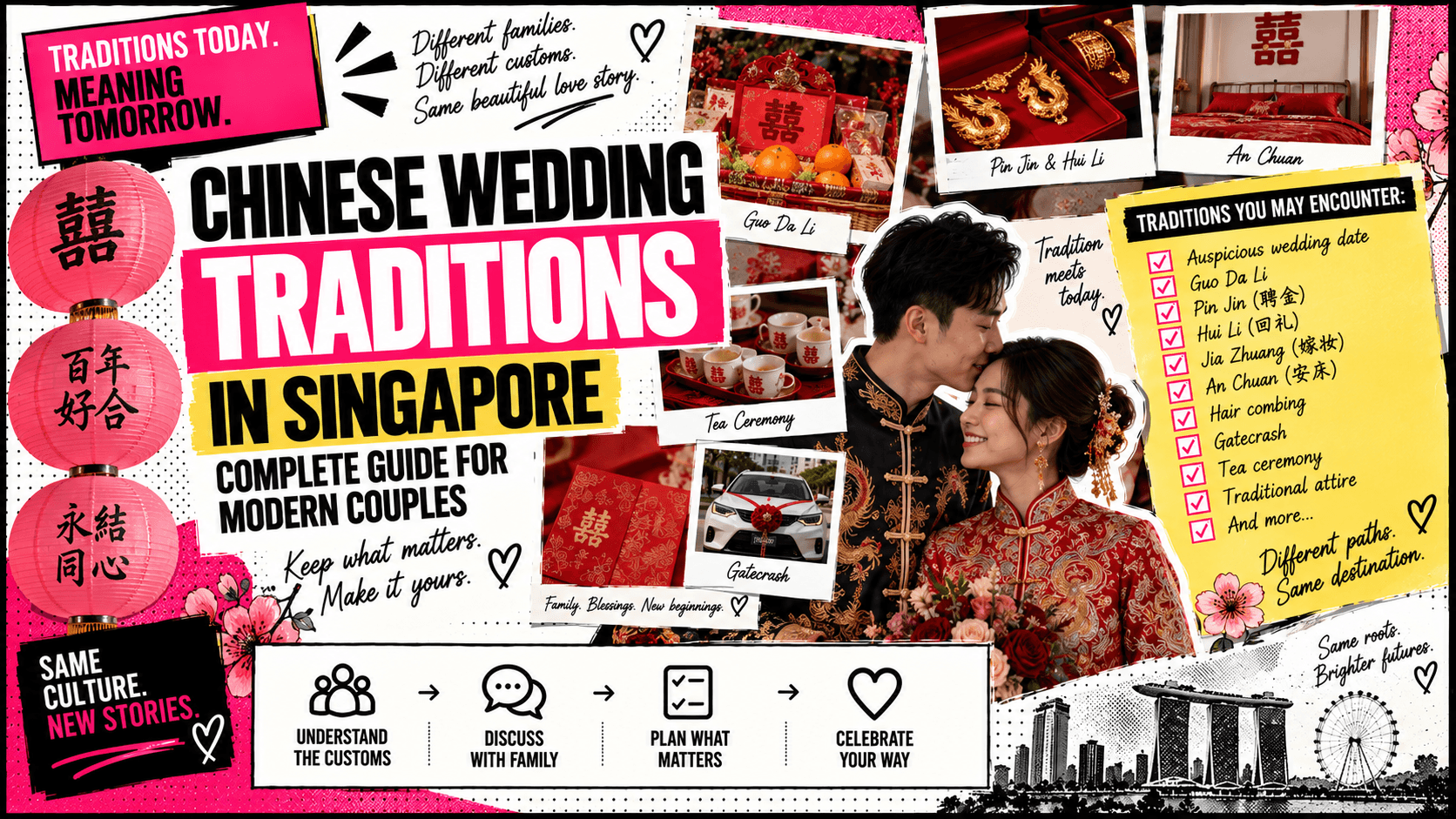
What Chinese wedding traditions are commonly practised in Singapore?
Chinese weddings in Singapore can look very different from one family to another.
Some couples follow several traditional customs.
Others keep only the traditions that feel meaningful to their families.
You may encounter:
- Choosing an auspicious wedding date
- Guo Da Li
- Pin Jin
- Hui Li
- Jia Zhuang
- An Chuan
- Hair combing
- Gatecrash
- Fetching the bride
- Tea ceremony
- Red packets
- Traditional wedding attire
- Returning to the bride's family
You do not necessarily need to follow every tradition in this guide.
Customs can differ according to dialect group, religion, family practices and how traditional your parents or grandparents are.
Think of this as a map of the major Chinese wedding traditions in Singapore, then discuss with both families which customs you actually want to observe.
For your wider planning journey, use Aven's Ultimate Singapore Wedding Planning Guide.
Why do Chinese wedding customs vary between Singapore families?
There is no single checklist followed identically by every Chinese family.
Singapore's Chinese community includes families with different ancestral and dialect backgrounds, including:
- Hokkien
- Teochew
- Cantonese
- Hakka
- Hainanese
- Other backgrounds
Family practices can also evolve over generations.
One family may consider a particular item essential while another family has never practised the custom.
Inter-dialect and intercultural marriages can introduce even more variation.
Before buying ceremonial items or setting your schedule, speak to both families first.
Start by discussing traditions with both families
Before searching for the "correct" Chinese wedding procedure online, ask your families what actually matters to them.
Discuss:
- Which traditions they expect
- Which traditions are optional
- Dialect-group customs
- Guo Da Li expectations
- Pin Jin
- Hui Li
- Tea ceremony
- An Chuan
- Auspicious dates and timings
- Who needs to participate
Try to identify the traditions that carry genuine significance for your families.
This can prevent disagreements later when different relatives give you different versions of what you are "supposed" to do.
Choosing an auspicious wedding date
Some Chinese families prefer choosing an auspicious date for the wedding.
Depending on family practice, couples may consult:
- Traditional calendars
- A feng shui practitioner
- A wedding customs specialist
- Family elders
Some families may also consider the couple's birth information when selecting dates.
Others simply choose a practical wedding date that works for the couple, venue and family.
If auspicious-date selection matters to your family, discuss it before confirming a venue, because changing your date after paying deposits can become complicated.
What is Guo Da Li?
Guo Da Li (过大礼) is the traditional Chinese betrothal ceremony.
In Singapore, it is generally carried out before the wedding.
Traditionally, gifts from the groom's family are presented to the bride's family as part of formally recognising the marriage between the two families.
The exact items vary significantly according to family and dialect traditions.
Common categories may include:
- Traditional cakes or pastries
- Fruits
- Auspicious food items
- Jewellery
- Red packets
- Pin Jin
- Other ceremonial gifts
The bride's family may then return part of the gifts through Hui Li.
For a step-by-step explanation, continue to Aven's Guo Da Li Singapore Guide.
When is Guo Da Li usually held?
Guo Da Li is normally held before the wedding rather than on the actual wedding day.
The exact timing depends on family preference and any auspicious-date considerations.
Before choosing the date, confirm:
- Whether both families need to attend
- Who will deliver the gifts
- Where the ceremony will take place
- Whether an auspicious date or time is required
- When ceremonial items need to be ordered
Avoid purchasing a complete Guo Da Li set before both families agree on what is actually required.
What is Pin Jin?
Pin Jin (聘金) is commonly understood as the betrothal gift presented by the groom's side to the bride's family as part of Guo Da Li.
Modern Singapore families may approach Pin Jin differently.
Some place importance on symbolic meaning.
Others have established family expectations around the amount.
The bride's family may also return part of the Pin Jin as part of Hui Li.
There is no single amount that automatically applies to every Singapore Chinese wedding.
The best approach is for both families to discuss expectations respectfully rather than treating online figures as universal rules.
For a dedicated explanation, see Aven's Pin Jin Singapore Guide.
What is Hui Li?
Hui Li (回礼) refers to gifts returned by the bride's family after receiving the Guo Da Li gifts.
Returning part of the gifts can symbolically represent reciprocity between the families.
Depending on family practice, this may involve returning:
- Part of certain ceremonial gifts
- Part of the Pin Jin
- Other auspicious items
Do not assume you should simply return exactly half of everything.
The expected items and proportions can differ between traditions and families.
Confirm the process before the Guo Da Li day.
What is Jia Zhuang?
Jia Zhuang (嫁妆) refers to the bride's dowry.
Traditionally, these are items prepared by the bride's family for the bride as she enters married life.
Modern Jia Zhuang sets may include symbolic household or auspicious items.
What is included depends heavily on family tradition.
Some families maintain detailed customs.
Others keep the dowry highly symbolic.
If your families intend to observe Jia Zhuang, coordinate it alongside Guo Da Li so everyone understands which items come from each side.
What is An Chuan?
An Chuan (安床) is the traditional setting or installation of the matrimonial bed.
The ritual symbolises preparing the couple's marital home and wishing them a harmonious married life.
Depending on family tradition, An Chuan may involve:
- Choosing an auspicious date and time
- Preparing fresh bedding
- Placing auspicious items
- Following rules about who prepares or sits on the bed
Modern couples may simplify the ritual significantly, especially when they already live together or have practical housing arrangements.
For more detail, use Aven's An Chuan Singapore Guide.
What is the Chinese hair-combing ceremony?
The hair-combing ceremony is a traditional pre-wedding ritual symbolising the transition into married adulthood.
Where practised, it may take place before the wedding at the bride's and groom's respective homes.
A family elder or person considered auspicious may perform the ceremony.
The ritual traditionally involves symbolic combing accompanied by blessings.
Not every Singapore Chinese family practises this today.
If your family wants to include it, confirm the procedure and timing with the elders involved rather than relying on a generic version.
What happens on the morning of a Chinese wedding in Singapore?
A traditional-influenced Singapore Chinese wedding morning might include:
- Bride and groom preparation
- Groom and groomsmen travelling to the bride's home
- Gatecrash
- Groom meets the bride
- Tea ceremony with the bride's family
- Couple leaves for the groom's family home
- Tea ceremony with the groom's family
- Lunch, rest or preparation
- Solemnisation or banquet later in the day
Your wedding does not have to follow this exact order.
Modern schedules often change according to:
- Solemnisation timing
- Venue
- Photography
- Travel
- Family requirements
- Banquet timing
Use Aven's Singapore Actual-Day Wedding Timeline to build a realistic schedule.
What is the wedding gatecrash?
The wedding gatecrash is a popular part of many modern Singapore Chinese weddings.
The groom and groomsmen complete games or challenges prepared by the bridesmaids before the groom gets to meet the bride.
It can create:
- Funny moments
- Energy
- Interaction between the bridal party
- Memorable photographs and video
But gatecrash does not need to become an endurance test.
Keep the activities:
- Safe
- Respectful
- Reasonably timed
- Comfortable for everyone involved
For ideas and scheduling, use Aven's Wedding Gatecrash Guide Singapore.
How long should you allocate for gatecrash?
Avoid letting gatecrash consume your entire wedding morning.
Remember that you may still need time for:
- Tea ceremony
- Family photographs
- Travel
- Outfit changes
- Solemnisation
- Venue preparation
Work backwards from the next fixed event.
If the couple must leave the bride's home by a certain time, the bridesmaids and groomsmen should know when gatecrash must end.
A slightly shorter gatecrash that everyone enjoys is usually better than starting the entire wedding day behind schedule.
What is the Chinese wedding tea ceremony?
The tea ceremony is one of the most widely recognised Chinese wedding traditions.
The couple serves tea to parents and senior relatives as a gesture of respect and as part of formally acknowledging family relationships.
The couple may receive:
- Blessings
- Red packets
- Jewellery
- Other gifts
The tea ceremony also creates an opportunity for meaningful family photographs.
For a detailed order and preparation checklist, use Aven's Chinese Wedding Tea Ceremony Guide Singapore.
Who should be included in the tea ceremony?
The exact order depends on family structure and tradition.
Before the wedding, prepare a list containing:
- Name
- Relationship
- Which side of the family
- Serving order
- Whether the person will attend
- Any special considerations
Do not try to determine the entire sequence spontaneously on the wedding morning.
Ask both families to review the list beforehand.
Assign one family member from each side who knows the relatives well to help call people forward.
Should the bride's or groom's tea ceremony happen first?
The sequence can depend on the wedding schedule and family tradition.
Some couples hold separate tea ceremonies at each family home.
Others consolidate them at:
- One home
- Hotel
- Solemnisation venue
- Banquet venue
Practical factors matter too.
If travelling between homes adds significant time, both families may agree on a more convenient arrangement.
Confirm the expected order with your families before finalising the actual-day timeline.
What should you prepare for the tea ceremony?
Depending on your arrangement, prepare:
- Tea set
- Tea
- Cups
- Serving tray
- Hot water
- Tea ceremony seating
- Relative order list
- Person to prepare and refill tea
- Person to call relatives
- Safe place for red packets and jewellery
Assign these responsibilities before the wedding.
Your photographer and videographer should also know where the ceremony will happen so they can prepare for the space and lighting.
Use Aven's How to Choose a Wedding Photographer in Singapore and How to Choose a Wedding Videographer in Singapore when planning your coverage.
How should you handle tea ceremony jewellery and red packets?
Tea ceremonies can involve valuable jewellery and multiple red packets.
Decide beforehand who will take responsibility for them.
You may assign a trusted:
- Sibling
- Family member
- Bridesmaid
- Groomsman
Prepare a secure bag or container.
Avoid leaving valuables scattered around the room while everyone moves to the next part of the wedding.
The same principle applies to gifts received later at your reception.
Use Aven's Wedding Ang Bao Box & Gift Handling Guide for a broader handling plan.
Do you need to wear a traditional Chinese wedding outfit?
Traditional Chinese wedding attire is optional for many modern Singapore couples.
Some brides may wear:
- Qun Kwa
- Cheongsam
- Another Chinese-inspired outfit
The groom may also choose traditional or Chinese-inspired attire.
Some couples wear traditional clothing specifically for:
- Tea ceremony
- Guo Da Li
- Family photographs
before changing into Western-style wedding attire later.
If you plan multiple outfits, build enough changing time into your wedding schedule.
What is the bride-fetching tradition?
In many Chinese wedding schedules, the groom travels to the bride's family home to fetch the bride.
Gatecrash may happen before he enters.
After meeting the bride, the couple may:
- Complete the bride's family tea ceremony
- Take photographs
- Leave together
- Travel to the groom's family home
The exact process varies.
For modern couples, the key challenge is usually logistics.
Account for:
- Cars
- Parking
- Lift access
- Photography equipment
- Bridal party transport
- Travel time
- Buffer time
What is the bride's return to her family after marriage?
Some Chinese traditions include a custom involving the bride returning to her family home after marriage.
The timing and practice vary according to family tradition.
Modern Singapore couples may:
- Observe the tradition separately
- Incorporate a symbolic version
- Adapt it around their wedding schedule
- Not practise it at all
If an elder mentions a post-wedding return tradition, ask exactly what your family expects rather than assuming the procedure from another dialect group's customs.
How do Chinese traditions fit with ROM solemnisation?
Traditional Chinese customs and your legal marriage process are separate considerations.
Your wedding might include:
Morning
Gatecrash → Tea ceremony
Afternoon
Solemnisation
Evening
Wedding banquet
Or your solemnisation may happen on a completely different date.
Build the traditions around your actual schedule rather than forcing everything into one day.
For the civil marriage process, use Aven's Singapore ROM & Solemnisation Guide.
Can you simplify Chinese wedding traditions?
Yes.
Many Singapore couples adapt traditions around:
- Time
- Housing
- Family circumstances
- Personal beliefs
- Wedding format
- Practicality
For example, you might:
- Hold both tea ceremonies at one location
- Keep Guo Da Li symbolic
- Skip gatecrash
- Simplify An Chuan
- Wear traditional attire only for tea ceremony
- Observe only the customs meaningful to your families
Traditions can provide connection to family and culture without turning your wedding into a checklist of rituals you do not understand.
How should couples handle different family expectations?
This is often harder than the tradition itself.
One family may be highly traditional.
The other may be relaxed.
Start the conversation early.
Create three categories:
| Category | Meaning |
|---|---|
| Must keep | Important to the couple or family |
| Happy to adapt | Meaningful but flexible |
| Comfortable skipping | Not important to either side |
Discuss disagreements before deposits are paid or schedules are fixed.
Where possible, ask family members to explain why a tradition matters to them.
Understanding the meaning often makes compromise easier.
Chinese wedding traditions planning checklist
Use this checklist as a starting point.
Before booking major wedding plans
- Discuss traditions with both families
- Identify dialect or family-specific requirements
- Decide whether auspicious-date selection matters
- Confirm wedding date
Before the wedding
- Plan Guo Da Li
- Discuss Pin Jin
- Prepare Hui Li
- Prepare Jia Zhuang if applicable
- Plan An Chuan if applicable
- Plan hair-combing ceremony if applicable
- Prepare traditional attire if desired
Wedding day
- Confirm gatecrash timing
- Confirm bride-fetching logistics
- Prepare tea ceremony items
- Finalise tea ceremony order
- Assign family coordinators
- Assign jewellery and red-packet handler
- Brief photographer and videographer
- Include travel buffers
Frequently asked questions about Chinese weddings in Singapore
Do Singapore Chinese couples have to follow every traditional wedding custom?
No. Family practices differ, and many modern couples choose only the traditions meaningful to them.
Is Guo Da Li compulsory?
It depends on the couple and family expectations. It is a cultural tradition rather than a requirement for the legal validity of a civil marriage.
Is there a fixed Pin Jin amount in Singapore?
There is no single amount that universally applies to every family. Expectations can differ significantly, so discuss this between both families.
Do we need a gatecrash?
No. Gatecrash is optional.
Do we need a tea ceremony?
Whether you hold one is a family and personal decision. It remains an important tradition for many Singapore Chinese families.
Can both families have their tea ceremony at the same location?
Modern couples may consolidate ceremonies for practical reasons if both families are comfortable with the arrangement.
Can we modify traditional customs?
Many couples do. Discuss adaptations with the family members for whom the tradition is important.
Who should explain dialect-specific traditions?
Start with family elders who know your family's practices. If necessary, you can also consult a reputable wedding customs specialist.
Keep the traditions that mean something to you
A Chinese wedding in Singapore can combine old traditions with a very modern celebration.
You might have:
Guo Da Li weeks before the wedding.
Gatecrash at an HDB flat in the morning.
Tea ceremony with your grandparents.
ROM solemnisation at a hotel.
A ballroom banquet that evening.
There is no need for every couple's wedding to look identical.
Start by understanding what each tradition represents.
Then talk to both families.
Keep what matters.
Adapt what needs adapting.
And build a wedding day that still feels like yours.
Continue this cluster with the Guo Da Li Singapore Guide, Chinese Wedding Tea Ceremony Guide Singapore, Pin Jin Singapore Guide, An Chuan Singapore Guide and Wedding Gatecrash Guide Singapore.
For your complete wedding timeline, use the Complete Singapore Wedding Planning Timeline.
For everything else, return to the Ultimate Singapore Wedding Planning Guide.