
Blog
Do You Need a Wedding Planner in Singapore?
September 8, 2026 · Updated September 8, 2026
Do you need a wedding planner in Singapore? Learn what wedding planners do, when hiring one may help, when you can plan without one, and how planners differ from actual-day coordinators.
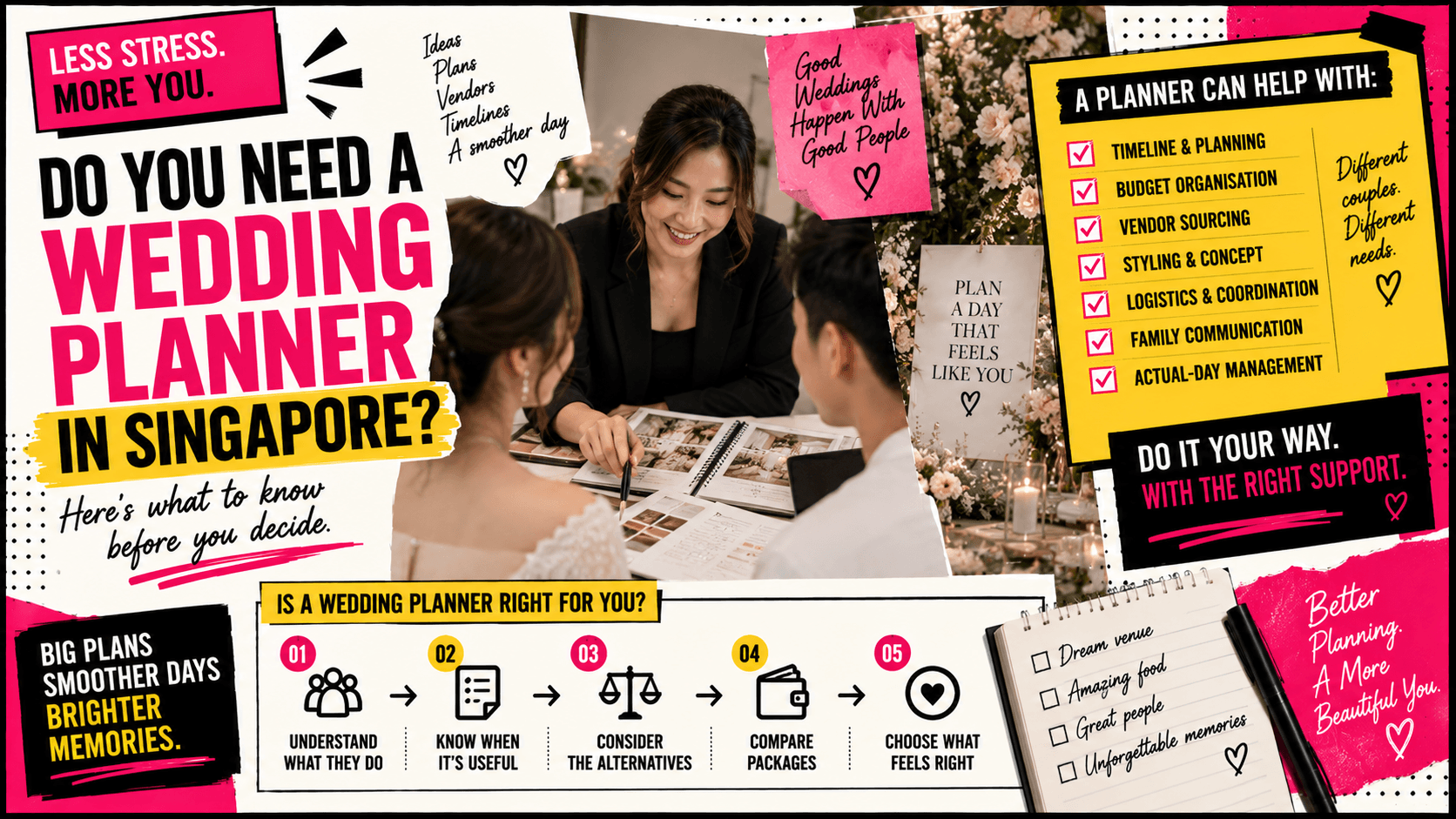
Do you actually need a wedding planner in Singapore?
Not every couple needs a wedding planner.
Some couples enjoy researching venues, comparing vendors, building timelines and organising every detail themselves.
Others would rather have someone help manage the process.
The question is therefore not:
"Are wedding planners necessary?"
A better question is:
"Would a wedding planner make planning our particular wedding significantly easier?"
That depends on:
- Wedding complexity
- Available time
- Number of vendors
- Number of venues
- Budget
- Family involvement
- How much planning you want to handle personally
This guide explains what a wedding planner in Singapore may do, when hiring one can be useful and when planning the wedding yourself may work perfectly well.
For the complete planning journey, start with Aven's Ultimate Singapore Wedding Planning Guide.
What does a wedding planner actually do?
The exact scope depends on the planner and package.
A wedding planner may help with areas such as:
- Planning timeline
- Budget organisation
- Venue search
- Vendor recommendations
- Vendor sourcing
- Quotation comparison
- Styling direction
- Logistics
- Wedding programme
- Vendor coordination
- Family coordination
- Actual-day timeline
- Wedding-day management
Some planners manage almost the entire planning journey.
Others provide selected services.
Always compare the actual scope rather than assuming every wedding planner provides the same service.
Wedding planner vs actual-day coordinator: what's the difference?
The main difference is generally when they become involved and how much they manage.
A wedding planner may work with you throughout the planning process.
An actual-day coordinator typically focuses more heavily on executing plans that have already been made.
| Area | Wedding Planner | Actual-Day Coordinator |
|---|---|---|
| Early planning | Often | Usually limited |
| Budget planning | May assist | Usually limited |
| Venue sourcing | May assist | Usually not primary role |
| Vendor sourcing | May assist | Usually not primary role |
| Styling planning | May assist | Depends on package |
| Timeline development | Often | Often |
| Vendor coordination | Often | Often closer to wedding |
| Wedding-day execution | Often | Primary focus |
There can be significant overlap between services.
For a detailed comparison, use Aven's Wedding Planner vs Actual-Day Coordinator Singapore.
When might hiring a wedding planner be useful?
A planner may provide more value when your wedding involves significant complexity.
Examples include:
- Many vendors
- Several locations
- Large guest list
- Custom venue
- Extensive decor
- Complicated programme
- Multiple cultural traditions
- Destination elements
- Limited personal planning time
None of these automatically means you need a planner.
But as the number of moving parts increases, having someone responsible for seeing the bigger picture can become increasingly useful.
A wedding planner may help if you have very little planning time
Wedding planning involves many small tasks.
You may need to:
- Research vendors
- Send enquiries
- Compare packages
- Attend meetings
- Review contracts
- Track payments
- Build schedules
- Coordinate logistics
- Follow up on decisions
If both of you have busy schedules, these tasks can accumulate quickly.
A planner does not eliminate the need for your decisions.
But they may reduce the amount of research, administration and coordination you need to manage personally.
A planner can be useful if you do not know where to start
The beginning of wedding planning can feel especially confusing.
You may be wondering:
- What should we book first?
- How much should we budget?
- Which vendors do we need?
- When should we book them?
- What should happen on the actual day?
A planner can help create structure around these decisions.
If you prefer planning independently, Aven's Complete Singapore Wedding Planning Timeline provides an 18-month-to-wedding-day roadmap.
A planner may help with vendor sourcing
Finding vendors can involve significant research.
For each category, you may need to:
- Find potential vendors
- Review portfolios
- Request quotations
- Compare packages
- Ask questions
- Check availability
- Review agreements
- Book
A planner may help narrow down options based on your:
- Style
- Requirements
- Wedding size
- Venue
- Budget
You should still review the vendors and make decisions you are comfortable with.
If you are sourcing vendors yourself, use Aven's Singapore Wedding Vendor Checklist.
A wedding planner may help keep the budget organised
Wedding budgets are rarely one single payment.
You may be managing deposits and balances across:
- Venue
- Photographer
- Videographer
- Makeup artist
- Florist
- Decorator
- Entertainment
- Attire
- Transport
- Other vendors
A planner may help keep the broader budget visible as decisions are made.
However, you should still understand:
- What you are spending
- What you have paid
- What remains due
- Which expenses are optional
Ultimately, it is still your money.
Use Aven's Wedding Budget Checklist Singapore to map your expected costs.
A planner can help connect decisions across different vendors
Wedding decisions rarely exist independently.
For example:
Your venue access time affects your decorator.
Your decor completion time affects your photographer.
Your makeup timing affects your morning photography.
Your solemnisation timing affects your banquet programme.
Your transport affects almost everything.
A planner can help see these dependencies across the wedding rather than treating every vendor as a separate booking.
A planner may be especially useful for multi-location weddings
A Singapore wedding might involve:
Bride's home → groom's home → solemnisation venue → hotel
Every move creates additional logistics.
You may need to coordinate:
- Couple
- Bridal party
- Family
- Photographer
- Videographer
- Makeup artist
- Transport
- Personal belongings
The more locations involved, the more important timing becomes.
Use Aven's Singapore Actual-Day Wedding Timeline when mapping the day.
A planner may help when your wedding has extensive custom decor
Custom styling can involve several vendors working within one space.
For example:
- Decorator
- Florist
- AV team
- Lighting
- Venue
- Signage vendor
- Furniture rental
Someone needs to understand:
- Who provides what
- When everyone arrives
- Where installations go
- What the venue permits
- When setup must finish
- Who removes everything
If your wedding relies heavily on custom styling, coordination can become a substantial part of the planning workload.
For decor planning, use Aven's How to Choose a Wedding Decorator in Singapore.
A planner can help when many family members are involved
Singapore weddings can involve expectations from multiple family members.
This may affect:
- Guest list
- Traditions
- Tea ceremony
- Seating
- Banquet programme
- Timing
A planner cannot make personal family decisions for you.
But having a neutral person managing logistics can sometimes reduce the number of operational questions being directed at the couple.
You still decide what happens.
The planner helps translate those decisions into a workable plan.
When might you not need a wedding planner?
You may be comfortable planning without a full-service planner if:
- You enjoy organising events
- You have sufficient planning time
- Your wedding is relatively straightforward
- Your venue handles many logistics
- You have a manageable number of vendors
- You are comfortable comparing contracts and quotations
- You already know the style of wedding you want
Planning your own wedding is completely realistic for many couples.
The key is having a system rather than trying to remember everything mentally.
A hotel wedding may reduce some planning complexity
Many wedding venues provide significant infrastructure.
Depending on the package, your venue may already coordinate elements such as:
- Banquet
- Tables
- Chairs
- Stage
- AV
- Basic decor
- Service staff
You may also have a venue coordinator managing venue-related matters.
This does not make them your personal wedding planner.
But it can reduce the number of external elements you need to organise.
Use Aven's How to Compare Wedding Venue Packages in Singapore to understand what your venue already covers.
Your venue coordinator is not necessarily your wedding planner
This distinction is important.
A venue coordinator generally represents and manages matters relating to the venue.
Their responsibilities may include:
- Venue arrangements
- Banquet
- Setup requirements
- Venue timeline
- In-house services
Your wedding may also involve things outside their responsibility, such as:
- Morning gatecrash
- Tea ceremony at home
- Makeup schedule
- External transport
- Photographer movements
- Videographer movements
- Personal belongings
Ask your venue coordinator exactly what they will and will not manage.
Could you plan the wedding yourself and hire an actual-day coordinator?
Yes.
This can be a useful middle ground.
You handle:
- Venue selection
- Vendor booking
- Budget
- Styling decisions
- Invitations
- Guest list
- Planning
Then closer to the wedding, an actual-day coordinator helps organise and execute the final plan.
This may suit couples who enjoy planning but do not want to personally manage every operational detail on the wedding day.
The important part is understanding when the coordinator becomes involved and what preparation they expect from you.
Could friends or bridesmaids coordinate the wedding instead?
Friends and bridal-party members often help with weddings.
They may assist with:
- Holding belongings
- Gathering family
- Managing small tasks
- Helping with gatecrash
- Directing guests
But think carefully before assigning one friend responsibility for the entire wedding.
That person may spend much of the celebration:
- Checking schedules
- Calling vendors
- Solving problems
- Moving items
- Finding people
If they are an important guest, decide whether that is how you want them to experience your wedding.
What does partial wedding planning mean?
You may not need complete planning support.
Some planning services may focus on selected areas.
For example:
- Vendor sourcing
- Styling
- Timeline development
- Final coordination
- Actual-day management
This can suit couples who have already completed part of the planning but need help with specific areas.
When comparing packages, focus on the responsibilities you want to hand over rather than simply choosing between "planner" and "no planner."
How should you compare wedding planner packages?
Create a side-by-side comparison.
| Service | Planner A | Planner B |
|---|---|---|
| Planning timeline | ||
| Budget support | ||
| Venue sourcing | ||
| Vendor sourcing | ||
| Vendor meetings | ||
| Styling | ||
| Contract tracking | ||
| Payment tracking | ||
| Actual-day timeline | ||
| Vendor coordination | ||
| Rehearsal | ||
| Actual-day team | ||
| Setup supervision | ||
| Teardown supervision |
Do not compare package names alone.
One vendor's "full planning" may have a different scope from another's.
Ask who will actually plan and coordinate your wedding
If you choose a planning company, find out who your main contact will be.
Ask:
- Who will handle our planning?
- Who attends meetings?
- Who builds the timeline?
- Who will be there on the wedding day?
- How many coordinators will be present?
- What happens if our assigned planner is unavailable?
You may have excellent chemistry with the person conducting the initial consultation.
Make sure you understand whether that person will actually manage your wedding.
Choose a planner whose communication style works for you
You may communicate with your planner for months.
Pay attention to how the relationship feels.
Consider:
- Are explanations clear?
- Do they understand your priorities?
- Are they organised?
- Do they listen before suggesting solutions?
- Do you feel comfortable disagreeing?
- Do they communicate in a way that works for you?
A good planning relationship should help create clarity rather than make you feel that you have lost control of your own wedding.
Questions to ask a wedding planner before booking
Use these questions when comparing planners:
- What planning services do you provide?
- When do you become involved?
- What exactly is included in this package?
- Do you help with budgeting?
- Do you source venues?
- Do you source vendors?
- Can we choose vendors outside your recommendations?
- Do you attend vendor meetings?
- Do you help with styling?
- Do you build the actual-day timeline?
- Do you coordinate directly with vendors?
- Will you be present on the wedding day?
- How many coordinators will be there?
- Who will be our main planner?
- What communication channels do you use?
- How often will we meet?
- What are the payment milestones?
- What are the cancellation or postponement terms?
- What happens if our assigned planner becomes unavailable?
Make sure the answers match the type of help you actually want.
Wedding planner decision checklist
Consider hiring a planner if several of these apply:
- We have limited planning time
- We do not know where to start
- Our wedding involves many vendors
- We have several locations
- We want extensive custom decor
- Our programme is complicated
- We want help sourcing vendors
- We want help managing the planning process
- We would rather delegate substantial coordination
You may be comfortable without full planning if:
- We enjoy planning
- We have sufficient time
- Our wedding is relatively straightforward
- Our venue handles many logistics
- We are comfortable managing vendors
- We already have a clear plan
- We mainly need wedding-day execution support
There is no score that determines the answer.
Use the checklist to identify where you genuinely need help.
Wedding planner red flags to clarify before booking
Ask more questions if:
- Package responsibilities are vague
- You do not know who your assigned planner is
- Vendor relationships are unclear
- You feel pressured toward particular vendors without understanding why
- Actual-day responsibilities are unclear
- Communication expectations are undefined
- Additional charges are difficult to understand
- Cancellation or postponement terms are unclear
These points do not automatically mean the planner is unsuitable.
They mean the arrangement needs to be clearer before you commit.
Frequently asked questions about wedding planners in Singapore
Is a wedding planner necessary in Singapore?
No. Many couples plan their own weddings successfully. Whether you need one depends on your wedding complexity, available time and how much planning you want to manage.
What is the difference between a wedding planner and coordinator?
A planner may become involved earlier and assist with broader planning, while an actual-day coordinator generally focuses more on final coordination and wedding-day execution. Exact services vary.
Does my hotel wedding coordinator replace a wedding planner?
Not necessarily. A venue coordinator generally manages venue-related responsibilities rather than every part of your wedding.
Can I hire a planner after I have already booked some vendors?
Potentially. Ask planners whether they offer partial planning or coordination packages suited to your stage of planning.
Can my bridesmaids coordinate the wedding instead?
They can help, but consider whether you want important guests spending the celebration managing logistics.
Should I hire a planner for a small wedding?
Wedding size is only one factor. A small but logistically complicated wedding may still benefit from planning support.
Can I plan everything myself and hire someone only for the actual day?
Yes. An actual-day coordination service may suit couples who want to manage the planning themselves but hand over execution closer to the wedding.
The best planning setup is the one that gives you the right amount of control
Hiring a wedding planner is not automatically the easier or better choice.
Planning everything yourself is not automatically the smarter choice either.
The right approach depends on how much of the process you actually want to own.
Ask yourselves:
- Do we enjoy planning?
- Do we realistically have enough time?
- How complicated is our wedding?
- Which parts are we comfortable managing?
- Which parts would we rather hand over?
- Do we need planning help, wedding-day help or both?
You may decide you want a full-service planner.
You may decide an actual-day coordinator is enough.
Or you may be perfectly comfortable managing the entire process yourselves.
The next guide in this series breaks down that middle ground in detail: Wedding Planner vs Actual-Day Coordinator Singapore.
For your vendor team, use the Singapore Wedding Vendor Checklist.
For your planning schedule, follow the Complete Singapore Wedding Planning Timeline.
And for the complete planning journey, return to the Ultimate Singapore Wedding Planning Guide.