
Blog
Wedding Vendor Contract Checklist Singapore: What to Check Before Signing
September 8, 2026 · Updated September 8, 2026
Use this Singapore wedding vendor contract checklist before signing. Review services, deliverables, payments, overtime, cancellations, postponements, replacements and other important terms.
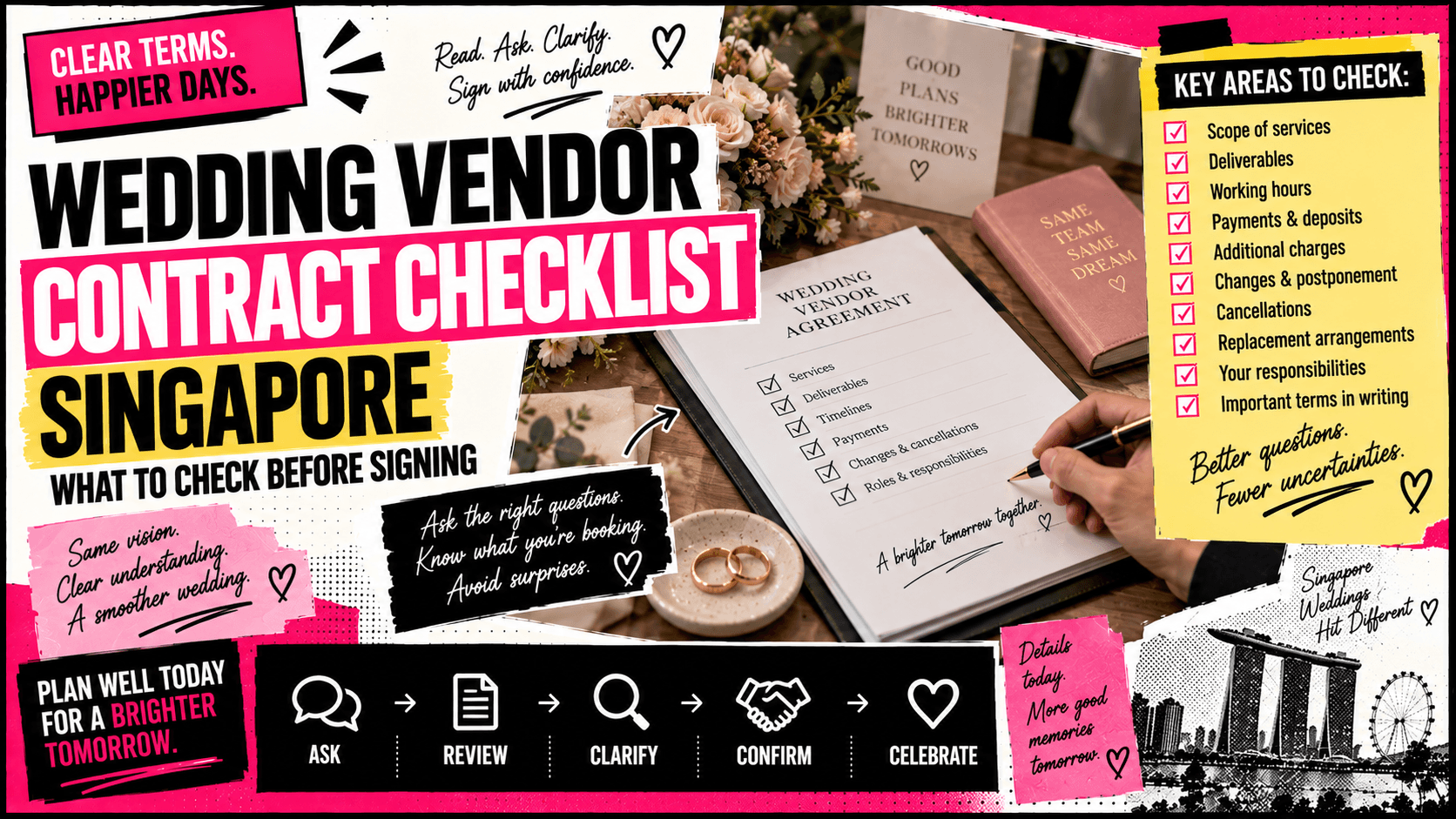
What should you check in a wedding vendor contract before signing?
You have found a wedding vendor you like.
The quotation looks reasonable.
You have discussed what you want.
Before paying the deposit, there is one more important step:
Understand what you are agreeing to.
A wedding vendor agreement should give both you and the vendor a clear record of the arrangement.
Depending on the service, you may need to check:
- Vendor identity
- Wedding details
- Scope of services
- Deliverables
- Working hours
- Payments
- Additional charges
- Overtime
- Changes
- Postponement
- Cancellation
- Replacement arrangements
- Responsibilities
This wedding vendor contract checklist for Singapore couples gives you a practical framework for reviewing an agreement before signing.
It is a general planning checklist, not legal advice.
If you are still comparing vendors, start with Aven's Questions to Ask Wedding Vendors Before Booking in Singapore.
Why does the wedding vendor contract matter?
Wedding planning can stretch across many months.
During that time, you may exchange:
- WhatsApp messages
- Emails
- Calls
- Meetings
- Quotations
- Reference images
- Revised packages
It becomes easy for details to become unclear.
A written agreement helps establish what both sides have actually committed to.
Before signing, you should be able to answer:
- What is being provided?
- Who is providing it?
- When will it be provided?
- How much are you paying?
- What could cost extra?
- What happens if plans change?
- What happens if either side cannot perform as expected?
If the contract does not answer an important question, clarify it before signing.
Check the vendor's identity and contact details
Start with the basics.
Check whether the agreement clearly identifies the vendor or business you are engaging.
Depending on the arrangement, relevant details may include:
- Business name
- Contact person
- Phone number
- Business address
- Other identifying business information where applicable
Also check that you know who your main contact will be throughout the planning process.
This is especially useful when booking through a company with multiple staff members.
Check your names, wedding date and venue
Small administrative mistakes can create unnecessary confusion.
Confirm:
- Couple names
- Wedding date
- Venue
- Solemnisation venue if different
- Other locations
- Service start time
- Service end time
If your wedding involves several locations, make sure the agreement reflects the locations relevant to that vendor.
For example, your photographer may need to cover:
Bride's home → groom's home → solemnisation venue → banquet venue
Do not assume additional locations are automatically included.
Check the exact scope of services
The agreement should make it reasonably clear what you are paying the vendor to do.
Avoid relying only on vague package labels such as:
Premium Package
or:
Actual-Day Package
Instead, look for the actual services.
For example:
- Hours of coverage
- Number of staff
- Number of setups
- Number of looks
- Number of performances
- Number of deliverables
- Locations
- Equipment
- Setup
- Teardown
You should be able to compare the contract against the quotation and your discussions.
Check what is specifically excluded
Understanding exclusions can be just as important as understanding inclusions.
Potential exclusions might involve:
- Transport
- Parking
- Early-start charges
- Overtime
- Additional locations
- Additional crew
- Additional revisions
- Printing
- Rentals
- Setup
- Teardown
Not every exclusion needs to appear in every wedding contract.
The important point is that you understand the limits of the package.
If something matters to you and its inclusion is unclear, ask before signing.
Check the deliverables carefully
For vendors providing a final product, understand exactly what you receive.
For example:
Photographer
- Edited photographs
- Online gallery
- Album
- Prints
Videographer
- Highlight film
- Long-form film
- Social edits
- Raw footage if applicable
Decorator
- Structures
- Signage
- Styling
- Rental items
Photo booth
- Prints
- Digital files
- Guestbook
Ask yourself:
Could someone who was not part of our earlier conversations understand what we are supposed to receive from this agreement?
If not, seek clarification.
Check when deliverables will be provided
If the service continues after the wedding, check the expected delivery timeline.
This is especially relevant for:
- Photography
- Videography
- Albums
- Printed products
- Digital galleries
Look for whether the timeline is expressed as:
- Specific date
- Number of days
- Number of weeks
- Number of months
Also check whether any action is required from you before the timeline begins.
For example, album production may depend on you selecting photographs first.
Check how many people are included
Some wedding services involve a team.
The agreement may need to clarify whether your package includes:
- One photographer or two
- One videographer or two
- Lead makeup artist plus assistant
- Planner plus coordinators
- Full band or selected musicians
- Photo booth attendants
Team size can affect:
- Coverage
- Setup
- Logistics
- Price
If you discussed a specific team configuration, check that the final agreement matches it.
Check whether you are booking a specific person
Sometimes you choose a vendor because you specifically want one individual.
For example:
- Photographer
- Videographer
- Makeup artist
- Emcee
- Planner
Ask whether your booking guarantees that person's attendance.
If not, understand:
- Who may replace them
- When substitutions may happen
- Whether you will be informed
- What happens if a suitable replacement is unavailable
This distinction is especially important when a business has several people providing the same service.
Check the working hours and coverage period
Do not assume phrases such as "10 hours coverage" answer every question.
Clarify:
- Start time
- End time
- Whether coverage is continuous
- Whether breaks count
- Whether travel counts
- Whether hours can be split
- Whether setup time counts
- Whether teardown time counts
The answers depend on the type of vendor.
For long wedding days, even a small difference in how hours are calculated can affect your schedule.
Use Aven's Singapore Actual-Day Wedding Timeline to estimate the coverage you may need.
Check the overtime terms
Weddings can run late.
Before signing, understand:
- Whether overtime is available
- Overtime rate
- Minimum overtime block
- How partial hours are calculated
- Whether overtime depends on vendor availability
- Who can approve overtime
For team-based vendors, ask whether the rate applies:
- Per person
- Per team
- Per service
Do not wait until 11pm on your wedding night to learn how overtime works.
Check the total price and payment schedule
The agreement should allow you to understand:
- Package price
- Deposit
- Subsequent payments
- Final balance
- Payment deadlines
- Accepted payment methods where relevant
Create a simple payment tracker.
| Payment | Amount | Due Date | Paid? |
|---|---|---|---|
| Deposit | |||
| Second payment | |||
| Final balance |
Repeat this for every major vendor.
For wider budgeting, use Aven's Wedding Budget Checklist Singapore.
Understand what your deposit means
Do not assume every vendor treats deposits in exactly the same way.
Read the agreement carefully to understand:
- Amount required
- What the payment confirms
- Whether it is refundable
- Circumstances where it may be retained
- Whether it can be transferred to another date
If the contract uses terms such as:
- Deposit
- Booking fee
- Reservation fee
focus on what the agreement says the payment actually does rather than relying only on the label.
Check for potential additional charges
Ask:
"Under what circumstances could the final amount exceed the amount shown here?"
Possible additional costs might include:
- Overtime
- Transport
- Parking
- Additional manpower
- Additional locations
- Custom requests
- Additional revisions
- Additional rentals
- Extra equipment
- Extended setup
Ideally, you should understand either:
- The actual additional rate, or
- How that additional cost will be determined
This makes your overall wedding budget easier to manage.
Check what happens if you change the wedding date
Review the postponement or rescheduling terms.
Questions to answer include:
- Can the booking move to another date?
- Is transfer subject to availability?
- Is there a rescheduling fee?
- Is there a deadline for choosing the new date?
- What happens if the vendor is unavailable?
- What happens if package prices change?
Different vendors may have different policies.
Understand these terms before you need them.
Check the cancellation terms
Cancellation clauses can have significant financial consequences.
Understand:
- How cancellation must be communicated
- Whether payments already made are refundable
- Whether additional payments become due
- Whether the outcome changes depending on when cancellation occurs
Do not skim this section simply because you do not expect to cancel.
The purpose of reviewing a contract is to understand what happens when circumstances do not go according to the original plan.
Check what happens if the vendor cannot perform the service
Ask what happens if the vendor becomes unable to provide the agreed service.
Depending on the vendor, possibilities might include:
- Replacement professional
- Replacement team
- Rescheduling
- Refund arrangements
- Other remedies stated in the agreement
For creative services, replacement may be particularly important because style can differ significantly between individuals.
Understand both:
What happens?
and:
Who decides whether the replacement is suitable?
Check force majeure and circumstances outside anyone's control
Some agreements contain clauses dealing with events outside either party's reasonable control.
The wording and consequences can vary.
Read the clause rather than assuming what it means.
Look for:
- What circumstances it covers
- What each party must do
- Whether rescheduling is possible
- How payments are treated
- Whether alternative arrangements are discussed
If the wording is important to your decision but you do not understand it, seek clarification before signing.
Check your responsibilities as the couple
Wedding agreements do not only create responsibilities for vendors.
You may also be required to provide:
- Final timeline
- Venue access
- Contact information
- Meal
- Parking
- Accommodation
- Permits
- Reference materials
- Final selections
- Guest information
There may also be deadlines.
For example, a vendor might require your final programme several weeks before the wedding.
Add these obligations to your planning checklist so they are not forgotten.
Check venue access and setup responsibilities
This is especially important for vendors such as:
- Florists
- Decorators
- Bands
- DJs
- Photo booths
Confirm:
- When venue access begins
- How equipment enters
- Who coordinates access
- Setup duration
- Power requirements
- Venue restrictions
- Teardown deadline
Your vendor contract and venue agreement should not contradict each other.
Use Aven's Wedding Venue Contract Checklist Singapore when reviewing the venue side.
Check ownership and usage of creative work
For photography, videography and other creative services, the agreement may contain terms covering:
- Copyright
- Usage rights
- Portfolio use
- Social media
- Publication
- Raw files
- Editing
Do not assume paying for a service automatically means every possible right transfers to you.
If privacy or public posting matters to you, review the relevant terms and discuss them before signing.
For photography and videography specifically, compare these details while choosing your vendor rather than only after booking.
Check revision and change-request terms
For services involving creative deliverables or custom designs, ask:
- How many revisions are included?
- What counts as a revision?
- When can changes be requested?
- What changes cost extra?
- When is the design considered final?
This may apply to:
- Wedding films
- Albums
- Invitations
- Signage
- Decor concepts
- Custom graphics
A clear revision process protects both sides from endless uncertainty.
Make sure important custom arrangements are documented
Suppose the standard package says one thing, but the vendor agrees to customise it for you.
Examples:
- One extra hour
- Additional location
- Special song
- Different deliverable
- Custom backdrop
- Extra makeup look
- Different payment date
Do not assume the original standard agreement automatically reflects that change.
Check whether important custom arrangements appear in:
- Agreement
- Updated quotation
- Written addendum
- Other clear written confirmation
The objective is simple:
Both sides should be able to refer to the same arrangement later.
Compare the contract with the quotation and your conversations
Before signing, place these side by side:
1. Final quotation
2. Contract
3. Important written discussions
Then compare:
- Package
- Price
- Hours
- Deliverables
- Team
- Locations
- Special requests
- Payment schedule
- Additional charges
If something important appears in one place but not another, ask the vendor how it should be documented.
Do this before paying rather than trying to reconstruct the discussion months later.
Wedding vendor contract checklist before signing
Use this final checklist:
- Vendor identity is clear
- Couple details are correct
- Wedding date is correct
- Venue and locations are correct
- Scope of services is clear
- Deliverables are clear
- Team size is clear
- Assigned person is clear where relevant
- Start and end times are clear
- Overtime terms are understood
- Total package price is correct
- Deposit is understood
- Payment schedule is clear
- Additional charges are understood
- Postponement terms are reviewed
- Cancellation terms are reviewed
- Vendor-unavailability arrangements are reviewed
- Couple responsibilities are understood
- Setup requirements are understood where relevant
- Teardown requirements are understood where relevant
- Creative usage terms are reviewed where relevant
- Revision terms are understood where relevant
- Custom arrangements are documented
- Contract matches the final quotation
- Unclear wording has been clarified
Do not rush simply because the vendor is waiting for the deposit.
Take enough time to understand the booking you are making.
Frequently asked questions about wedding vendor contracts
Should every wedding vendor provide a contract?
The documentation used can vary by vendor and service. For significant bookings, you should have clear written terms showing what has been agreed.
Should I pay a wedding vendor before reviewing the terms?
It is sensible to understand the terms governing your booking and payment before committing.
What if the quotation and contract say different things?
Ask the vendor to clarify the inconsistency before signing or paying.
What if something was promised over WhatsApp but is not in the contract?
Ask how that arrangement should be formally reflected or confirmed in writing.
Should I read the cancellation clause even if I am certain the wedding will proceed?
Yes. Contract review is partly about understanding what happens when circumstances change unexpectedly.
What if I do not understand a clause?
Ask for clarification before signing. If the clause has significant legal or financial consequences and you remain uncertain, consider obtaining appropriate professional advice.
Should I keep a copy of the signed agreement?
Yes. Keep your wedding agreements, quotations and important confirmations organised and accessible throughout planning.
A good wedding contract should reduce uncertainty
You do not need to approach every wedding contract expecting something to go wrong.
The purpose of reviewing it carefully is the opposite.
You want fewer unanswered questions.
Before signing, make sure you understand:
- Who you are booking
- What you are receiving
- How much you are paying
- When everything happens
- What you need to provide
- What could cost extra
- What happens if plans change
- What happens if the vendor cannot provide the service
If something important remains unclear, ask.
A few extra questions before booking can prevent much bigger misunderstandings later.
For the questions to ask during vendor consultations, use Questions to Ask Wedding Vendors Before Booking in Singapore.
For warning signs to consider while comparing vendors, continue to Wedding Vendor Red Flags Singapore.
Closer to your wedding, use the Wedding Vendor Confirmation Checklist.
For your complete vendor list, return to the Singapore Wedding Vendor Checklist.
And for the full planning journey, use the Ultimate Singapore Wedding Planning Guide.