
Blog
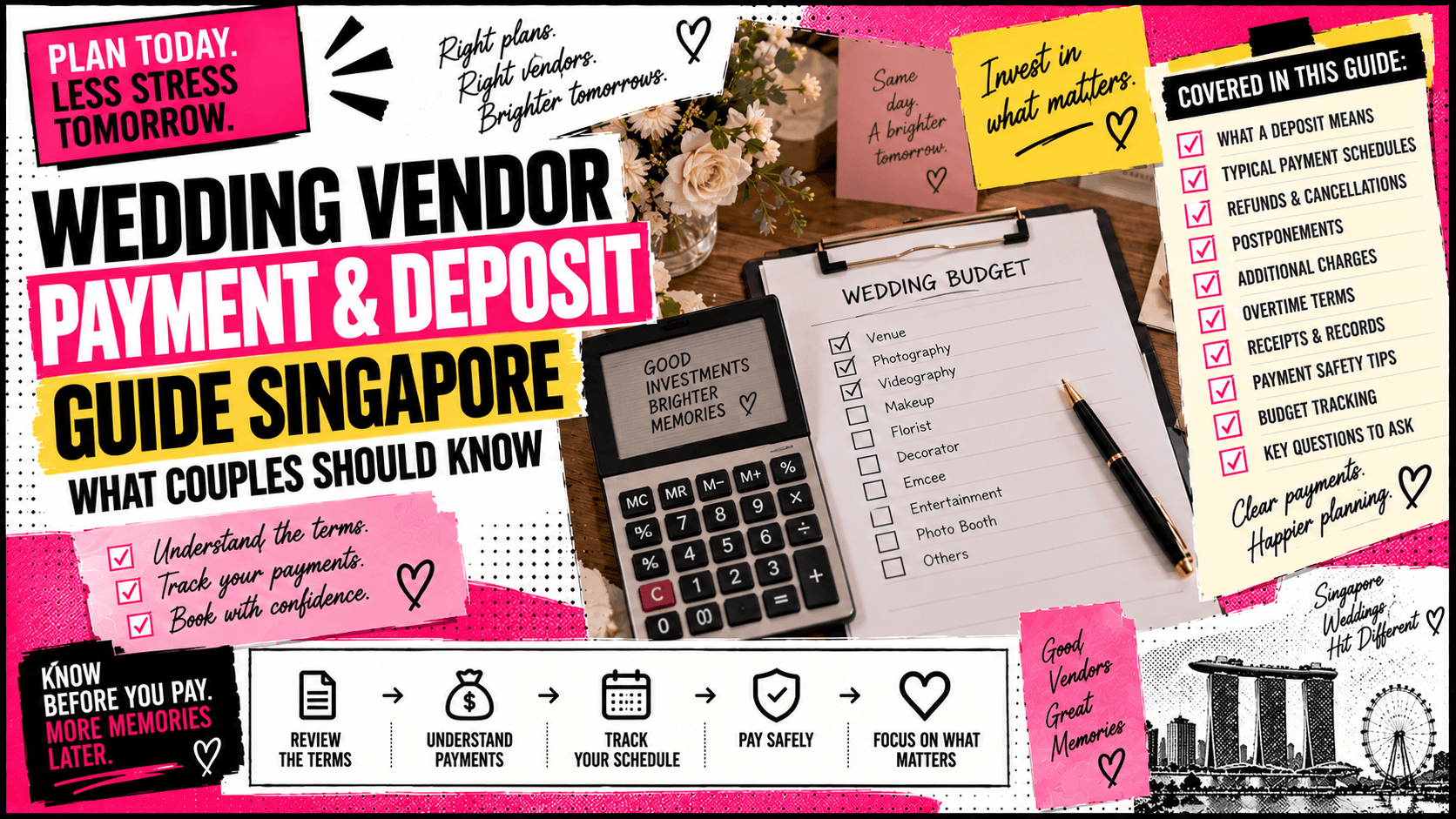
Wedding Vendor Payment & Deposit Guide Singapore: What Couples Should Know
September 8, 2026 · Updated September 8, 2026
Understand wedding vendor payments and deposits in Singapore, including booking fees, payment schedules, receipts, refunds, postponements, cancellations and how to track what you owe.
How do wedding vendor payments and deposits work in Singapore?
Booking several wedding vendors means managing several different payment arrangements.
You may have deposits for your:
- Photographer
- Videographer
- Makeup artist
- Florist
- Decorator
- Planner
- Emcee
- Entertainment
- Photo booth
- Other wedding services
Each vendor may structure payments differently.
One may require a deposit followed by the remaining balance.
Another may split payment across several milestones.
Another may require final payment before the wedding.
This wedding vendor payment and deposit guide for Singapore couples explains what to check before paying, how to track your payments and which questions to ask before committing.
For the complete list of vendors you may need, start with Aven's Singapore Wedding Vendor Checklist.
What is a wedding vendor deposit?
A wedding vendor may request an upfront payment when you confirm the booking.
Depending on the vendor and agreement, this may be described as a:
- Deposit
- Booking fee
- Reservation fee
- Initial payment
- First instalment
Do not assume these terms always mean exactly the same thing.
What matters is what the vendor's agreement says the payment does.
Before paying, understand:
- How much you are paying
- What the payment confirms
- Whether your wedding date becomes reserved
- Whether the payment is refundable
- What happens to it if your plans change
Why do wedding vendors ask for deposits?
Wedding vendors often take bookings months in advance.
Once your date is confirmed, the vendor may:
- Reserve that date
- Turn away other enquiries
- Begin planning
- Assign staff
- Order materials
- Prepare designs
- Commit resources
An upfront payment can therefore form part of the vendor's booking process.
The important question for couples is not simply:
"Does this vendor require a deposit?"
Instead ask:
"What are the terms attached to this payment?"
How much should a wedding vendor deposit be?
There is no single deposit amount or percentage that applies to every wedding vendor in Singapore.
Payment structures can vary according to:
- Vendor
- Service
- Package
- Wedding date
- Lead time
- Custom work
- Materials required
- Business practices
Instead of trying to find one "correct" percentage, evaluate the entire arrangement.
Ask:
- What is due now?
- What remains outstanding?
- When is the balance due?
- What happens to payments if plans change?
A larger upfront payment makes understanding the applicable terms even more important.
Do not compare vendors based only on deposit size
Suppose Vendor A requires a smaller initial payment than Vendor B.
That does not automatically make Vendor A the better choice.
Compare the complete package:
| Factor | Vendor A | Vendor B |
|---|---|---|
| Total price | ||
| Initial payment | ||
| Second payment | ||
| Final payment | ||
| Deliverables | ||
| Additional charges | ||
| Postponement terms | ||
| Cancellation terms |
The total financial commitment matters more than one payment in isolation.
Understand the full payment schedule before booking
Before paying your first amount, map the entire payment schedule.
For example:
| Stage | Amount | Due |
|---|---|---|
| Booking | ||
| Planning milestone | ||
| Before wedding | ||
| After wedding |
Your actual arrangement may look completely different.
The point is to understand every expected payment before you commit.
Ask whether any payment dates depend on:
- Contract signing
- Wedding date
- Design approval
- Delivery
- Completion of a milestone
When is the final wedding vendor payment usually due?
There is no universal final-payment date for every wedding service.
Depending on the vendor's terms, the balance may be due:
- Weeks before the wedding
- Days before the wedding
- On the wedding date
- After the service
- Before final deliverables are released
Check the actual agreement.
Do not assume your photographer, florist and emcee will all use the same schedule.
Tracking these dates becomes increasingly important as the wedding approaches.
Check exactly what your payment confirms
Before transferring money, ask:
"Once this payment is made, what exactly is confirmed?"
You may want confirmation of:
- Wedding date
- Package
- Price
- Coverage hours
- Assigned vendor where applicable
- Deliverables
- Locations
- Add-ons
If important details are still being negotiated, understand what is fixed and what can still change.
This reduces the risk of assuming that a payment confirmed something that had not actually been agreed.
Review the agreement before making a significant payment
Do not treat the payment and contract as completely separate parts of the booking.
Before committing, review the terms that govern the payment.
Check:
- Scope
- Price
- Deposit
- Payment schedule
- Additional charges
- Overtime
- Postponement
- Cancellation
- Vendor unavailability
Use Aven's Wedding Vendor Contract Checklist Singapore before signing.
Ask whether your wedding vendor deposit is refundable
Do not assume an upfront payment will automatically be returned if you change your mind.
Ask directly:
- Is this payment refundable?
- Under what circumstances?
- Does the outcome change depending on when we cancel?
- Are there administrative or other applicable charges?
- How is any refund calculated?
The answer should come from the terms governing your particular booking.
If the financial consequence matters to your decision, clarify it before paying.
Understand cancellation before paying
Even if you are certain you want the vendor, read the cancellation terms.
You should understand what happens if you cancel:
- Shortly after booking
- Several months before the wedding
- Close to the wedding
Check whether:
- Previous payments are retained
- Future instalments remain payable
- Different rules apply at different stages
You are not planning to cancel.
You are simply understanding the commitment you are making.
Understand what happens if you postpone the wedding
Postponement is different from cancellation.
Ask:
- Can the booking move to a new date?
- Is the existing payment transferred?
- Is transfer subject to availability?
- Is there a rescheduling charge?
- What happens if the vendor cannot make the new date?
- Does the package price change?
- How long do you have to choose another date?
If flexibility is particularly important to you, compare these terms before selecting a vendor.
Ask what happens if the vendor cannot provide the service
Your agreement should also address circumstances where the vendor cannot fulfil the booking.
Depending on the service and terms, this could involve:
- Replacement
- Rescheduling
- Refund arrangements
- Other agreed solutions
For services involving a specific person, ask whether another person can be assigned.
This is particularly relevant for:
- Photographers
- Videographers
- Makeup artists
- Planners
- Emcees
Do not assume the outcome. Check the terms that apply to your booking.
Watch for additional wedding vendor charges
The package price may not be the maximum amount you could eventually pay.
Potential additional charges could include:
- Overtime
- Transport
- Parking
- Early starts
- Late finishes
- Additional locations
- Additional manpower
- Additional revisions
- Rentals
- Custom requests
Ask:
"What circumstances could cause our final amount to increase?"
Then add realistic potential extras to your budget where appropriate.
For wider budgeting, use Aven's Wedding Budget Checklist Singapore.
Understand wedding vendor overtime charges
Your wedding schedule may run late.
Before the wedding, understand:
- Overtime rate
- Minimum overtime duration
- How partial hours are calculated
- Whether overtime is subject to availability
- Whether rates apply per person or team
- Who can approve overtime
This is particularly relevant for:
- Photography
- Videography
- Coordination
- Emcee services
- Entertainment
- Venue-related services
You should not need to negotiate these basics while your wedding is already running behind schedule.
Keep proof of every wedding vendor payment
Keep an organised record of payments.
Depending on how you pay, this could include:
- Invoice
- Receipt
- Bank transfer record
- Payment confirmation
- Updated statement
Your records should make it easy to answer:
How much have we paid?
How much do we still owe?
When is the next payment due?
Keep these records together with the relevant quotation and agreement.
Confirm who you are actually paying
Before transferring a significant amount, check the payment instructions provided by the vendor.
Confirm:
- Recipient details
- Amount
- Payment reference if required
- Which booking the payment relates to
If payment instructions suddenly change, particularly through an unexpected message, verify the change through a trusted communication channel before transferring funds.
Do not rush a transfer simply because a message appears urgent.
Be careful when payment details suddenly change
Wedding planning often involves communication through messaging apps and email.
If you unexpectedly receive new bank or payment details, verify them.
For example:
- Do not rely solely on the unexpected message.
- Contact the vendor through a previously established channel.
- Confirm the new payment instructions.
- Check the amount and recipient before transferring.
This is a sensible precaution for any significant payment, not only weddings.
Track all wedding vendor payments in one place
Once you have several vendors, create one master payment tracker.
| Vendor | Total | Paid | Balance | Next Due |
|---|---|---|---|---|
| Photographer | ||||
| Videographer | ||||
| Makeup | ||||
| Florist | ||||
| Decorator | ||||
| Emcee | ||||
| Entertainment | ||||
| Photo booth |
Update it whenever you make a payment.
This gives you a much clearer picture of your remaining wedding commitments.
Separate total wedding cost from cash already paid
These are two different numbers.
Suppose your booked vendors total $30,000.
You may only have paid $8,000 so far.
Your budget should therefore track:
Committed cost: $30,000
Paid so far: $8,000
Outstanding: $22,000
Tracking only money already paid can make your remaining wedding expenses look smaller than they actually are.
Aven's Singapore Wedding Budget Examples can help you think about the broader allocation.
Plan for months with several payments due at once
One common budgeting challenge is not only how much your wedding costs.
It is when the money leaves your account.
Several vendors may require final payments around the same period before your wedding.
Create a month-by-month view:
| Month | Vendor Payments Due | Expected Total |
|---|---|---|
| Month 1 | ||
| Month 2 | ||
| Month 3 | ||
| Wedding month |
This can help you identify cash-flow pressure earlier rather than discovering it during your final wedding month.
Do not pay for an upgrade without understanding it
During planning, vendors may offer additional services.
For example:
- Additional photographer
- Extra video coverage
- Additional floral installation
- Upgraded backdrop
- Extended photo booth hours
- Additional band set
Before paying, ask:
- What does this add?
- Why might we need it?
- What happens if we skip it?
- Does it change any other part of our package?
- Is the new total documented?
Update your budget every time you approve an upgrade.
Keep the latest version of every quotation
Packages can change throughout planning.
You might add:
- Hours
- Locations
- Deliverables
- Decorations
- Additional people
Label quotations clearly.
For example:
Photographer Quote - Final - 12 June
is easier to track than:
quotation_final_FINAL2.pdf
After a change, confirm:
- New total
- Amount already paid
- Remaining balance
- Updated payment schedule
This helps prevent old figures from being used accidentally.
Questions to ask before paying a wedding vendor
Before making your first significant payment, ask:
- What does this payment confirm?
- Is our wedding date reserved after payment?
- What is the total package price?
- What exactly is included?
- What could cost extra?
- How much is due now?
- When are future payments due?
- What happens if we postpone?
- What happens if we cancel?
- What happens if you cannot provide the service?
- Will we receive confirmation or a receipt?
- Are our agreed custom arrangements documented?
For a broader consultation checklist, use Aven's Questions to Ask Wedding Vendors Before Booking in Singapore.
Wedding vendor payment checklist
Before paying:
- Vendor and package confirmed
- Total price understood
- Scope understood
- Agreement reviewed
- Initial payment amount confirmed
- Purpose of initial payment understood
- Refund terms reviewed
- Payment schedule recorded
- Cancellation terms reviewed
- Postponement terms reviewed
- Additional charges understood
- Overtime rates understood where relevant
- Payment recipient verified
- Important custom arrangements documented
After paying:
- Payment confirmation saved
- Receipt or invoice saved where applicable
- Amount paid added to budget
- Remaining balance updated
- Next payment deadline recorded
- Latest quotation saved
- Agreement stored safely
Frequently asked questions about wedding vendor payments
Do all Singapore wedding vendors require a deposit?
Payment practices vary between vendors. Check the specific booking terms rather than assuming every vendor uses the same structure.
What percentage should a wedding vendor deposit be?
There is no single percentage that applies to every vendor. Focus on the amount, what it confirms, the remaining payment schedule and the applicable terms.
Are wedding vendor deposits refundable?
That depends on the agreement and circumstances. Review the specific refund and cancellation terms before paying.
Should I pay the full amount upfront?
Payment structures vary. If a significant amount is required upfront, make sure you understand the scope, terms and commitment before paying.
Should I get a receipt after paying?
Keep appropriate evidence of each payment and any confirmation provided by the vendor.
What if a vendor suddenly sends different payment details?
Verify unexpected changes through a trusted communication channel before transferring money.
What if I miss a payment deadline?
Check your agreement and contact the vendor promptly. Do not assume what the consequences will be.
Should I track deposits separately from my wedding budget?
Track both the total committed cost and the amount already paid so you understand your remaining financial obligations.
Good payment planning means fewer surprises later
Wedding vendor payments become much easier to manage when you stop thinking of them as isolated transfers.
Instead, track the full journey:
Book → Pay deposit → Track balance → Confirm changes → Make remaining payments → Keep records
Before paying any major vendor, you should understand:
- What you are buying
- What the total cost is
- What you are paying today
- What remains outstanding
- When future payments are due
- What could increase the price
- What happens if plans change
Then keep everything organised.
For your complete vendor list, use the Singapore Wedding Vendor Checklist.
Before booking, review Questions to Ask Wedding Vendors Before Booking in Singapore.
Before signing, use the Wedding Vendor Contract Checklist Singapore.
If something feels unclear during the booking process, review Wedding Vendor Red Flags Singapore.
Closer to your wedding, use the Wedding Vendor Confirmation Checklist.
For the complete planning journey, return to the Ultimate Singapore Wedding Planning Guide.