
Blog
Chinese Wedding Hair Combing Ceremony Singapore: Meaning, Steps & Checklist
September 9, 2026 · Updated September 9, 2026
Plan a Chinese wedding hair combing ceremony in Singapore with this guide to its meaning, timing, who performs it, what to prepare, traditional blessings and modern adaptations.
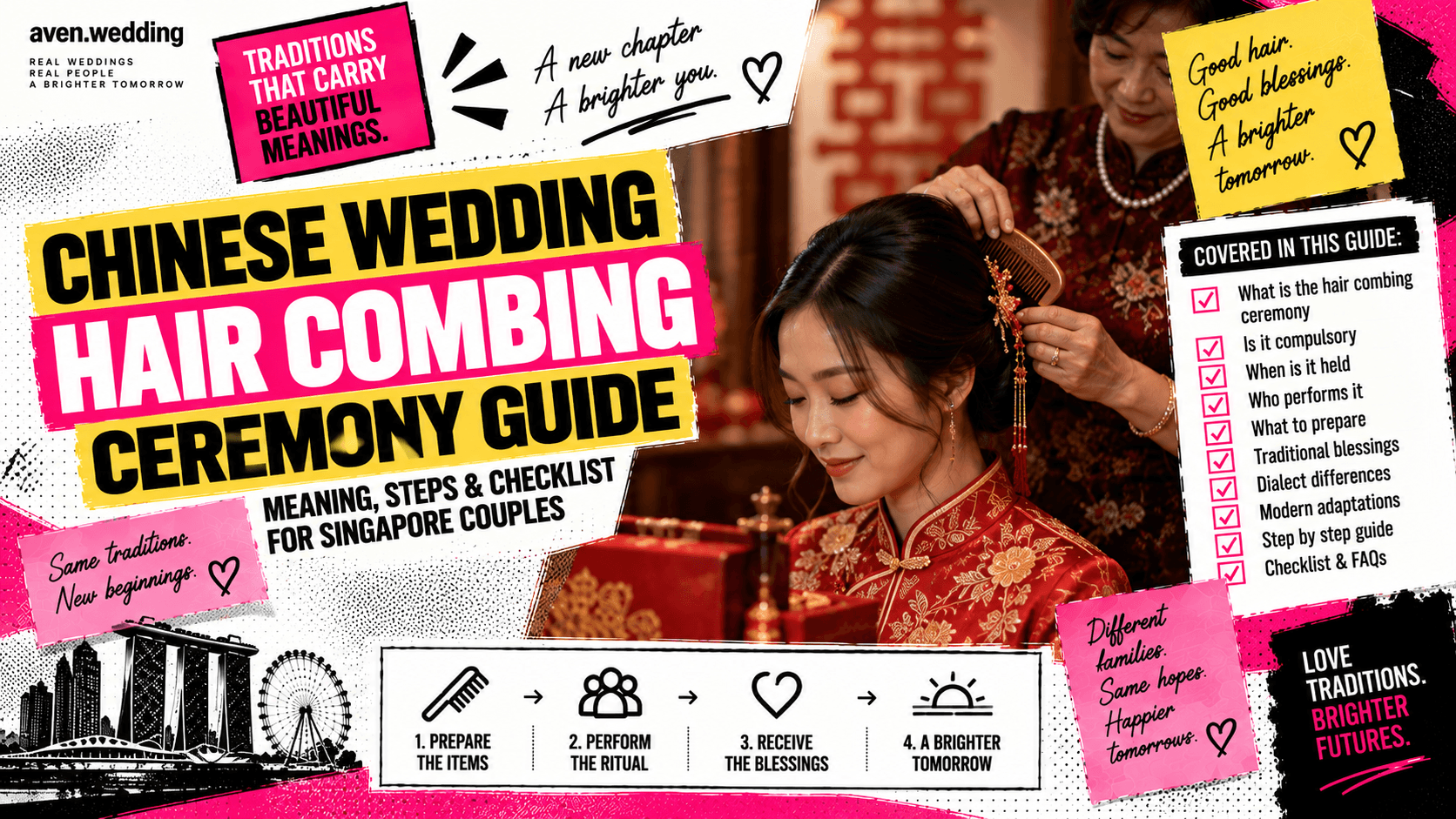
What is a Chinese wedding hair combing ceremony?
The Chinese wedding hair combing ceremony, often referred to as Shang Tou (上头), is a traditional pre-wedding ritual that symbolises the bride and groom entering adulthood and preparing for married life.
Depending on family tradition, the ceremony may involve:
- Combing the bride's and groom's hair
- Reciting auspicious blessings
- Wearing new clothing
- Preparing symbolic items
- Performing the ritual at an auspicious time
Some Singapore Chinese families observe the ceremony closely.
Others keep only a simplified version.
Some couples do not practise it at all.
This guide explains how the tradition works, what families may prepare and how modern couples can adapt it practically.
For a wider overview, start with Aven's Chinese Wedding Traditions in Singapore.
What does the hair combing ceremony symbolise?
The ceremony traditionally marks an important transition.
It can symbolise:
- Entering adulthood
- Beginning married life
- Family blessings
- A harmonious marriage
- Long-lasting companionship
- Prosperity and descendants
The ritual is often less about the physical act of combing hair and more about the blessings spoken during it.
For many families, it is an intimate moment between the couple and their parents or elders before the wedding day begins.
Is the hair combing ceremony compulsory?
No.
The hair combing ceremony is a cultural tradition rather than a legal requirement for marriage in Singapore.
Whether you practise it depends on:
- Family expectations
- Dialect background
- Personal beliefs
- How traditional your wedding is
- Whether your parents consider it meaningful
Some couples carry out the full ceremony.
Others may:
- Recite the blessings only
- Have a parent symbolically comb their hair
- Simplify the items used
- Skip the ritual
Discuss expectations with both families before planning it.
When is the Chinese wedding hair combing ceremony held?
The ceremony is traditionally held before the wedding, often on the night before or during the pre-wedding period.
Some families may also select an auspicious time.
The exact timing varies.
Before deciding, ask:
- Does your family follow an auspicious date?
- Does the ceremony need to happen at night?
- Does it need to happen before a particular wedding ritual?
- Are the bride and groom performing it separately?
- Who needs to be present?
If your wedding morning starts extremely early, completing the ritual the night before may also be more practical.
Do the bride and groom perform the ceremony together?
Traditionally, the bride and groom may perform the ceremony separately with their respective families.
This could mean:
- Bride at her family home
- Groom at his family home
Each side may have a parent or elder perform the hair combing and offer blessings.
Modern couples may adapt this.
For example, if both families are staying at the same hotel or the couple already lives together, they may create a simplified arrangement that still preserves the symbolic meaning.
Ask both families what they are comfortable with.
Who performs the hair combing?
The person performing the hair combing varies according to family practice.
It may be:
- Mother
- Father
- Married elder
- Relative considered fortunate in marriage and family life
Some traditions may prefer someone viewed as having an auspicious family life.
Other families simply choose a parent.
Do not assume there is one universally correct person.
Ask your parents or elders who your family expects to perform the ceremony.
What do you need for the hair combing ceremony?
The exact setup varies, but families may prepare items such as:
- Comb
- Mirror
- New clothing or pyjamas
- Red decorative items
- Candles
- Auspicious food
- Red packets
- Other family-specific ceremonial objects
Some traditions may use a complete ceremonial set.
Others may need little more than a comb and the person giving the blessings.
Before purchasing anything, ask your family what they actually practise.
Do you need a new comb?
Some families may prepare a new comb specifically for the ceremony.
Whether this is required depends on family tradition.
If a new comb is expected, prepare it beforehand and keep it together with the other ceremonial items.
Do not wait until the ceremony is about to start to find out nobody has a suitable comb.
Why might new clothing be worn?
Some families associate the ceremony with wearing new clothing to represent a fresh beginning.
This may involve:
- New pyjamas
- New casual clothing
- Traditional clothing
- Red or auspicious colours
You do not necessarily need an elaborate outfit.
If your family follows this custom, choose something comfortable because the ceremony often happens in a home environment rather than at the wedding venue.
What happens during the hair combing ceremony?
The exact ritual varies, but a simplified version may look like this:
- Couple or individual gets ready
- Ceremonial items are prepared
- Person performing the ritual takes the comb
- Hair is combed in a series of strokes
- Blessings are spoken with each stroke
- Family offers additional blessings
- Ceremony concludes
The most recognisable part is the sequence of blessings associated with the combing.
If your family follows a specific wording, confirm it beforehand.
What are the traditional hair combing blessings?
Families may recite auspicious blessings as the hair is combed.
These commonly express wishes for:
- A lifelong marriage
- Harmony between husband and wife
- Prosperity
- A growing family
- Good fortune
The exact wording may differ according to:
- Dialect
- Family tradition
- Language preference
If grandparents or parents know your family's version, ask them to provide it in advance.
That is preferable to searching for a random script immediately before the ceremony.
Do you need to memorise the blessings?
No.
If the person conducting the ceremony is worried about remembering the wording, prepare a small printed or digital reference.
Keep the text:
- Large enough to read
- In the language they are comfortable with
- Short enough to follow naturally
The ceremony should feel like a family blessing, not a memory test.
If your family is comfortable simplifying the wording, meaningful wishes in everyday language can also make the moment more personal.
Does dialect group affect the ceremony?
It can.
Families from different Chinese dialect backgrounds may have variations in:
- Blessings
- Ceremonial items
- Timing
- Who conducts the ritual
- Number of combing strokes
- Associated customs
You may encounter differences between Cantonese, Hokkien, Teochew, Hakka, Hainanese and other family traditions.
However, individual family practices can vary even within the same dialect group.
Use dialect traditions as guidance, but prioritise what your own parents and elders practise.
What if the couple comes from different dialect groups?
You do not need to create one complicated ceremony combining every possible custom.
Instead:
- Ask each family what matters
- Identify the key differences
- Keep the traditions each side values
- Simplify overlapping elements
- Let each side conduct its own version if needed
Because the bride and groom often perform the ritual separately, each family can preserve its own customs without creating conflict.
Does the ceremony need an auspicious date and time?
Some families may select an auspicious date or time for Shang Tou.
Others may simply perform it on a convenient evening before the wedding.
If auspicious timing matters to your family, clarify:
- Date
- Exact time
- Whether bride and groom use different times
- Whether another wedding tradition must happen first
Do this early.
Your wedding week can already contain:
- Guo Da Li
- Jia Zhuang
- An Chuan
- Vendor confirmations
- Family arrivals
- Wedding-day preparations
Adding another fixed timing at the last minute can create unnecessary stress.
How does the hair combing ceremony relate to An Chuan?
They are separate traditions.
Hair combing ceremony
Focuses on the bride or groom's transition into married life and family blessings.
An Chuan
Focuses on preparing the matrimonial bed and marital home.
Some families may perform both during the pre-wedding period.
If you are observing both, coordinate their dates and requirements.
Use Aven's An Chuan Singapore Guide for the wedding bed tradition.
How does it relate to Guo Da Li and Jia Zhuang?
The hair combing ceremony is another part of the wider group of Chinese wedding customs, but it serves a different purpose.
Guo Da Li
Formal betrothal gifts from the groom's family.
Hui Li
Return gifts from the bride's family.
Jia Zhuang
Bride's dowry.
Hair combing ceremony
Personal pre-wedding blessing and transition into married life.
For related planning, use:
Should photographers or videographers cover the ceremony?
That depends on how private you want the moment to feel.
The hair combing ceremony can create meaningful footage because it often involves:
- Parents
- Quiet family interactions
- Traditional rituals
- Spoken blessings
- Emotional reactions
If your photographer or videographer is covering it, tell them:
- Ceremony time
- Location
- Who will participate
- Whether flash or additional lighting is acceptable
- Whether you want the entire ritual documented
Some couples may prefer to keep it completely private.
Both approaches are valid.
For vendor planning, see Aven's How to Choose a Wedding Photographer in Singapore and How to Choose a Wedding Videographer in Singapore.
Can modern couples simplify the hair combing ceremony?
Yes.
A simplified version might include:
- Parent or elder
- Comb
- A few meaningful blessings
- New clothing if desired
- Short family moment
You do not need an elaborate setup if that is not important to your family.
The most meaningful part may simply be hearing your parents bless your marriage before the wedding begins.
What if you do not speak the dialect used in the blessings?
Use a language everyone understands.
The blessing does not become less meaningful because it is spoken in:
- Mandarin
- English
- Another family language
If your family wants to preserve traditional phrases, you can also:
- Recite the traditional phrase
- Follow with its meaning in a familiar language
This allows the couple to understand the blessing rather than simply repeating unfamiliar words.
Common hair combing ceremony mistakes
Avoid these common problems:
Assuming every family follows the same ritual
Practices can vary significantly.
Buying a full ceremony package immediately
Ask your parents what is actually required first.
Leaving the blessings until the last minute
Prepare the wording beforehand.
Not checking timing
Some families may want an auspicious time.
Making the ceremony too complicated
The ritual can be short and meaningful.
Forgetting the groom's side
If both families practise the tradition, coordinate both ceremonies.
Treating the ceremony only as content
If parents value the moment, give them space to experience it without turning every second into a photoshoot.
Chinese wedding hair combing ceremony checklist
Use this checklist as a starting point.
Family discussion
- Confirm whether the ceremony will be practised
- Ask both families about their customs
- Confirm bride's ceremony
- Confirm groom's ceremony
- Identify who will perform the hair combing
Timing
- Confirm date
- Confirm auspicious time if required
- Confirm location
- Coordinate with other pre-wedding traditions
Items
- Comb
- Mirror if required
- New clothing if required
- Red decorations if desired
- Ceremonial items required by family
- Red packets if applicable
Blessings
- Confirm traditional wording
- Translate if necessary
- Prepare printed reference if needed
Documentation
- Decide whether photography is wanted
- Decide whether videography is wanted
- Brief vendors if attending
Frequently asked questions about the Chinese wedding hair combing ceremony
What is Shang Tou?
Shang Tou refers to the traditional Chinese hair combing ceremony associated with the transition into adulthood and married life.
Is the hair combing ceremony compulsory?
No. It is a cultural tradition rather than a legal requirement.
When is it performed?
It is generally performed before the wedding, sometimes on the night before or at an auspicious time selected by the family.
Who combs the bride's hair?
This depends on family tradition. A parent, elder or another selected married relative may conduct the ritual.
Does the groom also have a hair combing ceremony?
In families that practise the tradition, the groom may also have his own ceremony with his family.
Do we need a special comb?
Some families use a new or ceremonial comb, while others may not have a specific requirement.
Do we have to use traditional Chinese blessings?
Not necessarily. Families can preserve traditional phrases or adapt the blessings into a language everyone understands.
Can we simplify the ceremony?
Yes. A short symbolic ceremony can still preserve the meaning if your family is comfortable with it.
A quiet tradition before a very busy wedding day
Chinese weddings can involve plenty of movement.
There are gifts to exchange.
Beds to prepare.
Games to play.
Tea to serve.
Relatives to greet.
But the hair combing ceremony can be something different.
A few quiet minutes.
A parent standing behind you.
A comb moving through your hair.
And words wishing you a good life with the person you are about to marry.
That may be all the tradition needs to be.
Continue planning with the Jia Zhuang Singapore Guide, Hui Li Singapore Guide, An Chuan Singapore Guide, Wedding Gatecrash Guide Singapore and Chinese Wedding Tea Ceremony Guide Singapore.
For the full betrothal process, use the Guo Da Li Singapore Guide and Pin Jin Singapore Guide.
For the complete cultural overview, return to Chinese Wedding Traditions in Singapore.
For your complete wedding journey, use the Ultimate Singapore Wedding Planning Guide.