
Blog
Hui Li Singapore Guide: What to Return After Guo Da Li
September 9, 2026 · Updated September 9, 2026
Understand Hui Li in Singapore, including what it means, what the bride's family may return after Guo Da Li, Pin Jin etiquette, common gifts and how modern couples can plan the exchange.
What is Hui Li in a Singapore Chinese wedding?
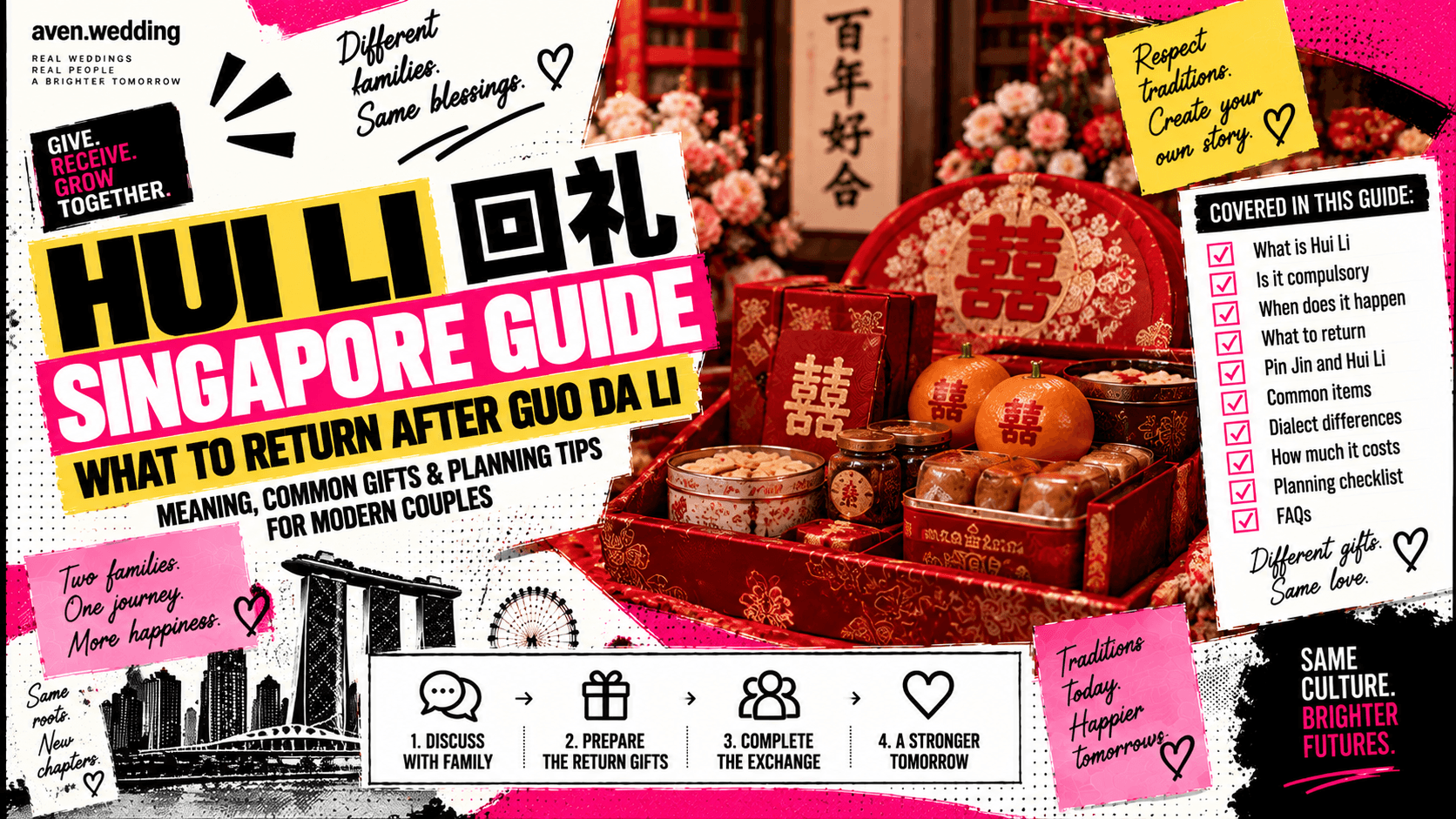
Hui Li (回礼) refers to the return gifts from the bride's family following the groom's family's Guo Da Li gifts.
If you are planning Guo Da Li for the first time, this can be confusing.
You may already be trying to understand:
- What the groom's family should bring
- What Pin Jin means
- What the bride's family should return
- Whether part of the Pin Jin is returned
- Which gifts should be returned
- Whether quantities matter
- What happens to everything afterwards
The important thing to understand is that Hui Li is part of an exchange between the two families.
It is not simply about giving unwanted gifts back.
This Hui Li Singapore guide explains how the tradition fits into Guo Da Li and how modern couples can plan it without making the process unnecessarily complicated.
Start with Aven's Guo Da Li Singapore Guide if you need an overview of the full ceremony.
What does Hui Li mean?
The Chinese term 回礼 refers broadly to returning or reciprocating a gift.
Within Chinese wedding traditions, Hui Li represents the bride's family's response after receiving the Guo Da Li gifts from the groom's side.
The exchange can symbolise:
- Reciprocity
- Acceptance
- Respect between families
- Goodwill
- The joining of two households
Rather than viewing Guo Da Li as one family giving and the other receiving, Hui Li completes the exchange.
For the wider cultural context, see Aven's Chinese Wedding Traditions in Singapore.
Is Hui Li compulsory?
No.
Hui Li is a cultural tradition rather than a legal requirement for marriage in Singapore.
Whether and how your family practises it depends on:
- Family customs
- Dialect traditions
- Parents' expectations
- How traditional your Guo Da Li will be
- What both families agree to
Some families may follow a detailed exchange.
Others may return only a few symbolic items.
Modern couples can also simplify the process if both families are comfortable with it.
When does Hui Li happen?
Hui Li is generally associated with the Guo Da Li ceremony.
The groom's family presents the betrothal gifts, after which the bride's family prepares or presents the agreed return gifts.
The exact sequence can vary.
Before the ceremony, confirm:
- What the groom's side is bringing
- What the bride's side will accept
- What needs to be returned
- Whether part of the Pin Jin will be returned
- Who handles the exchange
Preparing this beforehand prevents everyone from deciding what to return while the ceremony is already happening.
Why does the bride's family return gifts?
Hui Li reflects reciprocity between the two families.
Depending on the family's understanding of the tradition, returning part of the gifts can symbolise that the bride's family:
- Accepts the marriage
- Reciprocates the groom's family's goodwill
- Shares in the blessings represented by the gifts
- Is not simply receiving everything presented
The symbolism is more important than trying to calculate the financial value of everything moving between the families.
What does the bride's family return for Hui Li?
There is no single Hui Li list that applies to every Singapore Chinese family.
Depending on the Guo Da Li gifts and family tradition, the bride's family may return:
- Part of certain ceremonial gifts
- Part of the Pin Jin
- Selected auspicious food items
- Cakes or pastries
- Fruits
- Other symbolic items
Some families may also prepare specific return gifts according to dialect or family customs.
Do not purchase your Hui Li items from a generic checklist without first confirming what both families expect.
Do you return half of the Guo Da Li gifts?
You may hear a general idea of returning a portion of certain Guo Da Li items.
However, couples should not assume that everything must always be divided exactly in half.
Practices can differ according to:
- The item
- Family tradition
- Dialect group
- Symbolism
- What both families have agreed
Ask which specific items need to be returned and in what quantity.
A written list is much safer than relying on assumptions.
Does the bride's family return part of the Pin Jin?
Some families return part of the Pin Jin (聘金) as part of Hui Li.
This may represent reciprocity and goodwill between the families.
However, there is no universal rule requiring every family to return:
- Exactly half
- A particular percentage
- A particular dollar amount
The arrangement should be discussed before Guo Da Li.
For a deeper explanation of the monetary gift and how families can discuss it, use Aven's Pin Jin Singapore Guide.
How much Pin Jin should be returned?
There is no single amount that applies to every family.
Instead of searching for a fixed percentage, ask:
- Does the bride's family intend to return part of it?
- Is there a family precedent?
- Is the returned amount symbolic?
- Does an auspicious number matter?
- What have both sets of parents agreed?
For example, one family may return a symbolic portion while another may follow a different established family practice.
The agreed arrangement matters more than copying someone else's numbers.
Why should Hui Li be discussed before Guo Da Li?
Without preparation, the bride's family may receive the gifts and immediately start asking:
"Which one do we return?"
That creates unnecessary confusion.
Before Guo Da Li, both families should have a basic understanding of:
- Gift list
- Quantities
- Pin Jin
- Hui Li
- Jia Zhuang
- Who is preparing what
The couple can act as the bridge between both families.
You do not necessarily need a formal negotiation.
A clear WhatsApp message or shared checklist may be enough.
How should couples discuss Hui Li with their parents?
Speak to each family separately first.
Ask the bride's family:
- What do you normally return?
- Will part of the Pin Jin be returned?
- Are there specific return gifts?
- Does quantity matter?
- Is there anything we need to purchase?
Ask the groom's family:
- What gifts are being presented?
- Are any expected to be returned?
- Are there family-specific customs?
Then compare both sides.
If expectations differ, resolve them before the ceremony.
Does dialect group affect Hui Li?
It can.
Chinese wedding traditions in Singapore may vary between families with different dialect backgrounds.
Practices associated with families of:
- Cantonese
- Hokkien
- Teochew
- Hakka
- Hainanese
- Other Chinese backgrounds
may differ in the gifts used, quantities or ceremonial expectations.
However, even two families from the same dialect group may not practise the tradition identically.
Treat dialect customs as a reference point rather than assuming they automatically determine your family's exact Hui Li list.
What if the bride and groom come from different dialect groups?
This is common in Singapore.
You do not necessarily need to perform every tradition from both sides in full.
Instead:
- Ask each family what matters most
- Identify overlapping customs
- Identify traditions unique to each family
- Decide which ones to keep
- Agree on the Hui Li exchange
You can create a combined version that respects both families without doubling every ceremonial item.
What is the difference between Hui Li and Jia Zhuang?
These traditions are related to the wider wedding exchange but are not the same.
Hui Li (回礼)
Return gifts from the bride's family in response to Guo Da Li.
Jia Zhuang (嫁妆)
The bride's dowry prepared by her family for the marriage.
A simple way to organise your planning is:
| Tradition | Main purpose |
|---|---|
| Guo Da Li | Groom's family presents betrothal gifts |
| Pin Jin | Monetary betrothal gift |
| Hui Li | Bride's family returns or reciprocates gifts |
| Jia Zhuang | Bride's family prepares the bride's dowry |
Keeping these categories separate makes the entire process easier to understand.
Should Hui Li items be prepared in advance?
Yes.
Prepare as much as possible before Guo Da Li.
This may include:
- Return gift packaging
- Red packets
- Containers
- Gift quantities
- Jia Zhuang items if relevant
- A checklist
If some items from the groom's gifts are being returned, make sure everyone knows which ones.
You can even label the planning list:
Keep
and
Return
This is especially useful when many ceremonial items look similar.
Can you buy ready-made Hui Li packages?
Traditional wedding shops may provide Guo Da Li and return-gift packages.
These can simplify shopping, but you should still understand what you are buying.
Before ordering, ask:
- What is included?
- Which dialect tradition is it based on?
- Which items are for Guo Da Li?
- Which are for Hui Li?
- Can items be removed?
- Can quantities be adjusted?
- What does each item symbolise?
A convenient package should support your family's customs, not dictate them.
How much does Hui Li cost?
There is no standard Hui Li budget.
The cost depends on:
- Your Guo Da Li arrangement
- Number of ceremonial items
- Whether packages are purchased
- Whether part of Pin Jin is returned
- Family traditions
- How elaborate the presentation is
Do not look at the entire exchange only as a net cost.
Some parts involve gifts being exchanged or returned between families.
Still, any money the couple needs to prepare should be included in the overall wedding budget.
Use Aven's Wedding Budget Checklist Singapore to keep traditional expenses visible alongside your other wedding costs.
Who should keep track of the Guo Da Li and Hui Li items?
Assign someone who understands the plan.
This might be:
- Bride
- Groom
- Sibling
- Parent
- Close family member
Prepare a checklist showing:
| Item | From | Quantity | Keep | Return |
|---|---|---|---|---|
| Pin Jin | Groom's side | 1 | ||
| Gift item | Groom's side | |||
| Gift item | Groom's side | |||
| Return gift | Bride's side |
Replace the generic rows with your actual family list.
This can prevent confusion when many gifts arrive at once.
Can modern couples simplify Hui Li?
Yes.
If both families are comfortable with it, a simplified exchange might involve:
- Fewer ceremonial gifts
- Symbolic quantities
- A simplified Pin Jin arrangement
- Selected meaningful return gifts
The key is to agree before the ceremony.
Simplifying a tradition does not necessarily mean removing its meaning.
For many couples, understanding why the exchange happens is more meaningful than purchasing a large number of ceremonial items they do not understand.
Common Hui Li mistakes to avoid
Avoid these common problems:
Assuming everything is returned by half
Different items and families may follow different practices.
Not discussing Pin Jin beforehand
Clarify whether any portion will be returned.
Buying packages before checking family traditions
You may end up with unnecessary items.
Mixing Hui Li with Jia Zhuang
Keep the two categories separate.
Following dialect guides too rigidly
Your own family's practice matters more than a generic list.
Leaving everything until Guo Da Li day
Prepare the exchange beforehand.
Focusing only on monetary value
Remember that the exchange is symbolic as well as practical.
Hui Li Singapore planning checklist
Use this checklist before Guo Da Li.
Family discussion
- Confirm whether Hui Li will be practised
- Confirm bride's family customs
- Confirm groom's family customs
- Check dialect-specific expectations if relevant
- Resolve any differences beforehand
Guo Da Li gifts
- Finalise groom's gift list
- Confirm quantities
- Mark which items will be kept
- Mark which items will be returned
Pin Jin
- Confirm Pin Jin amount
- Confirm whether part will be returned
- Confirm returned amount or arrangement
- Prepare the relevant red packets
Hui Li
- Finalise return-gift list
- Purchase required items
- Prepare packaging
- Confirm quantities
- Assign person managing the exchange
Related traditions
- Confirm Jia Zhuang separately
- Confirm Guo Da Li date
- Confirm who will attend
- Prepare transport for gifts
Frequently asked questions about Hui Li in Singapore
What is Hui Li?
Hui Li refers to return gifts from the bride's family following the Guo Da Li gifts presented by the groom's family.
Does the bride's family have to return half of everything?
Not necessarily. Practices vary by family, item and tradition.
Is half of the Pin Jin always returned?
No. Some families return part of the Pin Jin, but there is no universal rule that exactly half must be returned.
When does Hui Li happen?
It is generally part of the Guo Da Li exchange before the wedding.
Is Hui Li the same as Jia Zhuang?
No. Hui Li refers to return gifts, while Jia Zhuang refers to the bride's dowry.
Do different dialect groups have different Hui Li customs?
They can, but individual family practices can differ even within the same dialect group.
Can we simplify Hui Li?
Yes, if both families agree.
Do we need a traditional wedding shop?
No. A specialist shop can make preparation easier, but it is not necessary if your family knows what it wants to prepare.
Hui Li completes the exchange between two families
Guo Da Li can look complicated when you see tables full of gifts, red packets, baskets and ceremonial items.
But the underlying idea is much simpler.
One family presents its blessings.
The other family responds.
That reciprocity is what makes Hui Li meaningful.
So before worrying about whether you need two oranges, four boxes or exactly half of something, start with your families.
Ask what they practise.
Ask what matters.
Agree on the exchange.
Then prepare only what you actually need.
Continue with the Guo Da Li Singapore Guide, Pin Jin Singapore Guide, An Chuan Singapore Guide, Wedding Gatecrash Guide Singapore and Chinese Wedding Tea Ceremony Guide Singapore.
For the complete cultural overview, return to Chinese Wedding Traditions in Singapore.
For your complete wedding journey, use the Ultimate Singapore Wedding Planning Guide.