
Blog
Wedding Outfit Change Guide Singapore: How to Plan Multiple Looks Without Rushing
October 12, 2026 · Updated October 12, 2026
Plan wedding outfit changes in Singapore with practical advice on gown changes, suits, Chinese wedding attire, makeup touch-ups, banquet march-ins, timing, packing and coordination.
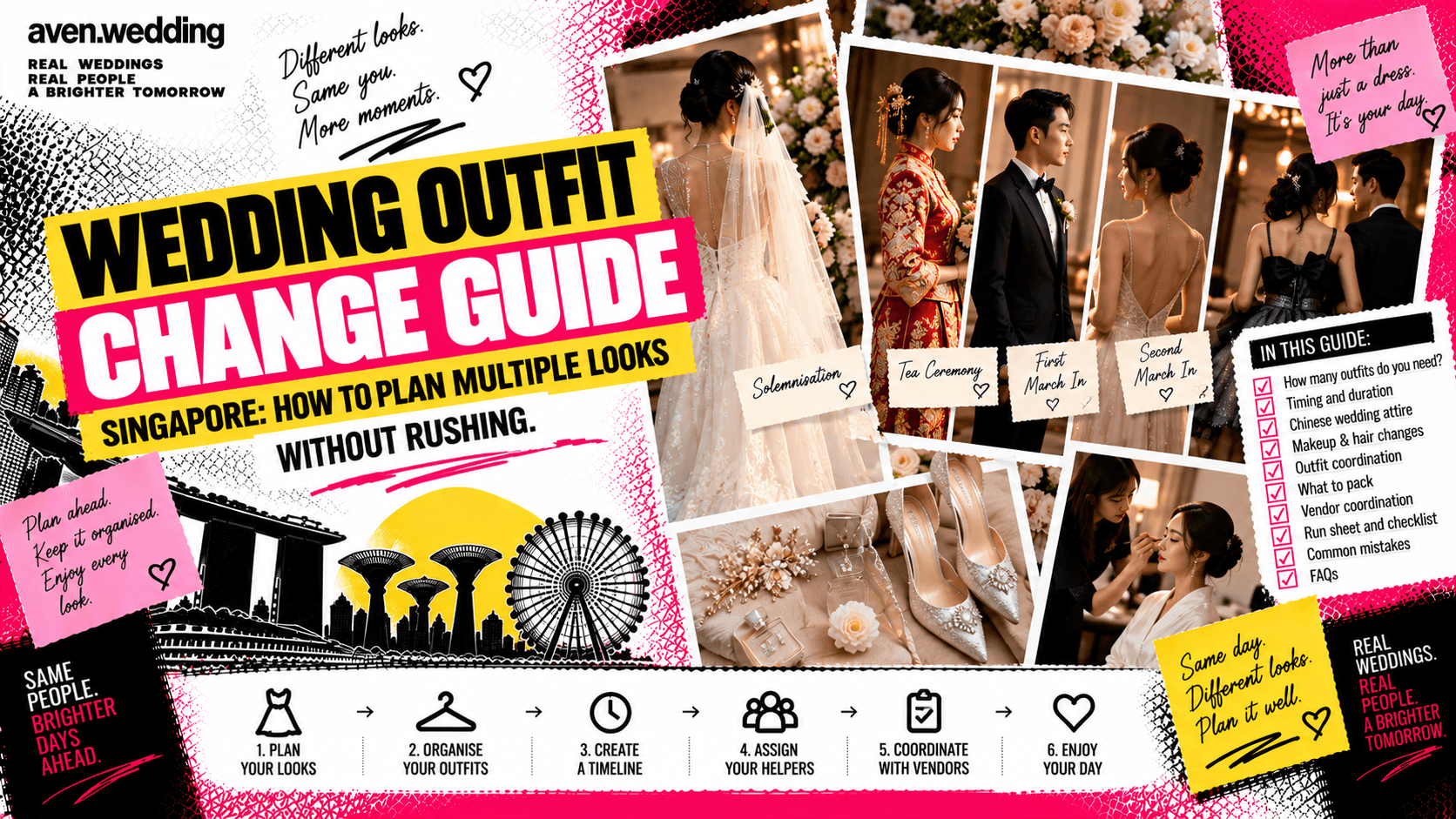
How do you plan wedding outfit changes without rushing?
You've spent months choosing your wedding outfits.
The gown.
The suit.
Maybe a qun kwa for the tea ceremony.
Another gown for the banquet.
And possibly one more look for the second march-in.
But there's something couples sometimes underestimate.
Changing outfits takes time.
And on a wedding day, you're rarely just changing clothes.
Someone needs to find the shoes.
Your makeup artist needs to touch up your face.
Your photographer wants a few portraits.
Your coordinator is checking whether the next programme segment can start.
Meanwhile, your guests are waiting downstairs.
This wedding outfit change guide for Singapore explains how to organise multiple looks without turning your wedding into a series of rushed dressing-room visits.
For the overall schedule, use Aven's Singapore Actual-Day Wedding Timeline.
How many outfits do you actually need for a Singapore wedding?
There is no required number of outfits.
Some couples wear one outfit throughout the celebration.
Others prepare several looks for different ceremonies.
A typical combination might include:
- Traditional Chinese wedding attire
- Solemnisation outfit
- First march-in gown or suit
- Second march-in outfit
- After-party outfit
But these are options, not requirements.
The right number depends on your traditions, budget, preferences and available time.
More outfits do not automatically mean a better wedding.
Choose looks you genuinely want to wear.
What are the most common wedding outfit changes?
For a wedding involving Chinese traditions and a hotel banquet, possible changes include:
| Programme | Possible Outfit |
|---|---|
| Morning gatecrash | Wedding gown or traditional attire |
| Tea ceremony | Qun kwa or other traditional outfit |
| Solemnisation | Wedding gown or suit |
| First march-in | Main wedding gown or suit |
| Second march-in | Evening gown or second suit |
| After-party | Comfortable or party outfit |
Some couples reuse the same outfit across multiple segments.
Others choose different looks for photography or cultural reasons.
Plan according to your actual programme rather than copying someone else's wedding.
Do you need a second march-in outfit?
No.
A second outfit can create a different look for the evening, but it also adds:
- Rental or purchase costs
- Alterations
- Accessories
- Makeup and hair coordination
- Changing time
- Additional logistics
If you love your main wedding gown, there is nothing wrong with wearing it throughout the banquet.
You can also create a different appearance through smaller styling changes.
The decision should be about what you enjoy, not what you feel obligated to do.
How long does a wedding outfit change take?
It depends on the clothing and the amount of styling involved.
For planning purposes, consider these illustrative ranges:
| Type of Change | Example Planning Allowance |
|---|---|
| Simple suit or dress change | 10–20 minutes |
| Wedding gown change | 15–30 minutes |
| Gown plus accessories | 20–35 minutes |
| Outfit plus makeup touch-up | 25–45 minutes |
| Outfit plus significant hairstyle change | 40–60 minutes or longer |
These are not guaranteed durations.
Ask your bridal boutique and makeup artist for estimates based on your actual outfits.
Then add time for travelling to the changing room and returning to the programme.
Why do wedding gown changes sometimes take longer?
Wedding gowns can involve:
- Multiple fastenings
- Corset backs
- Buttons
- Hooks
- Layers of fabric
- Long trains
- Delicate accessories
Some gowns are easy to put on.
Others require assistance.
Practise getting into your outfit before the wedding.
If possible, have the person who will assist you on the actual day learn how the fastening works.
Who should help the bride change outfits?
Assign one or two trusted people.
For example:
- Bridesmaid
- Sister
- Mother
- Bridal assistant
They should know:
- Which outfit comes next
- Where it is stored
- How the fastening works
- Which shoes and accessories belong to it
- When the bride needs to be ready
Avoid having six people crowding around the changing area.
More helpers do not necessarily make the process faster.
Use Aven's Bridesmaid & Groomsmen Duties Singapore.
Who should help the groom prepare for outfit changes?
The groom may need less assistance, but preparation still matters.
A groomsman or trusted friend can help with:
- Preparing the next suit
- Locating accessories
- Checking shoes
- Managing personal belongings
- Coordinating with the bride's changing schedule
Keep the next outfit ready rather than unpacking it five minutes before the march-in.
How should you plan Chinese wedding attire changes?
Some Singapore couples wear traditional Chinese wedding attire for:
- Bride fetching
- Tea ceremony
- Family photographs
- Other family customs
A qun kwa may be worn for one or several of these activities.
Discuss the sequence with your family.
You should know:
- When the traditional outfit is needed
- Where the change will happen
- Whether accessories need to be changed
- Whether photographs are planned
- When the next outfit is required
For attire planning, use Aven's Qun Kwa Singapore Guide.
For traditions, use the Chinese Wedding Traditions Checklist Singapore.
Should you change outfits between the tea ceremony and solemnisation?
You can, but check the timing carefully.
For example:
9:30am
Tea ceremony ends.
10:00am
Change into solemnisation attire.
10:30am
Depart for ceremony venue.
This only works if the change, preparation and travel arrangements are realistic.
If the solemnisation venue is far away, you may need more time.
Alternatively, consider using one outfit for both activities.
A simpler programme can create more breathing room.
How should you plan the first march-in outfit?
Your first march-in outfit should be ready before the banquet programme begins.
Confirm:
- Outfit is at the venue
- Shoes are available
- Accessories are ready
- Hair and makeup are complete
- Couple has enough time for photographs
- Coordinator knows when you're ready
Do not schedule the outfit change to finish exactly when the first march-in begins.
You still need time to move into position and coordinate with the venue.
When should you change for the second march-in?
Work backwards from the planned second march-in time.
For example:
8:45pm
Second march-in.
8:35pm
Couple ready and waiting.
8:10pm
Outfit change and touch-ups.
8:00pm
Couple leaves ballroom.
This is only an example.
Your actual schedule depends on:
- Outfit complexity
- Makeup changes
- Distance to changing room
- Banquet service flow
- Photography requirements
Coordinate the timing with your venue and emcee.
For banquet planning, use Aven's Singapore Wedding Banquet Programme Guide.
How do you coordinate outfit changes with your makeup artist?
Ask your makeup artist:
- How long will touch-ups take?
- Can they change your hairstyle?
- Is a second look included in the package?
- Will they remain onsite?
- Where should touch-ups happen?
- What preparation is required?
Do not assume every makeup package includes unlimited changes.
Confirm the scope before booking.
For choosing an artist, use Aven's How to Choose a Wedding Makeup Artist in Singapore.
Should you change your hairstyle for every outfit?
Not necessarily.
A hairstyle change can be beautiful, but it also takes time.
Consider whether you can create a different look through:
- Hair accessories
- Veil removal
- Small styling adjustments
- Jewellery changes
Discuss the options with your makeup artist.
Sometimes a simple adjustment achieves the look you want without requiring a full restyle.
How should you coordinate outfit changes with photographers and videographers?
Your photography and videography teams should know when outfit changes are happening.
They may need to plan:
- Final photographs in the first outfit
- Detail shots of the next outfit
- Couple portraits
- Coverage during banquet activities
- Positioning before the next march-in
If both teams are expected to capture the march-in, give them enough time to return to the ballroom.
For planning, use Aven's Wedding Photographer vs Videographer Singapore.
Where should you change outfits at a hotel wedding?
Possible locations include:
- Bridal suite
- Dedicated changing room
- Additional hotel room
- Private preparation space
Ask your venue:
- Is a changing room provided?
- How far is it from the ballroom?
- Is there a mirror?
- Is there enough space?
- Can outfits be stored there?
- Who has access?
A changing room ten minutes away from the ballroom affects your schedule differently from one next door.
Use Aven's Wedding Hotel Room Checklist Singapore.
How should you organise multiple wedding outfits?
Keep each look as a complete set.
For example:
LOOK 1: Morning
- Traditional outfit
- Shoes
- Jewellery
- Hair accessories
LOOK 2: Solemnisation
- Wedding gown
- Veil
- Shoes
- Earrings
LOOK 3: Second march-in
- Evening gown
- Shoes
- Necklace
- Earrings
Use labelled garment bags and accessory pouches.
The goal is for someone else to locate everything without asking you.
Should you prepare separate shoes for each outfit?
Only if needed.
Some couples use one comfortable pair across several looks.
Others prefer shoes that suit each outfit.
If you are changing shoes, check:
- Heel height
- Dress length
- Walking comfort
- Ease of changing
- Where the previous pair will be stored
A change in heel height can affect how a long dress falls.
Test your complete looks before the wedding.
What should you do with the outfit you just removed?
Prepare a system for used outfits.
For example:
- Empty garment bag
- Designated hanger
- Labelled storage area
- Trusted person responsible
Keep jewellery and accessories together.
Do not leave a valuable gown on a random hotel chair while everyone rushes back downstairs.
Also confirm any gown rental return requirements before the wedding.
What if your wedding outfits are rented?
Check the rental terms.
Important details may include:
- Collection date
- Return date
- Alteration arrangements
- Cleaning requirements
- Damage policies
- Accessories included
- Late-return charges
- Whether assistance is provided
Keep a record of which items belong to the boutique.
Do not mix rented accessories with personal jewellery.
How much should you budget for multiple wedding looks?
Additional looks can increase spending on:
- Outfit rental or purchase
- Alterations
- Shoes
- Jewellery
- Accessories
- Makeup touch-ups
- Hairstyle changes
- Extra room arrangements
- Additional vendor coverage where relevant
Before adding another look, calculate the complete cost rather than looking only at the gown rental price.
For budget planning, use Aven's Singapore Wedding Budget Checklist.
How should you include outfit changes in your wedding run sheet?
Treat each change as a scheduled activity with an assigned person.
For example:
| Time | Activity | Responsible |
|---|---|---|
| 8:00pm | Couple leaves ballroom | Coordinator |
| 8:05pm | Next outfits ready | Wedding party |
| 8:10pm | Outfit changes begin | Couple and helpers |
| 8:25pm | Makeup touch-ups | Makeup artist |
| 8:35pm | Couple ready | Coordinator |
| 8:45pm | Second march-in | Emcee and venue |
This is illustrative.
Adapt the timings to your actual outfits and programme.
Use Aven's Wedding Day Run Sheet Singapore.
What if an outfit change takes longer than expected?
Your coordinator should know how to respond.
Possible adjustments include:
- Delaying the next announcement
- Allowing dinner service to continue
- Adjusting a flexible programme segment
- Informing the emcee and venue
- Updating photography and video teams
Avoid rushing the couple into the ballroom before they are ready.
A good run sheet includes enough flexibility to handle minor delays.
For coordination, use Aven's Wedding Day Contact List Singapore.
Should you have an outfit-change rehearsal?
For complicated gowns or traditional attire, a short rehearsal can be useful.
You don't need to recreate the entire wedding.
Simply practise:
- Putting on the outfit
- Fastening it
- Changing shoes
- Attaching accessories
- Managing the train
- Removing the outfit safely
Ask the person who will assist you to attend where possible.
This can reveal problems before the actual day.
Common wedding outfit change mistakes
Avoid these:
Planning too many looks
Each change takes time away from other activities.
Underestimating change duration
Allow for accessories and touch-ups.
Not assigning helpers
Choose people who know the outfits.
Mixing accessories
Keep each look together.
Forgetting travel to the changing room
Account for the full transition.
Not briefing vendors
Tell the coordinator, photographer, videographer and emcee.
Ignoring rental requirements
Check return dates and included items.
Not testing the full outfit
Practise walking and changing.
Scheduling changes too close to march-ins
Include a buffer.
Forgetting to enjoy the outfits
Leave enough time to actually wear and appreciate each look.
Wedding outfit change checklist Singapore
Outfit planning
- Number of looks decided
- Morning attire confirmed
- Solemnisation attire confirmed
- First march-in outfit confirmed
- Second march-in outfit confirmed
- After-party outfit considered
- Rental terms checked
Accessories
- Shoes matched to outfits
- Jewellery grouped by look
- Hair accessories prepared
- Undergarments checked
- Veil and train arrangements confirmed
- Garment bags labelled
Timing
- Change durations estimated
- Makeup touch-up timings confirmed
- Hairstyle changes confirmed
- Travel to changing room considered
- Buffer time added
- Run sheet updated
People
- Bride's helpers assigned
- Groom's helpers assigned
- Coordinator briefed
- Makeup artist briefed
- Photographer briefed
- Videographer briefed
- Emcee briefed
Final checks
- Outfits tried on
- Fastenings tested
- Shoes tested
- Changing location confirmed
- Used outfit storage arranged
- All outfits and accessories packed
Frequently asked questions about wedding outfit changes
How many wedding outfits should I have?
As many as suit your preferences, traditions, budget and schedule. One outfit is perfectly acceptable.
How long does a wedding gown change take?
It depends on the gown and whether makeup or hair changes are included. Confirm with your boutique and makeup artist.
Do I need a second march-in gown?
No. It is optional.
Should I change outfits for the tea ceremony?
That depends on your family's traditions and the attire you choose.
Who should help with outfit changes?
Assign one or two trusted people who understand the outfits and accessories.
Can I change my hairstyle between march-ins?
Yes, if your makeup artist offers the service and the schedule allows enough time.
Where should I change at a hotel banquet?
Use a bridal suite, changing room or other suitable private space agreed with the venue.
Should outfit changes be included in the run sheet?
Yes. Include the timing, location, helpers and vendor coordination.
More outfits are nice. More time to enjoy your wedding is better.
There's nothing wrong with wanting different looks.
Maybe you've always imagined walking down the aisle in a particular gown.
Maybe wearing a qun kwa matters to your family.
Maybe you found an evening dress you absolutely love.
Wear them.
But remember what the day is actually about.
You don't want to spend your entire wedding moving between a ballroom and a changing room.
Choose the outfits that mean something to you.
Prepare them properly.
Give yourself realistic changing times.
And let someone else handle the logistics.
That way, you can actually enjoy being in each outfit instead of immediately worrying about the next one.
Continue with Aven's Wedding Day Packing List Singapore, Wedding Hotel Room Checklist Singapore and Wedding Day Run Sheet Singapore.
For your complete planning journey, return to the Ultimate Singapore Wedding Planning Guide.
Explore more planning resources at Aven.wedding.