
Blog
Chinese Wedding Traditions Checklist Singapore: What to Prepare & When
September 9, 2026 · Updated September 9, 2026
Use this Chinese wedding traditions checklist for Singapore couples to plan Guo Da Li, Pin Jin, Hui Li, Jia Zhuang, An Chuan, hair combing, gatecrash, tea ceremony and more.
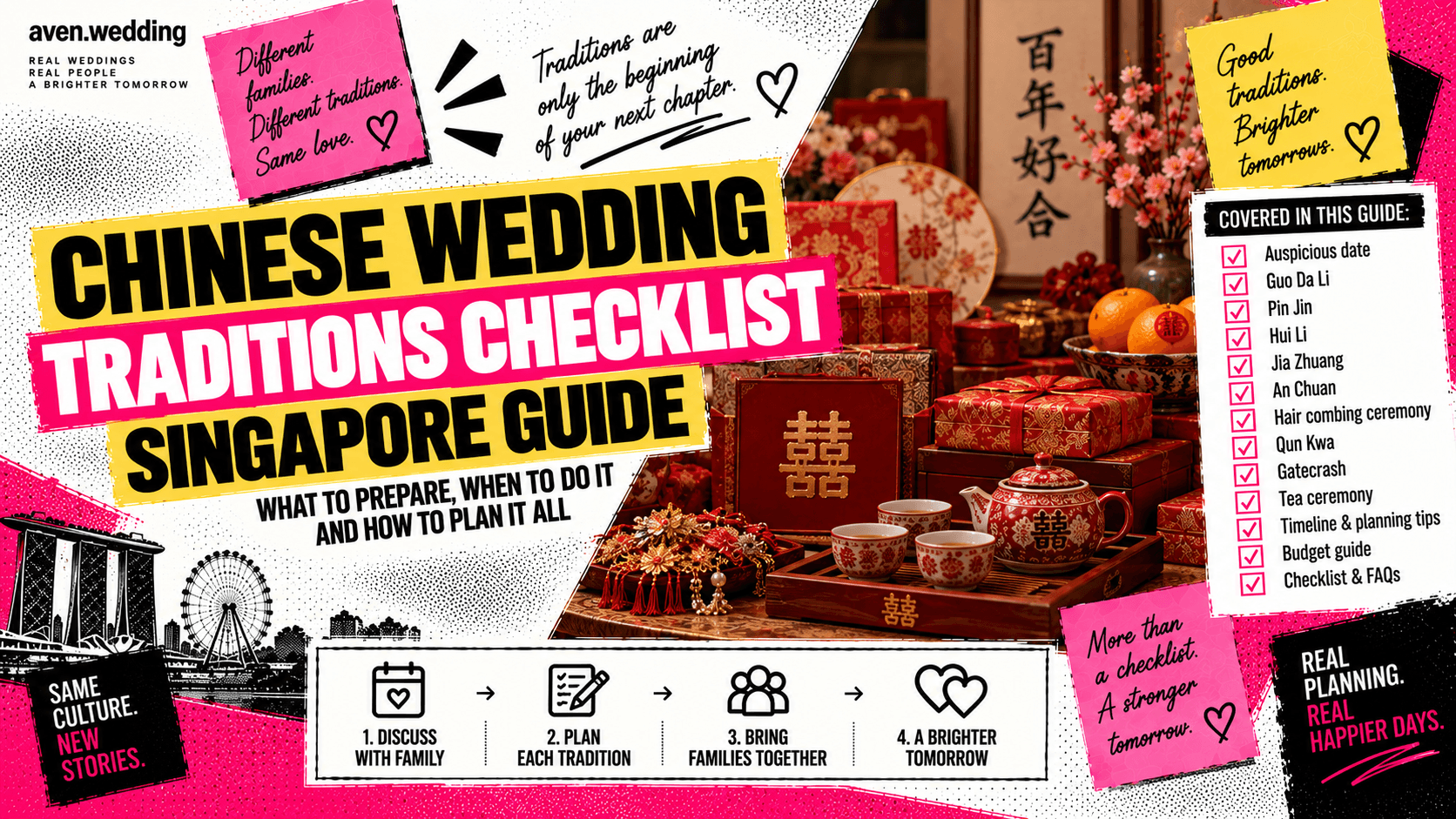
What Chinese wedding traditions do Singapore couples need to plan?
Chinese weddings in Singapore can involve far more than just the banquet and solemnisation.
Depending on your family, you may also hear about:
- Auspicious wedding dates
- Guo Da Li
- Pin Jin
- Hui Li
- Jia Zhuang
- An Chuan
- Hair combing ceremony
- Qun Kwa
- Gatecrash
- Bride fetching
- Tea ceremony
The difficult part is not simply knowing what each tradition means.
It is knowing:
Which ones does your family actually want?
When should each happen?
Who prepares what?
Which traditions can be simplified?
This Chinese wedding traditions checklist for Singapore couples brings the major customs into one planning sequence.
For deeper explanations of each tradition, start with Aven's Chinese Wedding Traditions in Singapore.
Start by asking both families what they actually practise
Do this before buying anything.
Sit down with both families and ask:
- Which traditions matter to us?
- Which traditions can be simplified?
- Are there dialect-specific customs?
- Do auspicious dates matter?
- Are there particular family items or heirlooms involved?
- Who should lead each ritual?
You may find that your parents care deeply about three traditions and barely care about the rest.
That is much more useful than trying to follow every Chinese wedding custom you find online.
Create a must-do, optional and skip list
A simple way to organise family expectations is to divide traditions into three categories.
| Tradition | Must Do | Optional | Skip |
|---|---|---|---|
| Auspicious date | |||
| Guo Da Li | |||
| Pin Jin | |||
| Hui Li | |||
| Jia Zhuang | |||
| An Chuan | |||
| Hair combing | |||
| Gatecrash | |||
| Tea ceremony | |||
| Qun Kwa |
Ask both families to review the list.
This gives you one shared starting point instead of dozens of assumptions.
Do you need an auspicious wedding date?
Some families want the wedding date selected according to traditional Chinese considerations.
Others do not.
If this matters to your family, resolve it before paying major deposits.
You may need to:
- Consult parents or elders
- Consult a date-selection practitioner
- Provide birth information
- Shortlist several acceptable dates
- Compare those dates against venue and vendor availability
Do not ask for only one acceptable date if you can avoid it.
Multiple options make planning much easier.
Use Aven's Chinese Wedding Auspicious Date Guide Singapore for the full planning process.
Plan Guo Da Li early enough to avoid last-minute shopping
Guo Da Li (过大礼) is the traditional betrothal ceremony where the groom's family presents gifts to the bride's family.
Your checklist may include:
- Confirm Guo Da Li date
- Confirm family or dialect customs
- Finalise gift list
- Confirm Pin Jin
- Confirm Hui Li
- Prepare packaging
- Arrange transport
- Confirm who will attend
Do not buy a standard package before checking what your families actually expect.
Use Aven's Guo Da Li Singapore Guide for the detailed gift and preparation guide.
Confirm Pin Jin before Guo Da Li
Pin Jin (聘金) is the monetary betrothal gift associated with Guo Da Li.
There is no universal amount for every Singapore Chinese family.
Before the ceremony, confirm:
- Whether your families practise Pin Jin
- Agreed amount
- Whether auspicious numbers matter
- Who prepares the red packet
- Who presents it
- Whether any portion will be returned
- How Hui Li will work
Discuss the amount early enough for both families to be comfortable with the arrangement.
Use Aven's Pin Jin Singapore Guide for the full explanation.
Prepare Hui Li alongside the Guo Da Li gifts
Hui Li (回礼) refers to the bride's family's reciprocal or return gifts.
Do not wait until Guo Da Li day to decide what comes back.
Prepare:
- Return-gift list
- Quantities
- Returned Pin Jin amount if applicable
- Packaging
- Person managing the exchange
- Separate list for items being kept and returned
This makes the exchange much smoother.
Use Aven's Hui Li Singapore Guide for a full return-gift checklist.
Keep Jia Zhuang separate from Hui Li
Jia Zhuang (嫁妆) is the bride's dowry.
It is different from Hui Li.
Depending on family tradition, Jia Zhuang may include:
- Household items
- Bedding
- Tea sets
- Bowls and chopsticks
- Red packets
- Jewellery
- Traditional symbolic items
Your checklist:
- Confirm whether Jia Zhuang is required
- Confirm family-specific items
- Set a budget
- Coordinate with the matrimonial home
- Coordinate with An Chuan
- Arrange transport or storage
Use Aven's Jia Zhuang Singapore Guide for the detailed dowry guide.
Plan An Chuan around your actual housing situation
An Chuan (安床) refers to the traditional preparation of the matrimonial bed.
Your family may want:
- Auspicious timing
- New bedding
- Wedding decorations
- Symbolic items
- A particular person to prepare the bed
Your checklist:
- Confirm whether An Chuan is required
- Confirm date and time
- Confirm who performs it
- Prepare bedding
- Prepare ceremonial items
- Ask about post-ceremony restrictions
If you already live together or your BTO is not ready, discuss how the tradition can be adapted.
Use Aven's An Chuan Singapore Guide.
Confirm whether your family practises the hair combing ceremony
The Chinese wedding hair combing ceremony, often known as Shang Tou (上头), is a pre-wedding blessing ritual.
Families may perform it separately for the bride and groom.
Prepare:
- Date and time
- Person performing the ceremony
- Comb
- New clothing if required
- Ceremonial items
- Blessing wording
- Printed reference if needed
If the ceremony is held the night before the wedding, account for sleep and your next morning's call time.
Use Aven's Chinese Wedding Hair Combing Ceremony Singapore.
Decide whether you want to wear a Qun Kwa
A Qun Kwa (裙褂) can be worn during the traditional portions of the wedding.
Common moments include:
- Morning preparations
- Gatecrash
- Bride fetching
- Tea ceremony
- Family portraits
Your checklist:
- Decide rental or purchase
- Set fitting date
- Test walking and sitting
- Test kneeling if required
- Choose shoes
- Plan jewellery
- Brief makeup artist
- Schedule outfit change
Use Aven's Qun Kwa Singapore Guide for choosing and styling the outfit.
Keep the wedding gatecrash fun and short enough
The gatecrash is usually one of the most energetic parts of the wedding morning.
Prepare:
- Bridesmaid lead
- Number of games
- Game props
- Boundaries
- Allergies and food restrictions
- Ang baos if included
- Hard stop
- Cleanup supplies
- Timekeeper
The gatecrash should fit within the day's schedule rather than delaying every ceremony that follows.
Use Aven's Wedding Gatecrash Guide Singapore.
Plan the bride-fetching sequence
After the gatecrash, the groom traditionally meets or fetches the bride before the couple proceeds with the next part of the day.
Your exact flow may vary.
A possible sequence is:
- Gatecrash ends
- Groom meets bride
- Couple portraits
- Family photographs
- Tea ceremony
- Bride leaves family home
- Travel to next location
Ask your parents whether there are any family-specific customs attached to leaving or entering the home.
Keep transport ready so the wedding party is not waiting around after the photographs.
Create your tea ceremony family order in advance
The tea ceremony can become confusing when nobody knows who goes next.
Prepare a family list.
| Order | Relative | Relationship | Family Side |
|---|---|---|---|
| 1 | |||
| 2 | |||
| 3 | |||
| 4 |
Then prepare:
- Tea set
- Tea
- Hot water
- Chairs
- Coordinator
- Tea helper
- Gift handler
- Red packet bag
- Jewellery box
Use Aven's Chinese Wedding Tea Ceremony Guide Singapore for the full order and etiquette guide.
Plan both families' tea ceremonies together
If both families are having tea ceremonies, decide whether they happen:
- At separate family homes
- At one home
- At the hotel
- At the wedding venue
- In a private function room
Separate homes may preserve a more traditional flow but add travel.
One location may simplify logistics.
Compare:
- Travel time
- Parking
- Number of relatives
- Elderly family members
- Photography space
- Wedding schedule
Do not automatically choose the most traditional option if it makes the entire morning unmanageable.
Decide who handles red packets and jewellery
Chinese wedding traditions can involve valuables throughout the day.
These may include:
- Pin Jin
- Gatecrash ang baos
- Tea ceremony red packets
- Jewellery
- Family gifts
Assign trusted people for each stage.
Your checklist:
- Secure red packet bag
- Jewellery pouch or box
- Named gift handler
- Handover process
- Safe storage location
- Final count or transfer responsibility
The bride and groom should not be carrying everything themselves.
Use Aven's Wedding Ang Bao Box & Gift Handling Guide for broader wedding-day security planning.
Coordinate your photographer and videographer with the traditions
Traditional ceremonies can happen quickly.
Give your photography and video team the schedule in advance.
Tell them about:
- Guo Da Li if being documented
- Hair combing ceremony
- Gatecrash
- Qun Kwa details
- Tea ceremonies
- Important jewellery
- Grandparents
- Family heirlooms
- Special rituals
Your vendors cannot capture a meaningful moment if they do not know it is about to happen.
Use Aven's How to Choose a Wedding Photographer in Singapore and How to Choose a Wedding Videographer in Singapore.
Build all the traditions into one actual-day timeline
Avoid planning each tradition separately.
Instead, combine everything into one timeline.
For example:
Bride preparation
↓
Groom arrival
↓
Gatecrash
↓
Bride fetching
↓
Bride's family tea ceremony
↓
Travel
↓
Groom's family tea ceremony
↓
Outfit change
↓
Solemnisation
↓
Banquet
Your exact flow may differ.
The important thing is understanding how every ritual affects the next one.
Use Aven's Singapore Actual-Day Wedding Timeline to build the full schedule.
Add buffer around traditional ceremonies
Family rituals rarely run with stopwatch precision.
Extra time may be needed because:
- Relative is late
- Jewellery takes time to put on
- Tea needs refilling
- Family photographs expand
- Lift takes longer than expected
- Someone needs help walking
- Parents want another photograph
Do not place every tradition directly against the next event.
A small buffer throughout the morning is much safer than one large buffer at the end.
How far in advance should you prepare Chinese wedding traditions?
A practical approach is to spread preparation across the wedding timeline.
Several months before
- Ask family expectations
- Confirm auspicious-date requirements
- Identify traditions
- Start Qun Kwa search if applicable
One to three months before
- Finalise Guo Da Li
- Pin Jin discussion
- Hui Li
- Jia Zhuang
- An Chuan planning
- Tea ceremony participant list
Wedding month
- Confirm ritual dates
- Prepare ceremony items
- Finalise gatecrash
- Brief vendors
- Prepare red packet handling
Wedding week
- Pack everything
- Reconfirm family sequence
- Reconfirm helpers
- Reconfirm timing
How much should you budget for Chinese wedding traditions?
There is no single traditional-wedding budget.
Possible expenses include:
- Guo Da Li gifts
- Pin Jin
- Hui Li
- Jia Zhuang
- An Chuan items
- Qun Kwa
- Jewellery
- Tea ceremony supplies
- Gatecrash props
Some amounts are exchanged between families, while others are direct wedding expenses.
Create a separate budget category called:
Chinese Wedding Traditions
This makes the costs easier to track.
Use Aven's Wedding Budget Checklist Singapore for your full wedding budget.
How can modern couples simplify Chinese wedding traditions?
Start by preserving meaning rather than quantity.
You might:
- Reduce the number of Guo Da Li items
- Keep Pin Jin symbolic
- Simplify Hui Li
- Choose practical Jia Zhuang items
- Perform a symbolic An Chuan
- Keep the hair combing ceremony intimate
- Limit the gatecrash to a few games
- Combine both tea ceremonies at one venue
Simplification works best when both families understand and agree with it.
Do not silently remove a tradition that your parents consider important.
Common Chinese wedding tradition planning mistakes
Avoid these common problems:
Trying to follow every tradition
Your family may not even practise all of them.
Asking too many relatives
You may receive conflicting instructions.
Buying packages too early
Confirm family requirements first.
Not separating similar traditions
Guo Da Li, Hui Li and Jia Zhuang are not the same thing.
Ignoring the wedding timeline
Traditional ceremonies still need to fit into the day.
Not assigning helpers
The couple cannot coordinate everything themselves.
Treating traditions only as photo opportunities
Some rituals matter deeply to parents and grandparents.
Assuming traditional means inflexible
Many families are willing to adapt when couples explain the practical reasons.
Complete Chinese wedding traditions checklist
Use this master checklist as your planning overview.
Before booking
- Ask both families which traditions matter
- Confirm auspicious date requirements
- Shortlist acceptable wedding dates
- Confirm general wedding-day structure
Pre-wedding traditions
- Guo Da Li
- Pin Jin
- Hui Li
- Jia Zhuang
- An Chuan
- Hair combing ceremony
Attire
- Qun Kwa if desired
- Fitting
- Shoes
- Jewellery
- Outfit-change timing
Wedding morning
- Gatecrash
- Gatecrash props
- Bride fetching
- Family photographs
- Tea ceremony
- Family serving order
- Tea helpers
Valuables
- Pin Jin handler
- Red packet handler
- Jewellery handler
- Secure storage
People
- Bridesmaid lead
- Best man
- Tea ceremony coordinator
- Family representative
- Timekeeper
- Photographer briefed
- Videographer briefed
Final logistics
- Full actual-day timeline
- Transport
- Parking
- Ceremony props packed
- Family expectations reconfirmed
- Buffer time included
Frequently asked questions about Chinese wedding traditions in Singapore
Do we need to follow every Chinese wedding tradition?
No. Different families practise different customs. Start with what matters to your own families.
Which tradition should we plan first?
If your family requires an auspicious wedding date, resolve that early because it can affect venue and vendor bookings.
What is the difference between Guo Da Li and Jia Zhuang?
Guo Da Li refers to betrothal gifts from the groom's family, while Jia Zhuang refers to the bride's dowry.
Is Pin Jin compulsory?
No. It is a cultural tradition and the amount depends on family expectations.
Do we need both a gatecrash and tea ceremony?
No. Each can be practised or skipped independently.
Can both tea ceremonies happen at one venue?
Yes, if both families are comfortable with the arrangement.
Can traditional ceremonies be simplified?
Yes. Many modern Singapore couples preserve the parts their families value while adapting the logistics.
Who should coordinate everything on the wedding day?
Assign different trusted people to specific responsibilities rather than expecting the couple to manage every detail.
Traditions should help your families come together, not make planning impossible
Chinese wedding traditions can look overwhelming when they are presented as one enormous list.
But your wedding does not need every item on that list.
Start with your families.
Find out what matters.
Understand why it matters.
Then build those traditions into the wedding you are actually planning.
Maybe that means a full Guo Da Li.
Maybe it means a short tea ceremony.
Maybe your grandmother wants to see you in a Qun Kwa.
Maybe your parents only care that everyone sits down for tea together.
There is no prize for completing the largest number of traditions.
The goal is to create a wedding where the customs you keep still mean something.
Explore the full traditions cluster:
- Chinese Wedding Traditions in Singapore
- Chinese Wedding Auspicious Date Guide Singapore
- Guo Da Li Singapore Guide
- Pin Jin Singapore Guide
- Hui Li Singapore Guide
- Jia Zhuang Singapore Guide
- An Chuan Singapore Guide
- Chinese Wedding Hair Combing Ceremony Singapore
- Qun Kwa Singapore Guide
- Wedding Gatecrash Guide Singapore
- Chinese Wedding Tea Ceremony Guide Singapore
For the wider wedding journey, use the Ultimate Singapore Wedding Planning Guide.