
Blog
Wedding Venue Site Visit Checklist Singapore: What to Check Before You Book
September 3, 2026 · Updated September 3, 2026
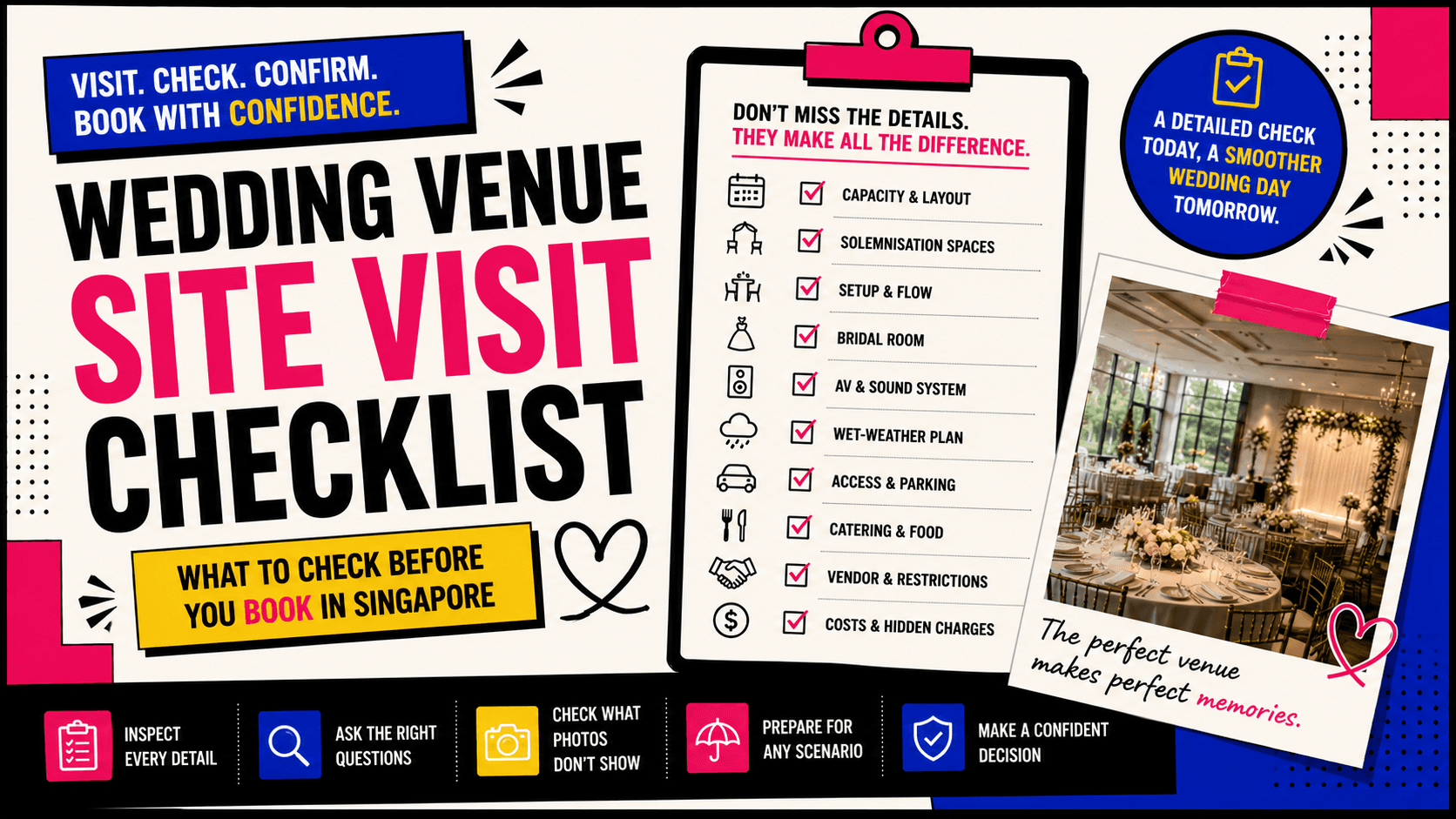
Use this Singapore wedding venue site visit checklist to inspect layout, capacity, accessibility, solemnisation spaces, logistics, AV, wet-weather plans and hidden venue restrictions before booking.
Why should you visit a wedding venue before booking?
Wedding venue photos can tell you whether a space looks beautiful.
A site visit tells you whether it actually works.
When you walk through a venue in person, you can evaluate things that are difficult to understand from photographs:
- Actual room size
- Ceiling height
- Table spacing
- Guest flow
- Lighting
- Noise
- Accessibility
- Bridal facilities
- Solemnisation setup
- Vendor access
- Wet-weather alternatives
A beautiful venue can still create difficult wedding-day logistics.
Use this Singapore wedding venue site visit checklist to inspect each venue systematically before paying a deposit.
For the wider decision-making process, this article forms part of Aven's Singapore Wedding Venue Guide.
What should you bring to a wedding venue site visit?
Bring enough information to evaluate the venue against your actual wedding.
Useful items include:
- Estimated guest count
- Preferred wedding date
- Rough wedding programme
- Budget range
- List of important questions
- Phone for photos and videos
- Notes app or notebook
- Measuring tape if useful
- Floor plan if the venue provides one
If you are comparing several venues, use the same checklist at every visit.
That makes your comparison much more objective.
Instead of remembering:
"Venue A felt nicer."
you can compare actual information.
Start your site visit before you enter the venue
Your guests experience the journey to the venue before they experience the wedding itself.
Check:
- Nearest MRT station
- Bus access
- Driving route
- Drop-off point
- Taxi and private-hire access
- Parking
- Sheltered pathways
- Distance from parking to venue
- Signage
- Accessibility for elderly guests
Try approaching the venue from the direction your guests are likely to use.
Ask yourself:
Would someone who has never been here know where to go?
If the answer is no, you may need additional signage or ushers.
Check the venue entrance and reception area
The entrance creates your guests' first impression.
Look at whether there is enough room for:
- Registration
- Guestbook
- Ang bao box
- Welcome signage
- Photo display
- Reception staff
- Guests waiting before entry
Also consider congestion.
If 50 guests arrive within a short period, will everyone fit comfortably?
Check whether guests entering the venue would interfere with:
- Hotel guests
- Restaurant customers
- Other events
- Public walkways
If you intend to set up an ang bao collection point, use the Wedding Ang Bao Box & Gift Handling Guide when planning the reception table.
Check the comfortable guest capacity, not just the maximum
A venue may advertise a maximum capacity.
That does not necessarily mean the room is comfortable at that number.
Ask to see a sample layout for your estimated guest count.
Check whether there is enough space for:
- Guest tables
- Chairs
- Aisles
- Stage
- March-in
- AV equipment
- Photographer movement
- Videographer movement
- Service staff
- Buffet stations if applicable
- Dance floor if required
A room that technically fits 200 people may feel crowded once all wedding elements are included.
Our Wedding Venue Guest Count Guide will help you evaluate capacity in greater detail.
Look carefully at the room layout
Do not evaluate the venue only from the centre of the room.
Walk around it.
Look for:
- Pillars
- Corners
- Split levels
- Narrow sections
- Low ceilings
- Obstructed views
- Permanent structures
- Fixed furniture
Then ask:
Will every guest be able to see the important moments?
A ballroom with pillars, for example, might need careful table placement.
An unusual event space may look beautiful but require creative planning to ensure good guest sightlines.
Walk the march-in route
If you plan to have a march-in, physically walk the route.
Check:
- Where you enter
- Length of the aisle
- Width of the aisle
- Turns
- Steps
- Doors
- Guest tables
- Lighting
- Stage access
Imagine yourself walking the route while:
- Wearing formal attire
- Carrying a bouquet
- Being photographed
- Guests are standing or turning around
A route that appears simple on a floor plan can feel very different in person.
Stand where the stage will be
If your celebration includes a stage, check its relationship with the room.
Look at:
- Visibility
- Height
- Width
- Screen placement
- Speaker placement
- Lighting
- Access from bridal room
- Space for speeches
- Space for performances
Then sit at several guest tables and look back at the stage.
This helps you identify obstructed views before the seating plan is created.
Later, use the Singapore Wedding Seating Plan Guide when assigning guests to tables.
Check the solemnisation area
If you plan to solemnise at the venue, inspect the ceremony space separately.
Check:
- Guest seating
- Aisle
- Ceremony table
- Signing table
- Backdrop
- Audio
- Microphones
- Entrance route
- Photographer positions
- Videographer positions
- Transition into the reception or banquet
Ask whether the solemnisation setup is included in your package.
Also ask whether the ceremony space needs to be cleared or transformed afterward.
For the wider process, use the Singapore ROM & Solemnisation Guide.
Inspect the wet-weather backup space
If any part of your wedding is outdoors, this is essential.
Do not accept:
"We have a wet-weather backup."
Ask to physically see it.
Then check:
- Capacity
- Layout
- Lighting
- Ventilation
- Decor possibilities
- Ceremony setup
- Guest comfort
- Photography
- Accessibility
Ask how and when the decision to move indoors is made.
You should be comfortable holding your wedding in the backup space.
If you would be disappointed using it, the venue may not be the right choice.
Our Indoor vs Outdoor Wedding Venue Singapore guide will explore this decision further.
Check lighting at the venue
Lighting affects:
- Atmosphere
- Photography
- Videography
- Makeup
- Decor
- Guest experience
Look at both natural and artificial lighting.
Ask whether lighting can be:
- Dimmed
- Repositioned
- Customised
- Supplemented
If possible, visit around the same time of day as your wedding.
A venue at 11am can look completely different at 7pm.
For evening weddings, ask to see photographs or videos showing how the space looks after dark.
Check the venue's AV setup
If your programme includes:
- Speeches
- Videos
- Music
- Performances
- Same-day edit
- Slideshows
inspect the AV setup carefully.
Ask about:
- Projector or LED screens
- Screen size
- Screen location
- Microphones
- Speakers
- Audio inputs
- Technician support
- Laptop connections
- Backup equipment
Also check whether guests seated at the sides or back of the room can see the screen comfortably.
Do not assume AV is automatically included just because equipment is visible.
Check photography and videography restrictions
Ask whether there are restrictions affecting your photo and video team.
Possible issues include:
- Tripod restrictions
- Lighting restrictions
- Drone restrictions
- Limited equipment space
- Restricted areas
- Vendor access times
- No-flash policies
- Noise limitations
Show your photographer and videographer the venue details before the wedding where practical.
Once your vendors are confirmed, use the Wedding Vendor Confirmation Checklist to align everyone on venue requirements.
Inspect the bridal room
Do not simply ask whether a bridal room exists.
Go inside.
Check whether it has:
- Mirrors
- Chairs
- Table
- Power points
- Good lighting
- Air-conditioning
- Clothing rack
- Toilet access
- Space for makeup
- Space for multiple people
- Secure storage
You may use this room for:
- Outfit changes
- Makeup touch-ups
- Personal items
- Wedding documents
- Short breaks
A tiny storage room labelled as a bridal room may not meet your needs.
Understand exactly what you are getting.
Check the toilets
This is easy to forget during venue shopping.
Look at:
- Distance from event space
- Cleanliness
- Capacity
- Accessibility
- Whether toilets are shared with the public
- Whether elderly guests can reach them easily
If guests need to walk through another event or a public area every time they use the toilet, that affects the overall experience.
Small logistical details often become much more noticeable on the wedding day.
Look for accessibility issues
Consider guests who may have:
- Mobility limitations
- Wheelchairs
- Walking aids
- Young children
- Strollers
Check:
- Lifts
- Ramps
- Steps
- Accessible toilets
- Drop-off point
- Distance between spaces
- Outdoor pathways
If your grandparents or elderly relatives are attending, imagine the day from their perspective.
A short staircase or long outdoor walk may seem insignificant during your site visit but become difficult for some guests.
Check parking and transport arrangements
Ask:
- How many parking spaces are available?
- Are parking coupons or complimentary tickets included?
- Is there nearby alternative parking?
- Where can cars drop passengers off?
- Can buses or larger vehicles enter?
- Is overnight parking possible?
- Are there restrictions during certain hours?
If several events happen at the venue simultaneously, parking availability may change.
Also consider how the couple, wedding party and vendors will travel throughout the day.
Your Singapore Actual-Day Wedding Timeline can help identify transport requirements.
Check vendor loading and access
Your guests may enter through the beautiful front entrance.
Your vendors may not.
Ask to see:
- Loading bay
- Service lift
- Vendor entrance
- Equipment route
- Storage area
- Setup area
Consider whether large items such as:
- Decor structures
- Speakers
- Flowers
- Photo booths
- Props
- Furniture
can physically reach the event space.
A narrow lift or staircase can create significant setup problems.
Confirm setup and teardown times
Ask exactly when vendors are allowed to enter.
Then ask when everything must be removed.
Record:
- Earliest setup time
- Earliest decorator access
- AV setup time
- Florist access
- Sound-check window
- Latest teardown time
- Overtime charges
Do not assume your vendors can arrive whenever they want.
If the venue allows three hours of setup but your decorator needs five, you need to solve that before booking.
Check whether other weddings or events will happen nearby
Ask whether another event could take place:
- Next door
- Upstairs
- Downstairs
- In the same foyer
- At another part of the property
Then ask:
- Are reception areas shared?
- Are entrances shared?
- Are toilets shared?
- Can music from another event be heard?
- Could guests enter the wrong ballroom?
- Will signage be provided?
Hotels frequently host multiple events.
Other wedding venues may also divide their spaces.
Understand exactly how private your celebration will be.
Inspect the venue's existing decor
Look at what is already provided.
This might include:
- Stage
- Backdrop
- Tablecloths
- Chairs
- Centrepieces
- Lighting
- Flowers
- Signage
- Furniture
Then decide what you would genuinely replace.
This helps you estimate your real decor needs.
A venue with beautiful existing styling may reduce the amount of additional decor you need.
A blank venue may offer more creative freedom but require more setup.
Factor those differences into your Singapore Wedding Cost & Budget Guide.
Ask about catering and food service
For hotels and restaurants, check how food service works.
For other wedding venues, confirm whether catering is:
- In-house
- From approved vendors
- Fully external
Ask about:
- Menu options
- Dietary requirements
- Kitchen facilities
- Food preparation
- Service staff
- Drinks
- Corkage
- Cake service
- Food tasting
If catering is external, inspect the service route too.
Food may need to travel from preparation areas to the dining space efficiently.
Ask what you are not allowed to do
Restrictions can matter just as much as inclusions.
Ask whether the venue prohibits:
- Open flames
- Confetti
- Sparklers
- Smoke effects
- Loud music
- External catering
- Certain decor installations
- Wall attachments
- Moving furniture
- Pets
- Drones
If you already have a strong wedding concept, discuss it during the site visit.
Do not discover after paying a deposit that one of your major ideas is prohibited.
Ask about additional venue charges
Before you leave, ask:
What could make the final venue bill higher than the quotation?
Possible additional charges may relate to:
- Overtime
- Extra guests
- Additional rooms
- Additional setup time
- External vendors
- AV
- Cleaning
- Corkage
- Furniture
- Additional staffing
- Parking
- Decor
Record these separately.
A venue that looks cheaper initially may not remain cheaper once the full requirements are added.
Our upcoming Wedding Venue Package Comparison Guide will help you compare these costs side by side.
Take photos strategically during the site visit
Do not take only beautiful wide-angle photos.
Photograph practical details too.
Capture:
- Main room
- Entrance
- Stage
- Solemnisation area
- Bridal room
- Reception area
- Toilets
- Wet-weather space
- Loading bay
- Parking
- AV equipment
- Existing decor
Take a short video walking through the venue.
Later, when several venues start blending together in your memory, these practical photos can make comparison much easier.
Questions to ask during your wedding venue site visit
Use this quick question list.
- What is the comfortable guest capacity?
- What is included in the package?
- What costs extra?
- Can we hold our solemnisation here?
- What is the wet-weather plan?
- Can we bring external vendors?
- Are there vendor restrictions?
- What AV equipment is included?
- What are the setup hours?
- What are the teardown rules?
- Is there a bridal room?
- Is parking available?
- Can another wedding happen nearby?
- Are there decor restrictions?
- Are there overtime charges?
- What happens if guest count changes?
- What are the payment terms?
- What are the cancellation or postponement terms?
For a deeper consultation checklist, continue to Aven's Wedding Venue Questions Singapore.
Wedding venue site visit scorecard
After every visit, score the venue before visiting the next one.
| Category | Score 1–5 |
|---|---|
| Atmosphere | |
| Guest capacity | |
| Layout | |
| Solemnisation | |
| Food | |
| Accessibility | |
| Parking | |
| Bridal facilities | |
| AV | |
| Photography | |
| Videography | |
| Vendor access | |
| Wet-weather plan | |
| Package value | |
| Logistics | |
| Overall feeling |
Then circle your five most important categories.
A venue scoring perfectly on low-priority factors should not automatically beat one that performs strongly where it matters most to you.
What should you do immediately after the site visit?
Do not rely on memory.
Within the same day, record:
- What you liked
- What you disliked
- Outstanding questions
- Estimated additional costs
- Important restrictions
- Your overall impression
Then compare the venue against your priorities.
If you visited with parents or other family members, collect their feedback separately before everyone influences each other's opinions.
This helps distinguish genuine concerns from group momentum.
Frequently asked questions about wedding venue site visits
Should we visit a wedding venue before booking?
Where practical, yes. A site visit helps you assess layout, capacity, accessibility, logistics and facilities that may not be obvious from photographs.
How many wedding venues should we visit?
There is no required number. Shortlist venues based on your guest count, budget and priorities first, then visit the strongest options rather than viewing every possible venue.
Should our parents attend the site visit?
That depends on how involved your families are in the venue decision. You can also conduct an initial shortlist yourselves and bring family members to the final options.
What should we wear to a venue site visit?
Wear something comfortable enough to walk around and inspect different areas. There is usually no need to dress formally.
Can we take photos during a wedding venue visit?
Usually, but ask if you are unsure. Practical photos and videos can be extremely useful when comparing several venues later.
Should our wedding planner attend?
If you are working with a planner, having them involved in important venue visits can help identify operational issues and questions.
Should we bring our photographer or videographer?
Usually not for the first visit. Once shortlisted or booked, venue familiarity can help them plan coverage and equipment requirements.
Do not choose a wedding venue based on appearance alone
The best wedding venue is not simply the one that photographs beautifully.
It is the venue that supports the wedding you want to have.
Before booking, evaluate:
- Guest capacity
- Layout
- Solemnisation
- Accessibility
- Food
- AV
- Photography and videography
- Vendor access
- Setup requirements
- Wet-weather backup
- Package value
- Wedding-day logistics
If you are deciding between venue formats, compare Hotel Weddings vs Other Wedding Venues in Singapore and our already-published Hotel Wedding vs Restaurant Wedding Guide.
Next, use the Wedding Venue Questions Singapore guide to make sure you understand the contract, package and venue policies before paying a deposit.
All of these articles will connect through Aven's Singapore Wedding Venue Guide.
For your complete planning journey, return to the Ultimate Singapore Wedding Planning Guide.