
Blog
Chinese Wedding Morning Timeline Singapore: Gatecrash, Tea Ceremony & Bride Fetching
September 9, 2026 · Updated September 9, 2026
Plan your Chinese wedding morning in Singapore with a practical timeline for hair and makeup, gatecrash, bride fetching, tea ceremony, family photos, travel and outfit changes.
How should you plan a Chinese wedding morning in Singapore?
A Chinese wedding morning can contain more moving parts than almost any other part of the wedding.
Before lunch, you might need to fit in:
- Bride's hair and makeup
- Groom's preparation
- Gatecrash
- Bride fetching
- Tea ceremony
- Family photographs
- Travel between homes
- Outfit changes
- Solemnisation
- Venue arrival
And somewhere in between all of that, you are supposed to actually enjoy getting married.
The solution is not to rush every tradition.
It is to build one realistic Chinese wedding morning timeline that connects everything together.
This guide gives Singapore couples example schedules, timing principles and practical ways to stop the morning from becoming one long race against the clock.
For the wider cultural overview, start with Aven's Chinese Wedding Traditions in Singapore.
Which traditions happen on the wedding morning?
Your morning depends entirely on what your families practise.
Possible activities include:
- Hair combing ceremony
- Bride and groom preparation
- Qun Kwa dressing
- Groom's departure
- Gatecrash
- Bride fetching
- Chu Men
- Bride's family tea ceremony
- Groom's family tea ceremony
- Family photographs
- Traditional departure customs
You do not need all of them.
Before building the timeline, use Aven's Chinese Wedding Traditions Checklist Singapore to decide which traditions actually belong in your wedding.
Start with your fixed timings
Do not start your timeline by deciding what time the bride should wake up.
Start with the events that cannot easily move.
These may include:
- Auspicious departure timing
- Solemnisation
- Venue access
- Lunch banquet
- Makeup completion
- Photographer coverage
- Videographer coverage
Then work backwards.
For example:
Solemnisation: 11:30am
↓
Couple must arrive: 11:00am
↓
Leave groom's home: 10:30am
↓
Tea ceremony ends: 10:15am
↓
Continue working backwards until you reach the beginning of the morning.
This is much safer than building forward and discovering you arrive at your solemnisation 40 minutes late.
Does auspicious timing affect the morning schedule?
It can.
Some families may want:
- Groom arrival within a particular period
- Bride to leave home by a particular time
- Tea ceremony at a selected time
- Another traditional event within a specific window
If your family observes auspicious timing, confirm exactly which action needs to happen at that time.
"9am is auspicious" is not enough information.
Ask:
Does the groom arrive at 9am?
Does the bride leave at 9am?
Does the tea ceremony begin at 9am?
One clarification can completely change the schedule.
Use Aven's Chinese Wedding Auspicious Date Guide Singapore for the wider planning process.
How early should bridal hair and makeup start?
Work backwards from when the bride needs to be fully dressed and ready.
Ask your makeup artist how much time they require for:
- Hair
- Makeup
- Touch-ups
- Dressing assistance
- Mother's makeup if included
- Bridesmaids if included
Do not estimate this yourself.
If the photographer or videographer is capturing preparation, allow time after makeup for:
- Qun Kwa details
- Jewellery
- Parent interactions
- Portraits
- Final touch-ups
Use Aven's How to Choose a Wedding Makeup Artist in Singapore for broader makeup planning.
Should the bride be ready before the gatecrash starts?
Ideally, she should be close to ready.
The gatecrash can move faster than expected.
If the bride still needs another 30 minutes of makeup when the groom finishes the games, the entire wedding party may end up waiting.
A safer target is:
Bride fully dressed and ready before or shortly after the groom arrives.
That also gives the photographer and videographer time to capture her before the room becomes crowded.
How much time should you allocate for gatecrash?
For planning purposes, around 30 to 45 minutes can be a useful starting range for many gatecrashes.
Your actual timing depends on:
- Number of games
- Complexity
- Number of participants
- Negotiation
- Space
- Family schedule
Set a hard finishing time.
If the games are running late, remove one.
Do not sacrifice your tea ceremony, family photographs or solemnisation because somebody insists the groom still needs to complete Game Number Six.
Use Aven's Wedding Gatecrash Guide Singapore.
How much time should you allow after the gatecrash?
Do not schedule:
Gatecrash ends 8:30am → Tea ceremony starts 8:30am
You may need time for:
- Groom meeting bride
- Bouquet presentation
- Couple photographs
- Bridesmaid and groomsman photos
- Parents joining the couple
- Everyone moving into position
Even 10 to 15 minutes of transition can make the morning feel significantly less rushed.
Transitions are part of the schedule.
Where does bride fetching fit into the timeline?
Bride fetching is not always one isolated event.
It can describe a sequence involving:
Groom arrival → Gatecrash → Groom meets bride → Tea ceremony → Chu Men → Couple leaves
When building your timeline, break the sequence into individual activities instead of creating one block called:
"Fetch bride: 8am to 10am"
Specific timings make delays easier to identify.
Use Aven's Chinese Wedding Bride Fetching Singapore Guide.
How long should you allocate for a tea ceremony?
The answer depends heavily on the number of relatives.
A small immediate-family tea ceremony may move quickly.
A large extended-family ceremony can take significantly longer.
Estimate based on:
- Number of people being served
- Serving order
- Jewellery presentation
- Photographs
- Elderly relatives
- Tea refills
- Seating changes
Prepare the serving order before the wedding.
Use Aven's Chinese Wedding Tea Ceremony Guide Singapore to build your family list and ceremony flow.
Should you hold two tea ceremonies in one morning?
You can.
A traditional-style sequence may involve:
Bride's family tea ceremony
↓
Travel
↓
Groom's family tea ceremony
This works well when:
- Both homes are reasonably accessible
- Family sizes are manageable
- The wedding starts later
- There is enough buffer
It becomes harder when you also have:
- Long gatecrash
- Early solemnisation
- Large families
- Significant travel
- Multiple outfit changes
If the schedule becomes unrealistic, consider combining the tea ceremonies at one location.
Can both tea ceremonies happen at the hotel?
Yes, if both families are comfortable with it.
This can eliminate a major block of travel.
Possible locations include:
- Bridal suite
- Function room
- Solemnisation venue
- Banquet venue
- Private family room
A combined location can be especially useful for elderly relatives who would otherwise need to travel between several homes.
Tradition should be discussed with your families, but logistics deserve a seat at the table too.
How much time should you allocate for family photographs?
Family photographs expand very easily.
Start with a shot list.
For example:
- Couple + bride's parents
- Couple + bride's immediate family
- Couple + grandparents
- Couple + siblings
- Couple + bridal party
Prioritise the photographs that matter.
If every aunt, uncle, cousin and family friend creates a separate combination, a planned 10-minute session can become much longer.
Your photographer can help organise the sequence if they receive the list in advance.
How much travel buffer should you add?
Never use the fastest map estimate as your wedding travel time.
Add time for:
- Walking to the car
- Lifts
- Parking
- Security
- Loading bags
- Organising wedding party
- Photography
- Traffic
A 20-minute drive does not mean the wedding party moves from one living room to another in 20 minutes.
Build buffer around every location change.
How should you plan outfit changes?
A bride might wear:
Qun Kwa → White gown → Evening gown
Every change requires time.
You may need to:
- Remove jewellery
- Change shoes
- Change clothing
- Adjust hair
- Touch up makeup
- Pack the previous outfit
If the Qun Kwa is used only for the morning traditions, decide exactly where the change happens.
Use Aven's Qun Kwa Singapore Guide for fitting, styling and wedding-day planning.
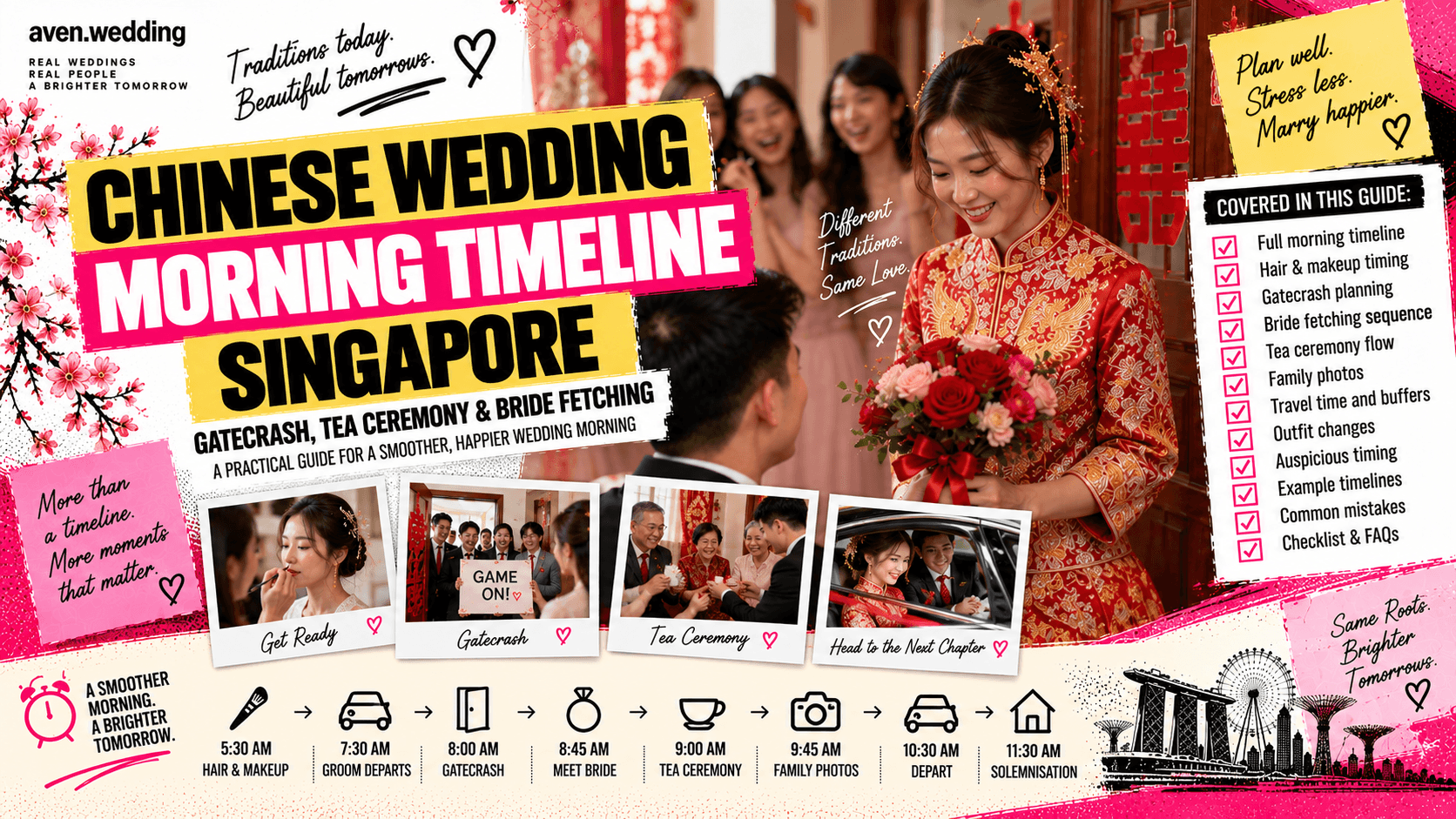
Example timeline: traditional morning with two family homes
Here is one illustrative planning example:
| Time | Activity |
|---|---|
| 5:30am | Bride hair and makeup begins |
| 6:30am | Groom prepares |
| 7:15am | Bride dresses in Qun Kwa |
| 7:30am | Photographer/video preparation coverage |
| 7:45am | Groom and groomsmen depart |
| 8:00am | Groom arrives |
| 8:10am | Gatecrash begins |
| 8:45am | Gatecrash ends |
| 8:45am | Groom meets bride |
| 9:00am | Bride's family tea ceremony |
| 9:30am | Family photographs |
| 9:45am | Bride leaves home |
| 10:15am | Arrive at groom's family home |
| 10:25am | Groom's family tea ceremony |
| 10:55am | Family photographs |
| 11:10am | Leave for venue |
This is an example, not a traditional rule.
Your actual schedule should reflect your families, locations and fixed event timings.
Example timeline: gatecrash with one combined tea ceremony
Combining tea ceremonies can create a much simpler morning.
For example:
| Time | Activity |
|---|---|
| 6:00am | Bride hair and makeup |
| 7:30am | Bride dresses |
| 8:00am | Groom arrives |
| 8:10am | Gatecrash |
| 8:45am | Groom meets bride |
| 9:00am | Couple and family photographs |
| 9:20am | Leave for hotel |
| 10:00am | Arrive and settle |
| 10:20am | Combined tea ceremony |
| 11:00am | Outfit change |
| 11:30am | Solemnisation preparation |
This removes one entire home-to-home journey.
For couples with an early solemnisation, that can make a significant difference.
Example timeline: simple modern Chinese wedding morning
Not every couple wants a packed traditional morning.
A simplified version could look like:
| Time | Activity |
|---|---|
| 7:00am | Hair and makeup |
| 8:30am | Bride ready |
| 9:00am | Groom arrives |
| 9:10am | Short gatecrash |
| 9:30am | Couple meets |
| 9:45am | Family tea ceremony |
| 10:15am | Family photographs |
| 10:30am | Leave for venue |
| 11:15am | Arrive and change |
| 12:00pm | Solemnisation |
Keeping fewer traditions can create more space for each one.
A shorter schedule is not a less meaningful wedding.
What if your gatecrash starts extremely early?
Work backwards carefully.
A very early gatecrash may mean:
- Makeup starts in the middle of the night
- Photographer arrives before sunrise
- Bridesmaids travel extremely early
- Family members sleep very little
- Neighbours hear the celebration
- Everyone becomes tired before the banquet begins
If an early timing comes from tradition, clarify exactly which moment needs to occur at that time.
Sometimes the schedule has more flexibility than couples initially realise.
Should the hair combing ceremony be included in the morning timeline?
The traditional hair combing ceremony may happen before the wedding morning, depending on family practice.
If yours happens late the night before, include it when thinking about rest.
A midnight ceremony followed by a 4:30am makeup call can leave everyone exhausted before the groom even arrives.
Coordinate the ceremony with the next morning's schedule.
Use Aven's Chinese Wedding Hair Combing Ceremony Singapore.
Who should be the morning timekeeper?
Assign one person.
Good options include:
- Actual-day coordinator
- Wedding planner
- Maid of honour
- Best man
- Trusted sibling
They should know:
- Full timeline
- Hard deadlines
- Auspicious timings
- Driver contacts
- Vendor contacts
- Next location
They also need permission to say:
"We need to move."
A timeline is useless if nobody is willing to enforce it.
How should photographers and videographers fit into the timeline?
Do not simply send them a list of ceremony start times.
Discuss:
- Bride preparation coverage
- Groom preparation coverage
- Gatecrash
- First meeting
- Tea ceremony
- Family photographs
- Travel
- Qun Kwa portraits
- Departure
- Venue arrival
If the photographer and videographer need to travel separately, their movement also needs to fit into the timeline.
Give them the final schedule before the wedding.
They may also spot unrealistic transitions that you missed.
What should happen if the morning starts running late?
Decide what can be shortened before the wedding.
For example:
Can shorten
- One gatecrash game
- Extra bridal-party photographs
- Casual portraits
- Unnecessary waiting
Should protect
- Fixed solemnisation
- Important family rituals
- Essential travel
- Required venue arrival
This creates a priority system.
When the schedule slips, your coordinator knows what to cut instead of asking the couple to make decisions under pressure.
Common Chinese wedding morning timeline mistakes
Avoid these problems:
No transition time
Moving people takes time.
Gatecrash with no hard stop
Games expand until someone stops them.
Using Google Maps time only
Parking, lifts and loading matter too.
No family photo list
Photographs become endless.
Too many outfit changes
Each one consumes actual wedding time.
Not clarifying auspicious timing
Know exactly which event needs to happen at the selected time.
Making the couple keep time
Assign someone else.
Scheduling everything back-to-back
One small delay then affects the entire day.
Chinese wedding morning timeline checklist
Use this checklist when building your schedule.
Traditions
- Confirm gatecrash
- Confirm bride fetching
- Confirm Chu Men customs
- Confirm bride's tea ceremony
- Confirm groom's tea ceremony
- Confirm auspicious timings
Bride preparation
- Makeup start
- Hair
- Qun Kwa
- Jewellery
- Preparation photos
- Outfit-change timing
Groom
- Preparation
- Departure
- Wedding car
- Bouquet
- Gatecrash ang baos
Family
- Tea ceremony serving order
- Family photo list
- Elderly relatives
- Helpers
- Valuables handler
Travel
- Every address confirmed
- Drivers briefed
- Parking checked
- Security access checked
- Travel buffer added
Timeline
- Fixed events identified
- Worked backwards
- Transition time included
- Hard gatecrash stop
- Timekeeper assigned
- Backup cuts identified
- Final timeline sent to vendors
Frequently asked questions about Chinese wedding morning timelines
How long should a Chinese wedding morning be?
There is no fixed duration. It depends on your traditions, family size, locations and later wedding events.
How long should gatecrash take?
Around 30 to 45 minutes can be a useful planning range for many couples, but your games may require more or less time.
How long does a tea ceremony take?
It depends primarily on the number of relatives and the ceremony format.
Should the bride be ready before gatecrash?
Ideally, she should be fully or nearly ready before the groom completes the games.
Can both tea ceremonies happen at the hotel?
Yes, if both families agree.
Should we visit both family homes?
Not necessarily. Couples can combine ceremonies to reduce travel.
How much travel buffer should we add?
Allow more than the driving estimate because parking, lifts, walking and moving the wedding party all take time.
Who should manage the timeline?
Assign a coordinator, wedding-party member or trusted family member rather than making the couple manage it themselves.
Your wedding morning should feel like a wedding, not a relay race
There is a strange temptation when planning a Chinese wedding morning.
Add one more tradition.
One more game.
One more photo.
One more location.
Until suddenly the bride is waking up at 3am and everyone is sprinting between HDB blocks with tea sets and garment bags.
You do not need to fit everything in.
Choose the traditions that matter.
Give them enough time.
Add buffers.
And protect the moments where nothing needs to happen except being with your family.
Continue planning with the Wedding Gatecrash Guide Singapore, Chinese Wedding Bride Fetching Singapore Guide, Chinese Wedding Tea Ceremony Guide Singapore, Qun Kwa Singapore Guide and Chinese Wedding Red Packet Guide Singapore.
For all the traditions in one place, use the Chinese Wedding Traditions Checklist Singapore.
For your complete actual day, continue to the Singapore Actual-Day Wedding Timeline.
For the complete cultural overview, return to Chinese Wedding Traditions in Singapore.