
Blog
Your First 90 Days as a Wedding Vendor in Singapore
October 3, 2026 · Updated October 3, 2026
A practical 90-day launch plan for Singapore wedding vendors. Define your offer, prepare your portfolio and booking process, then test your marketing and review the results.
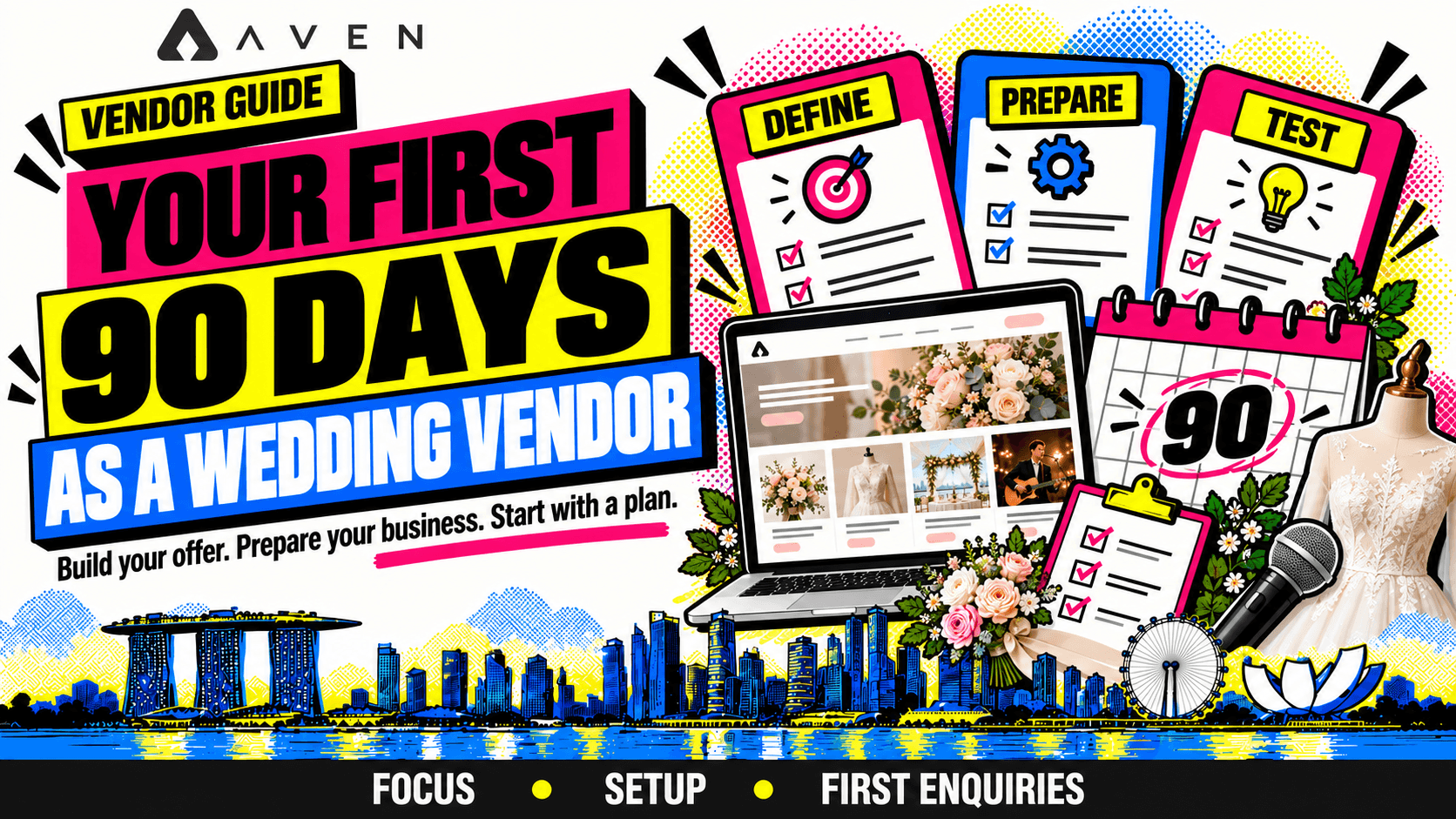
Use your first 90 days to build a business you can actually deliver
Starting a wedding business creates a long list of possible tasks: choosing a name, building a portfolio, buying equipment, setting prices and finding clients.
A staged plan helps you decide what matters first.
The goal for your first 90 days is to establish a clear offer, prepare a workable delivery process and gather evidence about the clients you can serve. It is a planning framework, not a promise of bookings within a fixed period.
This guide applies to photographers, bridal beauty providers, florists, planners, boutiques, entertainers, photobooth operators and other wedding vendors in Singapore.
Read our guide to starting a wedding business for the broader foundations, or use the complete Singapore wedding vendor business guide to explore the full roadmap.
Start by assessing your readiness
Your starting point affects the timeline.
An experienced practitioner launching an independent business may already have relevant work. Someone entering a new service category may need supervised experience before accepting responsibility for a wedding.
Assess:
- Your demonstrated skills.
- Your relevant event experience.
- The equipment, materials and support you need.
- Your available working hours.
- Your setup budget.
- The responsibilities you can confidently accept.
Allow more time where a gap affects delivery. You can develop your business setup while continuing training or assisting.
The 90-day plan should support readiness, rather than encourage you to accept work before you can fulfil it.
Your 90-day plan at a glance
| Period | Main focus | Practical outcome |
|---|---|---|
| Days 1–30 | Define the offer and business foundations. | A clear service, intended client profile and initial cost plan. |
| Days 31–60 | Prepare evidence and the booking process. | Relevant portfolio material, understandable packages and working enquiry tools. |
| Days 61–90 | Test discovery channels and review feedback. | Evidence about enquiries, client fit and the changes needed next. |
Some tasks will overlap. Registration, permissions or preparation may take longer than your preferred schedule, so adjust the plan to your circumstances.
Keep a weekly record of completed work, unresolved questions and the next priority.
Days 1–7: Define one clear starting offer
Write down what you will sell and what the client receives.
Include the service scope, intended wedding requirements, main deliverables and important exclusions. Identify the people, equipment and materials needed to deliver it.
Start with an offer that fits your current ability. A florist might begin with bouquets and smaller arrangements. An entertainer might offer a clearly defined performance format. A coordinator might limit the service to a specific handover and event scope.
Avoid combining several unfamiliar services just to create a larger package.
By the end of this stage, you should be able to explain the offer in a short paragraph.
Use how to choose your wedding business niche to focus the direction.
Days 8–14: Define client fit and review the market
Identify the couples whose requirements match the offer.
Focus on their wedding plans, priorities and support needs. For Singapore weddings, consider how home preparations, customary ceremonies, solemnisation, meals and celebrations may affect the scope.
Review comparable vendors to understand how services are presented. Compare inclusions and working arrangements rather than treating a starting price as the whole offer.
Speak with potential clients or collaborators to identify questions and uncertainties. Treat early observations as information to test, not proof of broad demand.
Your output should be a short client profile and a list of assumptions that need evidence.
Read how to identify your ideal wedding clients for a practical template.
Days 15–21: Prepare the business foundations
Decide how the business will operate and who is responsible for each stage.
Check the current registration and activity-specific requirements relevant to your circumstances. Confirm your intended business structure before committing to the setup.
If you are choosing a name, complete preliminary searches and review business-name and trademark considerations separately.
For a partnership, document ownership, contributions, decisions and working responsibilities. For an independent business, identify tasks that may need external support.
Create a basic system for keeping business records and controlling access to accounts.
Useful next reads are naming your wedding business and freelance wedding vendor versus studio.
Days 22–30: Estimate costs, pricing and capacity
List setup costs, recurring expenses and direct costs per booking.
Estimate the full workload, including enquiries, preparation, travel, setup, delivery, finishing and administration. Your price needs to account for more than the hours visible to the couple.
Then assess your capacity. Consider the work before and after the event as well as availability on the date.
Prepare an initial package with a defined scope. Record the assumptions behind the price so you can compare them with actual results later.
Avoid buying every possible tool at this stage. Prioritise what your offer requires and assess suitable rental or support arrangements where relevant.
Use the wedding vendor pricing guide and service cost calculation guide.
Days 31–40: Build the evidence your offer needs
Review existing work and identify the most important portfolio gaps.
Choose projects that demonstrate the service you intend to sell. Assisting, supervised work, practice projects and styled shoots can each provide useful evidence when accurately described.
For a bridal boutique, focus on garments, fit and the appointment process. For a photobooth service, show the actual setup and outputs. For a planner, prepare clearly labelled sample documents and describe relevant experience.
Agree on permissions and credits before publishing material.
Your objective is a focused collection that helps couples understand your work.
Read how to build an early wedding portfolio and, where relevant, how to organise a styled shoot.
Days 41–50: Prepare your packages and client information
Turn the offer into information a couple can assess.
Prepare:
- A clear service introduction.
- Package scope and inclusions.
- Relevant portfolio examples.
- Answers to common questions.
- A quotation format.
- A suitable written service agreement.
- An explanation of the booking process.
Keep the information consistent. A consultation should not promise a service that the package excludes.
Address delivery expectations, change requests and other relevant arrangements. Obtain suitable professional advice for terms that need legal assessment.
Use our brand positioning guide and package structure guide to make the offer understandable.
Days 51–60: Test the enquiry and delivery process
Set up a manageable route from first contact to confirmed booking.
Test your enquiry form, email address, messaging links and calendar. Submit a sample request and check that the information reaches the correct place.
Prepare a reply that acknowledges the brief, explains the relevant offer and gives a clear next step.
Also rehearse the operational process. Check equipment, materials, handover documents, transport assumptions and backup arrangements relevant to your service.
Make sure you know when a booking becomes confirmed and how changes will be recorded.
If you are launching a website, use the wedding business website checklist. Prepare your communications with wedding enquiry reply examples.
Days 61–70: Launch through a manageable set of channels
Choose channels you can maintain rather than trying to appear everywhere at once.
You might begin with a website or vendor profile, one active social account and relationships with complementary vendors.
Publish content that explains the offer. Show relevant work, describe your process and answer questions couples need to resolve before enquiring.
When approaching collaborators, explain the connection between your services and the clients you serve. Keep the request specific.
Record where enquiries originate. Early activity should help you learn which messages and channels bring suitable interest.
Read the Singapore wedding vendor marketing guide to compare discovery options.
Days 71–80: Learn from enquiries and consultations
Review the actual questions couples ask.
Look for repeated uncertainty about scope, style, timing, price or the booking process. Improve the information where appropriate.
Assess whether enquiries match your proposed client profile. If they do not, examine what your marketing shows and where visitors are finding you.
If you accept a booking, keep it within your capacity and agreed service scope. A deadline in your launch plan should not decide whether you are ready for the work.
Use how to qualify wedding enquiries and how to run a useful vendor consultation to structure the conversation.
Days 81–90: Review the results and choose the next priorities
Compare progress with the assumptions you started with.
| Area | Review question |
|---|---|
| Offer | Can couples understand what we provide? |
| Client fit | Are enquiries relevant to our strengths and scope? |
| Portfolio | What evidence are couples still asking to see? |
| Pricing | Do the expected costs and hours remain realistic? |
| Process | Can we handle a booking from enquiry to delivery? |
| Marketing | Which activity brings suitable interest? |
| Capacity | What limits the work we can responsibly accept? |
Separate what you have demonstrated from what remains uncertain.
Wedding bookings may happen well before the event. An accepted quotation gives you information about sales, while completed delivery provides different evidence about workload and results.
Choose a small number of priorities for the next quarter.
Track progress without relying only on bookings
Bookings matter, but they are not the only useful indicator during setup.
Track completed foundations such as a clear package, relevant portfolio evidence, tested enquiry tools and workable delivery arrangements.
For marketing, record suitable enquiries, consultations and outcomes. For completed projects, record costs, hours, scope changes and feedback.
Avoid treating follower counts or views as proof that the business is ready or financially sustainable.
Use the marketing results guide to connect discovery activity with enquiries and eventual bookings.
Frequently asked questions about your first 90 days
Do I need to secure a booking within 90 days?
No fixed deadline establishes whether the business will work. Use the period to build readiness and gather evidence. Review the reasons behind the response you receive.
Can I follow the plan part-time?
Yes. Adjust the schedule to your available hours and responsibilities. Allow time for preparation and delivery, not only marketing.
What if I need more experience?
Continue training or supervised work while preparing the business. Delay accepting responsibility for work you cannot yet deliver.
Should I spend on advertising immediately?
First make sure interested couples can assess the offer and submit a working enquiry. Any advertising test should have a clear objective, a manageable budget and a way to review results.
What if I already have a portfolio?
Review whether it supports the current offer and whether you have permission to use it. Spend more time on packages, operations and testing where those are the gaps.
What happens after day 90?
Use the evidence to set the next priorities. Continue developing the offer, improving delivery and reviewing the financial results of actual work.
Your first 90-day readiness checklist
By the end of your initial plan, aim to have:
- A service you can explain and deliver.
- A practical profile of the clients it suits.
- An appropriate business setup.
- Clear ownership and responsibilities.
- A cost plan and defined package.
- Relevant portfolio evidence.
- Consistent client information.
- A suitable quotation and agreement process.
- Tested enquiry tools.
- Workable delivery and backup arrangements.
- A manageable marketing approach.
- A record of feedback and next priorities.
Adjust the timeline where necessary. The useful outcome is a clearer, better-prepared business with evidence to guide its next decisions.
Continue with the Singapore wedding vendor marketing guide, or return to the complete wedding vendor business guide.