
Blog
San Chao Hui Men Singapore Guide: Chinese Bride Return Tradition Explained
September 9, 2026 · Updated September 9, 2026
Understand San Chao Hui Men, the Chinese bride return tradition, including its meaning, timing, what couples may bring, family customs and how Singapore couples can adapt it today.
What is San Chao Hui Men?
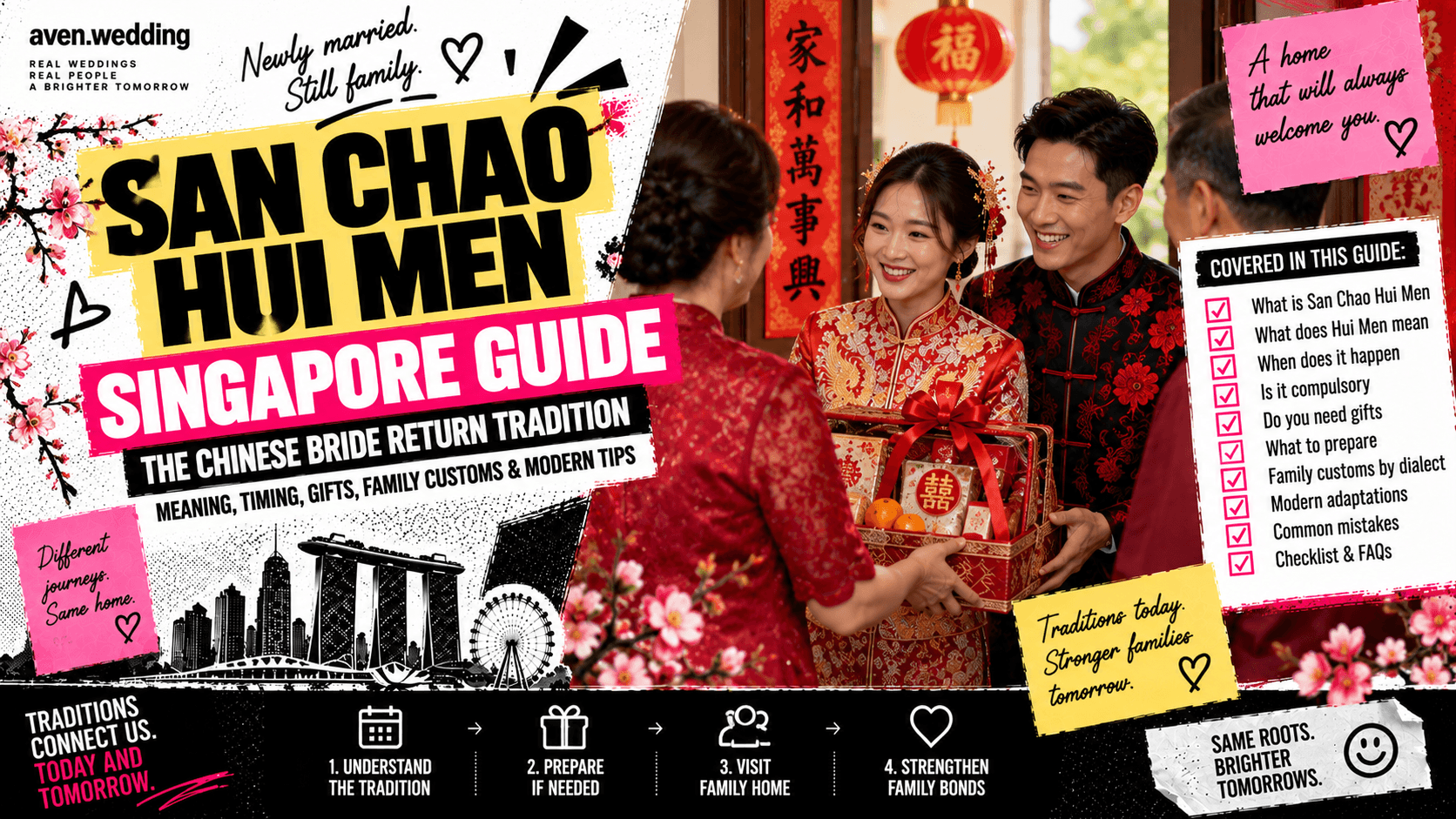
San Chao Hui Men (三朝回门) is a traditional Chinese wedding custom involving the bride returning to her family home after marriage.
You may also hear it described simply as:
- Hui Men
- Bride return
- Returning to the bride's family home
- Returning to the maiden home
Traditionally, the custom represents the bride returning to visit her parents after leaving her family home as part of the marriage.
For modern Singapore couples, the tradition may be observed formally, simplified into a family visit or skipped altogether.
This San Chao Hui Men Singapore guide explains the meaning, timing, gifts and practical decisions couples may encounter.
For the wider cultural overview, start with Aven's Chinese Wedding Traditions in Singapore.
What does San Chao Hui Men mean?
The Chinese characters help explain the tradition:
三朝 (San Chao) refers traditionally to the third day.
回门 (Hui Men) means returning home or returning through the door.
Together, the term refers to the traditional return of the bride to her family home after marriage.
The custom reflects an older social context where marriage often represented a much more significant transition away from the bride's original household.
Modern Singapore couples may already:
- Live independently
- Own a home together
- Visit both families regularly
- Have lived together before marriage
The practical circumstances have changed, but some families continue the tradition because of its cultural and emotional significance.
Is San Chao Hui Men compulsory?
No.
San Chao Hui Men is a cultural tradition, not a requirement for marriage in Singapore.
Whether you practise it depends on:
- Family expectations
- Dialect traditions
- Parents and grandparents
- Wedding schedule
- Personal preference
Some families may consider it an important post-wedding custom.
Others may barely mention it.
Ask both families rather than assuming it applies to every Chinese wedding.
When does San Chao Hui Men happen?
Traditionally, the name is associated with the bride returning around the third day after marriage.
However, modern families may interpret the timing differently.
Depending on family custom and practical circumstances, the visit may happen:
- A few days after the wedding
- On another agreed date
- When both families are available
- As part of another family gathering
If your family follows a specific traditional timing, confirm it directly with them.
Do not assume that every Singapore Chinese family uses exactly the same schedule.
Does Hui Men have to happen exactly three days after the wedding?
Not necessarily for every modern family.
The traditional concept and the way families practise it today can differ.
Work schedules, honeymoons, travel and family availability may make the traditional timing difficult.
Ask your parents:
"Does the return need to happen on a particular day, or is the family visit itself what matters?"
That distinction can make planning much easier.
Is an auspicious date needed for San Chao Hui Men?
Some families may care about traditional timing or date selection.
Others may not.
If your family follows auspicious dates closely, ask whether Hui Men requires:
- A particular date
- A particular time
- A date selected alongside the wedding
- No separate selection at all
Try to resolve this while planning the other traditional ceremonies.
For the wider topic, use Aven's Chinese Wedding Auspicious Date Guide Singapore.
How is Hui Men different from Hui Li?
The names sound similar, but they refer to different traditions.
| Tradition | Meaning |
|---|---|
| Hui Li (回礼) | Return or reciprocal gifts associated with Guo Da Li |
| Hui Men (回门) | Bride returning to visit her family after marriage |
Hui Li is connected primarily with the exchange of wedding gifts.
Hui Men is connected with the bride returning home after the wedding.
They should not be treated as interchangeable terms.
For return gifts, use Aven's Hui Li Singapore Guide.
How is Hui Men connected to bride fetching?
The two traditions represent different parts of the traditional wedding journey.
During bride fetching, the groom arrives and the bride eventually leaves her family home.
During Hui Men, she returns after marriage.
You can think of the broad symbolic sequence as:
Bride's family home
↓
Bride fetching and Chu Men
↓
Marriage and wedding celebrations
↓
Hui Men
↓
Return visit to bride's family
This helps explain why the return can carry emotional meaning for families.
Use Aven's Chinese Wedding Bride Fetching Singapore Guide for the earlier part of the sequence.
Does the groom return with the bride?
Traditionally, Hui Men is generally understood as a return visit involving the newly married couple rather than simply the bride making an ordinary visit alone.
However, specific expectations can vary.
Ask your family:
- Who should attend?
- Does the couple arrive together?
- Are other relatives involved?
- Is there a family meal?
For modern couples, it may simply become a meaningful visit by the newlyweds to the bride's parents.
What happens during San Chao Hui Men?
The exact ritual depends on family tradition.
A modern version can be very simple:
- Couple prepares any required gifts
- Couple travels to bride's family home
- Parents welcome the couple
- Gifts are presented if practised
- Family spends time together
- Family shares a meal
Some families may observe additional customs.
Others may treat it almost entirely as a family lunch or dinner.
The significance can remain even when the ceremony itself is minimal.
Do you need to bring gifts for Hui Men?
Some families may expect the couple or groom to bring gifts when returning to the bride's family home.
The specific items can vary according to:
- Family practice
- Dialect group
- Traditional symbolism
- How formally the custom is observed
Rather than buying a generic Hui Men package immediately, ask the bride's parents what they expect.
A useful question is:
"Is there anything we should prepare or bring when we come back?"
This avoids unnecessary spending and prevents you from missing something your family considers important.
What gifts may be prepared for Hui Men?
Depending on family tradition, return-visit gifts may involve food, symbolic items or other presents for the bride's family.
Because practices differ, there is no universal shopping list that every Singapore couple needs to follow.
If your family wants a traditional gift set:
- Ask for the exact items
- Confirm quantities
- Ask whether pairs matter
- Confirm whether anything is returned
- Clarify who prepares the gifts
If your family is flexible, a thoughtful gift or contribution to the family meal may be enough.
Follow family expectations rather than trying to maximise the number of traditional items.
Does the bride's family need to return anything?
This depends on the family's practice.
Do not assume the exchange works like Guo Da Li and Hui Li.
If gifts are being brought for Hui Men, ask whether:
- Everything is kept
- Anything is returned
- There are symbolic quantities
- Parents prepare something for the couple
If nobody in either family expects a formal exchange, there is no need to invent one.
Is there usually a family meal?
A family meal can be an important part of the return visit.
For modern Singapore couples, this may be the easiest way to preserve the spirit of the tradition.
It could be:
- Home-cooked lunch
- Home-cooked dinner
- Restaurant meal
- Small extended-family gathering
After a hectic wedding, a quieter meal can also give the couple and bride's family time together without:
- Photographers
- Wedding schedules
- Gatecrash games
- Banquet guests
- Vendor coordination
Sometimes the simplest version of the tradition becomes the most personal.
What should the bride wear for Hui Men?
Ask your family if there is any attire expectation.
Depending on how formally the tradition is observed, the bride might wear:
- Qun Kwa
- Cheongsam
- Red dress
- Another festive outfit
- Regular clothing
There is no reason to assume the Qun Kwa must automatically be worn again.
If you rented your Qun Kwa, the rental return deadline may also affect whether it is available.
For traditional bridal attire planning, use Aven's Qun Kwa Singapore Guide.
What should the groom wear?
The groom's clothing can generally match the formality of the visit.
If the family expects a ceremonial return, he may dress more formally.
If the modern version is essentially a family meal, simpler attire may be perfectly appropriate.
The couple should look coordinated without turning a relaxed family visit into another full wedding production unless that is what the family wants.
What if you are leaving for your honeymoon immediately?
This is one of the most practical conflicts modern couples may face.
If your honeymoon begins shortly after the wedding, discuss Hui Men before confirming the travel schedule.
Possible options include:
- Observing it before departure if appropriate
- Adjusting the honeymoon date
- Holding the return visit after the honeymoon
- Agreeing on a simplified family arrangement
Whether changing the traditional timing is acceptable depends on your family.
The important thing is to discuss it before flights and accommodation become difficult to change.
What if the bride already visits her parents regularly?
Modern life can make Hui Men feel unusual.
You may live ten minutes away.
You may have dinner with your parents every week.
You may have slept at your parents' home immediately before the wedding.
That does not necessarily make the tradition meaningless.
If your family wants to observe it, treat the return as a symbolic post-marriage visit rather than pretending the bride has been absent for an extended period.
Traditions can retain emotional meaning even when the practical circumstances that created them have changed.
What if the couple already lived together before marriage?
The same principle applies.
You do not need to recreate an older household arrangement that does not reflect your life.
Instead, ask what your family values about Hui Men.
It may simply be:
- Returning together as newlyweds
- Showing respect to the bride's parents
- Sharing a meal
- Maintaining family connection
If that is the meaningful part, build the modern version around it.
Do different dialect groups practise Hui Men differently?
They can.
Chinese wedding traditions in Singapore may vary between families with Hokkien, Teochew, Cantonese, Hakka and other backgrounds.
Differences may involve:
- Timing
- Gifts
- Food
- Quantities
- Ritual sequence
- Family roles
Even within the same dialect group, two families may follow different practices.
Treat dialect traditions as useful context rather than an automatic rulebook.
Your own family remains the most important reference.
What if the bride and groom come from different dialect groups?
Do not try to perform two complete sets of customs unless both families genuinely want that.
Instead:
- Ask each family what matters
- Identify overlapping traditions
- Identify genuine differences
- Decide which practices to retain
- Agree on a simple sequence
The same approach works across Guo Da Li, Hui Li, Jia Zhuang, tea ceremony and other Chinese wedding traditions.
The goal is not to prove which family's version is more correct.
Can San Chao Hui Men be simplified?
Yes.
A simplified modern version could be:
Couple visits bride's parents → brings a thoughtful gift → shares lunch → spends time together
That may be enough for a family that values the meaning more than the formal ritual.
Before simplifying, confirm whether there are one or two specific customs your parents still want preserved.
You may discover that a very small gesture carries most of the meaning.
Do you need a photographer for Hui Men?
Usually, you do not need to turn the return visit into another wedding shoot.
But you can still take:
- Family photograph
- Couple with parents
- Gift presentation
- Meal photograph
- Casual phone photos
If your family observes a particularly meaningful ceremony, you may choose to document it more intentionally.
Otherwise, letting the visit remain private can be refreshing after a wedding filled with cameras.
Common San Chao Hui Men mistakes to avoid
Avoid these common problems:
Assuming it must happen exactly the same way for every family
Practices vary.
Confusing Hui Men with Hui Li
They are different traditions.
Booking the honeymoon before checking family expectations
The timing may conflict.
Buying gifts without asking
Your family may expect something different or nothing at all.
Overcomplicating the tradition
A simple family visit may be enough.
Treating dialect customs as universal
Family practice matters more.
Forgetting the meaning
The tradition centres on reconnecting with the bride's family after marriage, not completing another wedding checklist.
San Chao Hui Men Singapore checklist
Use this checklist to plan the bride's return visit.
Family expectations
- Ask whether your family practises Hui Men
- Confirm how formal the tradition should be
- Confirm dialect-specific customs
- Confirm who should attend
Timing
- Confirm preferred day
- Check whether auspicious timing matters
- Check work schedules
- Check honeymoon plans
- Confirm visit time with parents
Gifts
- Ask whether gifts are expected
- Confirm required items
- Confirm quantities
- Confirm who prepares them
- Ask whether anything is returned
Visit
- Confirm bride's attire
- Confirm groom's attire
- Arrange transport
- Confirm family meal
- Decide whether photographs are wanted
Before the day
- Gifts packed
- Parents informed
- Timing reconfirmed
- Restaurant booked if required
- Keep the rest of the day relatively relaxed
Frequently asked questions about San Chao Hui Men
What is San Chao Hui Men?
San Chao Hui Men is a traditional Chinese wedding custom involving the bride returning to visit her family after marriage.
What does Hui Men mean?
Hui Men (回门) means returning home or returning through the door.
Does it have to happen exactly three days after the wedding?
Traditional timing is associated with the third day, but modern family practices may vary.
Is Hui Men compulsory?
No. It is a cultural tradition rather than a marriage requirement.
Does the groom go with the bride?
The tradition is generally understood as a return visit by the newly married couple, though family practices can vary.
Do we need to bring gifts?
Some families expect gifts while others keep the visit simple. Ask the bride's family.
Is Hui Men the same as Hui Li?
No. Hui Li refers to reciprocal gifts associated with Guo Da Li, while Hui Men refers to the bride's return visit.
Can we do Hui Men after our honeymoon?
Some families may be comfortable adapting the timing, while others may prefer traditional timing. Discuss it before booking travel.
Do I need to wear my Qun Kwa again?
Not necessarily. Ask whether your family has any attire expectations.
Sometimes returning home means something different after the wedding
For many modern Singapore couples, marriage does not mean the bride suddenly disappears from her family.
You might still live nearby.
You might still meet your parents every weekend.
You might have a family WhatsApp chat that never stops.
So Hui Men can seem like a tradition from a very different world.
And historically, it is.
But there is still something meaningful about walking back through your parents' door after the wedding, this time together as a married couple.
It does not need to be elaborate.
Maybe you bring some gifts.
Maybe your mum cooks too much food.
Maybe everyone sits around the same dining table you have sat at for years.
The difference is simply that a new chapter has started.
Continue with the Chinese Wedding Bride Fetching Singapore Guide, Chinese Wedding Tea Ceremony Guide Singapore, Hui Li Singapore Guide, Qun Kwa Singapore Guide and Chinese Wedding Traditions Checklist Singapore.
For the complete cultural overview, return to Chinese Wedding Traditions in Singapore.
For your complete wedding journey, use the Ultimate Singapore Wedding Planning Guide.