
Blog
Wedding Seating Etiquette Singapore: Who Sits Where at Your Banquet?
September 10, 2026 · Updated September 10, 2026
Plan who sits where at your Singapore wedding with practical seating etiquette for parents, relatives, VIPs, friends, colleagues, couples, children and sensitive family situations.
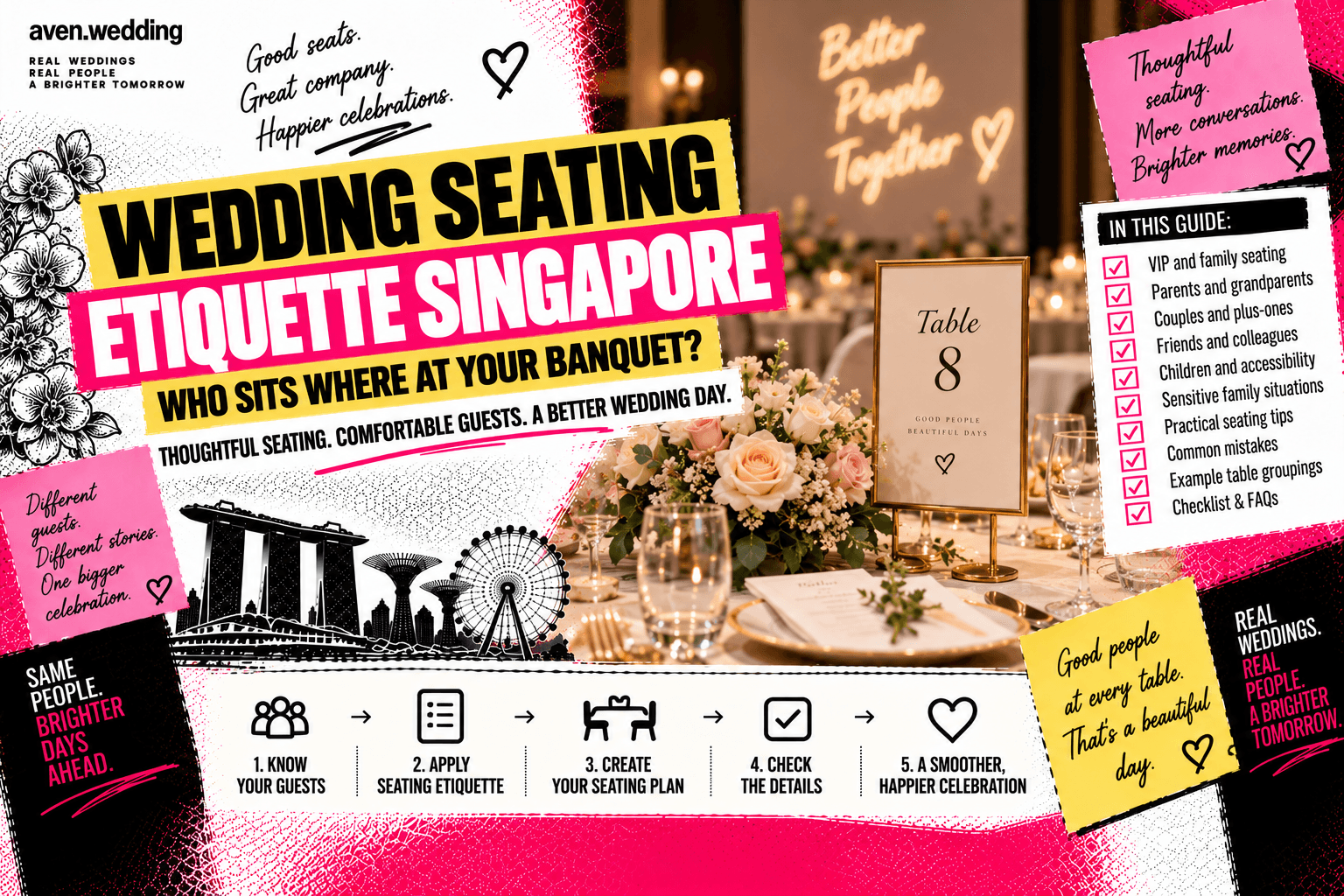
Who should sit where at a Singapore wedding?
Wedding seating sounds simple until you actually start assigning names.
Then the questions begin.
Should both sets of parents sit together?
Where do grandparents sit?
Should colleagues be grouped by company?
Do couples always sit together?
What happens when relatives do not get along?
And who gets the tables closest to the stage?
This wedding seating etiquette guide for Singapore focuses specifically on who should sit with whom and where different guests should be placed.
For the actual process of building your seating chart, managing table capacity and finalising assignments, use Aven's Singapore Wedding Seating Plan Guide.
Think of seating etiquette as the human side of the seating plan.
The goal is not to create a perfect social hierarchy.
It is to make your guests comfortable.
Is there a correct wedding seating arrangement?
No single arrangement works for every Singapore wedding.
Your seating depends on:
- Family traditions
- Venue layout
- Table size
- Guest relationships
- Parents' preferences
- Cultural expectations
- Accessibility
- Wedding format
Some families care strongly about traditional table placement.
Others are completely comfortable mixing relatives and friends.
Discuss expectations before building the final plan rather than discovering them after sending the seating chart to your parents.
What is the VIP table at a Singapore wedding banquet?
At some wedding banquets, couples designate one or more prominent tables for immediate family or important guests.
These may be positioned:
- Near the stage
- Near the couple
- Along the central aisle
- In another prominent part of the ballroom
Who sits there varies by family.
Possible guests include:
- Parents
- Grandparents
- Immediate family
- Senior relatives
- Important family guests
Do not assume there is one universal Singapore wedding rule for the VIP table.
Ask both families what matters to them.
Should both sets of parents sit together?
They can, but they do not have to.
One arrangement is:
Couple + both sets of parents + immediate family
Another is:
Bride's family at one table
and
Groom's family at another
The second arrangement may be easier when:
- Both families have many immediate relatives
- Parents are hosting their own guests
- Table capacity is limited
- Family traditions favour separate tables
There is no need to force both families onto one table purely because it looks symbolic.
Where should grandparents sit?
Grandparents are often placed at a prominent family table.
But comfort should come before prestige.
Consider:
- Walking distance
- Steps
- Loudspeakers
- Air-conditioning
- Restroom access
- Wheelchair space
- Stage visibility
The closest table to the stage is not automatically the best table if a speaker is blasting directly beside it.
Ask older relatives what would make them comfortable.
Where should siblings sit?
Siblings may sit:
- With parents
- At the main family table
- With cousins
- With the wedding party
- With their partners
Their role during the wedding can affect the decision.
A sibling who is also maid of honour may prefer sitting with the wedding party.
A sibling with a spouse and children may be more comfortable with family.
Prioritise relationships and practical needs over rigid categories.
Should married and dating couples always sit together?
As a general courtesy, avoid separating couples unnecessarily.
This applies especially when:
- They do not know many other guests
- One partner is attending mainly because of the other
- They are travelling together
- They are married or in a long-term relationship
There may be exceptions.
For example, someone in the wedding party may temporarily sit elsewhere because of programme responsibilities.
But do not split couples merely because two different tables each have one empty seat.
How should you seat guests with plus-ones?
Seat the guest and their plus-one together.
Then try to place them with people they could comfortably talk to.
Useful connections might include:
- Similar age
- Mutual friends
- Same social circle
- Shared interests
- Other couples
Avoid creating a table made entirely of random plus-ones who know nobody except their respective partners.
Your guest-list policy should already be settled before this stage.
Use Aven's Singapore Wedding Guest List Guide for plus-one planning.
How should you seat extended relatives?
Family relationships are usually more useful than family-tree distance.
Instead of automatically grouping everyone labelled "relative," consider:
- Who actually talks to each other
- Generational differences
- Dialect or language
- Family branches
- Existing relationships
- Sensitive history
Your parents can be extremely helpful here.
You may know that someone is your second aunt.
Your parents probably know whether your second aunt wants to sit beside your third aunt for three hours.
How should you seat cousins?
Cousins can often be grouped by age or social connection.
For example:
- Younger adult cousins together
- Cousins with partners
- Cousins with young children
- Older cousins with their parents
Do not automatically place every cousin at one table if there is a large age range and they barely interact.
The objective is conversation, not genealogical accuracy.
How should you seat parents' friends?
Parents' friends are often easiest to arrange by social group.
Possible groups include:
- School friends
- Former colleagues
- Current colleagues
- Neighbours
- Family friends
- Community groups
Ask your parents to suggest table groupings rather than simply giving you a list of names.
They know the relationships better than you do.
You can then fit their preferred groups into the venue's table capacities.
How should you seat work colleagues?
Grouping colleagues together often works well because they already know one another.
But avoid treating the company organisation chart as a seating chart.
You do not necessarily need:
Management table
Senior staff table
Junior staff table
unless there is a genuine social reason for it.
Think about who actually interacts.
If you invited colleagues from different jobs or stages of your career, separate groups may make more sense.
Should bosses and senior colleagues get a better table?
Not automatically.
You may choose a convenient or prominent table for an important professional guest as a courtesy.
But your wedding does not need to reproduce workplace hierarchy.
Family, accessibility and personal relationships may be more important factors.
If your boss is attending as someone you genuinely value, seat them thoughtfully.
If you are placing them near the stage purely because of their job title, reconsider whether that actually matters.
How should you seat different friend groups?
Keep established groups together where possible.
Examples:
- Secondary school friends
- Polytechnic or JC friends
- University friends
- National Service friends
- Work friends
- Sports friends
- Hobby groups
If one group does not fill a table, combine groups thoughtfully.
Look for connections.
For example, two outgoing groups of similar age may mix easily.
Two groups where everyone is quiet and knows nobody else may produce a very peaceful dinner.
Should bridesmaids and groomsmen sit together?
They can.
A wedding-party table works well when the group knows each other and will enjoy sitting together.
But you can also seat them with:
- Their partners
- Existing friend groups
- Family
Consider their responsibilities.
If bridesmaids and groomsmen need to repeatedly leave the table for programme duties, place them somewhere with easy access.
Use Aven's Bridesmaid & Groomsmen Duties Singapore to assign their actual-day responsibilities.
How should children be seated at a wedding?
Young children are usually easiest to seat with their parents or caregivers.
Consider:
- High chairs
- Stroller space
- Children's meals
- Easy exit routes
- Restroom access
An independent children's table may work for older children who know one another, but it should not be used simply to remove children from the adult tables.
Ask parents what arrangement works for their children.
Where should guests with babies sit?
Think practically.
A table near an accessible exit may help parents who need to:
- Settle the baby
- Use a changing room
- Move a stroller
- Step outside temporarily
Avoid placing families with babies directly beside:
- Loudspeakers
- Stage effects
- Very congested walkways
Ask about their needs rather than guessing.
How should elderly guests be seated?
Prioritise accessibility.
Consider:
- Distance from entrance
- Walking route
- Steps
- Restrooms
- Wheelchair access
- Speaker volume
- Air-conditioning
- Easy access to family
A table that looks less prestigious on the floor plan may actually be much more comfortable.
Good seating etiquette is about hospitality, not just hierarchy.
How should guests with accessibility needs be seated?
Ask the guest or their family what they need.
Consider:
- Wheelchair clearance
- Accessible routes
- Proximity to lifts
- Restroom access
- Space for mobility aids
- Seating position at the table
- Easy entry and exit
Coordinate with your venue before finalising the floor plan.
Use Aven's Wedding Venue Floor Plan Guide Singapore to check the physical layout.
What if divorced or separated parents are attending?
Handle this privately and early.
There is no universal arrangement.
Depending on their relationship, they may:
- Sit at the same table
- Sit at different family tables
- Sit with their respective partners
- Be positioned in separate parts of the room
Do not use the wedding as an opportunity to force reconciliation.
Ask what arrangement allows everyone to participate comfortably while keeping the focus on the couple.
What if two relatives do not get along?
Do not seat them together simply because they belong to the same family branch.
Separate them if doing so reduces unnecessary tension.
You do not need to place them at opposite ends of the ballroom unless the situation requires it.
Often, different tables are enough.
The seating plan is one of the few wedding-planning tools that lets you quietly solve a problem before it happens.
What if both families disagree about important tables?
Discuss the principle before individual names.
For example:
Table 1 is for immediate family.
Table 2 is for grandparents and senior relatives.
Tables 3 and 4 are for close family.
Once everyone agrees on the structure, assigning names becomes easier.
If you begin with:
"Why is your uncle at Table 2 while mine is at Table 4?"
the discussion can become personal very quickly.
Does being closer to the stage mean a guest is more important?
Not necessarily.
Some guests may assume prominent tables indicate importance, especially at formal banquets.
But practical considerations matter too.
A table may be further away because:
- An elderly guest needs easy access
- A family needs stroller space
- A group fits better elsewhere
- The venue layout is irregular
Try to place key family thoughtfully, but do not obsess over ranking every table from "best" to "worst."
Your ballroom is not a leaderboard.
Where should the couple sit?
This depends on your banquet format.
Options include:
- Couple at a family VIP table
- Couple at a sweetheart table
- Couple with the wedding party
- Couple moving between tables
Ask your venue what is practical for:
- Stage access
- March-ins
- Meal service
- Speeches
- Outfit changes
- Table photography
If you are barely going to sit because of the programme, an elaborate couple-table arrangement may matter less than you think.
Should you fill every seat at every table?
Not necessarily.
A slightly underfilled table can be better than forcing incompatible groups together.
However, venue package requirements and table capacities may affect your options.
Before finalising the plan, confirm:
- Standard table capacity
- Minimum seating
- Maximum seating
- Whether tables can have different numbers
- Whether empty seats affect meal arrangements
Use Aven's How to Choose a Wedding Venue Based on Guest Count for broader capacity planning.
Common wedding seating etiquette mistakes
Avoid these:
Separating couples unnecessarily
Keep partners together where practical.
Treating tables as a status ranking
Comfort matters more.
Ignoring family relationships
Ask parents before grouping relatives.
Putting elderly guests beside speakers
Check the physical room.
Forgetting accessibility
Plan routes and space early.
Creating a random singles table
Being unmarried is not a shared interest.
Forcing conflicting relatives together
Use separate tables.
Separating plus-ones from the person who invited them
They may know nobody else.
Grouping colleagues only by seniority
Seat people who actually interact.
Making every table mathematically perfect
A comfortable table of nine can be better than an awkward table of ten.
Wedding seating etiquette checklist Singapore
Immediate family
- Couple's seating decided
- Parents' seating confirmed
- Grandparents considered
- Siblings and partners placed
- Important relatives discussed
Guest relationships
- Couples seated together
- Plus-ones seated with invited guests
- Friend groups considered
- Colleagues grouped naturally
- Parents' guests reviewed
- Wedding party seating decided
Comfort
- Elderly guests considered
- Accessibility needs checked
- Families with babies considered
- Children seated appropriately
- Speaker locations checked
- Entrances and exits checked
Sensitive relationships
- Divorced or separated parents discussed
- Family conflicts considered
- Guests who should not sit together identified
- Family expectations discussed privately
Final review
- Both families review relevant tables
- Venue capacity checked
- Reception team receives final plan
- Latest RSVP changes included
- Backup printed seating list prepared
Frequently asked questions about wedding seating etiquette in Singapore
Should both sets of parents sit together?
They can, but separate family tables are also completely workable.
Should couples always sit together?
Generally, yes. Avoid separating partners unnecessarily.
Should bridesmaids and groomsmen sit together?
They can, but they may also sit with partners, family or their existing friend groups.
Where should grandparents sit?
Usually with family in a comfortable location. Consider accessibility and noise rather than only proximity to the stage.
Should bosses sit at VIP tables?
Not automatically. Seat them thoughtfully based on your relationship and overall guest arrangement.
Should children have their own table?
Not necessarily. Young children are usually best seated with parents or caregivers.
What should we do with relatives who do not get along?
Seat them separately where practical.
Do tables closer to the stage have to be for more important guests?
No. Prominence may matter to some families, but comfort and practical considerations are equally important.
Should we fill every table completely?
Not necessarily. Check your venue's requirements, but do not create uncomfortable combinations purely to fill a final seat.
The best seating plan is the one nobody notices
Nobody arrives at a wedding hoping to admire the seating algorithm.
They want to find their table.
Sit beside people they like.
Have someone to talk to.
See the couple.
Eat.
Laugh.
Celebrate.
That is the goal.
You are not trying to perfectly rank every relationship in your life across 25 banquet tables.
You are creating small groups of people who can comfortably spend the next few hours together.
Put family considerations where they matter.
Respect sensitive relationships.
Keep partners together.
Look after elderly guests.
Think about accessibility.
Then stop trying to make every table perfect.
Because when seating works well, nobody talks about the seating plan.
They just have a good night.
Continue with the Singapore Wedding Seating Plan Guide, Singapore Wedding Guest List Guide, Wedding RSVP Guide Singapore and Wedding Reception Checklist Singapore.
For the physical room layout, use the Wedding Venue Floor Plan Guide Singapore.
For your banquet flow, continue with the Singapore Wedding Banquet Programme Guide.
For your complete planning journey, return to the Ultimate Singapore Wedding Planning Guide.