
Blog
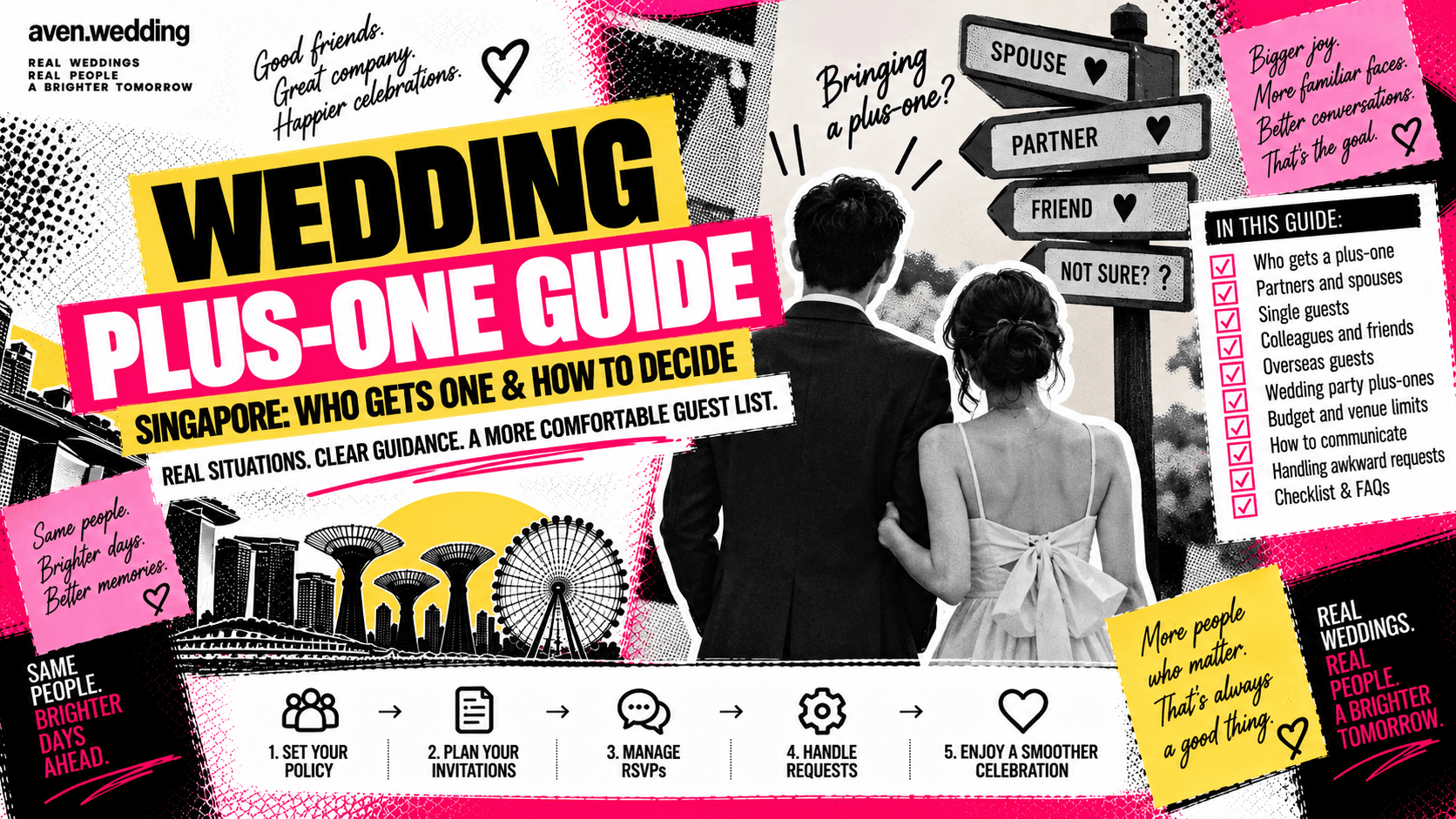
Wedding Plus-One Guide Singapore: Who Gets One & How to Decide
September 10, 2026 · Updated September 10, 2026
Decide who gets a plus-one at your Singapore wedding with practical guidance on partners, single guests, venue capacity, budget, invitations, RSVPs and awkward requests.
Who should get a plus-one at your Singapore wedding?
Plus-ones sound simple until you start building the guest list.
Your friend has been dating someone for three months.
Your colleague wants to bring their partner.
Your cousin recently started seeing someone you have never met.
Someone RSVPs for two people even though you invited one.
And suddenly:
"Can I bring someone?"
becomes one of the more awkward questions in wedding planning.
There is no universal wedding plus-one rule in Singapore.
The right approach depends on:
- Your relationship with the guest
- Whether they have an established partner
- Wedding size
- Venue capacity
- Budget
- Family expectations
- How consistently you apply your policy
This guide helps you decide who gets a plus-one, communicate it clearly and handle difficult requests without turning your guest list into chaos.
For the broader process, start with Aven's Singapore Wedding Guest List Guide.
What does plus-one actually mean?
A plus-one usually means an invited guest can bring another person.
That person may be:
- Their spouse
- Long-term partner
- Boyfriend or girlfriend
- Date
- Friend
- Someone you have never met
However, there is an important difference between:
Named partner
and
Open plus-one
If your invitation says:
Amanda & Benjamin
Benjamin is a specifically invited guest.
If it says:
Amanda + Guest
Amanda has an open plus-one.
That distinction becomes important when managing invitations and RSVPs.
Do married guests automatically get to bring their spouse?
In most social situations, established spouses are generally treated as a social unit.
If you know someone is married, consider inviting both partners even if you are closer to only one person.
The same principle can reasonably apply to established long-term relationships.
This does not mean every guest automatically receives an unrestricted plus-one.
It means there is a difference between recognising an existing relationship and giving someone permission to bring any additional guest.
What about long-term unmarried couples?
Consider treating established long-term partners similarly to married couples.
For example, if your friend has lived with their partner for several years, inviting only your friend may feel unusual even if you have rarely met the partner.
You do not need a strict definition of:
"Long enough."
Instead consider whether the partner is clearly part of your guest's life.
Consistency matters more than creating a complicated relationship-duration formula.
Do engaged couples get invited together?
Generally, it makes sense to invite both.
If you know the partner's name, address the invitation to both people rather than writing:
James + Guest
For example:
James Tan & Rachel Lim
This makes it clear that Rachel herself is invited rather than simply occupying a plus-one slot.
Do single guests need a plus-one?
Not automatically.
You can decide based on:
- Wedding size
- Budget
- Venue capacity
- Whether they know other guests
- How far they are travelling
- Your relationship with them
For example, a friend attending alone but seated with ten close university friends may not need a plus-one to feel comfortable.
An overseas guest travelling alone who knows nobody else at the wedding may benefit much more from one.
Use judgement rather than assuming every single guest requires the same arrangement.
Should your wedding party receive plus-ones?
Consider it seriously.
Bridesmaids and groomsmen may have already contributed substantial time to:
- Wedding preparation
- Gatecrash
- Tea ceremony
- Transport
- Reception
- Actual-day logistics
Allowing their established partners to attend can be a thoughtful gesture.
For open plus-ones, your decision may still depend on capacity and budget.
Use Aven's Bridesmaid & Groomsmen Duties Singapore when planning your wedding party.
Should colleagues get plus-ones?
Not necessarily.
If you invite a group of colleagues who already know each other, you may choose to invite only those colleagues.
If a colleague has a spouse or established partner whom you know socially, you may decide differently.
The key is to avoid creating arbitrary distinctions that are difficult to explain.
For example:
Inviting ten colleagues individually can make sense.
Allowing five of them plus-ones but not the other five for no clear reason may create unnecessary awkwardness.
Should overseas guests get plus-ones?
It can be worth considering.
An overseas guest may be:
- Paying for flights
- Booking accommodation
- Travelling alone
- Attending a wedding where they know very few people
Giving them a plus-one can make the trip more comfortable.
It is not mandatory.
But when deciding how to allocate limited plus-one spaces, travel circumstances can reasonably be one factor.
How does your wedding budget affect plus-ones?
Every additional guest has a cost.
Depending on your wedding, that may affect:
- Catering
- Banquet tables
- Drinks
- Favours
- Invitations
- Transport
- Venue capacity
Ten plus-ones can mean ten additional meals.
Twenty can affect several tables.
Before offering open plus-ones widely, understand what those additional guests mean for your budget.
Use Aven's Wedding Budget Checklist Singapore to account for guest-related costs.
How does venue capacity affect plus-ones?
Your venue may make the decision for you.
Imagine:
Venue comfortable capacity: 200
Current guest list: 192
You do not realistically have room to offer 40 open plus-ones.
Set your guest policy using actual capacity rather than hoping everyone will decline.
Use Aven's How to Choose a Wedding Venue Based on Guest Count when matching your guest list to the venue.
Should you create a plus-one policy?
Yes, even if it is informal.
For example:
Priority 1
Spouses, fiancés and established partners.
Priority 2
Wedding party and overseas guests.
Priority 3
Open plus-ones for other guests if capacity allows.
Your actual policy can be different.
The point is to make decisions consistently rather than negotiating every request from scratch.
Can different guests have different plus-one arrangements?
Yes.
Fair does not always mean identical.
A guest's spouse and another guest's hypothetical date are not necessarily equivalent situations.
However, your distinctions should have a reasonable basis.
Useful factors include:
- Established relationship
- Wedding-party role
- Travel circumstances
- Whether the guest knows others
- Available capacity
Avoid decisions based on whether you personally like someone's partner.
That can turn a logistical policy into a relationship problem.
How should plus-ones appear on wedding invitations?
When you know the partner's name, use it.
For example:
Sarah Lim & Daniel Tan
For an open plus-one, you can use wording such as:
Sarah Lim & Guest
Your digital RSVP can then ask for the guest's name.
Avoid ambiguous wording that makes someone unsure whether their partner is included.
Use Aven's Singapore Wedding Invitation Guide for invitation planning.
How should plus-ones work in your RSVP form?
Your RSVP should reflect the invitation.
If someone is invited alone, the form should not automatically ask:
"Who is your plus-one?"
If they have an open plus-one, collect:
- Plus-one name
- Dietary requirements
- Accessibility needs where relevant
If a named partner is invited, list or reference that person directly.
Use Aven's Wedding RSVP Guide Singapore for the complete RSVP process.
What if a guest adds an uninvited plus-one to the RSVP?
Do not ignore it.
Contact the guest privately.
You can say that the invitation was intended for the named guest only and that your numbers are limited.
Keep the explanation short.
You do not need to provide your:
- Banquet budget
- Family politics
- Seating spreadsheet
- Cost per table
The issue is simply that the additional person was not included in the invitation.
What if a guest asks, "Can I bring my partner?"
First check whether the partner should reasonably have been included under your own policy.
If yes, update the invitation.
If not, you can politely explain that you are working within limited numbers.
For example:
"We're keeping the wedding numbers quite tight, so unfortunately we're only able to accommodate the guests named on the invitation. Hope you understand, and we'd still really love to have you there."
Keep the response warm but clear.
Do not say:
"We'll see."
unless you genuinely intend to reconsider later.
Can you create a plus-one waitlist?
Yes.
If your initial guest list is near capacity, you can reserve open plus-ones until more RSVPs arrive.
For example:
- Invite confirmed partners first
- Collect initial RSVPs
- Review remaining capacity
- Offer additional plus-ones later
Be careful with timing.
Do not tell guests they can bring someone only a few days before the wedding unless that arrangement is genuinely practical.
What happens if someone's partner cannot attend?
If a named partner was invited, that does not automatically mean the guest can substitute another person.
You can decide whether substitutions are allowed.
For example:
Amanda & Benjamin
is different from:
Amanda + Guest
If Benjamin cannot attend, Amanda should not necessarily assume she can bring someone else.
If this distinction matters for your wedding, communicate it politely when the situation arises.
What if a guest changes their plus-one?
Ask them to tell you before your final venue deadline.
You may need to update:
- Guest name
- Seating
- Dietary requirements
- Place cards
- Reception list
For an open plus-one, changing the person may be manageable before finalisation.
For a specifically invited partner, treat the situation separately.
Once final details have been submitted, explain that changes may no longer be possible.
Where should plus-ones sit at the wedding?
Seat them with the person who brought them.
Avoid placing a plus-one at another table simply to make your table numbers work.
When possible, surround them with people their guest already knows or people likely to be welcoming.
Remember that a plus-one may know almost nobody at your wedding.
Use Aven's Wedding Seating Etiquette Singapore for more guidance.
How do plus-ones affect table planning?
Track them as individual guests.
Do not write:
Sarah +1
all the way until wedding day.
Once confirmed, collect the person's name.
Your seating list should eventually show:
Sarah Lim
Daniel Wong
rather than treating Daniel as an anonymous seat.
This makes:
- Registration easier
- Seating clearer
- Dietary tracking safer
- Place cards easier
- Guest counts more accurate
Use Aven's Singapore Wedding Seating Plan Guide when building tables.
How should parents handle plus-ones for their guests?
Agree on the policy with both families before invitations are distributed.
Parents may assume:
"Of course Uncle's son can bring his girlfriend."
while you may have budgeted for one person.
Discuss:
- Spouses
- Partners
- Children
- Open plus-ones
- Family allocations
The earlier everyone understands the rules, the fewer surprises appear during RSVP collection.
Common wedding plus-one mistakes
Avoid these:
No policy at all
Every request becomes a new negotiation.
Ambiguous invitations
Guests cannot tell who is included.
Giving every single guest an automatic plus-one before checking capacity
Your guest count can expand quickly.
Ignoring established partners
This may create unnecessary tension.
Letting the RSVP form add unlimited guests
Your form should reflect your invitations.
Treating named partners as interchangeable seats
A named invitation is different from an open plus-one.
Splitting couples across tables
Seat partners together.
Not collecting plus-one names
This creates reception and seating confusion.
Inconsistent family communication
Parents make promises based on different assumptions.
Wedding plus-one checklist Singapore
Create your policy
- Decide how spouses are handled
- Decide how established partners are handled
- Decide whether single guests receive plus-ones
- Consider wedding-party plus-ones
- Consider overseas guests
- Review venue capacity
- Review budget
Guest list
- Identify named partners
- Separate named partners from open plus-ones
- Track potential additional seats
- Discuss family expectations
- Set a maximum guest count
Invitations
- Name partners where known
- Make open plus-ones clear
- Avoid ambiguous wording
RSVP
- Form matches invitation
- Collect plus-one names
- Collect dietary requirements
- Resolve unexpected additions
- Confirm final attendance
Seating
- Seat couples together
- Add plus-one names to guest list
- Consider whether they know anyone else
- Update reception list
- Submit final numbers to venue
Frequently asked questions about wedding plus-ones
Does every wedding guest need a plus-one?
No.
Should married couples be invited together?
Generally, established spouses are treated as a social unit.
What about long-term partners?
Consider recognising established relationships even if the couple is not married.
Do single guests need plus-ones?
Not automatically. Consider your wedding size, capacity and the guest's circumstances.
Should bridesmaids and groomsmen get plus-ones?
It is worth considering, particularly for established partners.
Can I tell someone they cannot bring the extra person they added to their RSVP?
Yes. Politely clarify that the invitation was for the named guest only.
Can a guest replace their invited partner with someone else?
Not necessarily. A named partner is different from an open plus-one.
Should plus-ones sit together with the invited guest?
Yes, wherever reasonably possible.
Do I need their full name?
Yes. Collecting names makes seating and reception much easier.
A plus-one policy is really a guest-list policy
The difficult part about plus-ones is rarely the extra chair.
It is deciding where the line sits.
Your closest friend's husband?
Easy.
Your colleague's long-term girlfriend?
Probably straightforward.
Your cousin's date whom they met last Tuesday?
Now the spreadsheet starts staring back at you.
You will never create a rule that makes every possible situation identical.
You do not need to.
Create a reasonable policy.
Recognise established relationships.
Work within your budget and venue capacity.
Communicate invitations clearly.
And when someone asks for an exception, respond kindly without allowing every request to rewrite your guest list.
Continue with the Singapore Wedding Guest List Guide, Singapore Wedding Invitation Guide and Wedding RSVP Guide Singapore.
Once attendance is confirmed, use the Singapore Wedding Seating Plan Guide and Wedding Seating Etiquette Singapore.
For the complete guest journey, return to the Singapore Wedding Guest & Programme Guide.