
Blog
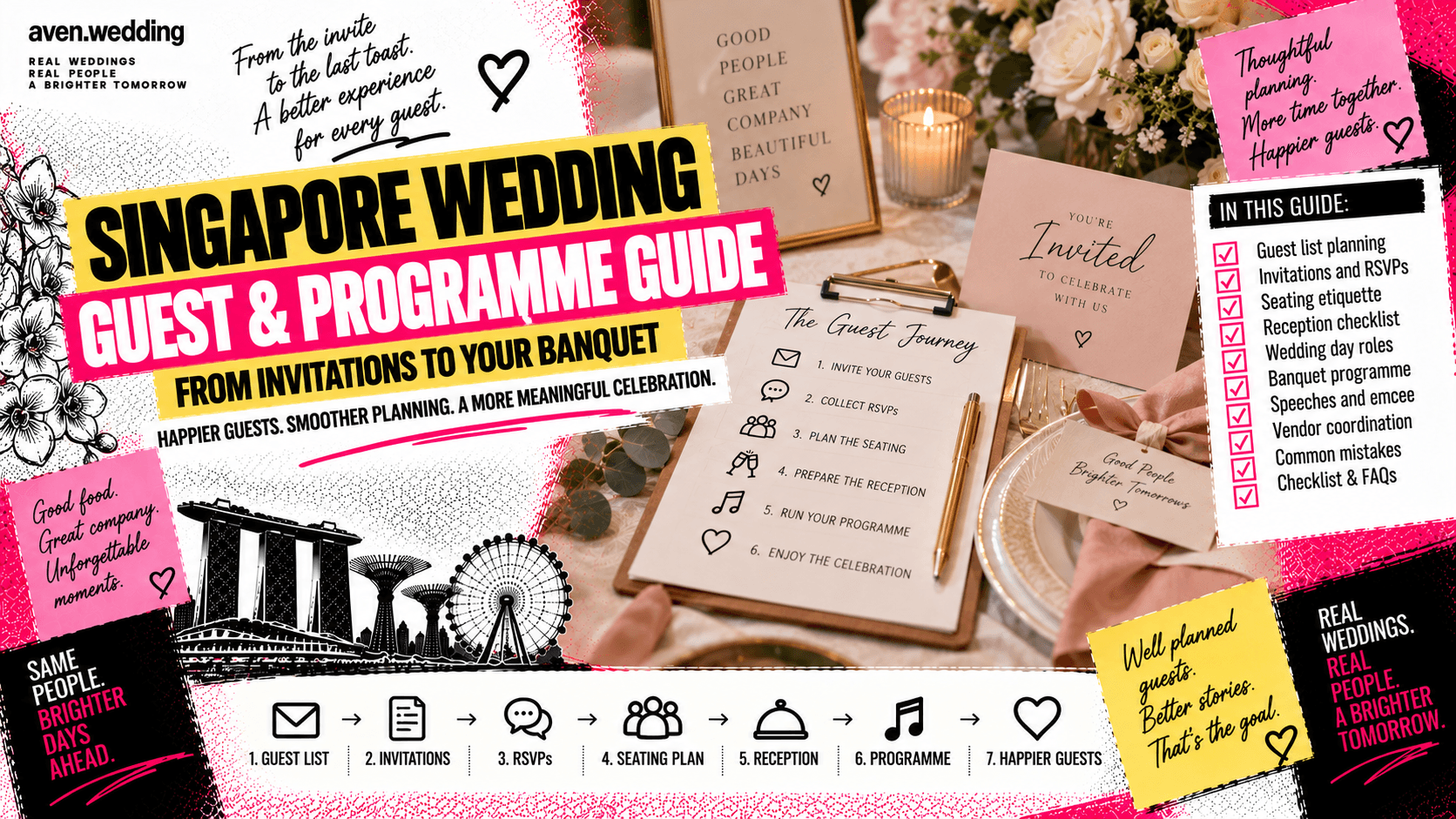
Singapore Wedding Guest & Programme Guide: From Invitations to Your Banquet
September 10, 2026 · Updated September 10, 2026
Plan your Singapore wedding guest experience from guest list and invitations to RSVPs, seating, reception, speeches, wedding party roles and your banquet programme.
How do you plan the guest experience for a Singapore wedding?
Wedding planning often gets divided into separate tasks.
Guest list.
Invitations.
RSVPs.
Seating.
Reception.
Speeches.
Banquet programme.
But your guests experience all of these as one journey.
They receive an invitation.
They decide whether they can attend.
They RSVP.
They arrive at your venue.
They find their table.
They watch your ceremony or march-in.
They eat, listen to speeches, take photographs and celebrate with you.
A good Singapore wedding guest and programme plan connects all of these stages.
This guide brings together Aven's guest-planning and wedding-programme resources so you can move from:
Who are we inviting?
to:
How do we make the wedding enjoyable once they arrive?
For your entire wedding journey beyond guests and programme, start with the Ultimate Singapore Wedding Planning Guide.
What does guest and programme planning include?
This part of wedding planning can be divided into eight stages:
- Build your guest list
- Prepare invitations
- Collect RSVPs
- Finalise attendance
- Create your seating plan
- Prepare guest reception
- Assign wedding-day roles
- Build your banquet programme
Each stage affects the next.
For example:
Guest list
↓
Invitations
↓
RSVPs
↓
Final headcount
↓
Seating plan
↓
Reception
↓
Banquet
Planning them as one connected system reduces last-minute work.
Step 1: Build your wedding guest list
Start with the people.
Before choosing table arrangements or printing invitations, decide who you actually want to invite.
Your guest list may include:
- Immediate family
- Extended relatives
- Friends
- Colleagues
- Parents' friends
- Wedding party
- Overseas guests
- Plus-ones
- Children
Do not begin by asking:
How many people can we possibly invite?
Instead ask:
Who matters to us, and how many people can our wedding realistically accommodate?
Use Aven's Singapore Wedding Guest List Guide for the full process.
How should you organise your guest list?
Use one master list rather than several disconnected spreadsheets.
Useful columns include:
| Guest | Side | Group | Plus-one | Children | RSVP | Table |
|---|---|---|---|---|---|---|
| Amanda Lee | Bride | University | Yes | No | Confirmed | 8 |
| Benjamin Tan | Groom | Work | No | No | Pending | |
| Cheryl Wong | Bride | Family | Yes | Yes | Confirmed | 3 |
You may also track:
- Dietary requirements
- Accessibility needs
- Contact details
- Invitation sent
- Follow-up status
Your guest list becomes the foundation for almost everything that follows.
How should parents' guest allocations be handled?
Discuss this early.
Parents may want to invite:
- Relatives
- Family friends
- Colleagues
- Business contacts
- Long-time neighbours
Instead of arguing over individual names immediately, agree on approximate allocations.
For example:
Couple's guests: 120
Bride's parents: 40
Groom's parents: 40
The actual numbers will vary.
The purpose is to create expectations before everyone's lists grow independently.
How do venue capacity and budget affect your guest list?
Every additional guest can affect:
- Catering
- Banquet tables
- Invitations
- Favours
- Transport
- Seating
- Venue requirements
Your venue may also have minimum and maximum capacities.
Do not finalise a 300-person guest list for a room that comfortably seats 220.
Use Aven's How to Choose a Wedding Venue Based on Guest Count when matching your list to a venue.
Step 2: Prepare your wedding invitations
Once the core wedding details are confirmed, prepare the invitation.
Guests usually need:
- Couple's names
- Date
- Time
- Venue
- Address
- Event details
- RSVP method
- RSVP deadline
You may also include:
- Dress code
- Solemnisation timing
- Parking information
- Plus-one information
- Children's policy
- Wedding website
The best invitation is not necessarily the most elaborate one.
It is the one guests understand immediately.
Use Aven's Singapore Wedding Invitation Guide for wording, timing and invitation formats.
Digital or printed invitations?
Both can work.
Many Singapore couples use a combination.
For example:
Printed invitations
for parents' guests and older relatives.
Digital invitations
for friends and colleagues.
Digital invitations can also connect directly to:
- RSVP form
- Wedding website
- Google Maps
- Venue information
Choose based on your guests rather than feeling that every person must receive the same format.
Step 3: Build a simple RSVP system
Once invitations are sent, you need to know who is actually coming.
Your RSVP system may collect:
- Guest name
- Attendance
- Plus-one
- Children
- Dietary requirements
- Accessibility requirements
- Contact information
Use one primary response method where possible.
If RSVPs arrive through:
- Calls
- Parents
- Google Forms
you will eventually need to consolidate them anyway.
Aven's Wedding RSVP Guide Singapore covers the full process.
When should your RSVP deadline be?
Work backwards from the dates when your venue and vendors need final information.
You need enough time after the RSVP deadline to:
- Follow up
- Resolve uncertain guests
- Confirm headcount
- Build seating
- Submit dietary requirements
- Update catering
- Prepare reception lists
Do not place your RSVP deadline one day before your venue needs the final number.
Give yourself a buffer.
How should you follow up with guests who do not RSVP?
Keep it simple.
You are not chasing an unpaid invoice.
A short personal message asking whether they will be able to attend is usually enough.
Track responses as:
- Confirmed
- Declined
- Pending
- Follow-up required
After reasonable follow-up, you may need to set a final cut-off so planning can continue.
Do not leave dozens of guests permanently marked:
"Probably coming."
Step 4: Turn RSVPs into your final headcount
Once responses settle, reconcile your master list.
Check:
- Confirmed adults
- Confirmed children
- Plus-ones
- Dietary requirements
- Accessibility needs
- Overseas guests
- Recent cancellations
Your final guest count affects:
- Tables
- Meals
- Seating
- Reception
- Venue charges
- Guest favours
Keep one current version.
Avoid having:
Guest List FINAL
Guest List FINAL 2
Guest List FINAL ACTUAL
Guest List FINAL ACTUAL USE THIS
Nobody knows which one is final anymore.
Step 5: Build your wedding seating plan
Now turn your confirmed guest list into tables.
Start with natural groups:
- Immediate family
- Extended family
- School friends
- University friends
- Colleagues
- Parents' friends
- Wedding party
Then solve the difficult tables.
Consider:
- Couples
- Plus-ones
- Children
- Elderly guests
- Accessibility
- Family relationships
- Table capacity
Use Aven's Singapore Wedding Seating Plan Guide for the full planning process.
Who should sit where?
This is where seating becomes less mathematical.
Think about:
- Parents
- Grandparents
- Senior relatives
- Couples
- Children
- Wedding party
- Colleagues
- Friends
- Sensitive family relationships
Comfort matters more than creating a perfect hierarchy.
Do not separate partners unnecessarily.
Do not seat relatives together purely because they share a surname if they do not get along.
And do not assume the closest table to the stage is automatically the best table.
Use Aven's Wedding Seating Etiquette Singapore for the social side of table planning.
How should your seating plan work with the venue floor plan?
A table assignment does not exist independently from the room.
Check:
- Stage
- Screens
- Speakers
- Entrances
- Exits
- Restrooms
- Service routes
- Wheelchair access
- Couple's table
- March-in route
An elderly relative may be important enough for a front table but uncomfortable sitting directly beside a loudspeaker.
Use Aven's Wedding Venue Floor Plan Guide Singapore before locking the layout.
Step 6: Prepare the wedding reception
The reception is your guest's first physical interaction with the wedding.
Prepare:
- Registration team
- Alphabetical guest list
- Table assignments
- Seating chart if applicable
- Ang bao box
- Gift area
- Signage
- Parking information
- Venue directions
Your helpers should know how to handle unexpected situations without immediately calling the couple.
Use Aven's Wedding Reception Checklist Singapore for the full setup.
How should wedding ang baos and gifts be handled?
Treat this as a security process, not simply decoration.
Assign trusted people to:
- Supervise the ang bao box
- Receive physical gifts
- Transfer valuables
- Store them securely
- Complete final handover
Minimise unnecessary handovers.
Decide where the ang bao box goes after reception closes.
Use Aven's Wedding Ang Bao Box & Gift Handling Guide for a detailed process.
Step 7: Assign your wedding day roles
Your wedding needs people who know what to do when questions appear.
Possible roles include:
- Overall coordinator
- Bride's point person
- Groom's point person
- Timekeeper
- Vendor contact
- Family coordinator
- Transport lead
- Reception lead
- Ang bao handlers
- Photo coordinator
- Emcee
- AV contact
One person can handle several compatible responsibilities.
But do not make one friend responsible for everything.
Use Aven's Wedding Day Roles Checklist Singapore to divide responsibilities.
What should bridesmaids and groomsmen actually do?
Your wedding party may help with:
- Preparation
- Gatecrash
- Tea ceremony
- Bride fetching
- Transport
- Personal belongings
- Family coordination
- Reception
- Banquet
- Photographs
- Outfit changes
Assign specific responsibilities rather than saying:
"Just help wherever needed."
Your friends should also get to enjoy your wedding.
Use Aven's Bridesmaid & Groomsmen Duties Singapore for a detailed breakdown.
Step 8: Build your wedding banquet programme
Your banquet programme may include:
- Guest reception
- Opening video
- First march-in
- Meal service
- Second march-in
- Cake ceremony
- Champagne pouring
- Toast
- Speeches
- Games
- Same-day edit
- Table photographs
- Farewell
You do not need all of them.
The goal is to create rhythm, not fill every minute.
Use Aven's Singapore Wedding Banquet Programme Guide to build the full flow.
How much programme is too much?
Add up the total time.
Imagine a banquet with:
- Two march-ins
- Three videos
- Six speeches
- Two games
- Cake cutting
- Champagne pouring
- Yum seng
- Same-day edit
- 30 table photographs
Individually, each item sounds reasonable.
Together, guests may spend most of dinner watching a programme.
Leave room for:
- Eating
- Conversation
- Photographs
- Bathroom breaks
- Natural delays
Your guests do not need organised entertainment every minute.
How should wedding speeches fit into the programme?
Choose speakers intentionally.
Possible speakers include:
- Couple
- Parents
- Maid of honour
- Best man
- Siblings
- Close friends
There is no required number.
A few meaningful speeches usually work better than a long queue of speakers.
Coordinate speech timing with the banquet manager so an emotional speech does not compete with dozens of servers placing the next course.
Use Aven's Wedding Speech Guide Singapore for writing and timing.
How should your emcee fit into the plan?
Your emcee connects the guest-facing programme.
They may:
- Welcome guests
- Introduce march-ins
- Introduce speakers
- Lead activities
- Make announcements
- Manage transitions
- Close the banquet
Give your emcee:
- Final run sheet
- Names and pronunciations
- Music cues
- Video cues
- Speech order
- Important announcements
- Backup instructions
Use Aven's How to Choose a Wedding Emcee in Singapore if you are still choosing one.
How does the guest programme connect to your actual-day timeline?
Your banquet is only one part of the wedding day.
The wider schedule may include:
- Makeup
- Gatecrash
- Bride fetching
- Tea ceremony
- Solemnisation
- Photography
- Travel
- Reception
- Banquet
If the morning runs late, your evening preparation may be affected.
Build buffers into the full day.
Use Aven's Singapore Actual-Day Wedding Timeline to connect all the pieces.
What should guests know before the wedding day?
Before the wedding, guests should be able to find:
- Date
- Venue
- Arrival time
- Event timing
- Dress code if applicable
- Transport information
- Parking information
- RSVP status
- Plus-one details
- Children's arrangements if relevant
Do not assume guests remember information from an invitation sent months earlier.
A short reminder closer to the wedding can be useful, particularly for logistical details.
What should your wedding team know before the wedding day?
Your key helpers should know:
- Timeline
- Responsibilities
- Venue
- Reporting time
- Key contacts
- Guest-list process
- Seating plan
- Vendor contacts
- Programme
- Transport
- Emergency procedures
Not everyone needs every document.
Give people the information relevant to their role.
Then make sure your overall coordinator has the complete picture.
Singapore wedding guest and programme master checklist
Guest list
- Target guest count
- Couple's guests
- Family allocations
- Plus-one policy
- Children policy
- Master guest list
Invitations
- Invitation design
- Wedding details checked
- RSVP instructions
- RSVP deadline
- Dress code if applicable
- Venue information
- Invitations sent
RSVP
- Response system
- Responses tracked
- Follow-ups completed
- Dietary requirements collected
- Accessibility needs collected
- Final headcount
Seating
- Tables created
- Couples seated together
- Family reviewed
- Elderly guests considered
- Accessibility checked
- Sensitive relationships considered
- Final seating plan
Reception
- Reception lead
- Guest lists
- Seating chart
- Signage
- Ang bao box
- Gift handling
- Parking information
- Late-arrival process
Wedding-day team
- Overall coordinator
- Bride's point person
- Groom's point person
- Timekeeper
- Vendor contact
- Family coordinator
- Transport lead
- Ang bao handlers
Banquet programme
- First march-in
- Second march-in if applicable
- Videos
- Speeches
- Toast
- Activities if applicable
- Table photographs
- AV files tested
- Emcee briefed
Final
- Venue has final headcount
- Venue has dietary requirements
- Helpers have final timeline
- Reception team has final seating plan
- Programme has realistic buffers
- Couple is not the default contact for every problem
Frequently asked questions about Singapore wedding guest and programme planning
What should we plan first, the guest list or venue?
They influence each other. Build an approximate guest count early, then make sure potential venues can accommodate it.
When should we create the seating plan?
After RSVPs are sufficiently confirmed. Avoid finalising tables while large numbers of guests are still uncertain.
Do we need printed wedding invitations?
No. Digital, printed or a combination can all work.
Do we need a seating chart?
Not always, but it can help guests navigate larger weddings.
Do we need two march-ins?
No.
Do we need wedding games?
No.
How many speeches should we have?
There is no required number. Prioritise meaningful speakers and a comfortable programme length.
Should bridesmaids and groomsmen manage the entire wedding?
No. Give them specific responsibilities without turning your wedding party into the entire operations team.
Who should handle unexpected guest problems?
Your reception lead or coordinator should manage them wherever possible rather than involving the couple.
What makes a good wedding programme?
Clear transitions, realistic timing and enough space for guests to eat, talk and enjoy themselves.
Your guest experience starts long before they enter the ballroom
A wedding does not begin for your guests at the first march-in.
It begins when your name appears on their phone.
An invitation.
A date.
A place.
A little message asking whether they can make it.
From there, every small planning decision shapes their experience.
Was it easy to RSVP?
Did they know where to go?
Could they find their table?
Were they seated with people they knew?
Did the programme flow?
Did they have time to eat?
Did they feel welcomed?
Most guests will never know how many spreadsheets, messages and decisions created that experience.
That is probably a good thing.
Good wedding planning often becomes invisible.
Everything simply feels like it belongs where it is supposed to be.
And instead of thinking about logistics, everyone gets to focus on the reason they came:
To celebrate with you.
Explore the full guest-planning series with the Singapore Wedding Guest List Guide, Singapore Wedding Invitation Guide, Wedding RSVP Guide Singapore, Singapore Wedding Seating Plan Guide and Wedding Seating Etiquette Singapore.
For the actual day, continue with the Wedding Reception Checklist Singapore, Wedding Day Roles Checklist Singapore, Bridesmaid & Groomsmen Duties Singapore, Singapore Wedding Banquet Programme Guide and Wedding Speech Guide Singapore.
For your complete wedding journey, return to the Ultimate Singapore Wedding Planning Guide.