
Blog
Chinese Wedding Traditions by Dialect Group in Singapore: Hokkien, Teochew, Cantonese & Hakka
September 9, 2026 · Updated September 9, 2026
Explore how Chinese wedding traditions can differ among Hokkien, Teochew, Cantonese and Hakka families in Singapore, from Guo Da Li gifts to tea ceremonies and family customs.
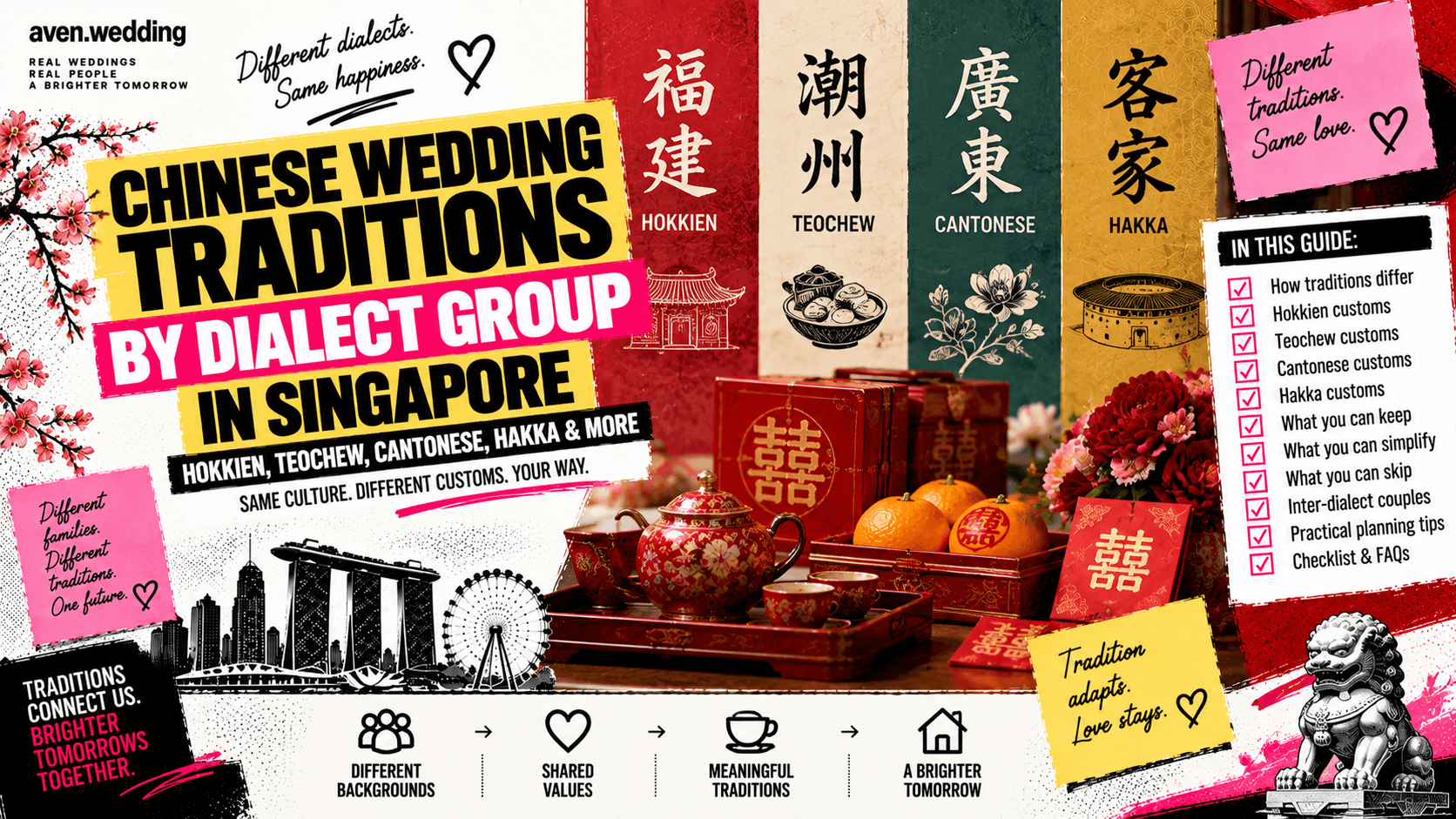
Do Chinese wedding traditions differ by dialect group in Singapore?
Yes, but probably not as neatly as many wedding checklists make it seem.
Singapore Chinese wedding traditions can vary among:
- Hokkien families
- Teochew families
- Cantonese families
- Hakka families
- Hainanese families
- Other Chinese communities
But dialect group is only one part of the picture.
Two Hokkien families may follow completely different customs.
A Teochew bride and Cantonese groom may combine traditions from both sides.
Another family may identify strongly with a dialect group but practise very few traditional wedding customs.
So treat this guide as a starting point for family conversations, not a fixed rulebook.
For the complete overview first, read Aven's Chinese Wedding Traditions in Singapore.
Why do dialect wedding traditions differ?
Chinese communities historically developed customs across different regions, languages and family traditions.
Over generations, wedding practices evolved differently.
In Singapore, those traditions have continued changing through:
- Inter-dialect marriages
- Mixed cultural backgrounds
- Smaller families
- Modern housing
- Hotel weddings
- Changing family expectations
- Couples living independently before marriage
As a result, there may be a recognisable dialect tradition without every family following it in exactly the same way.
Which dialect group should you follow?
There is no universal answer.
Traditionally, some families may place greater emphasis on customs associated with the groom's family.
Modern couples may instead:
- Follow both families
- Combine selected traditions
- Prioritise customs important to parents
- Use one family's ceremony format
- Create a simplified shared version
The best approach is to ask both sides directly.
Do not automatically assume the groom's dialect determines every detail of the wedding.
What if the bride and groom are from different dialect groups?
This is extremely manageable.
Start with two lists.
Bride's family
- Important traditions
- Guo Da Li expectations
- Hui Li expectations
- Tea ceremony customs
- Wedding-day customs
Groom's family
- Important traditions
- Guo Da Li expectations
- An Chuan expectations
- Tea ceremony customs
- Wedding-day customs
Then compare them.
You do not need to reproduce every custom from both sides.
Choose the traditions that carry the most meaning.
Hokkien wedding traditions in Singapore
Hokkien wedding customs may include traditions connected with:
- Guo Da Li
- Pin Jin
- Traditional food gifts
- Hui Li
- Jia Zhuang
- Tea ceremony
- Bride fetching
- Auspicious symbolism
Specific gifts and quantities can vary considerably between families.
If your parents say:
"For Hokkien weddings, we need this."
your next question should be:
"Is this something our family specifically practises?"
That distinction can save a lot of unnecessary shopping.
What might appear in a Hokkien Guo Da Li?
Depending on family tradition, a Hokkien Guo Da Li may involve items such as:
- Pin Jin
- Traditional cakes or pastries
- Oranges or other symbolic fruit
- Traditional food items
- Wedding-related symbolic gifts
Some traditional lists may mention items associated with particular family or regional practices.
Modern families frequently adapt these exchanges.
Do not purchase a complete online "Hokkien Guo Da Li set" without confirming the contents with both families first.
Use Aven's Guo Da Li Singapore Guide for the broader ceremony.
Teochew wedding traditions in Singapore
Teochew wedding customs may also involve a detailed Guo Da Li exchange and strong emphasis on symbolic gifts.
Depending on family practice, traditions may cover:
- Betrothal gifts
- Pin Jin
- Food gifts
- Hui Li
- Bridal dowry
- Tea ceremony
- Bride fetching
- Auspicious customs
Some families maintain extensive traditions.
Others retain only a few symbolic elements.
Again, being Teochew does not automatically mean your wedding requires every custom associated with Teochew weddings.
What might appear in a Teochew Guo Da Li?
A Teochew Guo Da Li may involve combinations of:
- Pin Jin
- Traditional pastries
- Fruit
- Symbolic food gifts
- Family-specific ceremonial items
The exact combination, quantity and return arrangement can vary.
Some families may also have strong preferences regarding how items are paired or presented.
Confirm the list with the older generation before ordering.
If the families disagree, focus on the items that both sides consider meaningful rather than trying to create the largest possible gift exchange.
Cantonese wedding traditions in Singapore
Cantonese wedding customs can similarly include:
- Guo Da Li
- Pin Jin
- Hui Li
- Jia Zhuang
- An Chuan
- Hair combing ceremony
- Tea ceremony
- Bride fetching
- Auspicious dates and timings
Some Cantonese families may place particular importance on specific ceremonial items or blessing rituals.
But the extent to which these are observed varies significantly between households.
Ask your family which traditions have actually been passed down rather than assuming every Cantonese custom applies.
What might appear in a Cantonese Guo Da Li?
Depending on the family, Cantonese betrothal gifts may include:
- Pin Jin
- Traditional cakes or pastries
- Fruit
- Symbolic food items
- Wedding-related ceremonial gifts
Modern Singapore couples may use simplified gift sets instead of recreating a large traditional exchange.
If you are buying a pre-packed dialect-specific set, show the contents to your parents first.
Convenient packaging does not necessarily mean the items match your family's customs.
Hakka wedding traditions in Singapore
Hakka families may observe many of the broader Chinese wedding traditions familiar across Singapore, including:
- Guo Da Li
- Pin Jin
- Hui Li
- Bridal dowry
- Tea ceremony
- Bride fetching
- Family blessings
Individual Hakka family customs can vary substantially.
Because generic Singapore wedding guides sometimes focus more heavily on larger dialect groups, asking parents and grandparents directly can be particularly useful.
Your family's own practice is more relevant than a generic list.
What about Hainanese and other Chinese dialect groups?
Singapore's Chinese community includes many other backgrounds, including Hainanese and smaller dialect communities.
These families may have their own:
- Betrothal customs
- Gift preferences
- Food symbolism
- Family rituals
- Tea ceremony practices
- Wedding-day traditions
Rather than forcing them into a Hokkien, Teochew or Cantonese template, document your family's actual customs.
This can be especially meaningful if grandparents or older relatives still remember traditions that are becoming less commonly practised.
Are Guo Da Li gifts different between dialect groups?
They can be.
This is one of the areas where couples often encounter dialect-specific lists.
But there is no single universal gift list for every family within one dialect group.
Instead of starting with:
"What does a Hokkien bride need?"
start with:
"What does our family expect for Guo Da Li?"
Then use dialect traditions as additional context.
Aven's Guo Da Li Singapore Guide explains how to build your final gift list.
Does Pin Jin differ by dialect group?
Family customs surrounding Pin Jin may differ, but there is no universal Hokkien, Teochew, Cantonese or Hakka amount that every couple must follow.
Avoid searching for one supposedly "correct" number.
Instead, both families should discuss:
- Expectations
- Symbolism
- Affordability
- Presentation
- Hui Li
The amount should make sense for your families rather than being copied from another wedding.
Use Aven's Pin Jin Singapore Guide.
Does Hui Li differ between dialect groups?
It can.
Families may have different expectations about:
- Which gifts are returned
- How much is returned
- Whether part of Pin Jin is returned
- How return gifts are presented
There is no universal percentage that applies to every dialect group.
Confirm the arrangement before Guo Da Li.
Use Aven's Hui Li Singapore Guide for the complete return-gift process.
Does Jia Zhuang differ by dialect group?
Yes, family expectations around Jia Zhuang can differ too.
Traditional bridal dowry lists may contain household, symbolic or personal items.
Modern families often adapt these considerably.
Instead of buying an entire dialect-specific dowry package, ask:
- Which items have meaning?
- Which items will actually be used?
- Are there heirloom items?
- Does the family want a symbolic set?
Use Aven's Jia Zhuang Singapore Guide.
Does the tea ceremony order change by dialect?
Family hierarchy and customs can influence tea ceremony order.
However, the safest approach is not to memorise a generic dialect-specific sequence.
Ask a knowledgeable family member to prepare the order.
They can account for:
- Grandparents
- Parents
- Uncles and aunts
- Older siblings
- Family seniority
- Special circumstances
Print or save the final sequence for your tea ceremony helper.
Use Aven's Chinese Wedding Tea Ceremony Guide Singapore.
Do An Chuan customs differ between families?
Yes.
Families may differ on:
- Whether An Chuan is required
- Who performs it
- When it happens
- Which items are placed on the bed
- What happens after the bed is prepared
Modern living arrangements can also change how the tradition is practised.
If you already live together, ask whether your family wants a symbolic version.
Use Aven's An Chuan Singapore Guide.
What about the hair combing ceremony?
The hair combing ceremony is another tradition where family practice can matter more than a generic dialect label.
Families may differ in:
- Timing
- Who conducts it
- Items prepared
- Spoken blessings
- Whether both bride and groom participate
If an elder knows the family's traditional version, ask them to explain it before the wedding.
That conversation itself can become part of preserving the tradition.
Use Aven's Chinese Wedding Hair Combing Ceremony Singapore.
Do dialect groups have different wedding-day customs?
Potentially.
Families may have particular customs involving:
- Leaving the bride's home
- Entering the groom's home
- Wedding cars
- Umbrellas
- Family greetings
- Tea ceremony
- Younger relatives
- Red packets
- Auspicious timings
Do not add every custom you find online to your actual-day schedule.
Confirm which ones your family genuinely follows.
Then build them into the Chinese Wedding Morning Timeline Singapore.
How should an inter-dialect couple combine traditions?
Try this process.
Step 1: Each family lists its important traditions
Do this separately first.
Step 2: Mark overlapping traditions
Both families may want tea ceremony or Guo Da Li.
Step 3: Identify genuinely different customs
These require discussion.
Step 4: Prioritise
Choose what matters rather than automatically keeping everything.
Step 5: Simplify duplicates
One meaningful ceremony may satisfy both families.
Step 6: Write down the final plan
Do not rely on everyone remembering the agreement.
What if one family is traditional and the other is not?
You do not need to make both sides equally traditional.
For example:
The groom's family might want:
- Guo Da Li
- An Chuan
- Auspicious timing
The bride's family might only want:
- Tea ceremony
That can be your wedding.
Cultural balance does not require both families to perform the same number of rituals.
Respecting what matters to each side is more useful than creating artificial symmetry.
What if parents disagree about the correct tradition?
This happens.
One relative may say:
"Hokkien people must do this."
Another Hokkien relative may say:
"We've never done that."
Both experiences can be genuine.
Instead of trying to determine who is universally correct, ask:
- Is this important to our immediate family?
- What meaning does it carry?
- Who expects it?
- Can we simplify it?
- Does it conflict with another family's custom?
You are planning one family's wedding, not writing a definitive rulebook for an entire dialect group.
How can you simplify dialect traditions without losing their meaning?
Focus on symbolic importance.
For example:
Instead of a huge Guo Da Li list, keep a few meaningful gifts.
Instead of travelling between several homes, hold both tea ceremonies at one venue.
Instead of reproducing every ceremonial detail, ask parents which elements matter most.
The principle is:
Understand first. Simplify second.
Use Aven's Modern Chinese Wedding Traditions Singapore for a complete keep, simplify or skip framework.
Chinese wedding dialect comparison at a glance
This table is intentionally broad because individual family practices vary.
| Area | Hokkien | Teochew | Cantonese | Hakka |
|---|---|---|---|---|
| Guo Da Li | Commonly practised by traditional families | Commonly practised by traditional families | Commonly practised by traditional families | May be practised |
| Pin Jin | Family-specific | Family-specific | Family-specific | Family-specific |
| Gift lists | Can vary | Can vary | Can vary | Can vary |
| Hui Li | Family-specific | Family-specific | Family-specific | Family-specific |
| Jia Zhuang | May be practised | May be practised | May be practised | May be practised |
| Tea ceremony | Common | Common | Common | Common |
| An Chuan | Depends on family | Depends on family | Depends on family | Depends on family |
| Wedding-day customs | Family-specific | Family-specific | Family-specific | Family-specific |
The biggest takeaway is not that all dialect traditions are identical.
It is that your family's version matters more than a generic online checklist.
Questions to ask your parents and grandparents
Use these questions before finalising your traditions.
- Which dialect traditions did you follow at your wedding?
- Which traditions matter most to you?
- What should happen during Guo Da Li?
- Are there specific gifts we need?
- How should Pin Jin and Hui Li be handled?
- Is Jia Zhuang expected?
- Do we need An Chuan?
- Do we need a hair combing ceremony?
- Is there a specific tea ceremony order?
- Are there customs for bride fetching?
- Are auspicious timings important?
- Are there traditions we can simplify?
- Is there anything you definitely do not expect us to do?
Record the answers.
You may be documenting family history at the same time.
Dialect tradition planning checklist
Identify
- Bride's dialect background
- Groom's dialect background
- Family-specific customs
- Knowledgeable elders
Compare
- Guo Da Li expectations
- Pin Jin expectations
- Hui Li expectations
- Jia Zhuang expectations
- An Chuan
- Hair combing
- Tea ceremony
- Bride fetching
- Wedding-day customs
Decide
- Traditions to keep
- Traditions to simplify
- Traditions to skip
- Duplicate customs to combine
- Conflicting customs to resolve
Prepare
- Final gift list
- Ceremony items
- Red packets
- Family roles
- Tea ceremony order
- Wedding morning timeline
- Final plan shared with both families
Frequently asked questions about Chinese wedding dialect traditions
Do Hokkien, Teochew and Cantonese weddings have different traditions?
Yes, historical customs can differ, particularly around betrothal gifts and family practices. However, individual households may practise them differently.
Which dialect should an inter-dialect couple follow?
There is no universal rule. Many couples combine meaningful customs from both families.
Does the groom's dialect determine the wedding traditions?
Not necessarily. Modern couples should discuss expectations with both families.
Are Guo Da Li gift lists different by dialect?
They can be, but exact requirements vary between families.
Is there a fixed Pin Jin amount for each dialect group?
No. There is no universal amount that applies to every family within a dialect group.
Can we combine Hokkien and Teochew traditions?
Yes. Choose the customs that matter to each family and resolve overlapping or conflicting practices together.
What if we do not know our family's traditions?
Ask parents, grandparents and older relatives. You can also choose a simplified set of traditions that feels meaningful to your family.
Do we need to follow every dialect tradition?
No. Families can keep, simplify or skip traditions according to their own values and circumstances.
Your family's tradition matters more than the label
It is useful to know whether your family is Hokkien, Teochew, Cantonese, Hakka, Hainanese or another dialect group.
It can help explain where certain wedding customs came from.
But your dialect is not a wedding instruction manual.
Traditions move through families.
They change.
They combine.
They disappear.
Sometimes they return because a grandparent suddenly remembers something their own parents used to do.
So use dialect guides as a starting point.
Then talk to the people who actually raised you.
Ask what they remember.
Ask what matters.
And build your wedding from there.
Continue with the Modern Chinese Wedding Traditions Singapore, Chinese Wedding Traditions Checklist Singapore and Chinese Wedding Morning Timeline Singapore.
For specific customs, explore the Guo Da Li Singapore Guide, Pin Jin Singapore Guide, Hui Li Singapore Guide and Chinese Wedding Tea Ceremony Guide Singapore.
For the complete cultural overview, return to Chinese Wedding Traditions in Singapore.
For your complete wedding planning journey, use the Ultimate Singapore Wedding Planning Guide.